Health
What is OFA hip screening?
A standardized X-ray evaluation, usually done at age two or older, that grades hip conformation on a scale from Excellent to dysplastic.

Quick answer
What is OFA hip screening?
A standardized X-ray evaluation, usually done at age two or older, that grades hip conformation on a scale from Excellent to dysplastic.
A hip certificate isn't a guarantee, but it's the single most useful piece of paper a puppy buyer can ask to see.
Prospective Australian Shepherd owners comparing breeders, and current owners trying to understand what a hip score on their dog's paperwork actually means.
This guide is not medical advice. If your dog shows pain, sudden behavior change, or worsening symptoms, consult a licensed veterinarian.
Some links may be affiliate links. We may earn a commission at no extra cost to you. We only suggest products we believe are helpful for dog owners.
We research and check what we publish, but we do not warrant that any figure, date, price, or statement is accurate, complete, or current, and we accept no liability for any loss, cost, injury, or other harm arising from the use of this site. Use it as one reference among several. You remain responsible for your own decisions and for your dog's care - confirm anything that matters with a licensed veterinarian or another qualified professional before you act on it. Full disclaimer.
Hip dysplasia screening exists specifically to reduce how often the condition appears in future generations, using standardized evaluations like OFA and PennHIP to grade breeding dogs before they're paired. This page focuses on the practical side: what these programs measure, what a score actually tells you, and what a prospective Australian Shepherd buyer should be asking a breeder to see.
Reputable Australian Shepherd breeders in health-conscious breeding communities commonly screen breeding stock, though screening isn't mandatory or universal across all breeders, which is exactly why buyers need to know what to ask for rather than assume it happened.
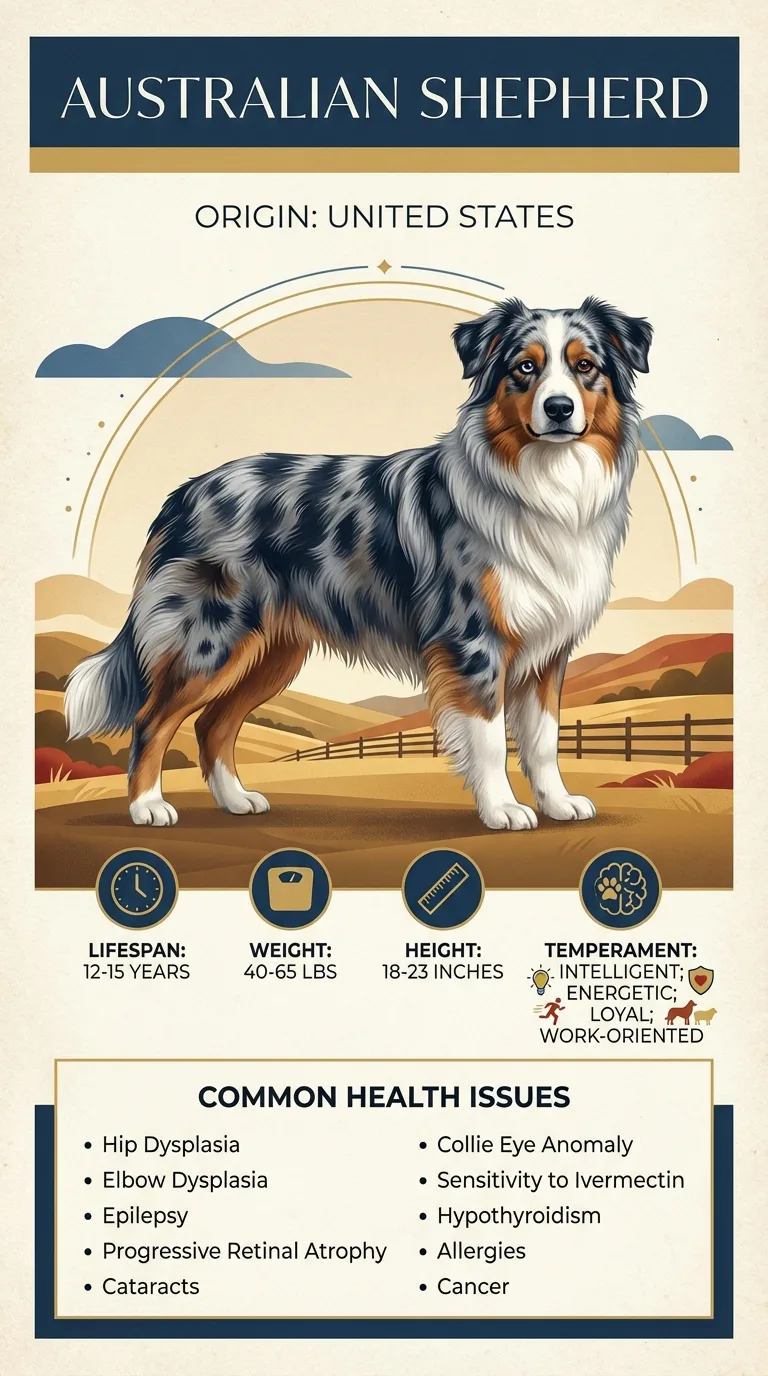
Hip dysplasia is documented as a common health issue in this breed, which is precisely the reason organized screening programs exist and are recommended for breeding stock in the first place.
Screening itself isn't affected by environment, but the breeding decisions made based on screening results directly shape how common the condition is in future generations — a program that consistently breeds away from poor scores will see rates decline over time.
Talk to your vet about hip screening options if you're planning to breed a dog, if you've adopted an adult Aussie with no known hip history, or if you simply want a baseline before starting an intense sport or working program.
See all Australian Shepherd health problems, which breeds are prone to hip dysplasia prevalence, or the full Australian Shepherd breed guide for temperament, exercise needs and ownership costs.
OFA final certification requires waiting until a dog is at least two years old, though preliminary screening can happen earlier. PennHIP results are typically available within a few weeks of the X-ray being taken and sent for evaluation.
Success looks like having clear, verifiable screening information before a breeding decision or puppy purchase, which doesn't guarantee an outcome but meaningfully improves the odds and lets you make an informed choice rather than a hopeful guess.
In the United States, the two main hip screening systems are OFA (Orthopedic Foundation for Animals) and PennHIP. OFA evaluation typically happens once a dog is at least two years old, using a standard X-ray position, with a panel of radiologists grading the joint as Excellent, Good, Fair, or one of several dysplastic grades. PennHIP can be done earlier, from about sixteen weeks on, and measures joint laxity directly with a specific stress-view technique, producing a numeric score compared against breed-specific norms.
Neither test eliminates hip dysplasia from a breeding line entirely, and neither guarantees an individual puppy's future hips, since the condition is influenced by more than one gene plus environmental factors during growth. What screening does reliably do is shift the odds: breeding only from dogs with good scores measurably reduces the rate of dysplastic offspring across a breeding program over time, even though it can't promise any single litter or puppy an outcome.
A responsible Australian Shepherd breeder should be able to produce OFA or PennHIP results for both parents, not just tell you verbally that 'the hips are good.' Ask to see the actual certificate or the OFA online database listing, which is public and searchable. It's also reasonable to ask about the hip scores of grandparents or previous litters if the breeder has that history, since a pattern across generations tells you more than a single pair of results.
A breeder who can't or won't produce documentation, or who dismisses the question, is a meaningful red flag regardless of how healthy the puppies look at eight weeks old — hip dysplasia often isn't visible at that age even in dogs that will go on to develop it.

If you think your Aussie has hip dysplasia prevalence, the plan is three steps: write down what you have seen and when it started, book a veterinary appointment rather than waiting for the next flare, and take video of the behaviour or symptom before you go — the thing you are worried about rarely happens in the consulting room. Screening in the parents covers hip dysplasia, elbow dysplasia, epilepsy.
What the vet visit should produce is a diagnosis and a written plan, not just reassurance: what is being ruled out, what the monitoring interval is, and which signs mean you come back sooner. Ask what the treatment costs across a year rather than per visit, because that is the number that decides whether you are managing this condition or reacting to it.
Between appointments, keep a short log — dates, what you saw, what changed. It is the single most useful thing an owner brings to a follow-up, and for hip dysplasia prevalence it is often what separates a clear pattern from a guess.
The Alvarez family had two Australian Shepherd breeders to choose between, both with similarly priced, similarly adorable litters. When they asked the first breeder for the parents' hip certificates, they got a folder with OFA numbers for both the sire and dam, plus a mention that the sire's own parents had also both scored Good or better. The second breeder said the dogs were 'healthy and never had any hip problems' but had no paperwork to show. When the family checked the OFA public database themselves, they found no record for either of the second breeder's dogs at all. They chose the first breeder. Their puppy, now three years old and heavily involved in agility, has had no hip issues, though they know that outcome reflects better odds, not a guarantee that came with the paperwork.
Key takeaway: A verifiable hip certificate is one of the few concrete, checkable facts available before you commit to a puppy — and a breeder's willingness to produce one says as much about their overall practices as the number itself does.
OFA grades hip conformation from a standard X-ray, usually done at two years or older, using categories like Excellent, Good, Fair, or dysplastic. PennHIP measures actual joint laxity with a stress-view technique and can be performed as early as sixteen weeks, producing a numeric score compared to breed norms.
No. Screening reduces the odds significantly across a breeding program but doesn't guarantee any individual puppy's outcome, since multiple genes and environmental factors during growth both play a role.
OFA generally requires a dog be at least two years old for a final certified rating, though preliminary evaluations are possible earlier. PennHIP can assess laxity from around sixteen weeks of age.
OFA results are searchable in a public online database using the dog's registered name, so you can verify a certificate independently rather than relying only on what a breeder tells you.
This is a reasonable, significant caution. Screening doesn't guarantee outcomes, but breeders who skip it entirely are not managing the single most well-established tool available for reducing dysplasia rates in their puppies.
Yes — an adult dog of any background can have hip X-rays taken and evaluated by OFA or through a private radiologist, which is useful information for planning exercise and management even without breeding implications.
It's a documented common health issue for this breed, similar to many other medium-to-large athletic breeds, though exact comparative rates vary by data source and aren't something this guide asserts a precise figure for.
A standardized X-ray evaluation, usually done at age two or older, that grades hip conformation on a scale from Excellent to dysplastic.
A stress-view X-ray technique that measures actual joint laxity numerically, and can be done as early as sixteen weeks old.
Yes — ask to see both parents' OFA or PennHIP results directly, not just a verbal assurance that the hips are fine.
Yes — OFA results are searchable in a free public online database by the dog's registered name.
No — it meaningfully reduces the odds across a breeding program but can't guarantee any individual puppy's outcome.
A one-page prep sheet for this condition: the signs, the questions to ask, what to get priced. Unlocks here.
You get: Vet visit prep sheet
No spam. One-click unsubscribe. See our privacy policy.
See a sample page before you decide.
Early access list
The free prep sheet covers the same-day warning signs, a symptom log and the questions to ask. We are considering a fuller kit that adds a cost worksheet for the usual tests and treatments (US price ranges with their sources) and a plain-English guide to ways of covering the bill. It is not built yet; this list tells us whether it is worth building.
One email, no spam, unsubscribe anytime. Information only, not veterinary advice.