Living
Which is the bigger dog?
The Saint Bernard, a giant breed reaching up to 180 lbs versus the Bernese's 115 lbs.

Quick answer
Which is the bigger dog?
The Saint Bernard, a giant breed reaching up to 180 lbs versus the Bernese's 115 lbs.
Bernese Mountain Dog or Saint Bernard? On paper they differ most on exercise need, and on the scales Saint Bernard is the heavier at 120–180 lbs. Here is how the two compare on everything that shapes an ordinary week.
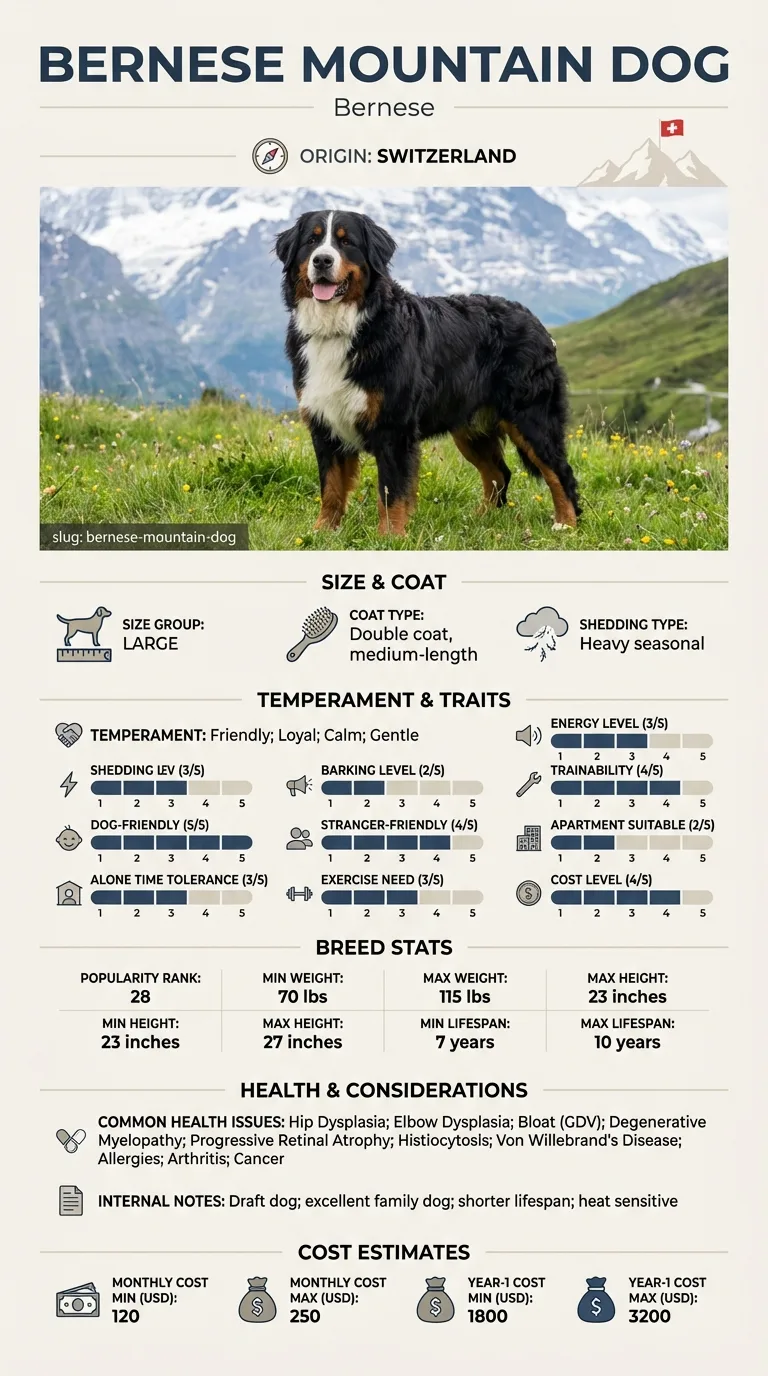
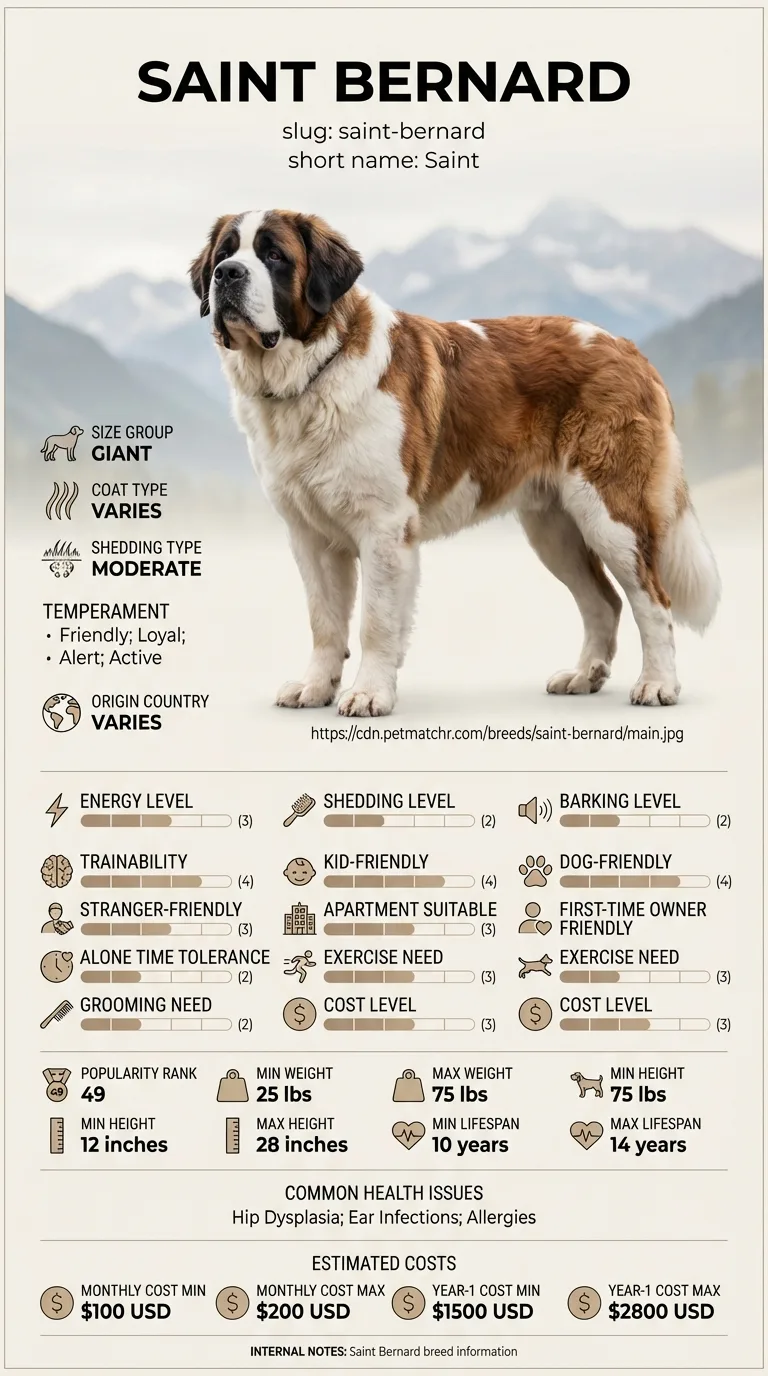
This is for someone already down to Bernese Mountain Dog and Saint Bernard and deciding between them. Because the two are so evenly matched, the page works through every axis rather than leading with one. Anyone choosing from a flat has a clear answer here: Bernese Mountain Dog rates 2/5 against 1/5. Breed history is left out; what follows is what you will actually live with.
Between Bernese Mountain Dog and Saint Bernard, they are closer than most pairings, and the choice comes down to temperament, and Bernese Mountain Dog is the lower-effort dog of the two to keep.
Choose Bernese Mountain Dog if this is your first dog, you already have another dog and you want a dog that picks up training quickly.
Choose Saint Bernard if your walking routine is modest.
| Feature | bernese mountain dog | saint bernard | Winner |
|---|---|---|---|
| Size class | large | giant | Equal |
| Weight | 70–115 lbs | 120–180 lbs | Equal |
| Height | 23–27 in | 26–30 in | Equal |
| Lifespan | 7–10 years | 8–10 years | saint bernard |
| Exercise need | Moderate (3/5) | Low (2/5) | saint bernard |
| Grooming need | Moderate (3/5) | Moderate (3/5) | Equal |
| Shedding | High (4/5) | High (4/5) | Equal |
| Energy level | Moderate (3/5) | Low (2/5) | Equal |
| Barking | Low (2/5) | Low (2/5) | Equal |
| Apartment suitability | Low (2/5) | Very low (1/5) | bernese mountain dog |
| Good for first-time owners | High (4/5) | Moderate (3/5) | bernese mountain dog |
| Tolerates being alone | Moderate (3/5) | Moderate (3/5) | Equal |
| Trainability | High (4/5) | Moderate (3/5) | bernese mountain dog |
| Good with kids | Very high (5/5) | Very high (5/5) | Equal |
| Good with other dogs | Very high (5/5) | High (4/5) | bernese mountain dog |
| Friendly to strangers | High (4/5) | High (4/5) | Equal |
| Cost level | High (4/5) | Very high (5/5) | bernese mountain dog |
| Coat | Double coat, medium-length | Short or long double coat | Equal |
| Origin | Switzerland | Various | Equal |
| Typical monthly cost | $120–$250 | $150–$310 | Equal |
| Typical first-year cost | $1,800–$3,200 | $2,200–$4,200 | Equal |
At 120 to 180 lbs and 26 to 30 in, the Saint Bernard qualifies as a true giant breed, dwarfing the Bernese Mountain Dog's already-large 70 to 115 lbs and 23 to 27 in frame by as much as 65 lbs at the top end. That is not a small gap — a full-grown Saint Bernard can outweigh a Bernese by more than half again its body weight, which matters for everything from crate size to how much space the dog needs to turn around indoors. Anyone drawn to the Bernese's build should know the Saint Bernard takes the same general silhouette and scales it up substantially.
Exercise need actually favors the Bernese here, rated Moderate (3/5) against the Saint Bernard's Low (2/5), and energy level follows the same order — Moderate (3/5) versus Low (2/5). Despite its size, the Saint Bernard is the more sedentary of the two, content with shorter, gentler walks rather than sustained activity, which can make it a surprisingly good match for owners who want a big dog without a big exercise commitment. The Bernese, while still no athlete, wants a bit more daily movement to stay content and avoid the boredom that comes with its working-breed background.
Grooming needs land equal at Moderate (3/5) for both breeds, and shedding matches too, both rated High (4/5) — so coat maintenance is not a deciding factor in this matchup the way it is in many others. The Bernese wears a medium-length double coat while the Saint Bernard comes in either a short or long double-coat variety, meaning shedding volume can vary somewhat by which Saint Bernard type you choose. Either way, expect regular brushing sessions and a fair amount of loose hair around the home from both breeds, with no clear winner for the fur-averse buyer.
Apartment suitability clearly favors the Bernese, rated Low (2/5) against the Saint Bernard's Very low (1/5) — the lowest score in this data set — while barking is a non-factor with both rated Low (2/5). Both dogs tolerate being alone at a Moderate (3/5) level, so neither is ideal for long solo stretches, but the Saint Bernard's sheer bulk makes small living spaces genuinely impractical rather than just suboptimal. A house with real square footage suits both breeds better than an apartment, but it is close to a requirement for the Saint Bernard specifically.
The Bernese edges ahead for new owners, rated High (4/5) versus Moderate (3/5) for the Saint Bernard, and trainability tells a similar story at High (4/5) against Moderate (3/5). Both breeds share a gentle, patient temperament — the Bernese described as friendly and calm, the Saint Bernard as gentle and patient — so neither is a difficult personality to live with, but the Bernese responds a touch more readily to structured training. First-time owners taking on either dog should prioritize early leash and size-management training, since a poorly trained giant or large breed becomes a real handling problem fast.
Both breeds score Very high (5/5) with kids, making this one of the closer matchups for family suitability, though the Bernese edges out the Saint Bernard with other dogs at Very high (5/5) versus High (4/5). Friendliness to strangers ties at High (4/5) for both. Given the Saint Bernard's patient, watchful nature and the Bernese's friendly, gentle disposition, either dog can anchor a busy family home — the main practical consideration becomes the Saint Bernard's far larger size around toddlers and small children during normal play rather than any temperament gap.
The Saint Bernard lives slightly longer, 8 to 10 years against the Bernese's 7 to 10, though both fall short of typical large-breed averages. Health-wise, the Bernese's list runs longer at ten conditions, including Bloat (GDV), Degenerative Myelopathy, Histiocytosis, and Von Willebrand's Disease, while the Saint Bernard's five flagged issues include Dilated Cardiomyopathy, Entropion, and its own Bloat (GDV) risk — a shared concern for both giant-chested breeds. Owners of either should learn the signs of bloat and consider a preventive gastropexy, since both breeds carry that risk independently in the data.
The Saint Bernard is the pricier breed to keep, rated Very high (5/5) for cost against the Bernese's High (4/5), with monthly costs of $150 to $310 versus $120 to $250 and first-year costs reaching $2,200 to $4,200 compared to $1,800 to $3,200. That gap traces directly to size — more food, larger medications, bigger boarding and grooming bills. Anyone budgeting for a giant breed should plan for the higher end of the Saint Bernard's range, especially in year one when initial veterinary workups and larger gear purchases stack up fastest.
Bernese Mountain Dog weighs 70–115 lbs and lives 7–10 years; Saint Bernard weighs 120–180 lbs and lives 8–10 years. No rated axis separates them by more than a single point, which makes this one of the closer pairings on the site. They are level on tolerates being alone, barking and grooming need, so those cannot decide it. The comparison marks an easier option only where one exists. Facts like weight and country of origin are not scored. Both dogs are rated from the same dataset, which is what makes the numbers comparable with each other even though any individual dog sits somewhere inside its breed's range.

Considerably — the Saint Bernard's 120-180 lb range can run up to 65 lbs heavier than the Bernese's 70-115 lbs, and it stands taller too, at 26-30 in versus 23-27 in.
The Saint Bernard, rated Low (2/5) for exercise need versus Moderate (3/5) for the Bernese — a rare case of the bigger dog being the more sedentary one.
Not really — it is rated Very low (1/5) for apartment suitability, the lowest score in this comparison, versus Low (2/5) for the Bernese.
Both score Very high (5/5) with kids, making this a tie; the difference shows up more with other dogs, where the Bernese scores Very high (5/5) against the Saint Bernard's High (4/5).
The Saint Bernard, rated Very high (5/5) for cost with a first-year range of $2,200-$4,200, versus High (4/5) and $1,800-$3,200 for the Bernese.
Yes — Bloat (GDV) appears on both breeds' health lists, reflecting the deep chests common to large and giant working breeds.
The Saint Bernard, by a small margin — 8-10 years versus 7-10 years for the Bernese.
The Saint Bernard, a giant breed reaching up to 180 lbs versus the Bernese's 115 lbs.
The Bernese — it is rated Moderate (3/5) for exercise versus Low (2/5) for the Saint Bernard.
The Bernese, at $120-$250 versus $150-$310 for the Saint Bernard.
The Bernese, rated High (4/5) for trainability versus Moderate (3/5) for the Saint Bernard.
Secure checkout on Stripe. We never see your card.
7-day money-back guarantee. Instant access.
Health information here is general and is not veterinary advice. If your dog shows pain, sudden behaviour change, or worsening symptoms, consult a licensed veterinarian.
Some links on this site are affiliate links. We may earn a commission at no extra cost to you, and we only suggest products we believe are helpful for dog owners.
We research and check what we publish, but we do not warrant that any figure, date, price, or statement is accurate, complete, or current, and we accept no liability for any loss, cost, injury, or other harm arising from the use of this site. Use it as one reference among several. You remain responsible for your own decisions and for your dog's care - confirm anything that matters with a licensed veterinarian or another qualified professional before you act on it. Full disclaimer.
Match your lifestyle to the right dog.
Take quizNot sure which breed is right for you? Take our 2-minute quiz to find out.
Take the quiz