Living
Which breed is more energetic?
The English Springer Spaniel, rated Very high (5/5) versus the Bernese's Moderate (3/5).

Quick answer
Which breed is more energetic?
The English Springer Spaniel, rated Very high (5/5) versus the Bernese's Moderate (3/5).
Bernese Mountain Dog or English Springer Spaniel? On paper they differ most on exercise need, and on the scales Bernese Mountain Dog is the heavier at 70–115 lbs. Here is how the two compare on everything that shapes an ordinary week.
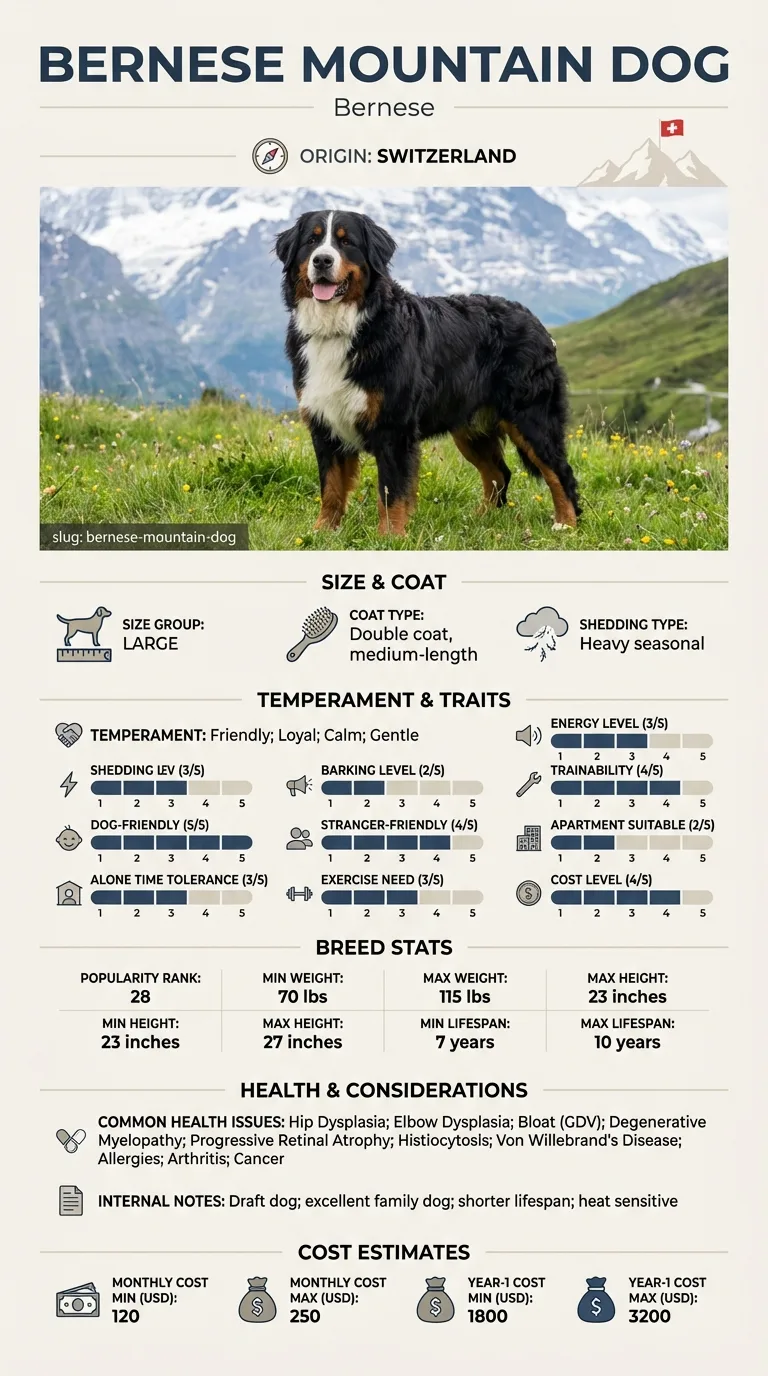
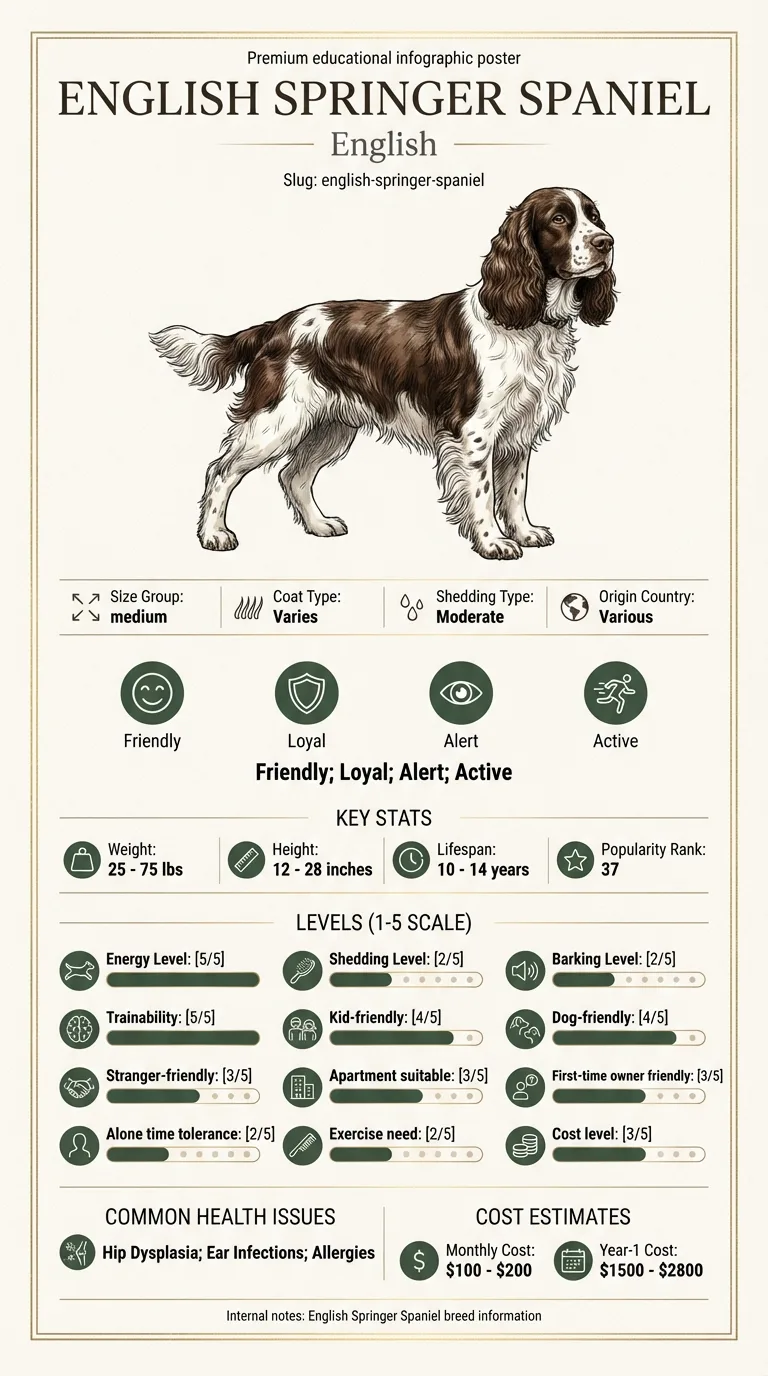
This is for someone already down to Bernese Mountain Dog and English Springer Spaniel and deciding between them. For this pair the decision usually turns on exercise need and energy level, so those are covered first and in most detail. Both rate 2/5 for flats, so housing does not settle this one. It is written for the decision rather than the breed history.
Between Bernese Mountain Dog and English Springer Spaniel, exercise need is what separates them, and Bernese Mountain Dog is the lower-effort dog of the two to keep.
Choose Bernese Mountain Dog if this is your first dog, you do not want a standing grooming appointment and your walking routine is modest.
Choose English Springer Spaniel if shedding is a problem in your house, you want a dog that picks up training quickly and a smaller dog suits your car, your home or your back.
| Feature | bernese mountain dog | english springer spaniel | Winner |
|---|---|---|---|
| Size class | large | medium | Equal |
| Weight | 70–115 lbs | 40–50 lbs | Equal |
| Height | 23–27 in | 19–20 in | Equal |
| Lifespan | 7–10 years | 12–14 years | english springer spaniel |
| Exercise need | Moderate (3/5) | Very high (5/5) | bernese mountain dog |
| Grooming need | Moderate (3/5) | High (4/5) | bernese mountain dog |
| Shedding | High (4/5) | Moderate (3/5) | english springer spaniel |
| Energy level | Moderate (3/5) | Very high (5/5) | Equal |
| Barking | Low (2/5) | Moderate (3/5) | bernese mountain dog |
| Apartment suitability | Low (2/5) | Low (2/5) | Equal |
| Good for first-time owners | High (4/5) | Moderate (3/5) | bernese mountain dog |
| Tolerates being alone | Moderate (3/5) | Low (2/5) | bernese mountain dog |
| Trainability | High (4/5) | Very high (5/5) | english springer spaniel |
| Good with kids | Very high (5/5) | Very high (5/5) | Equal |
| Good with other dogs | Very high (5/5) | High (4/5) | bernese mountain dog |
| Friendly to strangers | High (4/5) | High (4/5) | Equal |
| Cost level | High (4/5) | Moderate (3/5) | english springer spaniel |
| Coat | Double coat, medium-length | Medium, feathered double coat | Equal |
| Origin | Switzerland | Various | Equal |
| Typical monthly cost | $120–$250 | $100–$200 | Equal |
| Typical first-year cost | $1,800–$3,200 | $1,400–$2,900 | Equal |
An English Springer Spaniel's 40–50 lbs and 19–20 inch height put it solidly in the medium category, well below the Bernese Mountain Dog's 70–115 lbs and 23–27 inches but noticeably larger than the Cocker Spaniels covered elsewhere on this site. The Springer's build is athletic and endurance-oriented, a field dog meant to work all day, while the Bernese's heavier, thicker-boned frame was built for pulling and hauling rather than covering ground quickly. Owners sizing up living space should note the Springer, despite qualifying as medium, still needs real room to move given its Very high exercise rating.
This is the widest exercise gap in this batch: Very high (5/5) for the English Springer Spaniel against Moderate (3/5) for the Bernese Mountain Dog, with energy level following the same split. A Springer's Eager, Energetic temperament was shaped by generations of flushing and retrieving work, and it genuinely needs vigorous daily exercise, long runs, retrieving games, or off-leash time, to stay balanced. The Bernese's Calm, Gentle nature means it's satisfied with a moderate daily walk, making it, somewhat counterintuitively, the lower-energy dog of this pair despite being nearly triple the Springer's weight.
Grooming favors the Bernese at Moderate (3/5) against the Springer's High (4/5), while shedding flips toward the Springer at Moderate (3/5) versus the Bernese's High (4/5). The Springer's medium, feathered double coat needs regular brushing and trimming, especially around the ears and legs, to stay tangle-free after days in the field or yard. The Bernese sheds a larger raw volume of fur given its size, even though its grooming routine of brushing rather than trimming is more straightforward — a classic case of more hair not equaling more grooming work.
Apartment suitability is a rare tie here, both breeds rated Low (2/5), the Bernese for its sheer size, the Springer for its Very high exercise need that apartment living can't easily satisfy. Barking favors the Bernese at Low (2/5) against the Springer's Moderate (3/5). Tolerating time alone also favors the Bernese, Moderate (3/5) versus Low (2/5) for the Springer, whose Eager, Biddable nature makes it want to be involved in whatever its people are doing rather than settled alone in a crate or apartment for long stretches.
The Springer actually edges out the Bernese on trainability, Very high (5/5) against High (4/5), reflecting its Biddable temperament and gundog heritage of responding precisely to handler cues. But first-time-owner suitability favors the Bernese, High (4/5) versus Moderate (3/5) for the Springer — high trainability paired with Very high energy means a Springer needs an owner ready to actually put in the exercise and training time, not just one capable of teaching commands. The Bernese's more forgiving Calm temperament makes it easier to live with even when training isn't perfectly consistent.
Both breeds tie at Very high (5/5) with kids and High (4/5) with strangers, and the Bernese edges ahead with other dogs at Very high (5/5) versus the Springer's still-strong High (4/5). The Springer's Friendly, Eager temperament makes it an enthusiastic playmate for active kids who can match its energy, while the Bernese's Calm demeanor suits families wanting a gentler, lower-key presence around younger or less active children. Either breed works well in a multi-pet household, though the Springer's drive means rowdier play sessions are more likely.
The Bernese's 7–10 year lifespan again falls well short of a spaniel's, with the Springer typically living 12–14 years, a gap of several years that should factor into any adoption decision. The Springer's five-item list includes Phosphofructokinase Deficiency, a breed-specific metabolic disorder worth screening for, alongside more common Hip Dysplasia, Elbow Dysplasia, Ear Infections, and PRA. The Bernese's longer list is dominated by Cancer and Bloat (GDV), conditions that contribute directly to its shortened lifespan. Both breeds share hip and elbow dysplasia risk, making joint-supportive nutrition and controlled growth during puppyhood relevant to either choice.
Monthly costs run $120–$250 for the Bernese against $100–$200 for the Springer, with first-year totals at $1,800–$3,200 versus $1,400–$2,900, cost level rated High (4/5) for the Bernese and Moderate (3/5) for the Springer. Much of the Springer's ongoing cost comes from its High grooming need and Very high exercise requirement, which may mean a dog walker or daycare for owners with long workdays. The Bernese's cost premium is driven by food volume and larger-breed veterinary pricing, compounded by its shorter lifespan meaning fewer years to spread adoption and setup costs across.
Bernese Mountain Dog weighs 70–115 lbs and lives 7–10 years; English Springer Spaniel weighs 40–50 lbs and lives 12–14 years. The two diverge most on exercise need and energy level. They are level on apartment suitability, good with kids and friendly to strangers, so those cannot decide it. In the table, a "winner" means easier for an ordinary household — not better. Size, coat and origin are recorded without a verdict. Because both breeds are scored the same way, the gaps are reliable even where the absolute numbers are rough.

The English Springer Spaniel, by a wide margin — it's rated Very high (5/5) for exercise need versus the Bernese's Moderate (3/5), the largest exercise gap in this batch of comparisons.
Slightly, on paper — it rates Very high (5/5) for trainability versus the Bernese's High (4/5) — but its Very high exercise need means training alone isn't enough to keep it satisfied.
It's a metabolic disorder specific to the English Springer Spaniel's health list, not shared with the Bernese Mountain Dog, whose risks instead center on Cancer and Bloat.
The Bernese Mountain Dog, rated High (4/5) for first-time owners versus Moderate (3/5) for the Springer, largely because the Springer's Very high energy demands more exercise commitment.
Neither is ideal — both rate Low (2/5) for apartment suitability, the Bernese due to its size and the Springer due to its Very high exercise need.
About four to seven years longer — 12–14 years versus the Bernese's 7–10 years.
The English Springer Spaniel, rated Moderate (3/5) versus the Bernese's High (4/5).
The English Springer Spaniel, rated Very high (5/5) versus the Bernese's Moderate (3/5).
The Springer Spaniel, typically 12–14 years versus 7–10 for the Bernese.
The Bernese Mountain Dog, rated High (4/5) for first-time owners versus the Springer's Moderate (3/5).
The English Springer Spaniel, rated Moderate (3/5) versus the Bernese's High (4/5).
Secure checkout on Stripe. We never see your card.
7-day money-back guarantee. Instant access.
Health information here is general and is not veterinary advice. If your dog shows pain, sudden behaviour change, or worsening symptoms, consult a licensed veterinarian.
Some links on this site are affiliate links. We may earn a commission at no extra cost to you, and we only suggest products we believe are helpful for dog owners.
We research and check what we publish, but we do not warrant that any figure, date, price, or statement is accurate, complete, or current, and we accept no liability for any loss, cost, injury, or other harm arising from the use of this site. Use it as one reference among several. You remain responsible for your own decisions and for your dog's care - confirm anything that matters with a licensed veterinarian or another qualified professional before you act on it. Full disclaimer.
Match your lifestyle to the right dog.
Take quizNot sure which breed is right for you? Take our 2-minute quiz to find out.
Take the quiz