Living
Malamute vs Boston Terrier: which should I choose?
The Boston Terrier if you live in a flat, work full time and want an easy first dog. The Malamute if you are athletic, live somewhere cold and have space and a properly secured garden.

Quick answer
Malamute vs Boston Terrier: which should I choose?
The Boston Terrier if you live in a flat, work full time and want an easy first dog. The Malamute if you are athletic, live somewhere cold and have space and a properly secured garden.
These two breeds are limited by opposite ends of the thermometer. The Malamute is an Arctic freighting dog that overheats on a mild afternoon; the Boston Terrier is a short-faced city dog that cannot cool itself efficiently and has almost no insulation against cold. Whatever your climate, one of them is working against it.
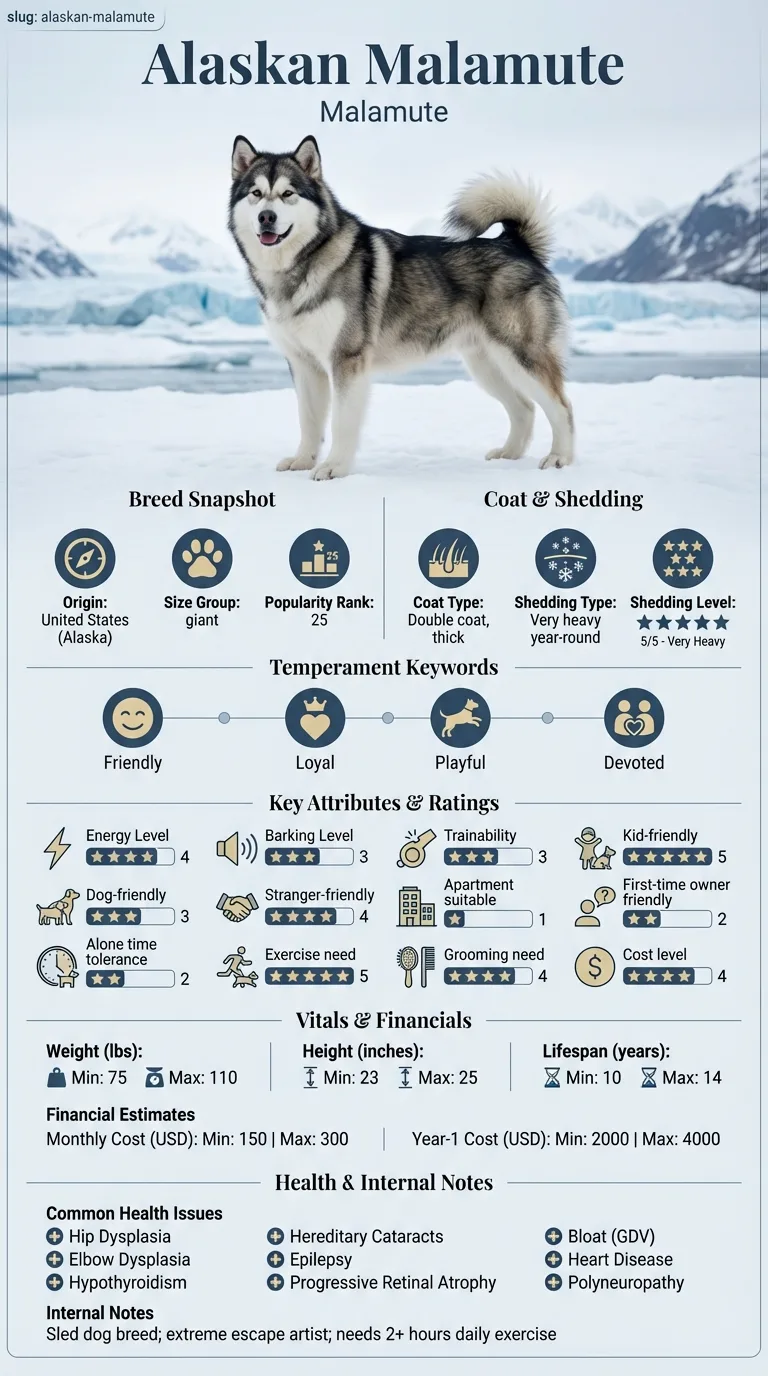
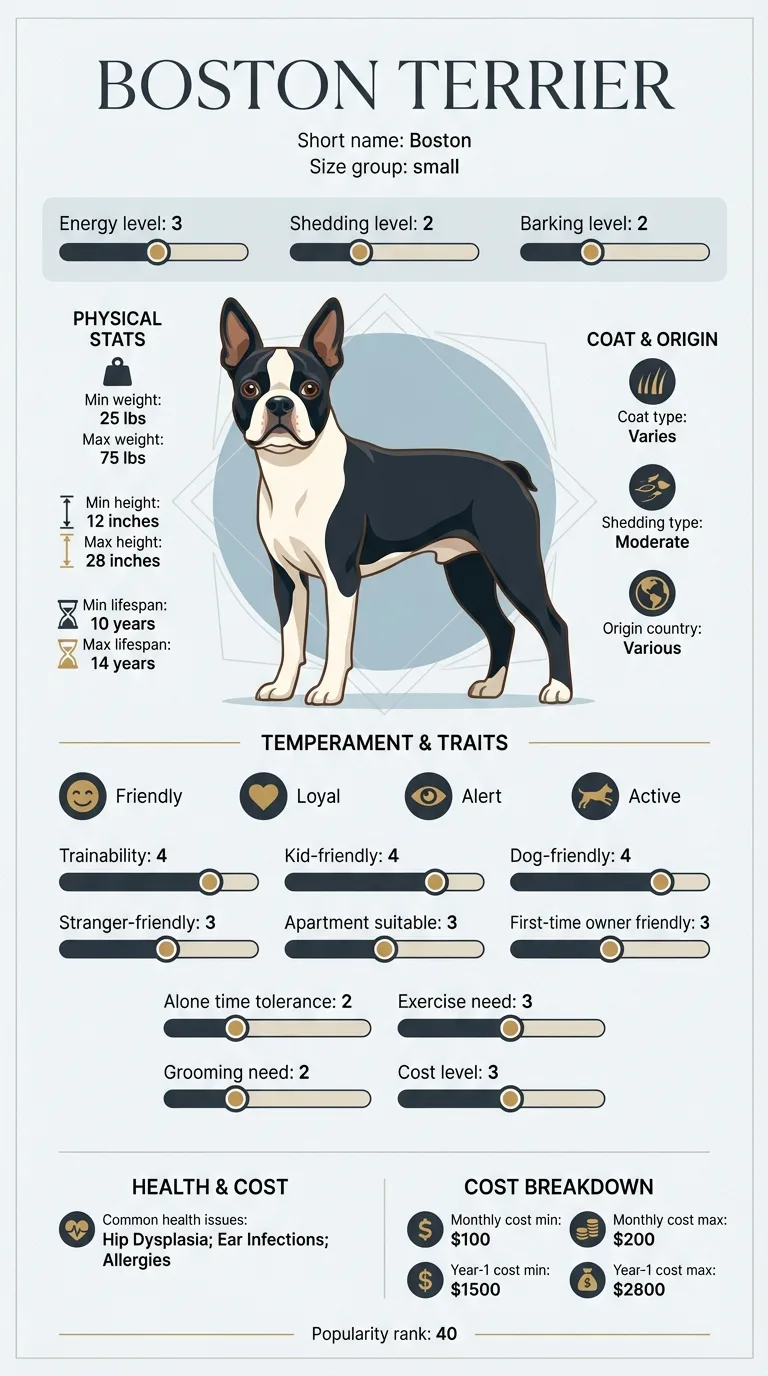
This page is for someone comparing two breeds at opposite ends of size and output. It covers climate limits honestly, the exercise gap, brachycephalic breathing and eye risk, deafness testing, and what each costs to keep.
The Boston Terrier is cheaper, easier and better suited to ordinary housing; the Malamute is a working dog that needs a landscape and a cold climate to be at its best.
Choose the Alaskan Malamute if you are athletic, have space and live somewhere cold. It rates 5/5 with children and needs no heat management indoors, and its structural soundness is a genuine advantage. You are accepting $150–$300 a month against $80–$150, 5/5 exercise, 5/5 shedding, 4/5 grooming and a 1/5 apartment rating.
Choose the Boston Terrier if you live in a flat and want an easy first dog. It rates 5/5 for apartments, first-time owners and children, 4/5 with other dogs and strangers, grooms at 1/5, needs only 2/5 exercise and tolerates being alone at 3/5. You are accepting a short face, real heat danger and eye fragility.
| Feature | alaskan malamute | boston terrier | Winner |
|---|---|---|---|
| Weight | 75–110 lbs | 12–25 lbs | Equal |
| Height | 23–25 in | 15–17 in | Equal |
| Lifespan | 10–14 years | 11–13 years | alaskan malamute |
| Coat | Thick double coat | Short and smooth | Equal |
| Grooming need | High (4/5) | Very low (1/5) | boston terrier |
| Shedding | Very high (5/5) | Low (2/5) | boston terrier |
| Energy level | High (4/5) | Moderate (3/5) | Equal |
| Exercise need | Very high (5/5) | Low (2/5) | boston terrier |
| Trainability | Moderate (3/5) | High (4/5) | boston terrier |
| Barking | Moderate (3/5) | Low (2/5) | boston terrier |
| Good with kids | Very high (5/5) | Very high (5/5) | Equal |
| Good with other dogs | Moderate (3/5) | High (4/5) | boston terrier |
| Friendly to strangers | High (4/5) | High (4/5) | Equal |
| Apartment suitability | Very low (1/5) | Very high (5/5) | boston terrier |
| Good for first-time owners | Low (2/5) | Very high (5/5) | boston terrier |
| Tolerates being alone | Low (2/5) | Moderate (3/5) | boston terrier |
| Typical monthly cost | $150–$300 | $80–$150 | boston terrier |
| Typical first-year cost | $2,000–$4,000 | $1,100–$2,300 | boston terrier |
Neither of these breeds is climate-neutral, and that is unusual enough to lead with.
The Malamute carries a thick double coat built for Arctic work. It is superbly comfortable in cold that keeps most dogs indoors, and it struggles in warmth — summer exercise moves to the cool ends of the day, long sessions become seasonal, and shade and water are not optional. Its coat should never be clipped, because it insulates against heat as well as cold and often regrows badly.
The Boston Terrier has the opposite pair of problems. A shortened skull means it cools itself inefficiently, so heat is genuinely dangerous rather than uncomfortable — no exercise in the middle of the day from spring onward. And a short smooth coat gives almost no insulation, so it needs a coat in winter and cannot be outdoors for long in cold.
In a hot climate the Boston is the more restricted dog. In a cold one, it is the more restricted dog again. The Malamute only has one bad season.
On everything else the Boston is easier: 2/5 exercise against 5/5, 1/5 grooming against 4/5, 5/5 for apartments against 1/5.
Brachycephalic airway syndrome heads the Boston Terrier's condition list. The skull is shortened while the soft tissue in it is not, producing narrowed nostrils, often an elongated soft palate, and in some dogs a narrow windpipe.
Because a dog cools itself by moving air, a restricted airway restricts cooling as well as breathing. The rules that follow are firm: exercise early and late in warm weather, a harness rather than a collar, strict weight control since every extra pound loads the airway, and never a parked car.
Most airlines refuse short-faced breeds in the hold, which is worth knowing if travel is part of your life.
The eyes are the everyday risk. They are large, prominent and set in shallow sockets, and corneal ulcers are on the list — a squinting, weeping or closed eye needs same-day attention, because an untreated ulcer can perforate.
Ask a breeder how the parents breathe under exertion rather than at rest, and how open their nostrils are.
The Malamute has no comparable structural limitation. Its constraints are the coat and the climate.
Congenital deafness appears on the Boston Terrier's condition list and it is worth naming because it is testable before you buy.
BAER testing measures the hearing response of each ear individually and can identify unilateral deafness, which owners frequently miss entirely — a dog deaf in one ear behaves normally in most situations and simply cannot locate sound. Ask whether the litter has been BAER tested and what the results were.
Patellar luxation is the common orthopaedic item — a kneecap that slips out of its groove, producing a momentary skipping step — and cataracts round out the list.
The Malamute's list is longer and mostly systemic: hip and elbow dysplasia, hypothyroidism, hereditary cataracts, progressive retinal atrophy, epilepsy, heart disease, bloat, inherited polyneuropathy and zinc-responsive skin disease.
Two of those have specific asks. Polyneuropathy has a DNA test and shows in young dogs as exercise intolerance and a wobbly gait. Zinc-responsive dermatosis produces crusting around the muzzle and eyes and resolves with supplementation once recognised.
Only the Malamute carries a real bloat risk, and that household should know the signs.
Children ties at 5/5 and strangers ties at 4/5. Both are sociable, demonstrative breeds and neither guards anything.
The Boston is easier on every other social row: 4/5 with other dogs against 3/5, 4/5 trainability against 3/5, 5/5 for first-time owners against 2/5, and quieter at 2/5 against 3/5.
It also copes better with a working day at 3/5 against 2/5, which is unusual for a companion breed and one of its real strengths.
The Malamute's social complications are same-sex intolerance with other dogs, which surfaces at social maturity around two years old, and containment. Its own breed notes describe an extreme escape artist: it digs, climbs, works at latches and travels once loose. A fence dug in at the base, secured gates and a recall treated as a bonus rather than a safety measure are the baseline.
A Boston has no such instinct. Its outdoor risk is heat and traffic rather than distance.
The Boston runs $80–$150 a month against the Malamute's $150–$300, and $1,100–$2,300 against $2,000–$4,000 in the first year — roughly half.
Food and weight-priced products explain most of it, and grooming explains the rest: 1/5 against 4/5, which is the difference between a weekly wipe over and an undercoat rake with several long sessions twice a year.
The Boston's risk is a single large bill rather than the running cost. Airway correction, knee surgery for a luxating patella and repeated corneal treatment are all realistic, and short-faced breeds are frequently quoted above what their size suggests for insurance, with airway conditions among the most commonly excluded as breed-related.
The Malamute's expensive risks are orthopaedic and a bloat emergency, both four-figure events in a dog this size.
On lifespan the Malamute is slightly ahead at 10 to 14 years against 11 to 13, and on exercise the difference is around two hours a day against twenty minutes.
These two breeds are limited by opposite ends of the thermometer. The Malamute is an Arctic freighting dog that overheats on a mild afternoon and needs shade, water and exercise moved to the cool hours in summer. The Boston Terrier is a short-faced dog that cools itself inefficiently, so heat is genuinely dangerous for it too, and its thin coat gives almost no protection against cold. Whatever the climate, one of them is working against it.
On everything else the Boston is the easier dog: 2/5 exercise against 5/5, 1/5 grooming against 4/5, and 5/5 for apartments and first-time owners against the Malamute's 1/5 and 2/5. What it carries in exchange is a brachycephalic airway, eye fragility, and a shorter expected life.
Choose the Malamute if you are athletic, have space and live somewhere cold. Choose the Boston Terrier if you live in a flat and want an easy first dog.

Neither is good, and they fail differently. The Malamute overheats because of a thick Arctic coat, so summer exercise moves to the cool ends of the day. The Boston Terrier overheats because a shortened skull restricts cooling, which makes heat genuinely dangerous rather than merely uncomfortable.
With a coat, yes, but it has almost no insulation of its own and cannot be outdoors for long in cold weather. That is the underappreciated half of the short-coat trade — the Boston is restricted in both hot and cold climates, while the Malamute is only limited by one season.
The Malamute needs around two hours a day at 5/5 and wants to pull — carting, scootering or loaded hikes rather than walking. The Boston Terrier needs 2/5, meaning two gentle walks timed around temperature. That is the largest daily difference between them.
It measures the hearing response of each ear individually and can identify deafness in one ear, which owners frequently miss entirely — a dog deaf on one side behaves normally and simply cannot locate sound. Congenital deafness is on the Boston's list, so ask whether the litter was tested and what the results were.
The Boston Terrier at 5/5 against the Malamute's 2/5. It is small, sociable, trains at 4/5 and copes with a working day at 3/5. The Malamute needs two hours of physical work daily, serious fencing, and an owner prepared for a coat that produces sheets of undercoat twice a year.
The Malamute, overwhelmingly — 5/5 against the Boston's 2/5, with grooming at 4/5 against 1/5. It sheds year-round and blows its undercoat in sheets twice a year. The Boston sheds a fine short hair that shows on dark clothing and needs nothing more than a weekly wipe over.
The Boston Terrier at 3/5 against the Malamute's 2/5, which is unusual for a companion breed. The Malamute was bred to work alongside a team all day and does not find an empty house neutral — and a bored one digs and escapes rather than simply waiting.
The Boston Terrier if you live in a flat, work full time and want an easy first dog. The Malamute if you are athletic, live somewhere cold and have space and a properly secured garden.
The Malamute runs $150–$300 a month and the Boston Terrier $80–$150, with first-year totals of $2,000–$4,000 and $1,100–$2,300. The Boston's risk is a single large airway, knee or eye bill.
A squinting, weeping or closed eye — prominent eyes in shallow sockets mean corneal ulcers are common and can perforate. Also any change in the sound of the breathing during exercise in warm weather.
The Malamute, by a wide margin. Its own breed notes call it an extreme escape artist — it digs, climbs, works at latches and travels once loose. A fence dug in at the base and secured gates are the baseline.
Secure checkout on Stripe. We never see your card.
7-day money-back guarantee. Instant access.
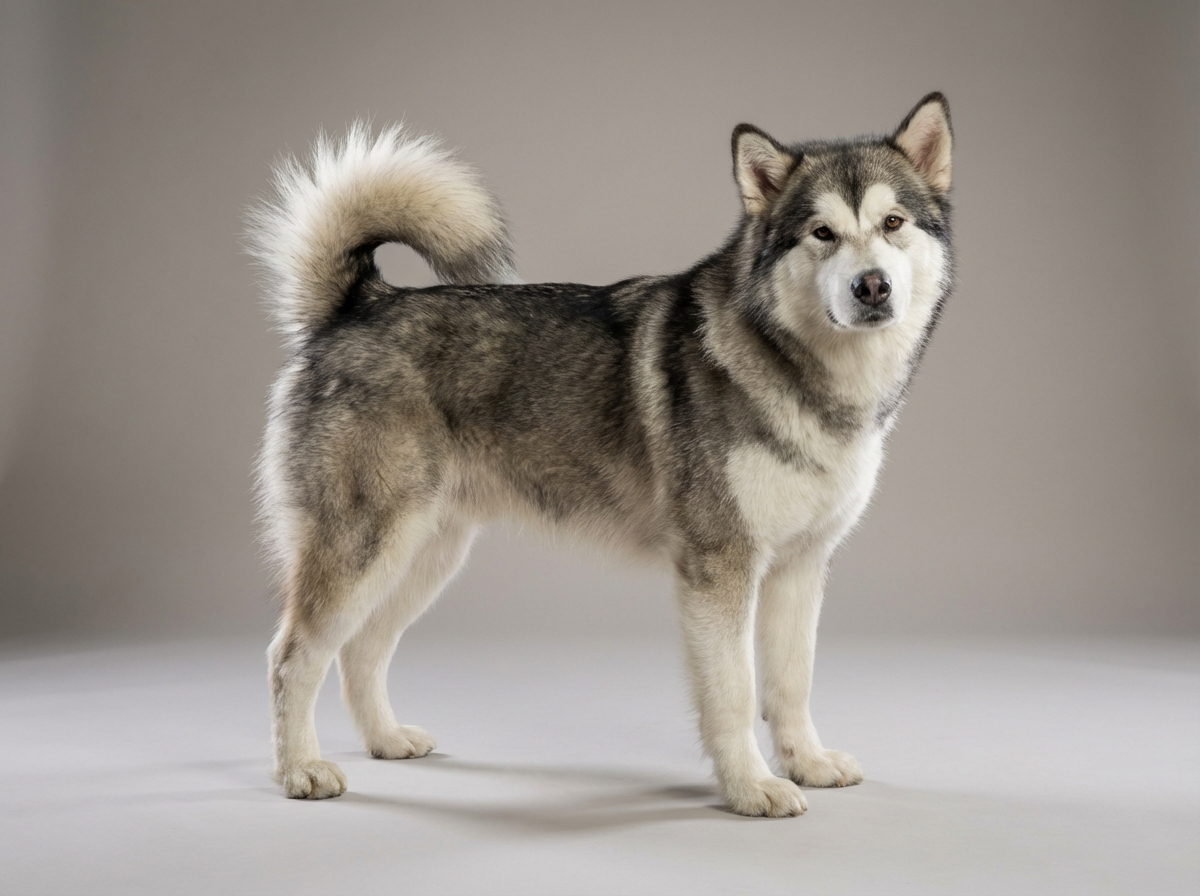
Health information here is general and is not veterinary advice. If your dog shows pain, sudden behaviour change, or worsening symptoms, consult a licensed veterinarian.
Some links on this site are affiliate links. We may earn a commission at no extra cost to you, and we only suggest products we believe are helpful for dog owners.
We research and check what we publish, but we do not warrant that any figure, date, price, or statement is accurate, complete, or current, and we accept no liability for any loss, cost, injury, or other harm arising from the use of this site. Use it as one reference among several. You remain responsible for your own decisions and for your dog's care - confirm anything that matters with a licensed veterinarian or another qualified professional before you act on it. Full disclaimer.
Match your lifestyle to the right dog.
Take quizNot sure which breed is right for you? Take our 2-minute quiz to find out.
Take the quiz