Behavior
Boston Terrier or Jack Russell Terrier for a quiet home?
Boston Terrier -- it barks far less (Low 2/5 vs Very High 5/5).

Quick answer
Boston Terrier or Jack Russell Terrier for a quiet home?
Boston Terrier -- it barks far less (Low 2/5 vs Very High 5/5).
Boston Terrier or Jack Russell Terrier? On paper they differ most on exercise need, and on the scales Boston Terrier is the heavier at 12–25 lbs. Here is how the two compare on everything that shapes an ordinary week.
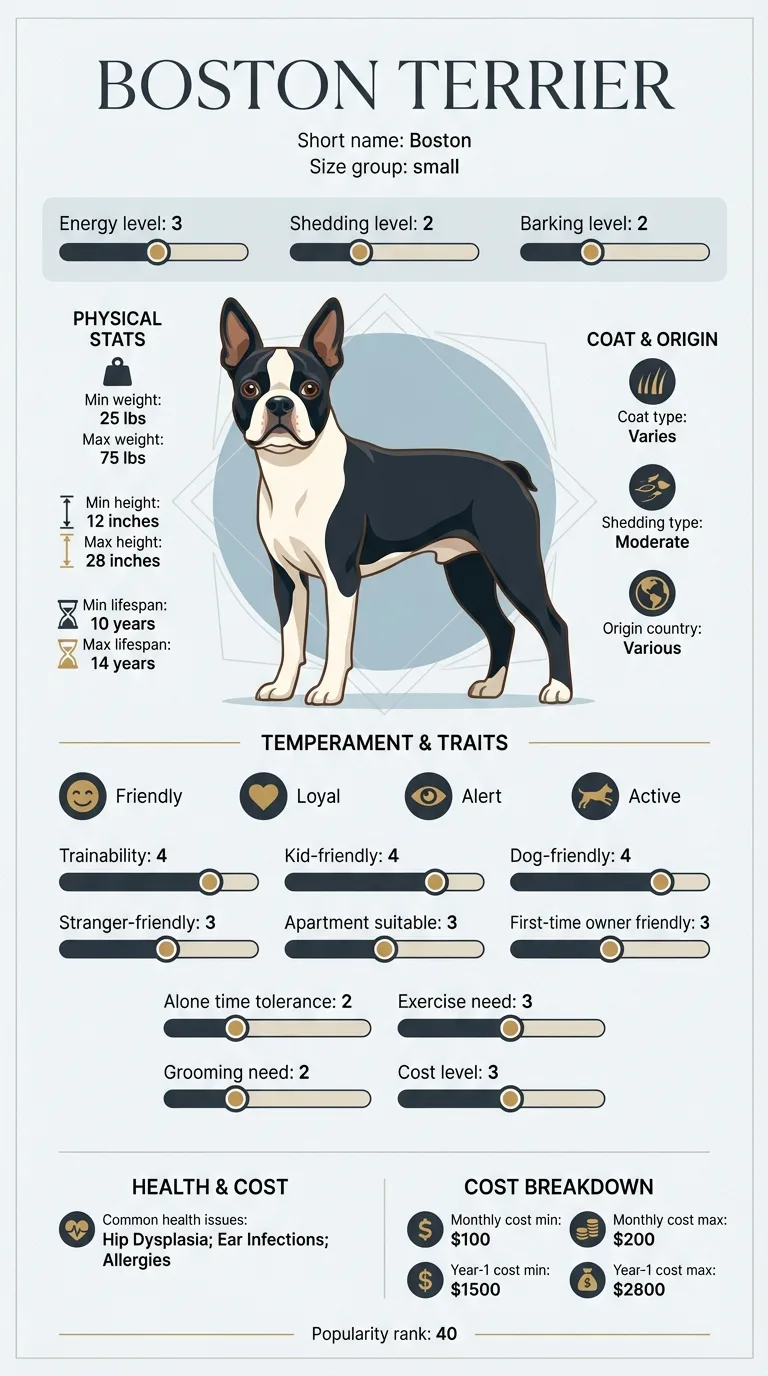
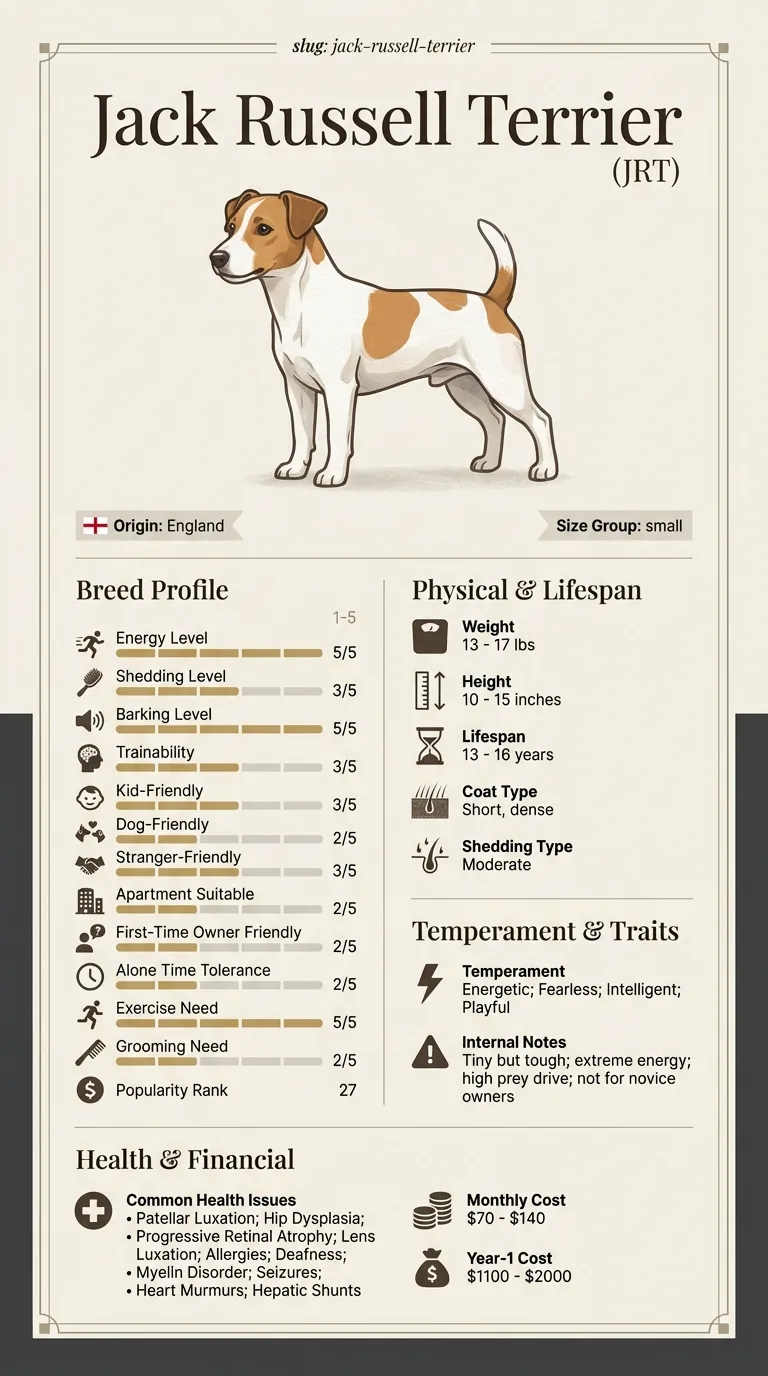
This is for someone already down to Boston Terrier and Jack Russell Terrier and deciding between them. For this pair the decision usually turns on exercise need and apartment suitability, so those are covered first and in most detail. Anyone choosing from a flat has a clear answer here: Boston Terrier rates 5/5 against 2/5. It is written for the decision rather than the breed history.
Between Boston Terrier and Jack Russell Terrier, exercise need is what separates them, and Boston Terrier is the lower-effort dog of the two to keep.
Choose Boston Terrier if you are in a flat or a smaller home, this is your first dog and you do not want a standing grooming appointment.
Choose Jack Russell Terrier if a smaller dog suits your car, your home or your back, you want a dog that can keep up with an active routine and you want a dog that is more watchful with visitors.
| Feature | boston terrier | jack russell terrier | Winner |
|---|---|---|---|
| Size class | small | small | Equal |
| Weight | 12–25 lbs | 13–17 lbs | Equal |
| Height | 15–17 in | 10–15 in | Equal |
| Lifespan | 11–13 years | 13–16 years | jack russell terrier |
| Exercise need | Low (2/5) | Very high (5/5) | boston terrier |
| Grooming need | Very low (1/5) | Low (2/5) | boston terrier |
| Shedding | Low (2/5) | Moderate (3/5) | boston terrier |
| Energy level | Moderate (3/5) | Very high (5/5) | Equal |
| Barking | Low (2/5) | Very high (5/5) | boston terrier |
| Apartment suitability | Very high (5/5) | Low (2/5) | boston terrier |
| Good for first-time owners | Very high (5/5) | Low (2/5) | boston terrier |
| Tolerates being alone | Moderate (3/5) | Low (2/5) | boston terrier |
| Trainability | High (4/5) | Moderate (3/5) | boston terrier |
| Good with kids | Very high (5/5) | Moderate (3/5) | boston terrier |
| Good with other dogs | High (4/5) | Low (2/5) | boston terrier |
| Friendly to strangers | High (4/5) | Moderate (3/5) | boston terrier |
| Cost level | Moderate (3/5) | Low (2/5) | jack russell terrier |
| Coat | Short and smooth | Short, dense | Equal |
| Origin | Various | England | Equal |
| Typical monthly cost | $80–$150 | $70–$140 | Equal |
| Typical first-year cost | $1,100–$2,300 | $1,100–$2,000 | Equal |
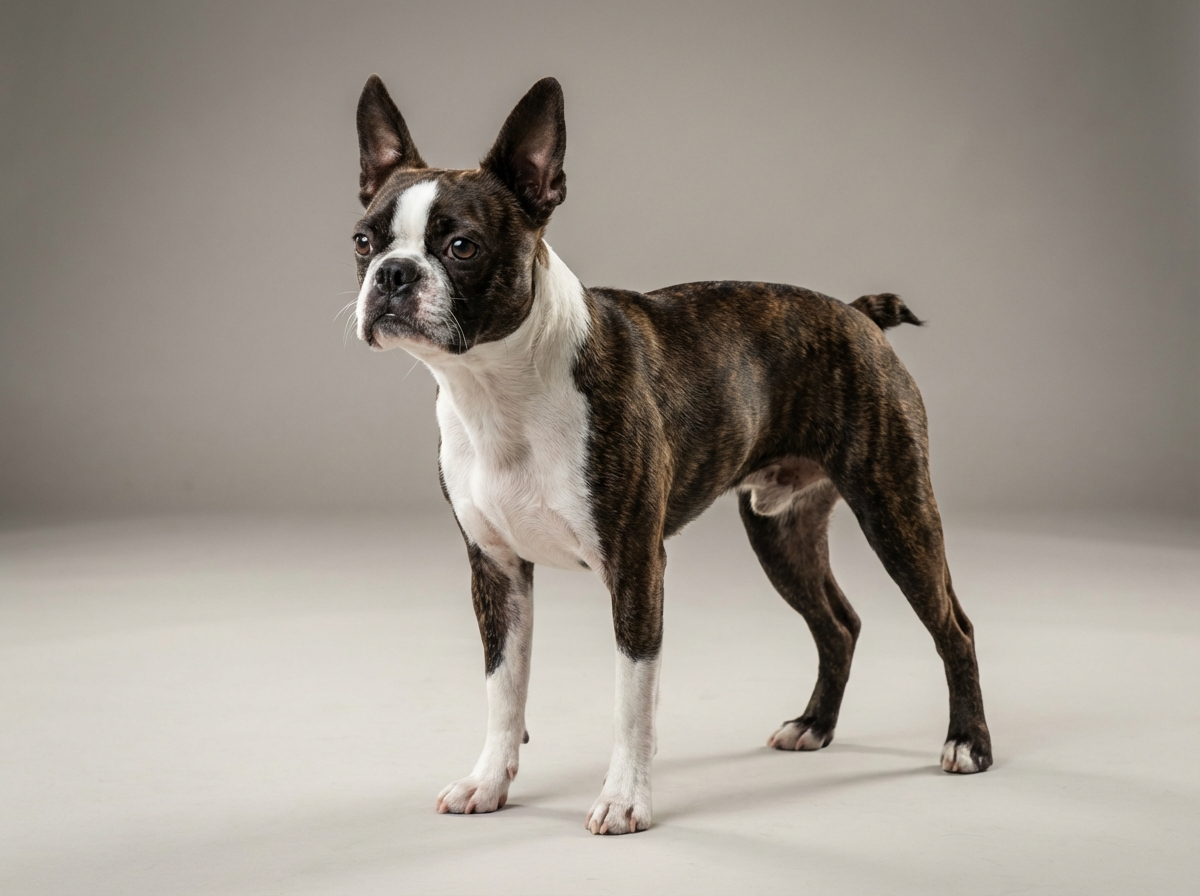
Twelve to 25 pounds versus 13 to 17 -- on paper the Boston Terrier and Jack Russell Terrier occupy similar weight brackets, but they carry that weight differently. The Boston stands 15 to 17 inches at the shoulder on a compact, boxy frame with a flat face, while the Jack Russell tops out shorter at 10 to 15 inches on a leaner, more athletic build made for going to ground after quarry. A Jack Russell's body reads more like a coiled spring; a Boston's reads more like a small, sturdy block. Neither breed is delicate, but owners sizing up furniture, crates, or car harnesses will find the Jack Russell's narrower chest and longer legs change the proportions more than the shared weight range suggests.
This is where the two breeds split hardest. The Boston Terrier rates just Low (2/5) for exercise need and Moderate (3/5) for energy, content with a couple of walks and some living-room zoomies. The Jack Russell Terrier rates Very High (5/5) on both counts -- it was bred to chase and dig for hours and behaves like it. An under-exercised Jack Russell tends to invent its own jobs, often destructive ones, while a Boston left on a lighter schedule is unlikely to spiral the same way. Anyone whose realistic daily output is a 20-minute stroll should lean Boston; anyone who runs, hikes, or plays fetch for 60-plus minutes a day has the activity budget a Jack Russell actually needs.
Grooming is a rare category where the Boston Terrier wins cleanly: Very Low (1/5) need against the Jack Russell's Low (2/5), and Low (2/5) shedding against Moderate (3/5). Both breeds wear short coats that never require professional grooming or scissoring, so this isn't a dramatic gap -- it's a small, steady one. A weekly wipe-down handles either dog's coat, though the Jack Russell's slightly denser coat sheds a bit more visibly on furniture and dark clothing. Neither breed drools much or carries a strong doggy odor. For owners chasing the lowest possible grooming bill and the least fur in the house, the Boston edges ahead, but this factor alone shouldn't decide between two dogs this close on coat care.
The gap here is stark. The Boston Terrier scores Very High (5/5) for apartment suitability and Low (2/5) for barking, while the Jack Russell scores Low (2/5) for apartments and Very High (5/5) for barking. A Jack Russell that hears a neighbor's footsteps or a delivery truck will often announce it loudly and repeatedly, which matters a great deal behind shared walls. The Boston also tolerates being alone at a Moderate (3/5) level versus the Jack Russell's Low (2/5), meaning a workday alone is more likely to go smoothly with the Boston. Anyone in a condo or thin-walled rental with long stretches away from home should weight this category heavily -- it's one of the widest splits in the whole comparison.
The Boston Terrier is rated Very High (5/5) for first-time owners and High (4/5) for trainability; the Jack Russell sits at Low (2/5) and Moderate (3/5) respectively. That's not because Jack Russells are unintelligent -- the breed's temperament list includes Intelligent and Fearless -- but because that intelligence pairs with independence and a strong prey drive that a novice handler can struggle to redirect. A first-time owner following basic reward-based training will usually get further, faster, with a Boston. Jack Russell owners tend to need more consistency, more mental enrichment, and often prior experience with a strong-willed terrier before the training clicks into place and stays there.
With kids, the Boston Terrier rates Very High (5/5) against the Jack Russell's Moderate (3/5), and with other dogs the gap is wider still -- High (4/5) versus Low (2/5). Temperament data backs this up: the Boston is described as Friendly, Comical, and Adaptable, while the Jack Russell is Fearless and Playful but also has a documented history of scrappiness with other dogs, especially same-sex pairings. Around strangers both breeds do reasonably well, though the Boston edges ahead at High (4/5) versus Moderate (3/5). Households with toddlers, frequent visitors, or an existing multi-dog pack will generally find the Boston the lower-friction choice; a Jack Russell can still thrive there, but usually needs more careful introductions and supervision.
The Jack Russell Terrier's 13-to-16-year lifespan outpaces the Boston Terrier's 11-to-13, and the health lists explain part of why. The Boston's five known issues -- Brachycephalic Airway Syndrome, Patellar Luxation, Cataracts, Corneal Ulcers, and Deafness -- center on its flat face and prominent eyes, structural traits that come with the breed's look. The Jack Russell's list runs longer, ten conditions including Hip Dysplasia, Progressive Retinal Atrophy, Lens Luxation, Seizures, and Hepatic Shunts, but none stem from a body shape working against the dog's own breathing. A brachycephalic dog's airway risk is a daily, heat-sensitive concern in a way a longer, varied list of possible conditions isn't, which is part of why the Jack Russell tends to outlive it.
Monthly costs sit close together -- $80 to $150 for the Boston versus $70 to $140 for the Jack Russell -- and the Boston is rated Moderate (3/5) on overall cost against the Jack Russell's Low (2/5). First-year costs land almost identically, $1,100-$2,300 versus $1,100-$2,000. The real cost difference isn't in the sticker price of food or supplies; it shows up later, in vet bills. A brachycephalic breed like the Boston can require airway surgery or emergency care during a heat wave, expenses the health list doesn't put a number on but that owners of flat-faced breeds budget for anyway. On paper the Jack Russell is the cheaper dog to keep; in practice, both deserve an emergency fund.
Boston Terrier weighs 12–25 lbs and lives 11–13 years; Jack Russell Terrier weighs 13–17 lbs and lives 13–16 years. The two diverge most on exercise need, apartment suitability and good for first-time owners and 4 other rated axes. Almost every rated axis separates them at least slightly. In the table, a "winner" means easier for an ordinary household — not better. Size, coat and origin are recorded without a verdict. Because both breeds are scored the same way, the gaps are reliable even where the absolute numbers are rough.

The Boston Terrier, by a wide margin -- it scores Very High (5/5) on apartment suitability and Low (2/5) on barking, while the Jack Russell scores Low (2/5) and Very High (5/5) on those same measures, meaning it's both harder to house in tight quarters and louder about it.
Yes, considerably -- Jack Russells rate Very High (5/5) for barking versus the Boston's Low (2/5), reflecting the terrier's alert, vocal nature.
The Boston Terrier is rated Very High (5/5) for first-time owners against the Jack Russell's Low (2/5); the Jack Russell's exercise needs and independent streak ask more of a novice handler.
The Jack Russell Terrier, typically 13 to 16 years compared with the Boston Terrier's 11 to 13, partly because it doesn't carry the Boston's brachycephalic airway risk.
Both can do well, but the Boston rates Very High (5/5) for kids versus the Jack Russell's Moderate (3/5), and the Boston's Friendly, Comical temperament tends to suit boisterous households more predictably.
A lot more -- the Jack Russell rates Very High (5/5) for exercise need against the Boston's Low (2/5), so it needs closer to an hour of vigorous activity daily rather than a couple of short walks.
The Jack Russell's list is longer on paper (ten conditions including Seizures and Hepatic Shunts versus the Boston's five), but the Boston's issues center on airway and eye structure tied directly to its flat face, which many owners find the more constant daily concern.
Boston Terrier -- it barks far less (Low 2/5 vs Very High 5/5).
The Jack Russell, at roughly $70-$140 versus the Boston's $80-$150.
The Jack Russell Terrier, by a clear margin in trainability and temperament.
The Boston Terrier, rated Low (2/5) versus the Jack Russell's Moderate (3/5).
Secure checkout on Stripe. We never see your card.
7-day money-back guarantee. Instant access.
Health information here is general and is not veterinary advice. If your dog shows pain, sudden behaviour change, or worsening symptoms, consult a licensed veterinarian.
Some links on this site are affiliate links. We may earn a commission at no extra cost to you, and we only suggest products we believe are helpful for dog owners.
We research and check what we publish, but we do not warrant that any figure, date, price, or statement is accurate, complete, or current, and we accept no liability for any loss, cost, injury, or other harm arising from the use of this site. Use it as one reference among several. You remain responsible for your own decisions and for your dog's care - confirm anything that matters with a licensed veterinarian or another qualified professional before you act on it. Full disclaimer.
Match your lifestyle to the right dog.
Take quizNot sure which breed is right for you? Take our 2-minute quiz to find out.
Take the quiz