Living
More energetic, Boston Terrier or Labradoodle?
The Labradoodle, rated Very High (5/5) versus the Boston's Moderate (3/5).

Quick answer
More energetic, Boston Terrier or Labradoodle?
The Labradoodle, rated Very High (5/5) versus the Boston's Moderate (3/5).
Boston Terrier or Labradoodle? On paper they differ most on exercise need, and on the scales Labradoodle is the heavier at 15–65 lbs. Here is how the two compare on everything that shapes an ordinary week.
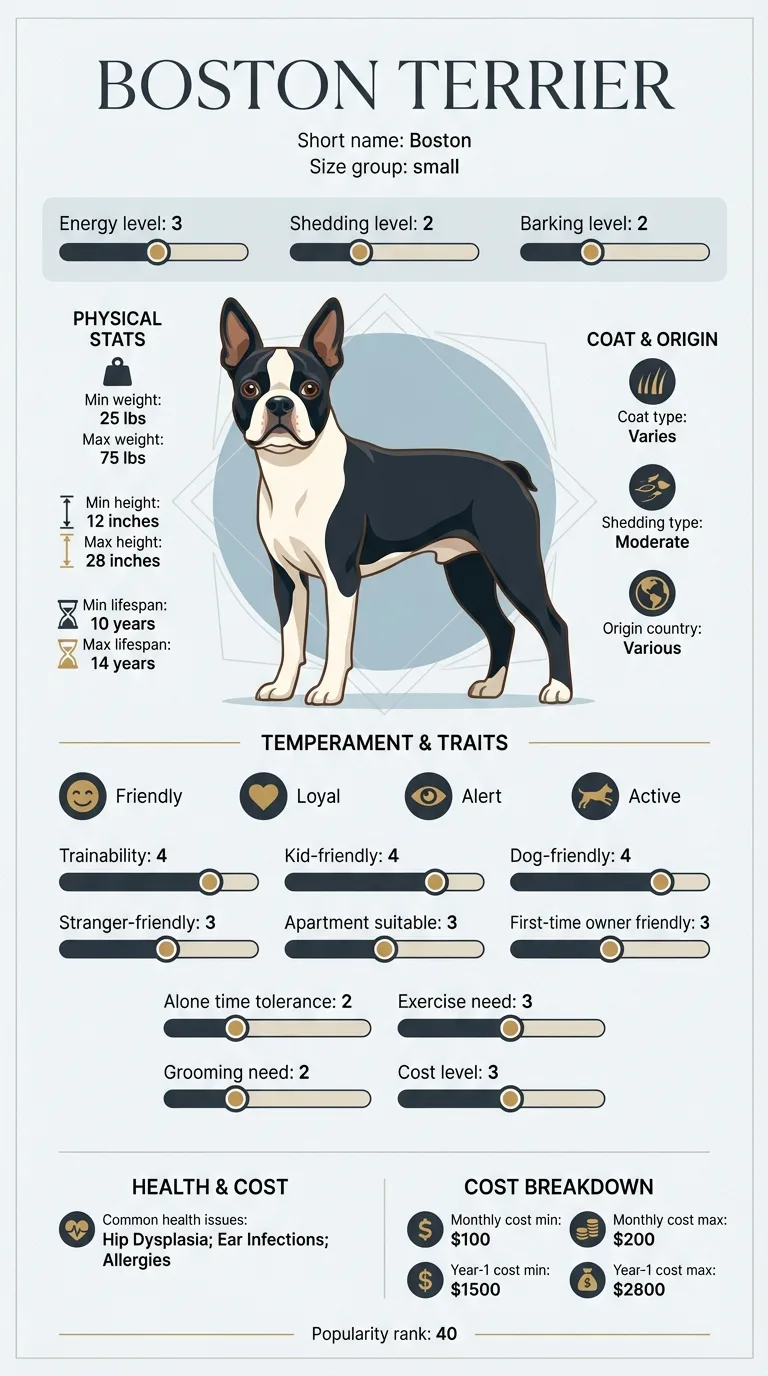
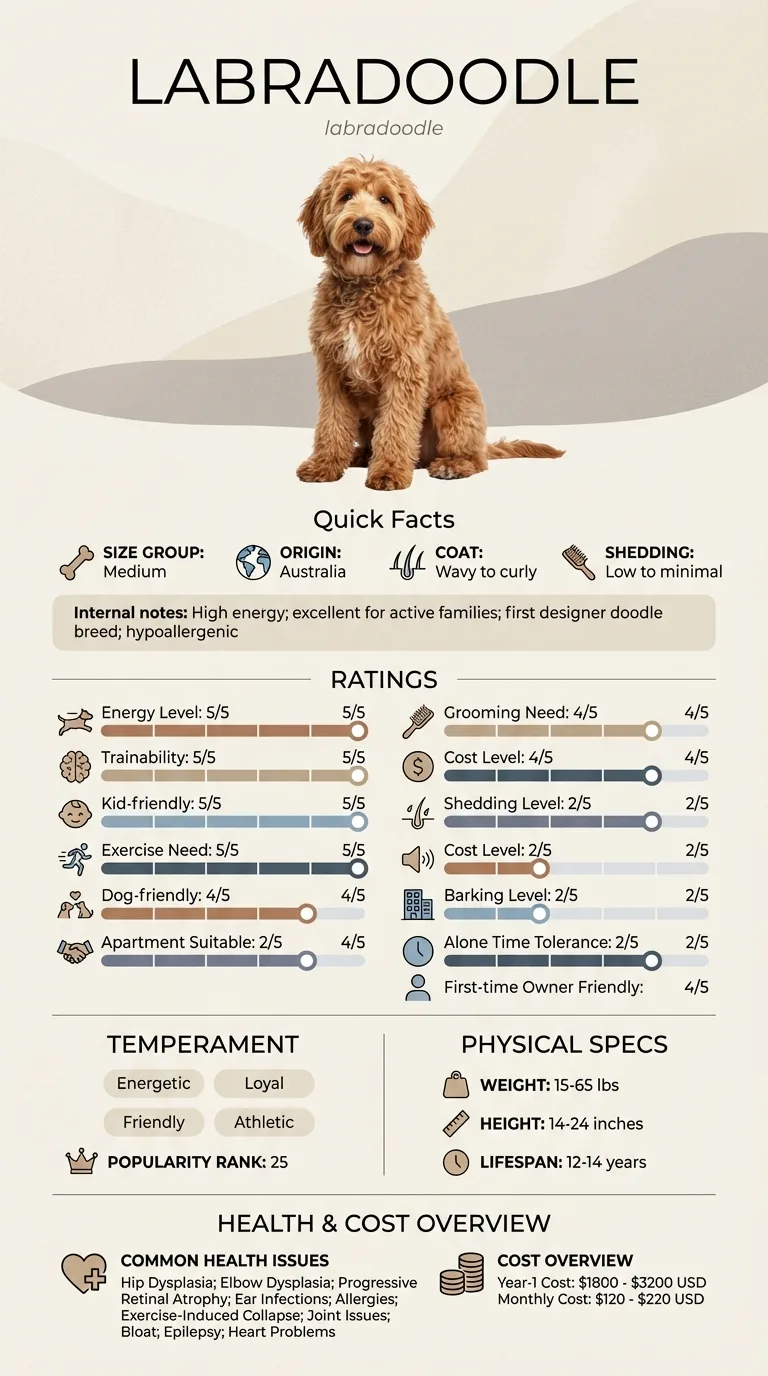
This is for someone already down to Boston Terrier and Labradoodle and deciding between them. For this pair the decision usually turns on exercise need and grooming need, so those are covered first and in most detail. Anyone choosing from a flat has a clear answer here: Boston Terrier rates 5/5 against 2/5. The focus throughout is on daily consequences rather than breed background.
Between Boston Terrier and Labradoodle, exercise need is what separates them, and Boston Terrier is the lower-effort dog of the two to keep.
Choose Boston Terrier if you are in a flat or a smaller home, this is your first dog and you do not want a standing grooming appointment.
Choose Labradoodle if you want a dog that picks up training quickly and you want a dog that can keep up with an active routine.
| Feature | boston terrier | labradoodle | Winner |
|---|---|---|---|
| Size class | small | medium | Equal |
| Weight | 12–25 lbs | 15–65 lbs | Equal |
| Height | 15–17 in | 14–24 in | Equal |
| Lifespan | 11–13 years | 12–14 years | labradoodle |
| Exercise need | Low (2/5) | Very high (5/5) | boston terrier |
| Grooming need | Very low (1/5) | High (4/5) | boston terrier |
| Shedding | Low (2/5) | Low (2/5) | Equal |
| Energy level | Moderate (3/5) | Very high (5/5) | Equal |
| Barking | Low (2/5) | Low (2/5) | Equal |
| Apartment suitability | Very high (5/5) | Low (2/5) | boston terrier |
| Good for first-time owners | Very high (5/5) | High (4/5) | boston terrier |
| Tolerates being alone | Moderate (3/5) | Low (2/5) | boston terrier |
| Trainability | High (4/5) | Very high (5/5) | labradoodle |
| Good with kids | Very high (5/5) | Very high (5/5) | Equal |
| Good with other dogs | High (4/5) | High (4/5) | Equal |
| Friendly to strangers | High (4/5) | High (4/5) | Equal |
| Cost level | Moderate (3/5) | High (4/5) | boston terrier |
| Coat | Short and smooth | Wavy to curly | Equal |
| Origin | Various | Australia | Equal |
| Typical monthly cost | $80–$150 | $120–$220 | Equal |
| Typical first-year cost | $1,100–$2,300 | $1,800–$3,200 | Equal |
The Labradoodle's weight range is enormous by comparison -- 15 to 65 pounds spanning miniature to standard lines -- against the Boston Terrier's tight 12-to-25-pound bracket. Height tells a similar story: 14 to 24 inches for the Labradoodle versus a fixed 15 to 17 inches for the Boston. Where the Boston is a single, predictable small-dog silhouette with a flat face and compact body, "Labradoodle" covers a genuine range of sizes depending on the Poodle parent used in the cross, so a buyer needs to ask a breeder which size line they're getting before assuming anything about adult weight. The Boston's consistency is itself a selling point for anyone who wants to know exactly what they're bringing home.
Very High (5/5) exercise need and Very High (5/5) energy define the Labradoodle, a legacy of its Retriever and Poodle ancestry, while the Boston sits at Low (2/5) exercise need and Moderate (3/5) energy. That's not a small gap -- it's closer to a different category of dog. A Labradoodle bred from working lines genuinely wants long runs, swimming, or fetch sessions most days, and a bored one can become destructive or restless. The Boston is satisfied by a couple of modest walks and indoor play. Prospective owners should be honest about which one describes their actual week: if exercise happens in short bursts, the Boston fits; if it's a daily hour-plus commitment, the Labradoodle's needs line up better.
Grooming need splits sharply -- Very Low (1/5) for the Boston against High (4/5) for the Labradoodle -- even though both breeds land at Low (2/5) shedding. That combination surprises people: the Labradoodle's wavy-to-curly coat doesn't shed heavily, but it mats without regular brushing and typically needs professional trimming every six to eight weeks, a recurring cost the Boston's short, smooth coat never generates. A Boston owner can go weeks between grooming sessions with just an occasional wipe-down; a Labradoodle owner is signing up for an ongoing grooming routine or a standing salon appointment. Anyone drawn to the Labradoodle for low shedding should understand that low-shed doesn't mean low-maintenance here -- the coat still demands real, regular upkeep.
Barking is a tie at Low (2/5) for both breeds, but apartment suitability isn't close -- Very High (5/5) for the Boston versus Low (2/5) for the Labradoodle. The difference isn't noise, it's space and stamina: a dog with Very High exercise needs cooped up in a small unit tends to get restless regardless of how quiet it is. The Boston also tolerates being alone better, Moderate (3/5) against the Labradoodle's Low (2/5), which matters for anyone working a standard office schedule. A Labradoodle can live in an apartment successfully, but it typically needs a dedicated dog walker, a nearby park, or a yard to burn off energy that a small unit alone can't provide.
Both breeds train well, but the Labradoodle edges ahead at Very High (5/5) trainability against the Boston's High (4/5), reflecting its Poodle heritage and the temperament traits Loyal and Athletic layered onto raw intelligence. The Boston still rates higher for first-time owners, Very High (5/5) versus High (4/5), mainly because its lower exercise ceiling means a novice is less likely to fall behind on the dog's needs. In practice, a first-time owner who commits to daily structured exercise can handle a Labradoodle just fine -- the training itself isn't the hard part. The harder part is keeping pace with an athletic, Very-High-energy dog day after day, which is where inexperienced owners more often struggle.
This pair ties on more than it splits: both score Very High (5/5) with kids, High (4/5) with other dogs, and High (4/5) with strangers, and both carry Friendly in their temperament list alongside the Boston's Comical and Adaptable and the Labradoodle's Loyal and Athletic. Practically, that means either breed integrates well into a busy household with children, visitors, and existing pets. The meaningful difference is energy management rather than temperament -- a Labradoodle's enthusiasm around kids needs an outlet or it turns into jumping and roughhousing, while the Boston's calmer baseline energy makes it naturally gentler in a living room full of small children without as much active management.
The Labradoodle's 12-to-14-year lifespan edges out the Boston's 11-to-13, and the two health lists point to very different sources of risk. The Boston's five conditions -- Brachycephalic Airway Syndrome, Patellar Luxation, Cataracts, Corneal Ulcers, Deafness -- trace back to its flat face and prominent eyes. The Labradoodle's ten-item list, including Hip Dysplasia, Elbow Dysplasia, Exercise-Induced Collapse, Bloat, and Heart Problems, reflects a larger, more athletic body under real physical strain, plus some inherited Poodle and Labrador conditions. Neither list is more manageable than the other, just different: Boston owners watch for heat and breathing distress, while Labradoodle owners watch joints, weight, and the deep-chested breed's bloat risk after meals.
The Labradoodle costs more to keep at almost every stage -- $120 to $220 monthly against the Boston's $80 to $150, and $1,800 to $3,200 in the first year versus $1,100 to $2,300. Cost level reflects that too, High (4/5) for the Labradoodle against Moderate (3/5) for the Boston. Most of that gap traces directly back to grooming: a Labradoodle's recurring professional coat maintenance alone can add $60 to $100 a month that a Boston owner simply never pays. Food costs also scale with the Labradoodle's larger body and higher activity level. Anyone comparing total cost of ownership rather than adoption price should weigh the Labradoodle's ongoing grooming bill as seriously as its higher purchase price.
Boston Terrier weighs 12–25 lbs and lives 11–13 years; Labradoodle weighs 15–65 lbs and lives 12–14 years. The two diverge most on exercise need, grooming need and apartment suitability and 1 other rated axes. They are level on barking, good with other dogs and good with kids, so those cannot decide it. The table below marks a winner only where one breed is genuinely easier for a typical owner; size and origin are facts rather than merits and stay level. Ratings come from one source applied to both breeds, so they are meaningful against each other rather than as absolute scores.

Labradoodles are often marketed as low-shedding, and the data backs that up at Low (2/5) shedding -- the same rating as the Boston Terrier -- but "hypoallergenic" isn't guaranteed for either breed, and allergy-prone owners should spend time with the specific dog first.
The Boston Terrier, by a wide margin -- Very Low (1/5) grooming need against the Labradoodle's High (4/5), since the Labradoodle's wavy-to-curly coat needs regular brushing and periodic professional trims.
It's possible but harder than with a Boston Terrier -- the Labradoodle rates Low (2/5) for apartment suitability against the Boston's Very High (5/5), mainly due to its Very High exercise needs.
The Boston Terrier rates Very High (5/5) for first-time owners versus the Labradoodle's High (4/5), largely because its lower exercise demands are easier for a novice to keep up with.
Yes -- both breeds rate Very High (5/5) with kids, and both carry Friendly in their temperament profile.
The Boston Terrier -- its first-year cost of $1,100-$2,300 undercuts the Labradoodle's $1,800-$3,200, driven largely by the Labradoodle's grooming expenses.
The Labradoodle, typically 12 to 14 years against the Boston Terrier's 11 to 13.
The Labradoodle, rated Very High (5/5) versus the Boston's Moderate (3/5).
They tie -- both rate Low (2/5) for shedding.
The Boston Terrier, needing almost no coat maintenance versus the Labradoodle's regular trims.
The Labradoodle, rated Very High (5/5) trainability versus the Boston's High (4/5).
Secure checkout on Stripe. We never see your card.
7-day money-back guarantee. Instant access.
Health information here is general and is not veterinary advice. If your dog shows pain, sudden behaviour change, or worsening symptoms, consult a licensed veterinarian.
Some links on this site are affiliate links. We may earn a commission at no extra cost to you, and we only suggest products we believe are helpful for dog owners.
We research and check what we publish, but we do not warrant that any figure, date, price, or statement is accurate, complete, or current, and we accept no liability for any loss, cost, injury, or other harm arising from the use of this site. Use it as one reference among several. You remain responsible for your own decisions and for your dog's care - confirm anything that matters with a licensed veterinarian or another qualified professional before you act on it. Full disclaimer.
Match your lifestyle to the right dog.
Take quizNot sure which breed is right for you? Take our 2-minute quiz to find out.
Take the quiz