Boston Terrier vs Cavalier King Charles Spaniel: Which Suits Your Home?
Quick answer
Boston Terrier or Cavalier - which should you get?
They're close on temperament and space needs. Choose the Boston if you're out of the house often and want the lowest-maintenance coat; choose the Cavalier if you want a dog that gets along with other dogs especially well and you're home enough to manage its attachment needs.
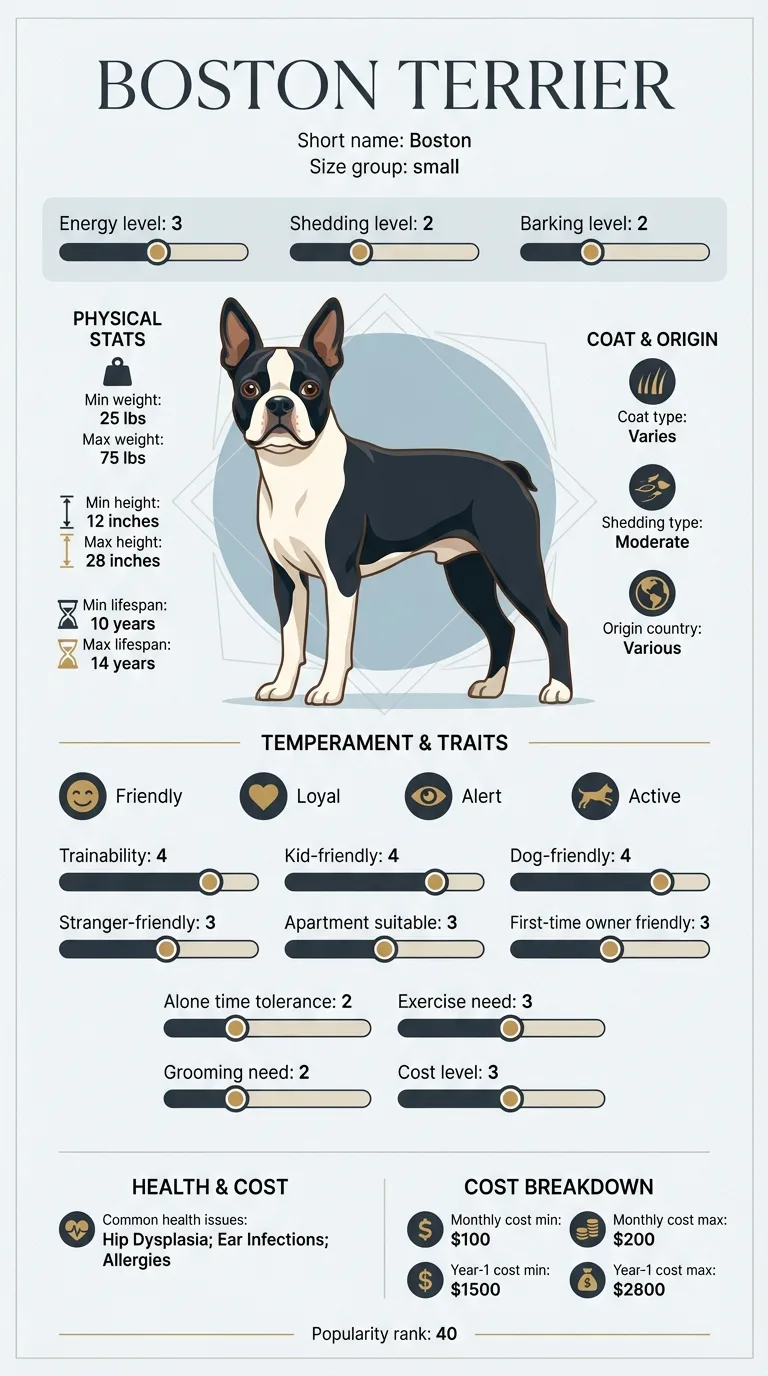
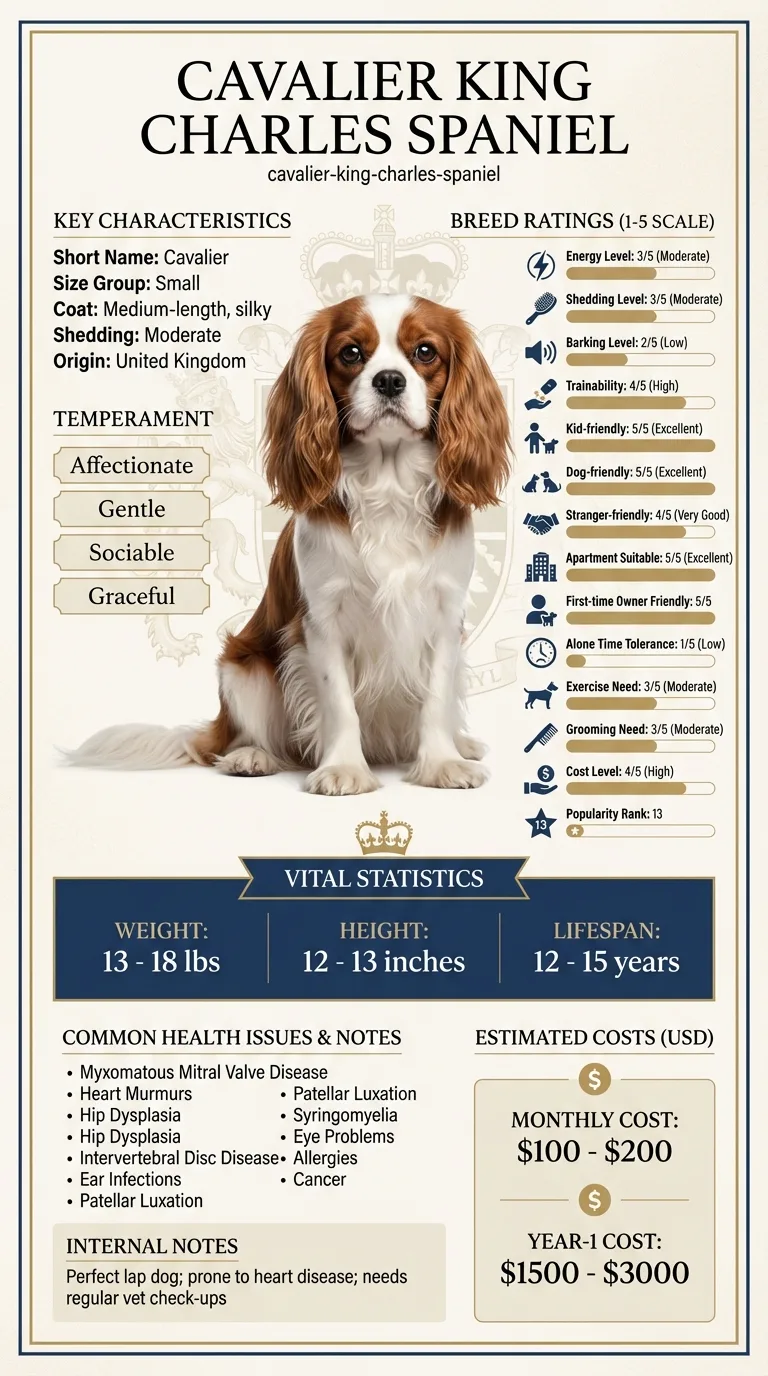
Boston Terrier or Cavalier King Charles Spaniel? On paper they differ most on grooming need, and on the scales Boston Terrier is the heavier at 12–25 lbs. Here is how the two compare on everything that shapes an ordinary week.
This is for someone already down to Boston Terrier and Cavalier King Charles Spaniel and deciding between them. For this pair the decision usually turns on grooming need and tolerates being alone, so those are covered first and in most detail. Both rate 5/5 for flats, so housing does not settle this one. There is no origin story here — only what changes about your week.
Quick verdict
Between Boston Terrier and Cavalier King Charles Spaniel, grooming need is what separates them, and Boston Terrier is the lower-effort dog of the two to keep.
Choose boston terrier if...
Choose Boston Terrier if you do not want a standing grooming appointment, shedding is a problem in your house and your walking routine is modest.
Choose cavalier king charles spaniel if...
Choose Cavalier King Charles Spaniel if you already have another dog, a smaller dog suits your car, your home or your back and you want a dog that can keep up with an active routine.
Head-to-head comparison
Feature
boston terrier
cavalier king charles spaniel
Winner
Size class
small
small
Equal
Weight
12–25 lbs
13–18 lbs
Equal
Height
15–17 in
12–13 in
Equal
Lifespan
11–13 years
12–15 years
cavalier king charles spaniel
Exercise need
Low (2/5)
Moderate (3/5)
boston terrier
Grooming need
Very low (1/5)
Moderate (3/5)
boston terrier
Shedding
Low (2/5)
Moderate (3/5)
boston terrier
Energy level
Moderate (3/5)
Moderate (3/5)
Equal
Barking
Low (2/5)
Low (2/5)
Equal
Apartment suitability
Very high (5/5)
Very high (5/5)
Equal
Good for first-time owners
Very high (5/5)
Very high (5/5)
Equal
Tolerates being alone
Moderate (3/5)
Very low (1/5)
boston terrier
Trainability
High (4/5)
High (4/5)
Equal
Good with kids
Very high (5/5)
Very high (5/5)
Equal
Good with other dogs
High (4/5)
Very high (5/5)
cavalier king charles spaniel
Friendly to strangers
High (4/5)
High (4/5)
Equal
Cost level
Moderate (3/5)
High (4/5)
boston terrier
Coat
Short and smooth
Medium-length, silky
Equal
Origin
Various
United Kingdom
Equal
Typical monthly cost
$80–$150
$100–$200
Equal
Typical first-year cost
$1,100–$2,300
$1,500–$3,000
Equal
Deep dive
Size and build
Both are small dogs and close in scale - the Boston runs 12-25 lbs at 15-17 inches, the Cavalier 13-18 lbs at a shorter 12-13 inches. The Cavalier is the more compact of the two, lower to the ground with a longer, silkier coat that changes its silhouette even at a similar weight, so on a scale you'll notice the two are close, but standing side by side the height difference reads more clearly than the numbers suggest.
Energy and exercise
The Cavalier rates moderate (3/5) for exercise need against the Boston's low (2/5) - a small but real gap. Both are moderate (3/5) energy indoors, so the difference shows up mainly on walks: the Cavalier wants a bit more distance and a bit more play than the Boston strictly requires, though neither dog needs the kind of structured daily workout that a sporting or working breed would demand of you.
Grooming and shedding
The Boston's smooth coat needs almost nothing - 1/5 grooming, 2/5 shedding. The Cavalier's medium-length, silky coat needs regular brushing to prevent mats, landing at 3/5 for both grooming and shedding. If low-maintenance fur is the priority, the Boston wins clearly, while the Cavalier will ask you for a brush a few times a week to keep its feathering tangle-free.
Apartment living, noise and time alone
Both score 5/5 for apartment living and 2/5 for barking - quiet, small-space-friendly dogs either way. The split shows up in a different category: tolerating time alone. The Boston sits at moderate (3/5); the Cavalier drops to very low (1/5), a breed known for attaching tightly to its people and struggling when left to its own devices for a full workday.
Training and owner experience
Trainability ties at high (4/5), and both score a full 5/5 for first-time owners - genuinely comparable dogs here. Neither will challenge a new owner's patience the way a more independent breed might, so if you've never trained a dog before, either one gives you a fairly forgiving starting point to learn on without much frustration along the way for either of you.
Kids, other dogs and visitors
Kids and strangers are a tie at very high and high respectively. The one gap is with other dogs: the Cavalier edges ahead at very high (5/5) versus the Boston's high (4/5), consistent with its history as a sociable lap breed bred to get along with everyone, canine or human, which can matter if you already have another dog at home or plan frequent dog-park visits.
Health and lifespan
The Cavalier lives longer on paper - 12-15 years versus the Boston's 11-13 - but its health list is the more serious one to weigh. Myxomatous Mitral Valve Disease and heart murmurs are common enough in the breed to be a real veterinary planning item, alongside syringomyelia and disc disease. The Boston's risks center on its airway and eyes instead, a different but not necessarily lighter set of concerns.
Cost to keep
The Boston runs $80-$150 a month and $1,100-$2,300 in year one; the Cavalier runs a bit higher at $100-$200 a month and $1,500-$3,000 in year one. The gap isn't huge, but the Cavalier's heart-related health risks can add unpredictable veterinary costs over a longer lifespan, so it's worth budgeting a cushion beyond the baseline monthly figure if you go with the Cavalier.
Boston Terrier vs Cavalier King Charles Spaniel at a glance
Boston Terrier weighs 12–25 lbs and lives 11–13 years; Cavalier King Charles Spaniel weighs 13–18 lbs and lives 12–15 years. The two diverge most on grooming need and tolerates being alone. They are level on apartment suitability, barking and energy level, so those cannot decide it. Where the table declares a winner it means less work for the owner, nothing more; descriptive rows are left as ties on purpose. The value here is in the differences between the two columns; treat any single score as approximate.
Boston Terrier vs Cavalier King Charles Spaniel: Which Suits Your Home? - Boston Terrier vs Cavalier King Charles Spaniel at a glance
Frequently asked questions
Which is more affectionate, the Boston Terrier or the Cavalier?
The data doesn't score affection directly, but the Cavalier's very low (1/5) tolerance for being alone points to a dog that bonds intensely and struggles with separation - often read as clinginess. The Boston tolerates alone time moderately better (3/5).
Does the Cavalier shed more than the Boston Terrier?
Yes - moderate (3/5) versus the Boston's low (2/5), and the Cavalier also needs more grooming (3/5 vs. 1/5) because of its longer coat.
Is either breed good for a first-time owner?
Both score a full 5/5 for first-time owners, so this comparison doesn't really separate on experience level - it's one of the closer matchups in that respect.
What's the biggest health concern for a Cavalier?
Myxomatous Mitral Valve Disease, a heart condition that shows up frequently enough in the breed to be worth budgeting for, along with heart murmurs and syringomyelia.
Which costs less to keep monthly?
The Boston Terrier, at $80-$150 versus the Cavalier's $100-$200 - a modest but real difference.
Which breed handles being left alone better?
The Boston, rated moderate (3/5) against the Cavalier's very low (1/5). If you're out of the house long hours, that gap matters more than almost anything else on this page.
Which one lives longer?
The Cavalier, typically 12-15 years against the Boston's 11-13, despite the Cavalier's more serious health list.
Boston Terrier or Cavalier - which should you get?
They're close on temperament and space needs. Choose the Boston if you're out of the house often and want the lowest-maintenance coat; choose the Cavalier if you want a dog that gets along with other dogs especially well and you're home enough to manage its attachment needs.
Costs
What's the monthly cost for each?
$80-$150 for the Boston Terrier, $100-$200 for the Cavalier - a modest gap that can widen if the Cavalier develops heart issues.
Behavior
How much exercise does each need?
The Cavalier needs slightly more, rated moderate (3/5) versus the Boston's low (2/5). Neither needs intense daily activity.
Health
Which breed lives longer?
The Cavalier, at 12-15 years versus the Boston Terrier's 11-13 years.
Related DogBreedCompass guides
Boston Terrier breed guide – Readers comparing the two usually want the full profile of Boston Terrier before deciding.
Health information here is general and is not veterinary advice. If your dog shows pain, sudden behaviour change, or worsening symptoms, consult a licensed veterinarian.
Some links on this site are affiliate links. We may earn a commission at no extra cost to you, and we only suggest products we believe are helpful for dog owners.
We research and check what we publish, but we do not warrant that any figure, date, price, or statement is accurate, complete, or current, and we accept no liability for any loss, cost, injury, or other harm arising from the use of this site. Use it as one reference among several. You remain responsible for your own decisions and for your dog's care - confirm anything that matters with a licensed veterinarian or another qualified professional before you act on it. Full disclaimer.