Behavior
Which needs less grooming?
The Boston Terrier, Very Low (1/5) versus the Schnauzer's High (4/5).

Quick answer
Which needs less grooming?
The Boston Terrier, Very Low (1/5) versus the Schnauzer's High (4/5).
Boston Terrier or Miniature Schnauzer? On paper they differ most on grooming need, and on the scales Boston Terrier is the heavier at 12–25 lbs. Here is how the two compare on everything that shapes an ordinary week.
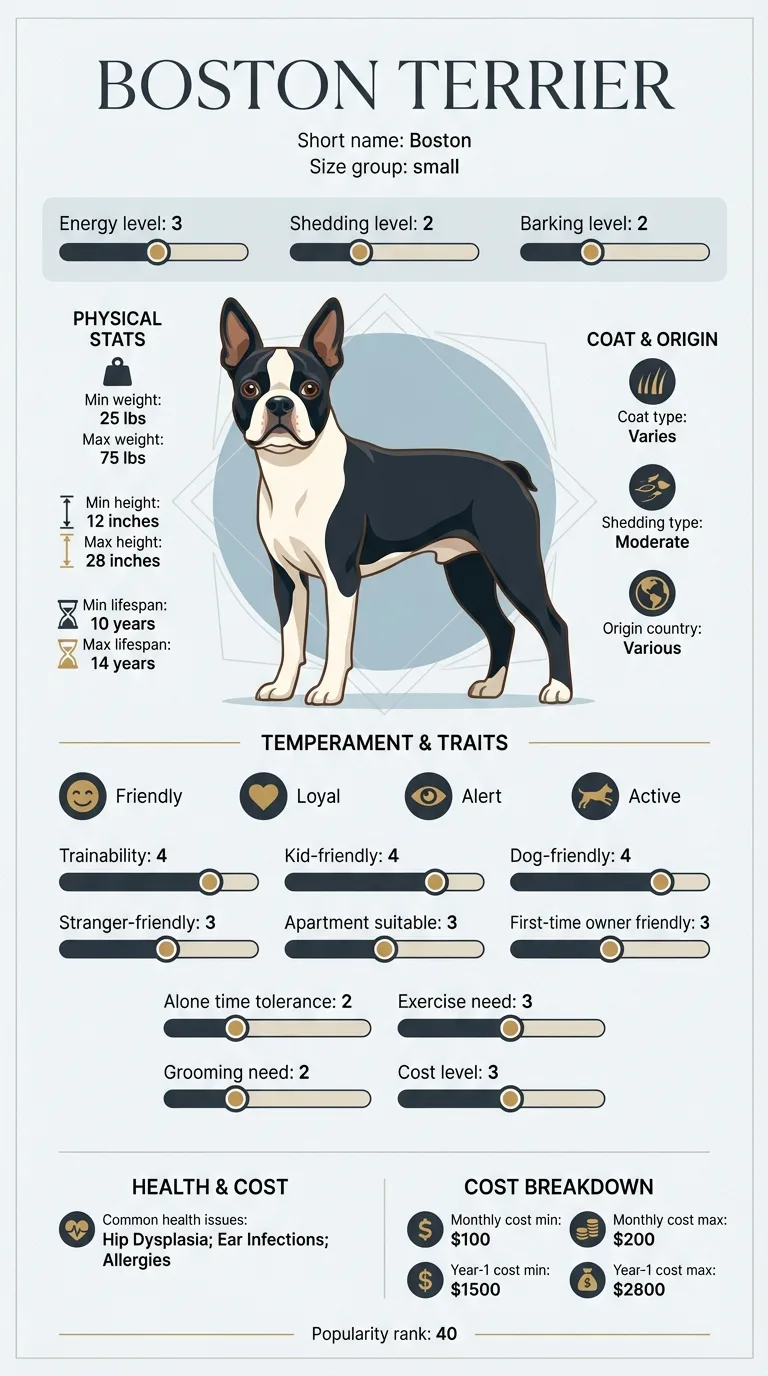
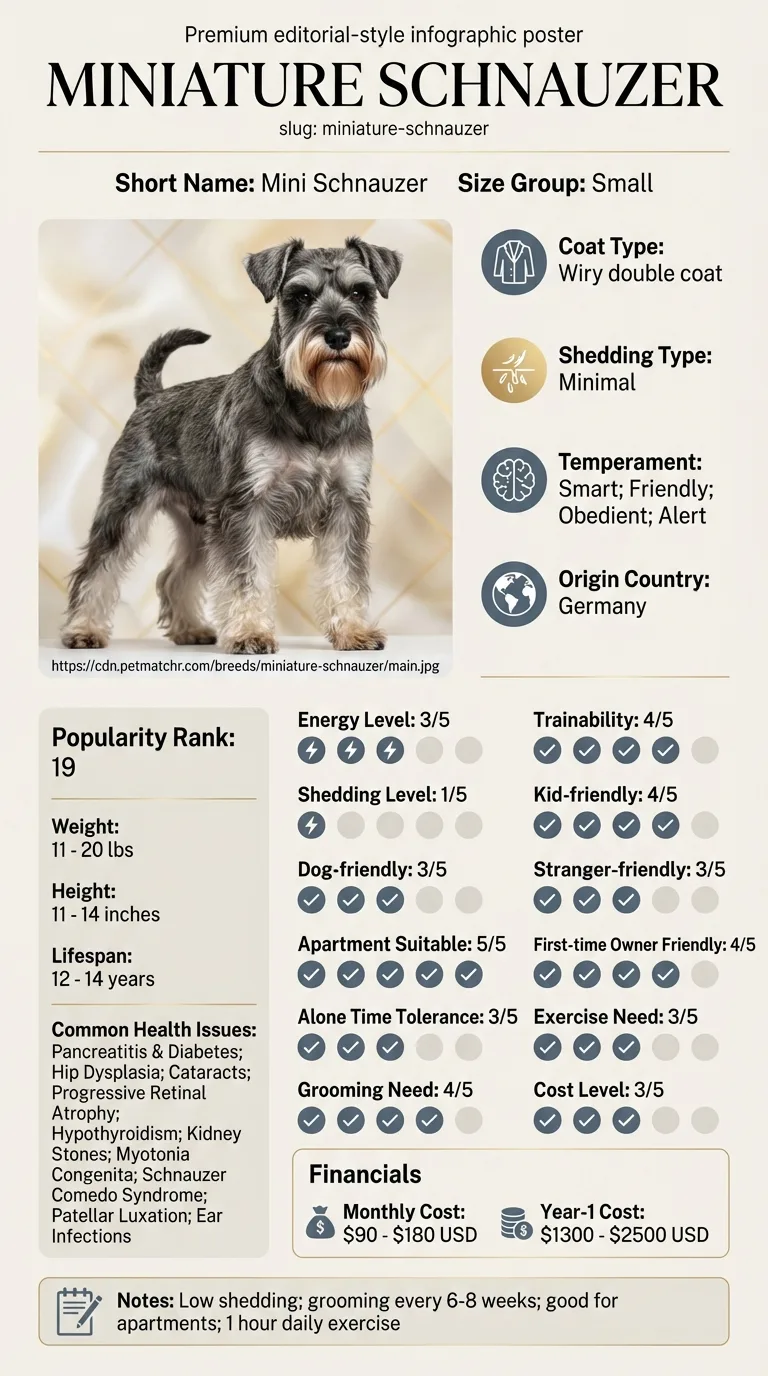
This is for someone already down to Boston Terrier and Miniature Schnauzer and deciding between them. For this pair the decision usually turns on grooming need and barking, so those are covered first and in most detail. Both rate 5/5 for flats, so housing does not settle this one. It is written for the decision rather than the breed history.
Between Boston Terrier and Miniature Schnauzer, grooming need is what separates them, and Boston Terrier is the lower-effort dog of the two to keep.
Choose Boston Terrier if this is your first dog, you do not want a standing grooming appointment and your walking routine is modest.
Choose Miniature Schnauzer if shedding is a problem in your house, a smaller dog suits your car, your home or your back and you want a dog that can keep up with an active routine.
| Feature | boston terrier | miniature schnauzer | Winner |
|---|---|---|---|
| Size class | small | small | Equal |
| Weight | 12–25 lbs | 11–20 lbs | Equal |
| Height | 15–17 in | 11–14 in | Equal |
| Lifespan | 11–13 years | 12–14 years | miniature schnauzer |
| Exercise need | Low (2/5) | Moderate (3/5) | boston terrier |
| Grooming need | Very low (1/5) | High (4/5) | boston terrier |
| Shedding | Low (2/5) | Very low (1/5) | miniature schnauzer |
| Energy level | Moderate (3/5) | Moderate (3/5) | Equal |
| Barking | Low (2/5) | High (4/5) | boston terrier |
| Apartment suitability | Very high (5/5) | Very high (5/5) | Equal |
| Good for first-time owners | Very high (5/5) | High (4/5) | boston terrier |
| Tolerates being alone | Moderate (3/5) | Moderate (3/5) | Equal |
| Trainability | High (4/5) | High (4/5) | Equal |
| Good with kids | Very high (5/5) | High (4/5) | boston terrier |
| Good with other dogs | High (4/5) | Moderate (3/5) | boston terrier |
| Friendly to strangers | High (4/5) | Moderate (3/5) | boston terrier |
| Cost level | Moderate (3/5) | Moderate (3/5) | Equal |
| Coat | Short and smooth | Wiry double coat | Equal |
| Origin | Various | Germany | Equal |
| Typical monthly cost | $80–$150 | $90–$180 | Equal |
| Typical first-year cost | $1,100–$2,300 | $1,300–$2,500 | Equal |
Eleven to 20 pounds and 11 to 14 inches -- the Miniature Schnauzer is close in weight to the Boston Terrier's 12-to-25-pound range but noticeably shorter than its 15-to-17-inch height, giving the Schnauzer a squarer, more compact silhouette. Both are genuinely small dogs built with sturdy, unfussy frames rather than delicate toy-breed proportions. The most visible difference isn't in the numbers but the coat and face: the Schnauzer's signature wiry double coat, bushy eyebrows, and beard give it a distinctly different look from the Boston's smooth, flat-faced profile, even though the two breeds occupy nearly the same size bracket on paper.
The Miniature Schnauzer rates Moderate (3/5) for exercise need against the Boston's Low (2/5), a modest but real gap, while both tie at Moderate (3/5) for overall energy level. In practice, the Schnauzer's terrier ancestry gives it a bit more drive for digging, chasing, and general busyness than the Boston's more laid-back demeanor suggests, even though neither breed demands serious daily mileage. A couple of brisk walks plus some play satisfies either dog. Owners coming from a low-activity lifestyle will find the Boston marginally easier to keep pace with, while those wanting a small dog with slightly more get-up-and-go, without going anywhere near a Jack Russell's intensity, will find the Schnauzer the better match.
This is the widest gap in the comparison: Very Low (1/5) grooming for the Boston against High (4/5) for the Miniature Schnauzer, even though the Schnauzer actually sheds less, Very Low (1/5) against the Boston's Low (2/5). That combination is classic wire-coat physics -- the Schnauzer's double coat traps dead hair rather than dropping it, which is great for allergy sufferers but means it needs regular hand-stripping or clipping, plus that signature beard needs near-daily wiping to stay clean and food-free. The Boston's short, smooth coat needs none of that upkeep. A Schnauzer owner is signing up for a genuine grooming routine or regular professional visits; a Boston owner mostly isn't.
Both breeds tie at Very High (5/5) for apartment suitability, but the Boston pulls ahead on noise, Low (2/5) barking against the Schnauzer's High (4/5) -- Miniature Schnauzers were bred partly as alert watchdogs and retain a strong instinct to vocalize at anything unfamiliar. That's a meaningful consideration for shared walls even though both breeds tie at Moderate (3/5) for tolerating time alone. A Schnauzer's barking tends to be triggered specifically, by doorbells, hallway noise, or passersby, rather than constant, so consistent training can manage it. Still, anyone in close-quarters housing prioritizing quiet over all else should note that gap clearly before assuming apartment suitability alone settles the question.
Trainability ties at High (4/5), and the Boston rates only slightly ahead for first-time owners, Very High (5/5) against the Schnauzer's High (4/5) -- both are genuinely solid choices for a novice. The Schnauzer's Smart, Obedient, Alert temperament makes it a naturally responsive student, and its terrier instincts, while present, are milder than in true terrier breeds like the Jack Russell. Housetraining and barking management tend to be where Schnauzer owners spend the most extra effort. The Boston requires a bit less active management overall, mainly because it has less watchdog instinct to redirect, but neither breed should intimidate a first-time owner willing to put in consistent basic training.
The Boston rates Very High (5/5) with kids against the Schnauzer's still-solid High (4/5), and edges ahead with other dogs, High (4/5) against Moderate (3/5), and strangers, High (4/5) against Moderate (3/5). The Schnauzer's Alert temperament, useful for watchdog duty, also means a bit more caution or vocal reaction toward unfamiliar dogs and people compared to the Boston's more uniformly Friendly and Adaptable nature. Both breeds still make good family dogs in practice. The distinction matters most for households that host frequently or maintain an active dog-park routine, where the Boston's slightly higher comfort with novelty makes for fewer tense introductions.
The Miniature Schnauzer's 12-to-14-year lifespan beats the Boston's 11-to-13, and its ten-condition health list includes some genuinely breed-specific concerns -- Pancreatitis & Diabetes, Myotonia Congenita, and Schnauzer Comedo Syndrome, a skin condition named for the breed itself, alongside more common issues like Hip Dysplasia and Cataracts. The Boston's shorter five-item list centers on Brachycephalic Airway Syndrome and eye conditions tied to its flat face. Notably, both breeds share Cataracts and Patellar Luxation, so eye checks and knee monitoring matter for either dog. A Schnauzer's pancreatitis risk in particular means owners need to watch fat content in treats and table scraps more carefully than a Boston owner typically does.
Cost level ties at Moderate (3/5), with monthly costs close together, $80 to $150 for the Boston against $90 to $180 for the Schnauzer, and first-year costs at $1,100-$2,300 versus $1,300-$2,500. The Schnauzer's modest premium traces mainly to grooming -- hand-stripping or clipping every six to eight weeks adds up over a year in a way the Boston's near-zero coat care never does. Both breeds are relatively affordable to keep compared with larger or more health-issue-prone breeds elsewhere in this dataset. For a budget-conscious owner choosing between the two on cost alone, the Boston has a slight edge, but the difference is modest enough that temperament and coat preference should probably decide first.
Boston Terrier weighs 12–25 lbs and lives 11–13 years; Miniature Schnauzer weighs 11–20 lbs and lives 12–14 years. The two diverge most on grooming need and barking. They are level on tolerates being alone, apartment suitability and cost level, so those cannot decide it. In the table, a "winner" means easier for an ordinary household — not better. Size, coat and origin are recorded without a verdict. Because both breeds are scored the same way, the gaps are reliable even where the absolute numbers are rough.

The Miniature Schnauzer, by far -- High (4/5) against the Boston's Very Low (1/5), due to its wiry double coat and signature beard.
More than Boston Terriers -- High (4/5) against Low (2/5) -- a legacy of the breed's watchdog instincts.
The Miniature Schnauzer, rated Very Low (1/5) against the Boston's Low (2/5), though its wiry coat needs more active maintenance to manage that.
Both work well, but the Boston Terrier rates slightly higher, Very High (5/5) against the Schnauzer's High (4/5).
The Miniature Schnauzer, typically 12 to 14 years against the Boston Terrier's 11 to 13.
Schnauzer Comedo Syndrome, a skin condition named for the breed, along with a notable risk of Pancreatitis & Diabetes tied to fatty diets.
The Boston Terrier, rated High (4/5) on both against the Schnauzer's Moderate (3/5) on both, reflecting the Schnauzer's more alert, watchful temperament.
The Boston Terrier, Very Low (1/5) versus the Schnauzer's High (4/5).
The Miniature Schnauzer, High (4/5) versus the Boston's Low (2/5).
The Miniature Schnauzer, 12-14 years versus the Boston's 11-13.
The Miniature Schnauzer, Very Low (1/5) versus the Boston's Low (2/5).
Secure checkout on Stripe. We never see your card.
7-day money-back guarantee. Instant access.

Health information here is general and is not veterinary advice. If your dog shows pain, sudden behaviour change, or worsening symptoms, consult a licensed veterinarian.
Some links on this site are affiliate links. We may earn a commission at no extra cost to you, and we only suggest products we believe are helpful for dog owners.
We research and check what we publish, but we do not warrant that any figure, date, price, or statement is accurate, complete, or current, and we accept no liability for any loss, cost, injury, or other harm arising from the use of this site. Use it as one reference among several. You remain responsible for your own decisions and for your dog's care - confirm anything that matters with a licensed veterinarian or another qualified professional before you act on it. Full disclaimer.
Match your lifestyle to the right dog.
Take quizNot sure which breed is right for you? Take our 2-minute quiz to find out.
Take the quiz