Living
Which is the smaller dog?
The Maltese, at 3-7 pounds versus the Boston's 12-25 pounds.

Quick answer
Which is the smaller dog?
The Maltese, at 3-7 pounds versus the Boston's 12-25 pounds.
Boston Terrier or Maltese? On paper they differ most on grooming need, and on the scales Boston Terrier is the heavier at 12–25 lbs. Here is how the two compare on everything that shapes an ordinary week.
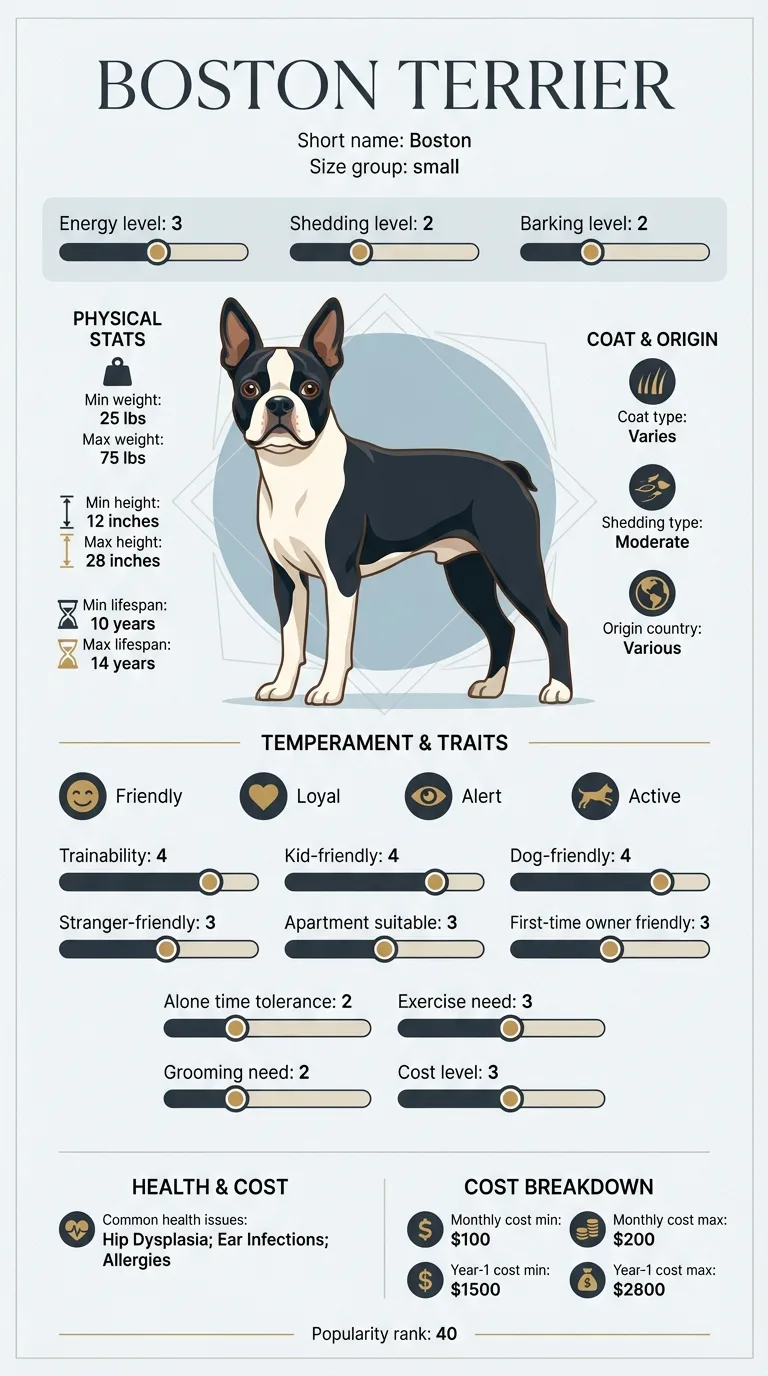
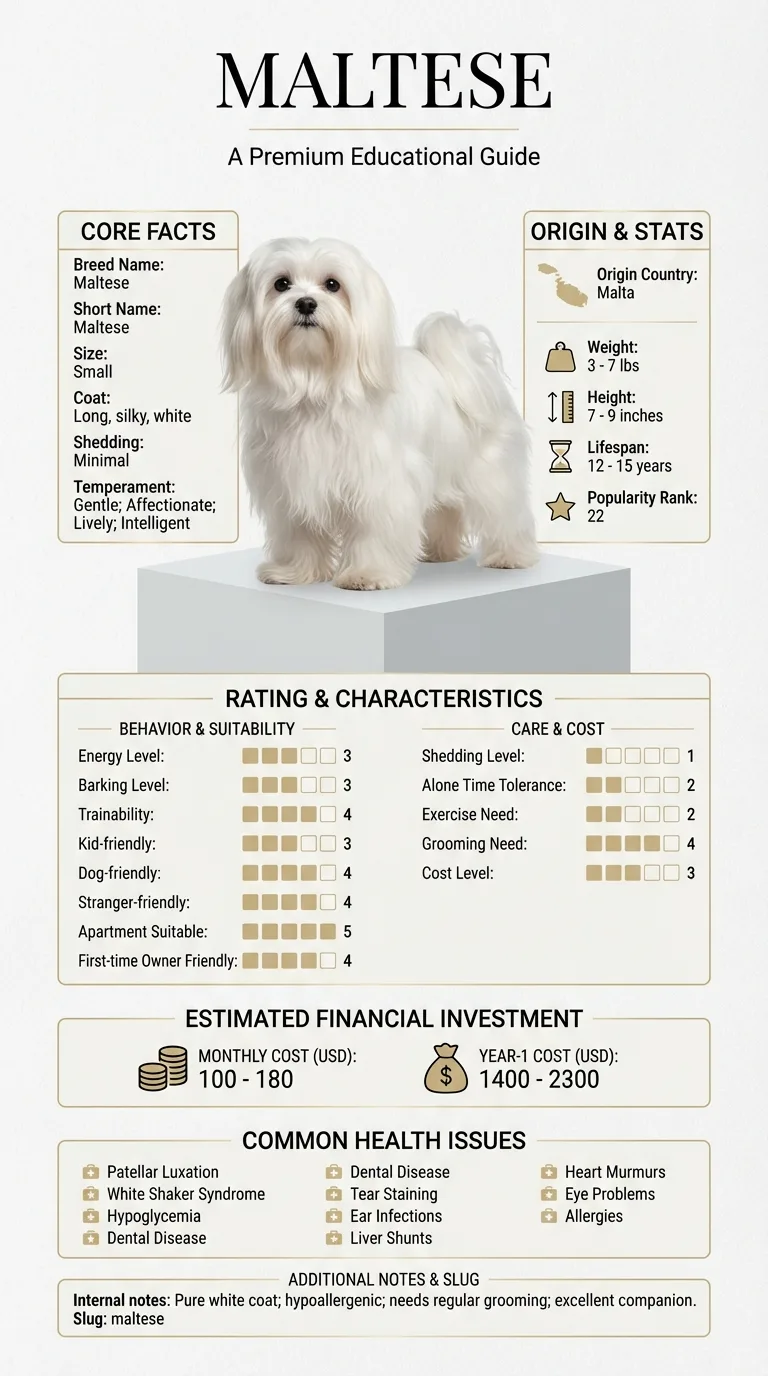
This is for someone already down to Boston Terrier and Maltese and deciding between them. For this pair the decision usually turns on grooming need and good with kids, so those are covered first and in most detail. Both rate 5/5 for flats, so housing does not settle this one. There is no origin story here — only what changes about your week.
Between Boston Terrier and Maltese, grooming need is what separates them, and Boston Terrier is the lower-effort dog of the two to keep.
Choose Boston Terrier if this is your first dog, you do not want a standing grooming appointment and the dog will be alone during the working day.
Choose Maltese if shedding is a problem in your house and a smaller dog suits your car, your home or your back.
| Feature | boston terrier | maltese | Winner |
|---|---|---|---|
| Size class | small | small | Equal |
| Weight | 12–25 lbs | 3–7 lbs | Equal |
| Height | 15–17 in | 7–9 in | Equal |
| Lifespan | 11–13 years | 12–15 years | maltese |
| Exercise need | Low (2/5) | Low (2/5) | Equal |
| Grooming need | Very low (1/5) | High (4/5) | boston terrier |
| Shedding | Low (2/5) | Very low (1/5) | maltese |
| Energy level | Moderate (3/5) | Moderate (3/5) | Equal |
| Barking | Low (2/5) | Moderate (3/5) | boston terrier |
| Apartment suitability | Very high (5/5) | Very high (5/5) | Equal |
| Good for first-time owners | Very high (5/5) | High (4/5) | boston terrier |
| Tolerates being alone | Moderate (3/5) | Low (2/5) | boston terrier |
| Trainability | High (4/5) | High (4/5) | Equal |
| Good with kids | Very high (5/5) | Moderate (3/5) | boston terrier |
| Good with other dogs | High (4/5) | High (4/5) | Equal |
| Friendly to strangers | High (4/5) | High (4/5) | Equal |
| Cost level | Moderate (3/5) | Moderate (3/5) | Equal |
| Coat | Short and smooth | Long, silky, white | Equal |
| Origin | Various | Malta | Equal |
| Typical monthly cost | $80–$150 | $100–$180 | Equal |
| Typical first-year cost | $1,100–$2,300 | $1,400–$2,300 | Equal |
Three to seven pounds -- that's the Maltese's entire adult weight range, a toy breed standing just 7 to 9 inches tall. Set beside the Boston Terrier's 12-to-25-pound, 15-to-17-inch frame, the Maltese is the smaller dog by a wide margin even though both fall under the site's "small" size class. A Boston at the low end of its range can still outweigh a full-grown Maltese three or four times over. That matters for households with boisterous kids or larger resident dogs, where a Maltese's fragility becomes a real physical concern in a way the sturdier, boxier Boston's doesn't. Anyone picturing a lap dog specifically should know the Maltese is smaller than "small" usually implies.
Exercise need ties at Low (2/5) and energy level ties at Moderate (3/5), making this one of the more evenly matched pairs in the whole comparison on activity level. Neither breed demands long runs or intense play sessions; both are satisfied with short walks and indoor time. The practical difference shows up less in quantity of exercise and more in style -- the Maltese, true to its Lively and Affectionate temperament, tends to express energy through attention-seeking and play with its owner directly, while the Boston's Comical streak often shows up in solo antics. For anyone whose lifestyle simply doesn't support high-energy dogs, either breed removes exercise as a real point of concern.
The Boston Terrier wins grooming decisively, Very Low (1/5) against the Maltese's High (4/5), but the Maltese wins shedding, Very Low (1/5) against the Boston's Low (2/5) -- a genuine trade-off rather than a clean win for either. The Maltese's long, silky white coat barely sheds, which is why it's popular with allergy-conscious owners, but that same coat mats easily and needs daily brushing plus regular professional grooming to stay in the flowing condition the breed is known for. The Boston's short coat needs almost no attention and sheds a little more but nothing that regular brushing can't manage in minutes. Buyers should decide whether they'd rather spend time on a beautiful coat or skip coat care almost entirely.
Both breeds tie at Very High (5/5) for apartment suitability, which makes sense given their shared small size and low exercise needs, but the Boston edges ahead on noise, Low (2/5) barking against the Maltese's Moderate (3/5). Maltese are known for a sharp, alert bark triggered by unfamiliar sounds, a trait tied to their watchful, affectionate nature toward their own household and wariness of the unknown. The bigger gap is alone tolerance: Moderate (3/5) for the Boston against Low (2/5) for the Maltese, a breed genuinely prone to separation anxiety given its intense attachment style. Apartment dwellers gone most of the day should weigh that alone-tolerance number carefully regardless of how well either breed fits the square footage.
Trainability ties at High (4/5), and both breeds are solid choices for first-time owners, though the Boston edges ahead at Very High (5/5) against the Maltese's High (4/5). The Maltese's Intelligent, Gentle temperament makes it a capable learner, but its small size means training also has to manage a real vulnerability to rough handling and jumping injuries that a Boston's sturdier build doesn't share. Housetraining is where Maltese owners most often report extra patience is needed, a common pattern in toy breeds with small bladders and a stubborn streak under the gentle exterior. Neither breed is a difficult training project overall; the Boston is simply the marginally more forgiving one for a first dog.
The clearest gap in this section is with kids: Very High (5/5) for the Boston against Moderate (3/5) for the Maltese, a real consideration for families with young children given the Maltese's small, fragile frame and lower tolerance for rough handling. Both breeds tie at High (4/5) with other dogs and High (4/5) with strangers, and both carry Lively in their temperament lists alongside the Boston's Friendly and Comical and the Maltese's Gentle and Affectionate. For a household without small kids, either breed does well socially. For one with toddlers or grade-schoolers who play rough, the Boston's combination of sturdier build and Very High kid rating makes it the safer everyday match.
The Maltese's 12-to-15-year lifespan beats the Boston's 11-to-13, and its ten-item health list -- including White Shaker Syndrome, Hypoglycemia, Tear Staining, and Liver Shunts -- reflects common toy-breed vulnerabilities tied to its tiny size, like blood sugar crashes in puppies and a genetic predisposition to liver shunts. The Boston's five conditions, led by Brachycephalic Airway Syndrome and eye problems like Cataracts and Corneal Ulcers, stem instead from its flat face and prominent eyes. Both breeds share Patellar Luxation, a loose kneecap condition common across small dogs generally. Owners of either breed should budget for eye care specifically -- Cataracts and Corneal Ulcers for the Boston, general Eye Problems for the Maltese -- since both lists flag it.
Cost level ties at Moderate (3/5), and the dollar figures are close: $80 to $150 monthly for the Boston against $100 to $180 for the Maltese, with first-year costs at $1,100-$2,300 versus $1,400-$2,300. Most of the Maltese's extra spending traces to grooming -- that long silky coat needs regular professional maintenance the Boston's coat simply doesn't require, plus grooming supplies like a slicker brush and detangling spray between salon visits. Toy-breed veterinary care can also run slightly higher per visit due to the precision anesthesia and dosing tiny dogs require. Neither breed is an expensive dog to keep overall, but a Maltese owner should expect the grooming line item to be a recurring, non-optional cost.
Boston Terrier weighs 12–25 lbs and lives 11–13 years; Maltese weighs 3–7 lbs and lives 12–15 years. The two diverge most on grooming need and good with kids. They are level on apartment suitability, cost level and good with other dogs, so those cannot decide it. Where the table declares a winner it means less work for the owner, nothing more; descriptive rows are left as ties on purpose. The value here is in the differences between the two columns; treat any single score as approximate.

The Maltese, by far -- it weighs just 3 to 7 pounds against the Boston Terrier's 12 to 25 pounds.
Yes -- the Maltese rates Very Low (1/5) shedding against the Boston's Low (2/5), though it needs far more grooming to stay mat-free.
The Boston Terrier, rated Very Low (1/5) against the Maltese's High (4/5) -- the Maltese's long silky coat needs daily brushing and regular professional trims.
Less reliably than Boston Terriers -- the Maltese rates Moderate (3/5) with kids against the Boston's Very High (5/5), largely due to its small, fragile size.
The Maltese, typically 12 to 15 years against the Boston Terrier's 11 to 13.
More than Boston Terriers -- Moderate (3/5) against Low (2/5) -- Maltese tend to alert-bark at unfamiliar sounds.
They're close, but the Boston Terrier's near-zero grooming needs generally keep its costs slightly lower than the Maltese's, whose coat requires regular professional care.
The Maltese, at 3-7 pounds versus the Boston's 12-25 pounds.
The Maltese, rated High (4/5) versus the Boston's Very Low (1/5).
The Boston Terrier, rated Very High (5/5) versus the Maltese's Moderate (3/5).
The Maltese, Moderate (3/5) versus the Boston's Low (2/5).
Secure checkout on Stripe. We never see your card.
7-day money-back guarantee. Instant access.
Health information here is general and is not veterinary advice. If your dog shows pain, sudden behaviour change, or worsening symptoms, consult a licensed veterinarian.
Some links on this site are affiliate links. We may earn a commission at no extra cost to you, and we only suggest products we believe are helpful for dog owners.
We research and check what we publish, but we do not warrant that any figure, date, price, or statement is accurate, complete, or current, and we accept no liability for any loss, cost, injury, or other harm arising from the use of this site. Use it as one reference among several. You remain responsible for your own decisions and for your dog's care - confirm anything that matters with a licensed veterinarian or another qualified professional before you act on it. Full disclaimer.
Match your lifestyle to the right dog.
Take quizNot sure which breed is right for you? Take our 2-minute quiz to find out.
Take the quiz