Boston Terrier vs Dachshund: Which Suits Your Home?
Quick answer
Boston Terrier or Dachshund - which is the better fit?
The Boston Terrier is the easier dog for a first-time owner, a household with kids, or anyone gone long hours. The Dachshund suits someone drawn to its distinctive build who can manage its higher alone-time needs and spine-related health risks.
Boston Terrier or Dachshund? On paper they differ most on good for first-time owners, and on the scales Dachshund is the heavier at 11–32 lbs. Here is how the two compare on everything that shapes an ordinary week.
This is for someone already down to Boston Terrier and Dachshund and deciding between them. For this pair the decision usually turns on good for first-time owners and tolerates being alone, so those are covered first and in most detail. Both rate 5/5 for flats, so housing does not settle this one. Breed history is left out; what follows is what you will actually live with.
Quick verdict
Between Boston Terrier and Dachshund, good for first-time owners is what separates them, and Boston Terrier is the lower-effort dog of the two to keep.
Choose boston terrier if...
Choose Boston Terrier if this is your first dog, you do not want a standing grooming appointment and your walking routine is modest.
Choose dachshund if...
Choose Dachshund if you want a dog that can keep up with an active routine and you want a dog that is more watchful with visitors.
Head-to-head comparison
Feature
boston terrier
dachshund
Winner
Size class
small
small
Equal
Weight
12–25 lbs
11–32 lbs
Equal
Height
15–17 in
5–9 in
Equal
Lifespan
11–13 years
12–16 years
dachshund
Exercise need
Low (2/5)
Moderate (3/5)
boston terrier
Grooming need
Very low (1/5)
Low (2/5)
boston terrier
Shedding
Low (2/5)
Low (2/5)
Equal
Energy level
Moderate (3/5)
Moderate (3/5)
Equal
Barking
Low (2/5)
High (4/5)
boston terrier
Apartment suitability
Very high (5/5)
Very high (5/5)
Equal
Good for first-time owners
Very high (5/5)
Moderate (3/5)
boston terrier
Tolerates being alone
Moderate (3/5)
Very low (1/5)
boston terrier
Trainability
High (4/5)
Moderate (3/5)
boston terrier
Good with kids
Very high (5/5)
Moderate (3/5)
boston terrier
Good with other dogs
High (4/5)
Moderate (3/5)
boston terrier
Friendly to strangers
High (4/5)
Low (2/5)
boston terrier
Cost level
Moderate (3/5)
Moderate (3/5)
Equal
Coat
Short and smooth
Short, wirehaired, or longhaired
Equal
Origin
Various
Germany
Equal
Typical monthly cost
$80–$150
$80–$150
Equal
Typical first-year cost
$1,100–$2,300
$1,200–$2,500
Equal
Deep dive
Size and build
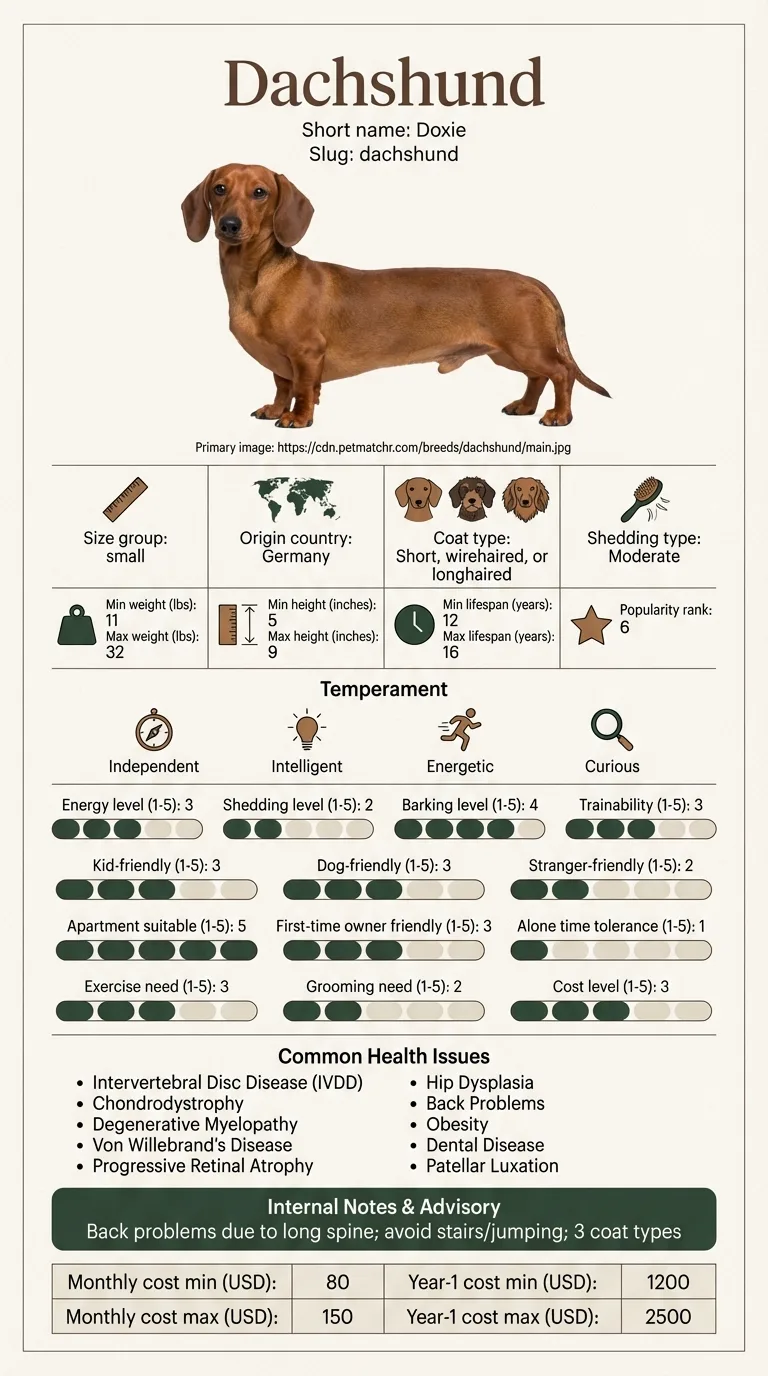
Both are small dogs by weight - the Boston at 12-25 lbs, the Dachshund at 11-32 lbs - but their shapes couldn't be more different. The Dachshund's signature long body and short legs put it at just 5-9 inches tall, less than half the Boston's 15-17 inches, despite a similar or even heavier weight range at the top end of each breed's scale.
Energy and exercise
The Dachshund needs a bit more exercise, rated moderate (3/5) against the Boston's low (2/5), though both tie on general energy at moderate (3/5). Dachshunds were bred to hunt and retain some of that drive to dig and chase, which shows up as a slightly higher activity requirement and a stronger urge to investigate every scent along a walk with you.
Grooming and shedding
Both are easy-care breeds. The Boston rates 1/5 for grooming against the Dachshund's 2/5 - a small gap, since the Dachshund comes in short, wirehaired, and longhaired coat varieties that can shift maintenance needs. Shedding ties at low (2/5) for both, so whichever coat type you choose, you're not signing up for heavy brushing duty on a weekly or even monthly basis.
Apartment living, noise and time alone
Apartment suitability ties at a perfect 5/5. Barking does not: the Dachshund rates high (4/5) against the Boston's low (2/5), a trait tied to its history as an alert, vocal hunting dog. That gap matters more than the tied apartment score in a building with thin walls, where a Dachshund's alert barking could become a real point of friction with neighbors.
Training and owner experience
The Boston trains more easily - high (4/5) versus the Dachshund's moderate (3/5) - and scores better for first-time owners (5/5 vs. 3/5). Dachshunds have a well-earned reputation for independence and stubbornness that tracks with these numbers, so short, engaging sessions with plenty of rewards tend to work far better than long, repetitive drilling with this particular breed and its notably stubborn streak.
Kids, other dogs and visitors
The Boston outscores the Dachshund with kids (5/5 vs. 3/5), other dogs (4/5 vs. 3/5), and strangers (4/5 vs. 2/5). Alone-time tolerance is the starkest gap of all: the Dachshund rates very low (1/5), among the lowest scores in this comparison, against the Boston's moderate (3/5), which is worth weighing heavily if your household is out of the house for long stretches.
Health and lifespan
The Dachshund lives longer on average - 12-16 years versus the Boston's 11-13 - but carries a well-known structural risk: its long spine makes Intervertebral Disc Disease (IVDD) a serious and common concern, alongside chondrodystrophy and degenerative myelopathy. Stairs, jumping off furniture, and excess weight all raise the risk. The Boston's health list is unrelated, centered on its airway and eyes instead.
Cost to keep
Monthly and first-year costs run close - $80-$150 and $1,100-$2,300 for the Boston, $80-$150 and $1,200-$2,500 for the Dachshund. The real cost risk with a Dachshund isn't the baseline numbers, it's the potential for an IVDD-related surgery, which can run into thousands of dollars if it happens, so pet insurance is worth serious consideration with this particular breed right from the start.
Boston Terrier vs Dachshund at a glance
Boston Terrier weighs 12–25 lbs and lives 11–13 years; Dachshund weighs 11–32 lbs and lives 12–16 years. The two diverge most on good for first-time owners, tolerates being alone and barking and 2 other rated axes. They are level on apartment suitability, cost level and energy level, so those cannot decide it. The comparison marks an easier option only where one exists. Facts like weight and country of origin are not scored. Both dogs are rated from the same dataset, which is what makes the numbers comparable with each other even though any individual dog sits somewhere inside its breed's range.
Boston Terrier vs Dachshund: Which Suits Your Home? - Boston Terrier vs Dachshund at a glance
Frequently asked questions
Why is IVDD such a concern for Dachshunds?
Its long spine and short legs - a build called chondrodystrophy - put extra strain on the discs between vertebrae, making Intervertebral Disc Disease common enough in the breed to be a defining health risk. It's not on the Boston Terrier's health list at all.
Does a Dachshund bark a lot?
Yes, rated high (4/5) against the Boston Terrier's low (2/5) - one of the clearer behavioral gaps in this comparison.
Is a Dachshund good with being left alone?
No - it rates very low (1/5), among the lowest scores anywhere on this site, compared to the Boston's moderate (3/5).
Which is easier to train?
The Boston Terrier, rated high (4/5) against the Dachshund's moderate (3/5). Dachshunds are known for an independent streak that can slow training progress.
Which costs less monthly?
They're essentially tied at $80-$150 a month for both, though a Dachshund's IVDD risk can bring a large, unpredictable veterinary bill.
Which lives longer?
The Dachshund, typically 12-16 years against the Boston's 11-13.
Is a Dachshund good with kids?
It rates moderate (3/5), below the Boston Terrier's very high (5/5) - worth factoring in with young, boisterous children given the breed's spine sensitivity too.
Boston Terrier or Dachshund - which is the better fit?
The Boston Terrier is the easier dog for a first-time owner, a household with kids, or anyone gone long hours. The Dachshund suits someone drawn to its distinctive build who can manage its higher alone-time needs and spine-related health risks.
Costs
What's the monthly cost for each?
They're close, at $80-$150 for both, though a Dachshund's IVDD risk can add a large unplanned vet bill.
Behavior
How much exercise does each need?
The Dachshund needs slightly more, rated moderate (3/5) against the Boston's low (2/5).
Health
Which breed lives longer?
The Dachshund, typically 12-16 years versus the Boston Terrier's 11-13 years.
Related DogBreedCompass guides
Boston Terrier breed guide – Readers comparing the two usually want the full profile of Boston Terrier before deciding.
Dachshund breed guide – The same for Dachshund, so the comparison can be checked against the detail.
Boston Terrier vs Pug – Pug is the closest breed to Boston Terrier on the measured axes, so it is the natural next comparison.
Dachshund vs Brussels Griffon – Brussels Griffon sits closest to Dachshund, which makes it the alternative worth ruling out.
Health information here is general and is not veterinary advice. If your dog shows pain, sudden behaviour change, or worsening symptoms, consult a licensed veterinarian.
Some links on this site are affiliate links. We may earn a commission at no extra cost to you, and we only suggest products we believe are helpful for dog owners.
We research and check what we publish, but we do not warrant that any figure, date, price, or statement is accurate, complete, or current, and we accept no liability for any loss, cost, injury, or other harm arising from the use of this site. Use it as one reference among several. You remain responsible for your own decisions and for your dog's care - confirm anything that matters with a licensed veterinarian or another qualified professional before you act on it. Full disclaimer.