Boston Terrier vs Bulldog (English): Which Suits Your Home?
Quick answer
Boston Terrier or Bulldog - which should you pick?
Pick the Boston Terrier if you want lower costs, easier grooming, and a dog that's simpler for a first-time owner to train. Pick the Bulldog if you're set on that low, broad-chested look and can handle roughly double the monthly upkeep.
Boston Terrier or Bulldog (English)? On paper they differ most on grooming need, and on the scales Bulldog (English) is the heavier at 40–50 lbs. Here is how the two compare on everything that shapes an ordinary week.
This is for someone already down to Boston Terrier and Bulldog (English) and deciding between them. For this pair the decision usually turns on grooming need and good for first-time owners, so those are covered first and in most detail. Both rate 5/5 for flats, so housing does not settle this one. There is no origin story here — only what changes about your week.
Quick verdict
Between Boston Terrier and Bulldog (English), grooming need is what separates them, and Boston Terrier is the lower-effort dog of the two to keep.
Choose boston terrier if...
Choose Boston Terrier if this is your first dog, you do not want a standing grooming appointment and shedding is a problem in your house.
Choose bulldog if...
Choose Bulldog (English) if its temperament and look are what you want; on the measurable axes it gives up nothing to the other.
Head-to-head comparison
Feature
boston terrier
bulldog
Winner
Size class
small
medium
Equal
Weight
12–25 lbs
40–50 lbs
Equal
Height
15–17 in
12–16 in
Equal
Lifespan
11–13 years
8–12 years
boston terrier
Exercise need
Low (2/5)
Low (2/5)
Equal
Grooming need
Very low (1/5)
Moderate (3/5)
boston terrier
Shedding
Low (2/5)
Moderate (3/5)
boston terrier
Energy level
Moderate (3/5)
Low (2/5)
Equal
Barking
Low (2/5)
Low (2/5)
Equal
Apartment suitability
Very high (5/5)
Very high (5/5)
Equal
Good for first-time owners
Very high (5/5)
Moderate (3/5)
boston terrier
Tolerates being alone
Moderate (3/5)
Moderate (3/5)
Equal
Trainability
High (4/5)
Moderate (3/5)
boston terrier
Good with kids
Very high (5/5)
Very high (5/5)
Equal
Good with other dogs
High (4/5)
High (4/5)
Equal
Friendly to strangers
High (4/5)
High (4/5)
Equal
Cost level
Moderate (3/5)
Very high (5/5)
boston terrier
Coat
Short and smooth
Short, smooth
Equal
Origin
Various
England
Equal
Typical monthly cost
$80–$150
$150–$350
Equal
Typical first-year cost
$1,100–$2,300
$2,500–$5,000
Equal
Deep dive
Size and build
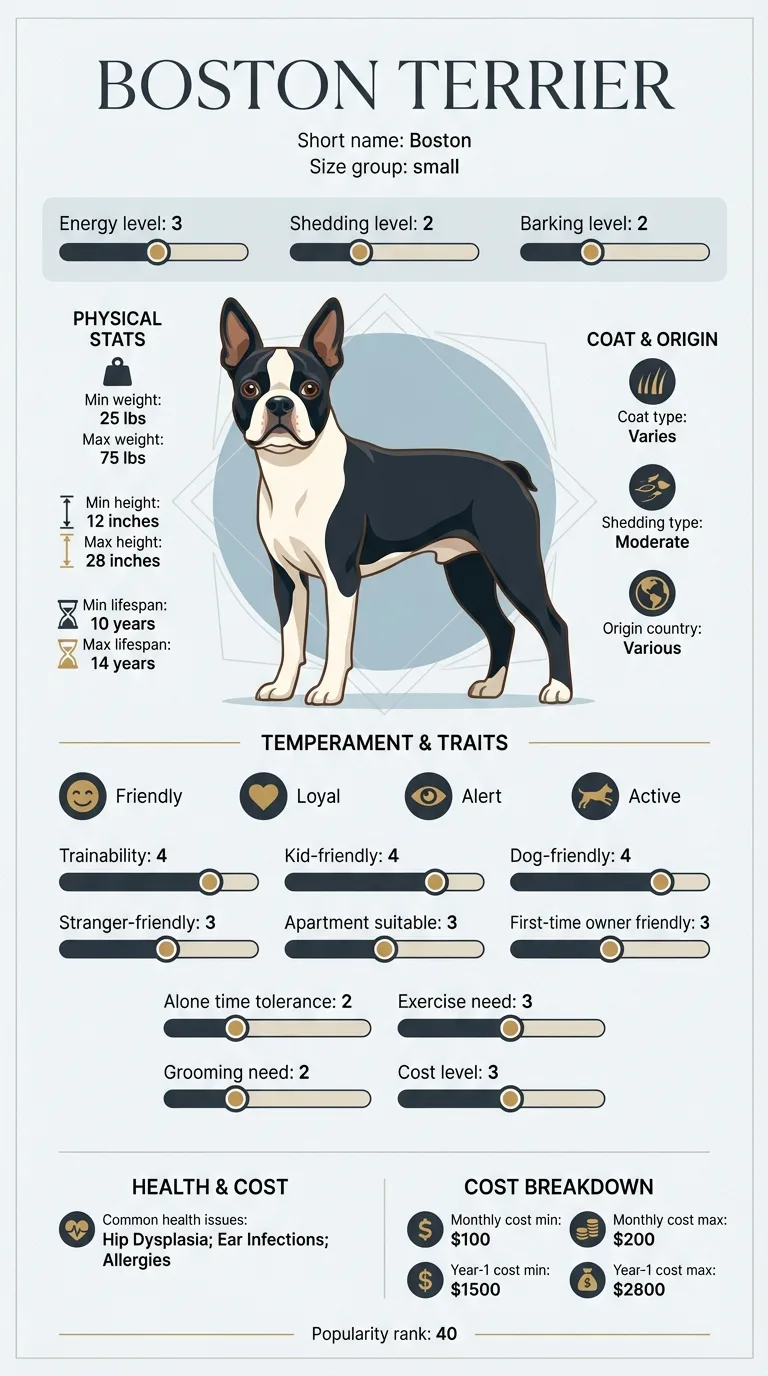
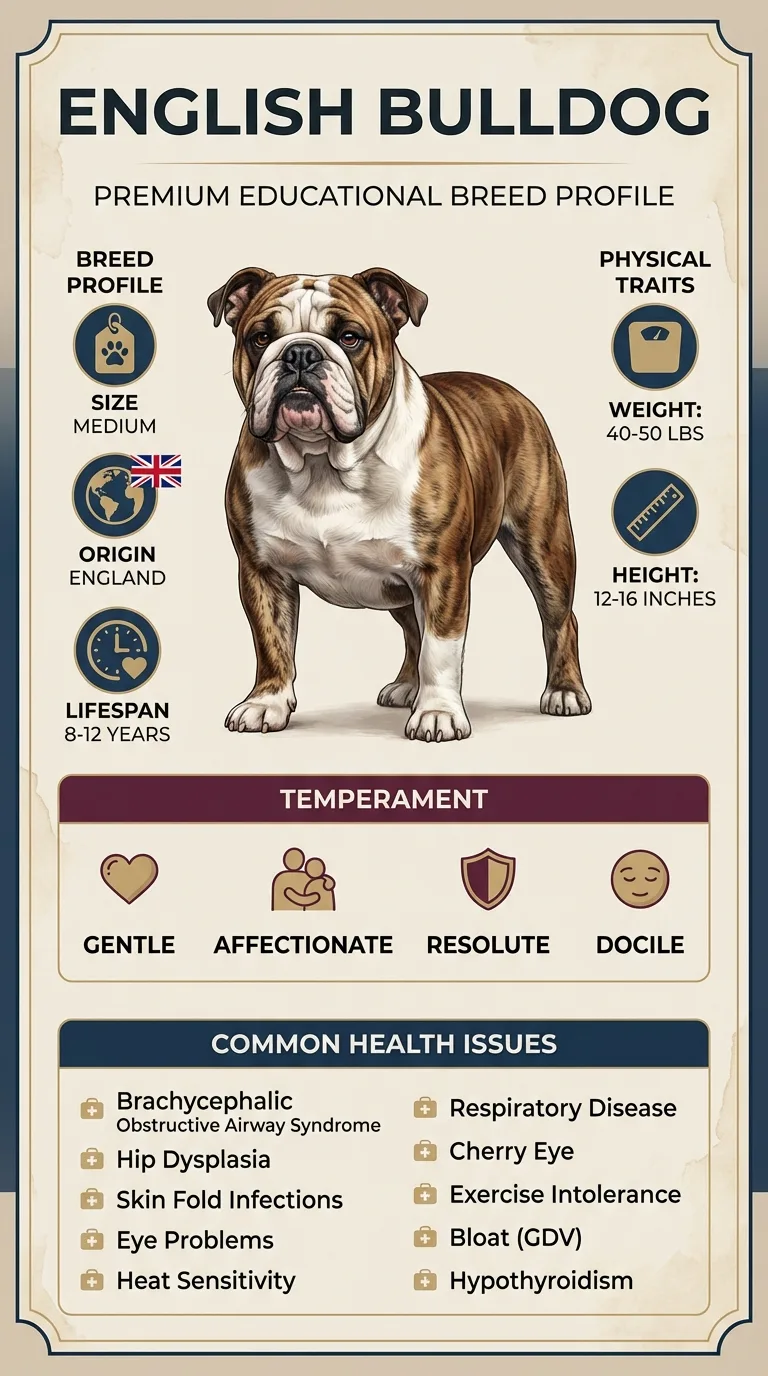
The Boston Terrier tops out around 25 lbs and stands 15-17 inches; the English Bulldog is built lower and heavier, 40-50 lbs on a 12-16 inch frame. Both count as small-to-medium dogs, but the Bulldog carries roughly double the Boston's weight in a shorter, stockier package. Neither needs much floor space, and both fit into a small one-bedroom apartment without much trouble at all.
Energy and exercise
Exercise need comes out identical here: both breeds rate a 2 out of 5, meaning short walks and some play cover it. The Boston edges into moderate energy (3/5) indoors, while the Bulldog stays lower (2/5) and is content lounging most of the day. Neither is a jogging partner, and both overheat fast in warm weather given their flat faces.
Grooming and shedding
This category splits clearly. The Boston Terrier's coat needs almost nothing - a 1 out of 5 grooming score and low (2/5) shedding. The Bulldog's facial wrinkles change the math: moderate grooming (3/5) and moderate shedding (3/5), plus the wrinkles need regular wiping to avoid skin infections. Budget more weekly maintenance time for the Bulldog, and check the folds after meals and walks so debris doesn't sit against the skin.
Apartment living, noise and time alone
Both breeds score a full 5 out of 5 for apartment suitability, and both bark at a low (2/5) rate - quiet neighbors, in other words. Alone-time tolerance ties too, at moderate (3/5) for each. If your building has noise complaints in its history, either breed is a safe bet on that front, and neither one demands a yard to feel settled indoors, which is really the point of the apartment score to begin with.
Training and owner experience
The Boston Terrier trains a bit more easily, rated high (4/5) against the Bulldog's moderate (3/5), and it also scores higher for first-time owners (5/5 vs. 3/5). Bulldogs aren't hard to live with, but their stubborn streak means sessions take longer to land, and food-motivated, patient repetition works better than pressure. A new owner will likely have an easier first year with the Boston, simply because fewer training plateaus show up along the way.
Kids, other dogs and visitors
Kids, other dogs, and strangers are a wash - both breeds score very high with children (5/5) and high with other dogs and visitors (4/5 each). The difference in this matchup isn't social temperament, it's physical: the Bulldog's heavier body and heat sensitivity mean closer supervision during rough play or hot afternoons, since a Bulldog can overheat and struggle to signal distress the way a more mobile breed would.
Health and lifespan
The Boston Terrier lives longer on average, 11-13 years against the Bulldog's 8-12. Both are brachycephalic and share airway syndrome risk, but the Bulldog's list runs longer - hip dysplasia, skin fold infections, cherry eye, bloat, and hypothyroidism on top of the shared breathing concerns. That's a heavier veterinary workload over the Bulldog's shorter life, and it's worth asking a breeder or shelter directly what health testing has already been done.
Cost to keep
Cost is where this comparison really separates. The Boston runs $80-$150 a month and $1,100-$2,300 in year one; the Bulldog runs $150-$350 a month and $2,500-$5,000 in year one - roughly double at every stage, driven by its higher health-issue rate and larger size. If budget is a factor, the Boston is the cheaper dog to own by a wide margin.
Boston Terrier vs Bulldog (English) at a glance
Boston Terrier weighs 12–25 lbs and lives 11–13 years; Bulldog (English) weighs 40–50 lbs and lives 8–12 years. The two diverge most on grooming need, good for first-time owners and cost level. They are level on tolerates being alone, apartment suitability and barking, so those cannot decide it. Where the table declares a winner it means less work for the owner, nothing more; descriptive rows are left as ties on purpose. The value here is in the differences between the two columns; treat any single score as approximate.
Boston Terrier vs Bulldog (English): Which Suits Your Home? - Boston Terrier vs Bulldog (English) at a glance
Frequently asked questions
Is a Boston Terrier smaller than a Bulldog?
Yes, by a lot in weight. The Boston tops out at 25 lbs while the Bulldog runs 40-50 lbs, even though the Bulldog is actually shorter at the shoulder (12-16 in vs. the Boston's 15-17 in).
Which one sheds less?
The Boston Terrier, rated low (2/5) shedding against the Bulldog's moderate (3/5). The Boston's grooming needs are also lower overall - a 1/5 versus the Bulldog's 3/5, mostly because of the wrinkle care Bulldogs require.
Which is better for a first-time owner?
The Boston Terrier scores a full 5/5 for first-time owners against the Bulldog's 3/5. It's also easier to train (4/5 vs. 3/5), so a newer owner will likely have a smoother learning curve with the Boston.
Do both do well in apartments?
Yes - both score 5/5 for apartment suitability and 2/5 for barking, so neither is likely to bother neighbors. Exercise needs are also low for both, which fits small-space living.
How much more does a Bulldog cost to keep?
Roughly double. Monthly costs run $150-$350 for the Bulldog versus $80-$150 for the Boston, and first-year costs land at $2,500-$5,000 versus $1,100-$2,300. The gap traces mostly to the Bulldog's larger size and longer health-issue list.
Do they share health problems?
Both are brachycephalic breeds and carry a risk of Brachycephalic Airway Syndrome. Beyond that, their lists diverge - the Boston adds patellar luxation and eye issues, while the Bulldog's list is longer, including hip dysplasia, bloat, and skin fold infections.
Which one lives longer?
The Boston Terrier, typically 11-13 years versus the Bulldog's 8-12. That three-year gap at the low end is worth weighing alongside the Bulldog's longer health-issue list.
Boston Terrier or Bulldog - which should you pick?
Pick the Boston Terrier if you want lower costs, easier grooming, and a dog that's simpler for a first-time owner to train. Pick the Bulldog if you're set on that low, broad-chested look and can handle roughly double the monthly upkeep.
Costs
What will you pay monthly for each?
The Boston runs $80-$150 a month; the Bulldog runs $150-$350. Over a year, that's a difference of well over a thousand dollars.
Behavior
How much exercise do they need?
Both are low-exercise breeds rated 2 out of 5. Short walks and indoor play sessions are enough for either.
Health
Which breed lives longer?
The Boston Terrier, at 11-13 years versus the Bulldog's 8-12 years.
Related DogBreedCompass guides
Boston Terrier breed guide – Readers comparing the two usually want the full profile of Boston Terrier before deciding.
Bulldog (English) breed guide – The same for Bulldog (English), so the comparison can be checked against the detail.
Boston Terrier vs Pug – Pug is the closest breed to Boston Terrier on the measured axes, so it is the natural next comparison.
Bulldog (English) vs Basset Hound – Basset Hound sits closest to Bulldog (English), which makes it the alternative worth ruling out.
Health information here is general and is not veterinary advice. If your dog shows pain, sudden behaviour change, or worsening symptoms, consult a licensed veterinarian.
Some links on this site are affiliate links. We may earn a commission at no extra cost to you, and we only suggest products we believe are helpful for dog owners.
We research and check what we publish, but we do not warrant that any figure, date, price, or statement is accurate, complete, or current, and we accept no liability for any loss, cost, injury, or other harm arising from the use of this site. Use it as one reference among several. You remain responsible for your own decisions and for your dog's care - confirm anything that matters with a licensed veterinarian or another qualified professional before you act on it. Full disclaimer.