Living
Which should you pick overall?
If your week doesn't have room for regular grooming or an active exercise routine, the Boston is the easier fit. If you enjoy an athletic dog and don't mind coat upkeep, the Cocker earns its keep.

Quick answer
Which should you pick overall?
If your week doesn't have room for regular grooming or an active exercise routine, the Boston is the easier fit. If you enjoy an athletic dog and don't mind coat upkeep, the Cocker earns its keep.
Boston Terrier or English Cocker Spaniel? On paper they differ most on grooming need, and on the scales English Cocker Spaniel is the heavier at 26–34 lbs. Here is how the two compare on everything that shapes an ordinary week.
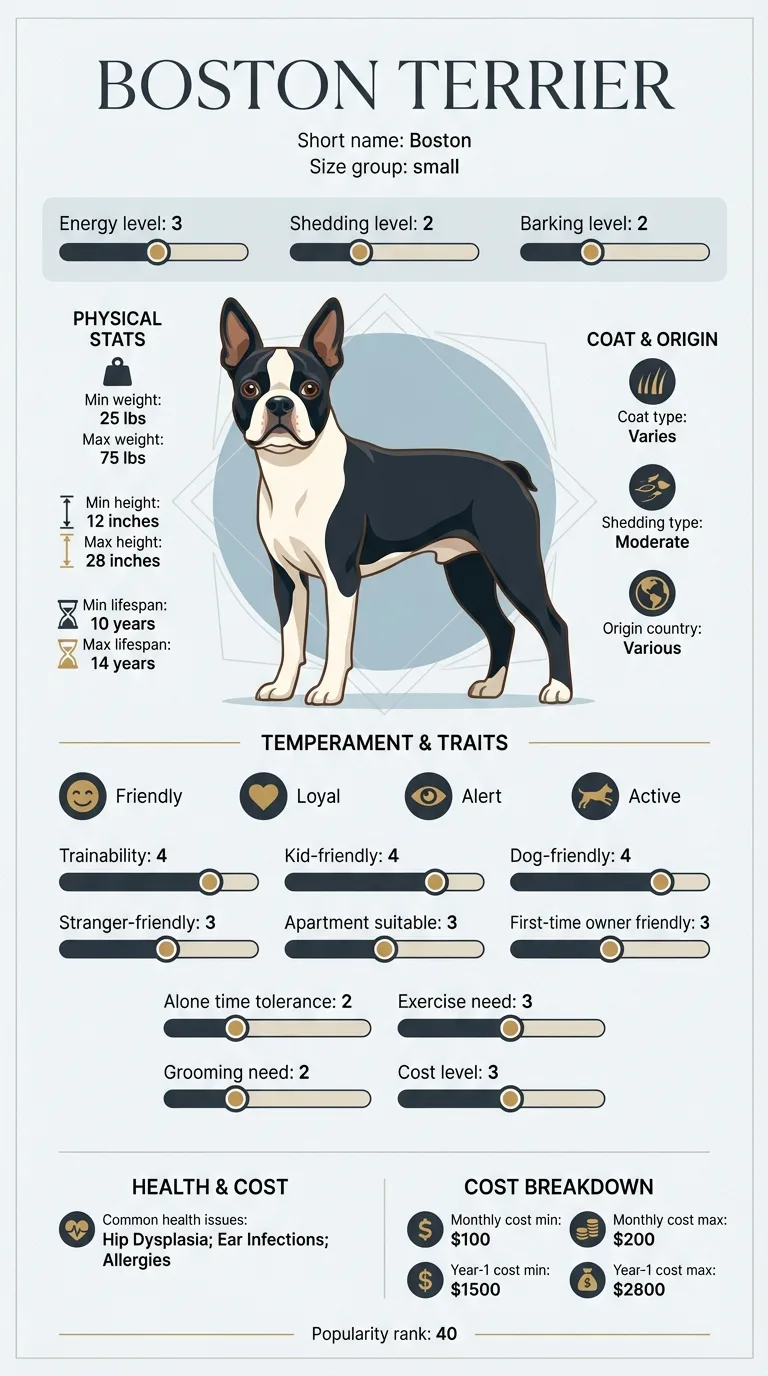
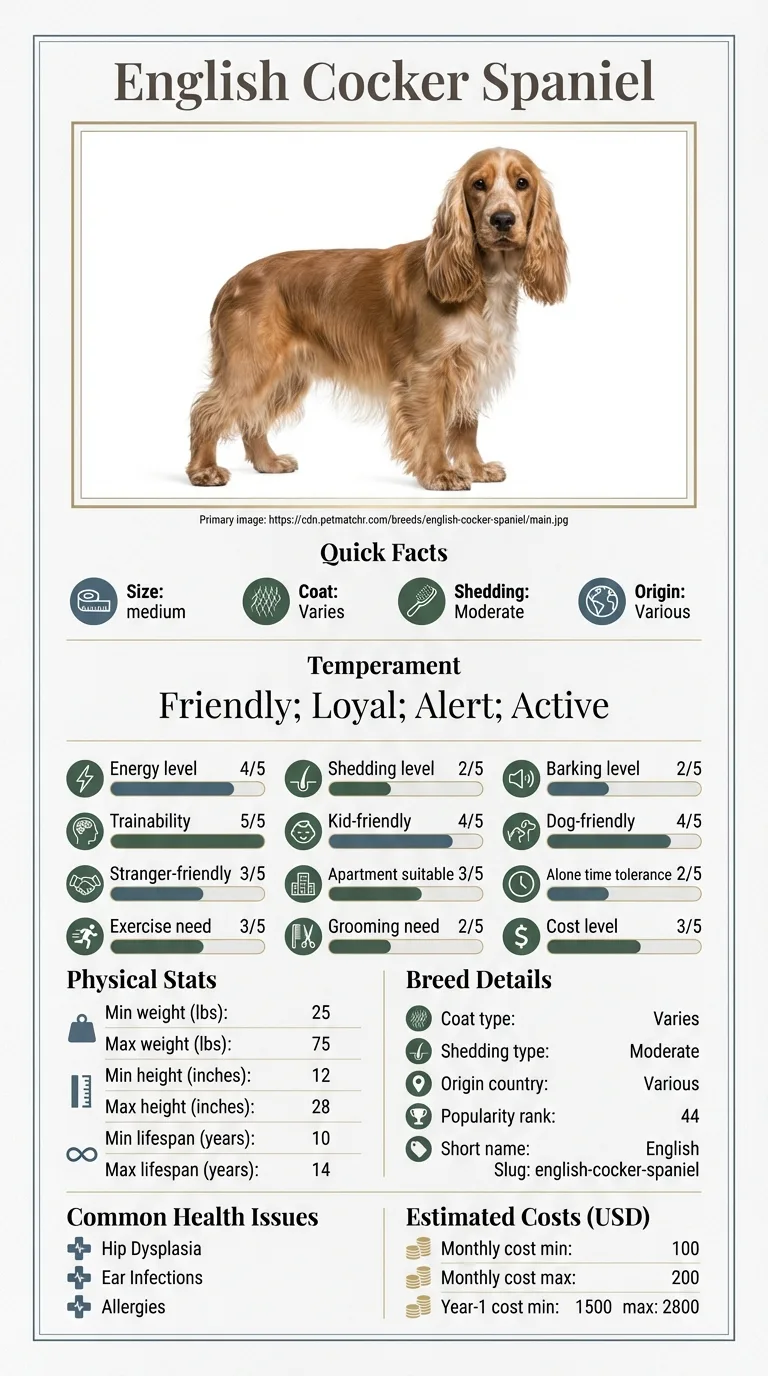
This is for someone already down to Boston Terrier and English Cocker Spaniel and deciding between them. For this pair the decision usually turns on grooming need and exercise need, so those are covered first and in most detail. Anyone choosing from a flat has a clear answer here: Boston Terrier rates 5/5 against 4/5. There is no origin story here — only what changes about your week.
Between Boston Terrier and English Cocker Spaniel, grooming need is what separates them, and Boston Terrier is the lower-effort dog of the two to keep.
Choose Boston Terrier if you are in a flat or a smaller home, this is your first dog and you do not want a standing grooming appointment.
Choose English Cocker Spaniel if you want a dog that can keep up with an active routine.
| Feature | boston terrier | english cocker spaniel | Winner |
|---|---|---|---|
| Size class | small | medium | Equal |
| Weight | 12–25 lbs | 26–34 lbs | Equal |
| Height | 15–17 in | 15–17 in | Equal |
| Lifespan | 11–13 years | 12–14 years | english cocker spaniel |
| Exercise need | Low (2/5) | High (4/5) | boston terrier |
| Grooming need | Very low (1/5) | High (4/5) | boston terrier |
| Shedding | Low (2/5) | Moderate (3/5) | boston terrier |
| Energy level | Moderate (3/5) | High (4/5) | Equal |
| Barking | Low (2/5) | Moderate (3/5) | boston terrier |
| Apartment suitability | Very high (5/5) | High (4/5) | boston terrier |
| Good for first-time owners | Very high (5/5) | High (4/5) | boston terrier |
| Tolerates being alone | Moderate (3/5) | Low (2/5) | boston terrier |
| Trainability | High (4/5) | High (4/5) | Equal |
| Good with kids | Very high (5/5) | Very high (5/5) | Equal |
| Good with other dogs | High (4/5) | High (4/5) | Equal |
| Friendly to strangers | High (4/5) | High (4/5) | Equal |
| Cost level | Moderate (3/5) | Moderate (3/5) | Equal |
| Coat | Short and smooth | Medium, silky and feathered | Equal |
| Origin | Various | Various | Equal |
| Typical monthly cost | $80–$150 | $100–$200 | Equal |
| Typical first-year cost | $1,100–$2,300 | $1,400–$2,900 | Equal |
Both dogs land around the same height, 15 to 17 inches at the shoulder, but the Cocker carries more frame: 26 to 34 pounds against the Boston's 12 to 25. Stand them side by side and the Cocker looks like a bigger dog even though the tape measure says otherwise. If floor space or a small car back seat matters, the Boston's lighter weight is the more relevant number here, not the height.
This is where the two breeds split. The Boston sits at a low 2 out of 5 for exercise need and a moderate 3 for energy, a couple of walks cover it. The Cocker rates a full 4/5 on exercise, bred to work fields for hours, and needs more than a leash stroll to stay settled. A Cocker left under-exercised gets restless; a Boston mostly naps.
The grooming gap is the single biggest number on this comparison: Boston Terriers score a 1/5, about as low as grooming gets, while English Cocker Spaniels score 4/5 thanks to that medium, silky, feathered coat. Shedding follows the same pattern, low for the Boston versus moderate for the Cocker. Budget for regular trims and ear and coat upkeep with a Cocker; the Boston just needs an occasional wipe-down.
The Boston rates 5/5 for apartment living and barks less (2/5) than the Cocker (3/5), and it tolerates solo time moderately well at 3/5. The Cocker still scores a respectable 4/5 for apartments, but its alone-time tolerance drops to 2/5, pair that with its higher exercise need and a Cocker in a small unit needs a real outlet, not just a patient neighbor.
Both breeds score 4/5 on trainability, so neither is a chore to teach. Where they differ is forgiveness for a first-timer: the Boston rates 5/5 for first-time owners, the Cocker 4/5. That's a small gap on paper, but it tracks with the Cocker's higher exercise and grooming demands, a new owner has more to keep up with day to day, even if the dog itself learns just as fast.
Both breeds score very high with kids (5/5) and high with other dogs and strangers (4/5), so this comparison won't be decided on family friendliness, they're evenly matched there. The temperament lists back that up: the Boston is friendly, lively, comical, and adaptable; the Cocker is merry, affectionate, energetic, and biddable. Either fits a household with children and other pets without much friction.
The Cocker edges out the Boston on longevity, 12 to 14 years against 11 to 13. Health risks don't overlap much: the Boston's list is BOAS, patellar luxation, cataracts, corneal ulcers, and deafness, largely tied to its flat face and eye shape. The Cocker's list, ear infections, progressive retinal atrophy, hip dysplasia, familial nephropathy, adult-onset neuropathy, points to a dog that needs regular ear checks and eye screening instead.
Monthly costs run close: $80-$150 for the Boston, $100-$200 for the Cocker. First-year costs show the same modest gap, $1,100-$2,300 versus $1,400-$2,900, with the difference mostly explained by grooming bills the Boston simply doesn't have. Both land in the moderate (3/5) cost bracket overall, so budget isn't really the deciding factor between these two, grooming time is.
Boston Terrier weighs 12–25 lbs and lives 11–13 years; English Cocker Spaniel weighs 26–34 lbs and lives 12–14 years. The two diverge most on grooming need and exercise need. They are level on cost level, good with other dogs and good with kids, so those cannot decide it. Where the table declares a winner it means less work for the owner, nothing more; descriptive rows are left as ties on purpose. The value here is in the differences between the two columns; treat any single score as approximate.

The Boston, by weight. It runs 12-25 lbs against the Cocker's 26-34 lbs, even though both stand about the same height (15-17 inches). Go by the scale, not the shoulder height, if size is your main concern.
More than the Boston, but not extremely so, it rates moderate (3/5) on shedding versus the Boston's low (2/5). The bigger difference is grooming effort: the Cocker's feathered coat needs regular brushing and trims, rated 4/5, against the Boston's 1/5.
Both work for a first-timer, but the Boston is rated slightly easier at 5/5 versus the Cocker's 4/5. The gap comes down to upkeep, the Cocker's higher exercise and grooming needs mean more for a new owner to manage.
The Boston, with a 5/5 apartment rating and low barking (2/5) plus low exercise needs. The Cocker still scores a solid 4/5 for apartments but needs more daily exercise and doesn't tolerate being alone as well (2/5 vs the Boston's 3/5).
Modestly more. Expect $100-$200 a month for a Cocker versus $80-$150 for a Boston, and $1,400-$2,900 in year one versus $1,100-$2,300. Grooming accounts for most of that gap.
Not really, their risk lists don't overlap. The Boston's issues (BOAS, patellar luxation, cataracts, corneal ulcers, deafness) trace to its short face and eye structure, while the Cocker's (ear infections, PRA, hip dysplasia, familial nephropathy, adult-onset neuropathy) are more typical of a longer-eared sporting breed.
The Cocker, slightly, 12 to 14 years versus the Boston's 11 to 13. It's a one-to-two-year edge, not a dramatic one.
If your week doesn't have room for regular grooming or an active exercise routine, the Boston is the easier fit. If you enjoy an athletic dog and don't mind coat upkeep, the Cocker earns its keep.
$80-$150 for a Boston, $100-$200 for a Cocker, both moderate, with the Cocker's grooming needs driving most of the gap.
The Boston rates low (2/5), a couple of walks does it. The Cocker rates high (4/5) and wants real activity, not just a stroll.
The Cocker, by a year or two on average, 12-14 years versus the Boston's 11-13.
Secure checkout on Stripe. We never see your card.
7-day money-back guarantee. Instant access.

Health information here is general and is not veterinary advice. If your dog shows pain, sudden behaviour change, or worsening symptoms, consult a licensed veterinarian.
Some links on this site are affiliate links. We may earn a commission at no extra cost to you, and we only suggest products we believe are helpful for dog owners.
We research and check what we publish, but we do not warrant that any figure, date, price, or statement is accurate, complete, or current, and we accept no liability for any loss, cost, injury, or other harm arising from the use of this site. Use it as one reference among several. You remain responsible for your own decisions and for your dog's care - confirm anything that matters with a licensed veterinarian or another qualified professional before you act on it. Full disclaimer.
Match your lifestyle to the right dog.
Take quizNot sure which breed is right for you? Take our 2-minute quiz to find out.
Take the quiz