DogBreedCompass

Malamute or Pit Bull: Twice the Cost, Five Times the Hair

The Malamute costs $150 to $300 a month, sheds at 5/5 and grooms at 4/5. The American Pit Bull Terrier costs $80 to $150, sheds at 3/5 and grooms at 1/5 — the lowest maintenance in this comparison by a wide margin. On running costs and housework these two are not close.

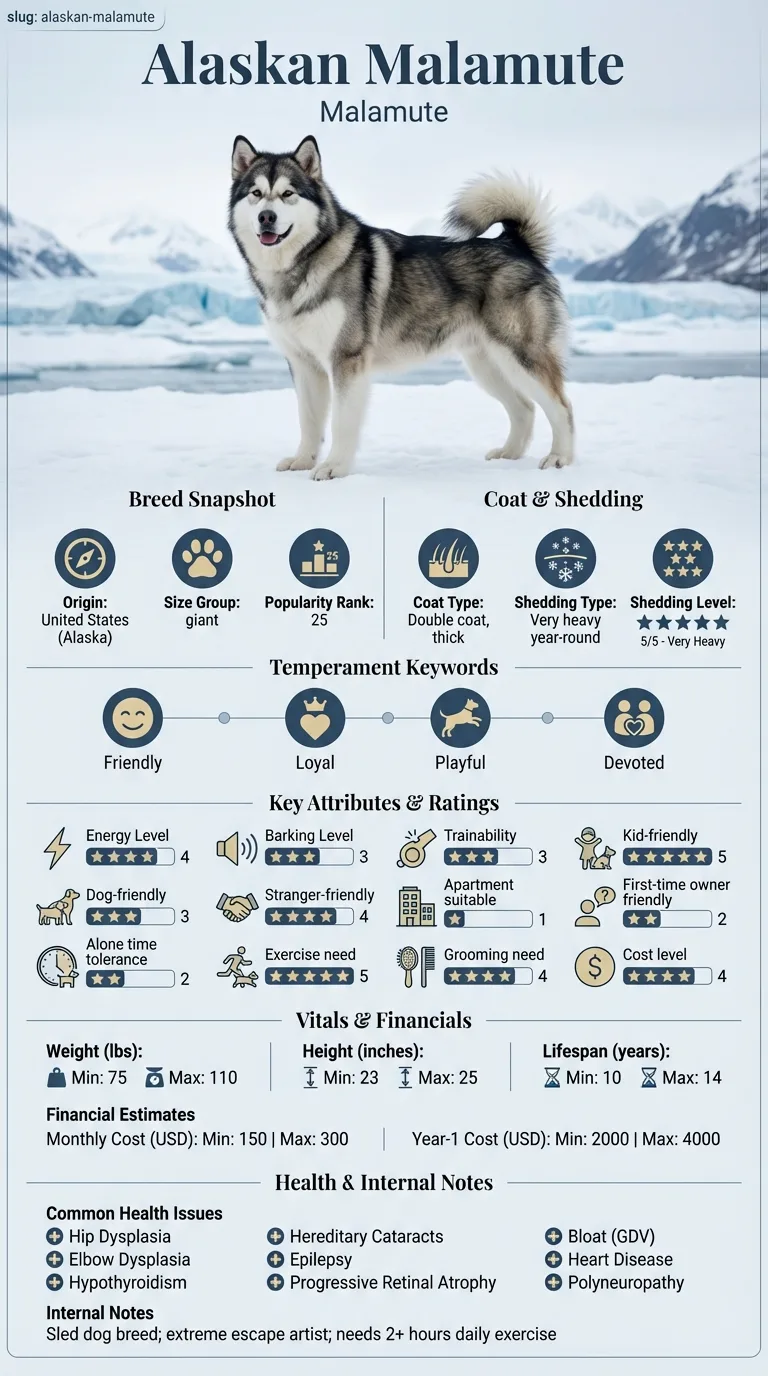
alaskan malamute infographic
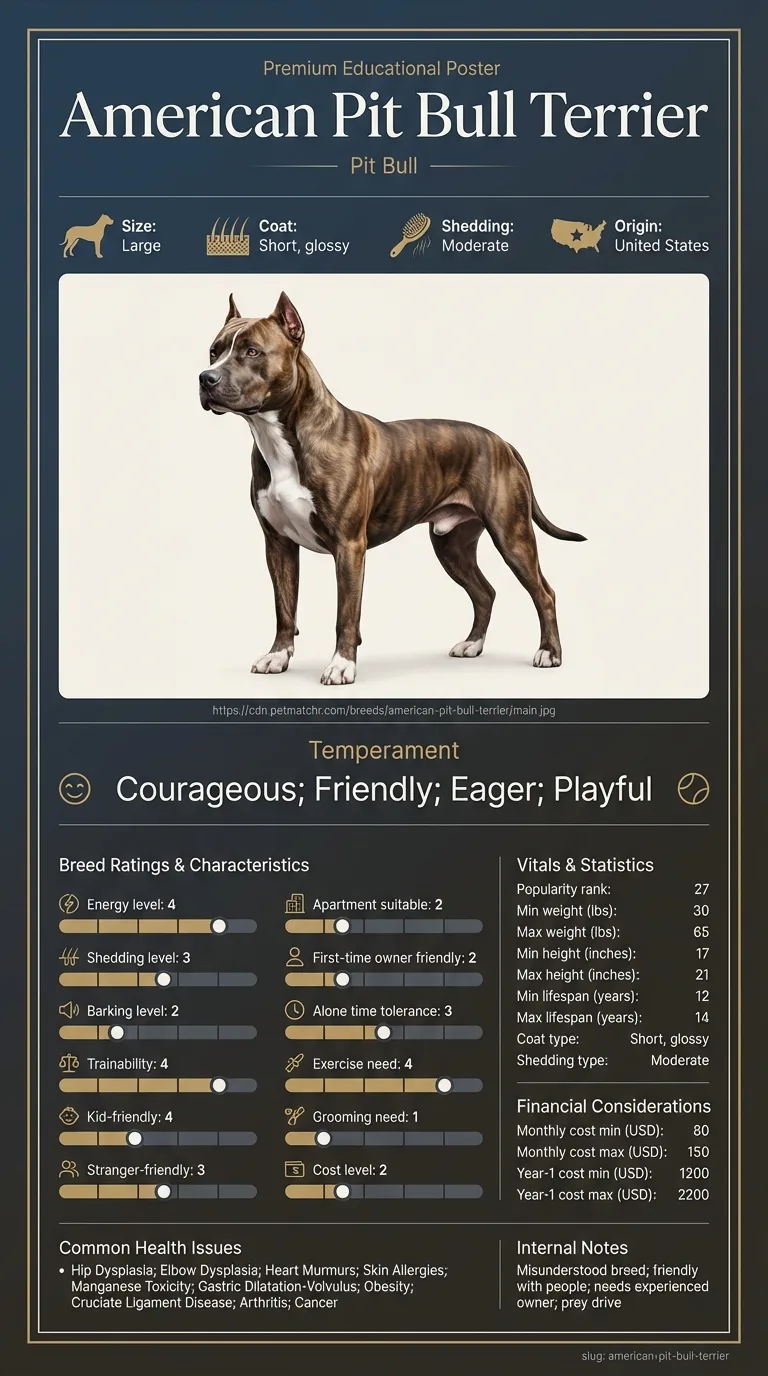
american pit bull terrier infographic

This page is for someone weighing two powerful breeds with very different upkeep. It covers running costs and coat work, the exercise gap, dog tolerance in both, health risks, and the housing and insurance realities that come with a pit bull type dog.

Quick verdict

The Pit Bull Terrier is dramatically cheaper and easier to maintain, and it comes with legal and housing complications the Malamute does not; the Malamute is the more expensive, hairier, more physically demanding dog.

Choose alaskan malamute if...

Choose the Alaskan Malamute if you are genuinely athletic, live somewhere cold, and want a sociable northern breed. It rates 5/5 with children and 4/5 with strangers. You are accepting $150–$300 a month, 5/5 shedding, 4/5 grooming, 5/5 exercise, a 1/5 apartment rating and an escape artist.

Choose american pit bull terrier if...

Choose the American Pit Bull Terrier if you want a powerful dog that is cheap and easy to keep. It costs $80–$150 a month, grooms at 1/5, sheds at 3/5, tolerates being alone at 3/5 and trains at 4/5. You are accepting 2/5 with other dogs, real prey drive, and possible insurance or housing restrictions.

Head-to-head comparison

Featurealaskan malamuteamerican pit bull terrierWinner
Weight75–110 lbs30–65 lbsEqual
Height23–25 in17–21 inEqual
Lifespan10–14 years12–14 yearsamerican pit bull terrier
CoatThick double coatShort and glossyEqual
Grooming needHigh (4/5)Very low (1/5)american pit bull terrier
SheddingVery high (5/5)Moderate (3/5)american pit bull terrier
Energy levelHigh (4/5)High (4/5)Equal
Exercise needVery high (5/5)High (4/5)american pit bull terrier
TrainabilityModerate (3/5)High (4/5)american pit bull terrier
BarkingModerate (3/5)Low (2/5)american pit bull terrier
Good with kidsVery high (5/5)High (4/5)alaskan malamute
Good with other dogsModerate (3/5)Low (2/5)alaskan malamute
Friendly to strangersHigh (4/5)Moderate (3/5)alaskan malamute
Apartment suitabilityVery low (1/5)Low (2/5)american pit bull terrier
Good for first-time ownersLow (2/5)Low (2/5)Equal
Tolerates being aloneLow (2/5)Moderate (3/5)american pit bull terrier
Typical monthly cost$150–$300$80–$150american pit bull terrier
Typical first-year cost$2,000–$4,000$1,200–$2,200american pit bull terrier

Deep dive

Alaskan Malamute vs American Pit Bull Terrier: the cost gap

$150–$300 a month against $80–$150, and $2,000–$4,000 against $1,200–$2,200 in the first year. The Malamute costs roughly twice as much to run.

Food explains most of it. A 100-pound working sled dog eats a great deal, and parasite treatments, joint supplements, most medications, anaesthesia and boarding are all priced by weight.

Grooming adds to it. A 4/5 coat on a giant breed means an undercoat rake, a good deal of time, and for many owners a professional de-shed twice a year.

The Pit Bull Terrier is one of the cheapest large dogs to keep. A 1/5 grooming rating means a rubber curry once a week and nothing else; there is no groomer and no seasonal clearing operation.

The cost the table does not show is insurance and housing, and it runs the other way — a pit bull type dog is restricted, surcharged or refused by some insurers, landlords and jurisdictions, which is a real constraint worth checking before you commit rather than at a lease renewal.

Two kinds of hard work

The Malamute rates 5/5 for exercise against the Pit Bull Terrier's 4/5, but the more useful difference is what each wants to do with the time.

A Malamute wants to pull and to cover ground. Two hours a day is realistic, and weight-pulling, carting, scootering, canicross or long hikes suit it far better than a walk. Heat is the constraint — a thick double-coated Arctic breed cannot do that volume in warm weather, so summer sessions move to the cool ends of the day.

A Pit Bull Terrier wants to exert itself in shorter, more intense bursts: flirt-pole work, tug, spring-pole, hill sprints and structured training. Around ninety minutes a day, and its 4/5 trainability means it takes to formal obedience and sports readily.

Both become destructive when under-exercised, and both are strong enough that the destruction is impressive.

The Malamute's 1/5 apartment rating is worse than the Pit Bull's 2/5, and it is about output and size together rather than either alone.

People yes, other dogs carefully

Both breeds are notably good with people and less reliable with other dogs, which surprises those who expect the reverse.

The Malamute rates 5/5 with children and 4/5 with strangers. It is a sociable, demonstrative dog and a poor guard — it will greet an intruder happily. With other dogs it rates 3/5, and same-sex intolerance is common in the breed, usually appearing at social maturity.

The Pit Bull Terrier rates 4/5 with children and 3/5 with strangers, and it is genuinely people-oriented — the breed's historical selection for handling by people is well documented. With other dogs it rates 2/5, and dog-directed reactivity is the honest headline risk of the breed. That is not a training failure and it is not fixed by socialisation alone; it is managed.

The practical rules are the same for both. Neither belongs in a dog park. Neither should be walked on a flexi lead. Both benefit from a muzzle taught early as a neutral thing, long before it is ever needed, and from an owner who reads a street ahead.

Both also carry serious prey drive toward cats and small animals.

Containment, and why it differs

The Malamute's own breed notes describe it as an extreme escape artist, and that is not decorative. It digs with real commitment, climbs, works at latches and tests boundaries persistently, and a loose Malamute travels — the instinct to cover distance is the whole point of the breed.

Recall is unreliable at 3/5 trainability with high prey drive. Long lines rather than off-lead in open ground, a fence dug in at the base, and secured gates are the baseline.

The Pit Bull Terrier is a different containment problem. It is less inclined to leave and more inclined to go through — a determined one will damage a weak fence panel rather than tunnel under it, usually because something on the other side has caught its attention.

For both, the fencing question is not really about height. It is about whether the boundary is solid, dug in, and free of anything the dog can use.

And for both, the consequence of a loose dog is greater than for most breeds — one because of what it might reach, the other because of what people will assume.

Two different health profiles

The Malamute's list runs to hip and elbow dysplasia, hypothyroidism, hereditary cataracts, progressive retinal atrophy, epilepsy, heart disease, bloat, polyneuropathy and zinc deficiency.

Two of those are worth naming. Inherited polyneuropathy affects the nerves and shows in young Malamutes as exercise intolerance, a wobbly or high-stepping gait and changes to the bark from laryngeal involvement — there is a DNA test and it should be part of any purchase conversation. Zinc-responsive dermatosis is the other: crusting and hair loss around the muzzle, eyes and ears in a northern breed dog, which responds to zinc supplementation once recognised.

The Pit Bull Terrier's burden is orthopaedic and dermatological: hip and elbow dysplasia, cruciate ligament disease, arthritis, obesity, skin allergies, heart murmurs and cancer. Skin allergies are the everyday one — itching, recurrent ear trouble and paw licking — and they are managed rather than cured.

Both carry a real bloat risk and both households should know the signs: unproductive retching, a distending abdomen, restlessness.

On lifespan the Pit Bull Terrier is slightly ahead at 12 to 14 years against 10 to 14.

Alaskan Malamute vs American Pit Bull Terrier at a glance

The Malamute costs $150 to $300 a month, sheds at 5/5 and grooms at 4/5. The American Pit Bull Terrier costs $80 to $150, sheds at 3/5 and grooms at 1/5 — the lowest maintenance rating in this comparison. On running costs and housework these two are not close.

The Malamute is the more sociable dog by breed design, rating 5/5 with children and 4/5 with strangers, but it wants two hours of pulling-type exercise a day, sheds heavily, and its own breed notes call it an extreme escape artist. The Pit Bull Terrier is cheaper and easier to maintain, trains well at 4/5, but rates only 2/5 with other dogs and may carry insurance or housing restrictions worth checking before you commit.

Choose the Malamute if you are genuinely athletic, live somewhere cold, and want a sociable northern breed. Choose the Pit Bull Terrier if you want a powerful, low-maintenance dog and can manage it carefully around other dogs.

Frequently asked questions

Which is cheaper to keep, a Malamute or a Pit Bull Terrier?

The American Pit Bull Terrier, by roughly half — $80–$150 a month against the Malamute's $150–$300, and $1,200–$2,200 against $2,000–$4,000 in the first year. Food and weight-priced products explain most of it, and a 1/5 grooming rating against 4/5 explains the rest.

Which sheds more?

The Malamute, dramatically — 5/5 against 3/5, with grooming at 4/5 against 1/5. It sheds heavily year-round and blows its undercoat in sheets twice a year. The Pit Bull Terrier needs a rubber curry once a week; its short stiff hairs weave into fabric but there is no seasonal clearing operation.

Are either of these good with other dogs?

Neither is reliable. The Malamute rates 3/5 with same-sex intolerance common at social maturity; the Pit Bull Terrier rates 2/5 and dog-directed reactivity is the breed's honest headline risk. Neither belongs in a dog park, and both benefit from a muzzle taught early as a neutral thing.

Is a Malamute a good guard dog?

No. It rates 4/5 with strangers and 5/5 with children — it is a sociable, demonstrative breed that will greet an intruder happily. If deterrence is what you want, neither of these is the right answer; the Malamute's appeal is sociability and the Pit Bull Terrier's is people-orientation.

How much exercise does each need?

The Malamute needs around two hours a day at 5/5 — pulling, carting, hiking or scootering rather than walking, and moved to the cool ends of the day in summer. The Pit Bull Terrier needs around ninety minutes at 4/5, in shorter more intense bursts, and takes readily to formal training at 4/5 trainability.

Are there housing or insurance restrictions on pit bull type dogs?

In many places, yes — restricted, surcharged or refused by some insurers, landlords and jurisdictions. It is a genuine constraint on where you can live and what you pay, and it is worth checking before you commit rather than discovering it at a lease renewal or a policy renewal.

What is polyneuropathy in Malamutes?

An inherited nerve disorder showing in young dogs as exercise intolerance, a wobbly or high-stepping gait, and a change to the bark where the larynx is involved. There is a DNA test and it belongs in any Malamute purchase conversation, alongside hip and elbow scores and eye certification.

Quick answers

View more answers
Living

Malamute vs American Pit Bull Terrier: which should I choose?

The Pit Bull Terrier if cost and upkeep matter — it runs at half the price with a 1/5 grooming rating. The Malamute if you are athletic, live somewhere cold, and want a sociable northern breed.

Costs

How much does each cost per month?

The Malamute runs $150–$300 a month and the Pit Bull Terrier $80–$150, with first-year totals of $2,000–$4,000 and $1,200–$2,200. Check insurance and rental restrictions for a pit bull type dog before committing.

Behavior

Which is easier to contain?

Neither is easy. The Malamute digs, climbs and travels — its own breed notes call it an extreme escape artist. The Pit Bull Terrier is less inclined to leave and more likely to go through a weak panel after something it has noticed.

Health

Do both breeds risk bloat?

Yes, both carry a real gastric dilatation-volvulus risk. Learn the signs — unproductive retching, a distending abdomen, restlessness — and know where your nearest out-of-hours surgery is before you need it.

Related DogBreedCompass guides

  • Alaskan Malamute breed guideThe Malamute profile covers exercise, containment and the breed's coat.
  • American Pit Bull Terrier guideThe Pit Bull Terrier profile covers temperament, dog tolerance and skin health.
  • Akita vs Siberian HuskyThe Siberian Husky is the lighter northern breed most often confused with the Malamute.
  • Malamute vs American Staffordshire TerrierThe Amstaff is the closely related breed worth weighing against the Pit Bull Terrier.
  • Pit Bull skin allergiesSkin allergies are the everyday health complaint in pit bull type dogs.
  • Malamute bloat and GDVBloat is a genuine emergency in both breeds and every owner should know the signs.

Related guides

Important reminder

Health information here is general and is not veterinary advice. If your dog shows pain, sudden behaviour change, or worsening symptoms, consult a licensed veterinarian.

Some links on this site are affiliate links. We may earn a commission at no extra cost to you, and we only suggest products we believe are helpful for dog owners.

Find Your Perfect Breed

Match your lifestyle to the right dog.

Take quiz

Find your match

Not sure which breed is right for you? Take our 2-minute quiz to find out.

Take the quiz