Malamute or Bernese: An Easier Dog With a Much Shorter Life
Quick answer
Malamute vs Bernese Mountain Dog: which should I choose?
The Bernese if you want a calm, gentle family dog and can accept 7 to 10 years. The Malamute if longevity matters or you are genuinely athletic — it lives three to four years longer and carries a far lighter cancer burden.
The Bernese Mountain Dog is easier than the Malamute on almost every row that matters in a house — half the exercise, better with other dogs, better for a first-time owner, better at being left alone. And it lives 7 to 10 years, one of the shortest lifespans of any breed. That trade is the whole comparison.
This page is for someone weighing two large, thick-coated breeds and needing the lifespan question stated plainly. It covers cancer risk in the Bernese, the exercise gap, temperament, heat tolerance, coat work and cost.
Quick verdict
The Bernese is the gentler, easier, more family-suited dog and you get several years fewer of it; the Malamute is harder work in every daily respect and is likely to be with you longer.
Choose alaskan malamute if...
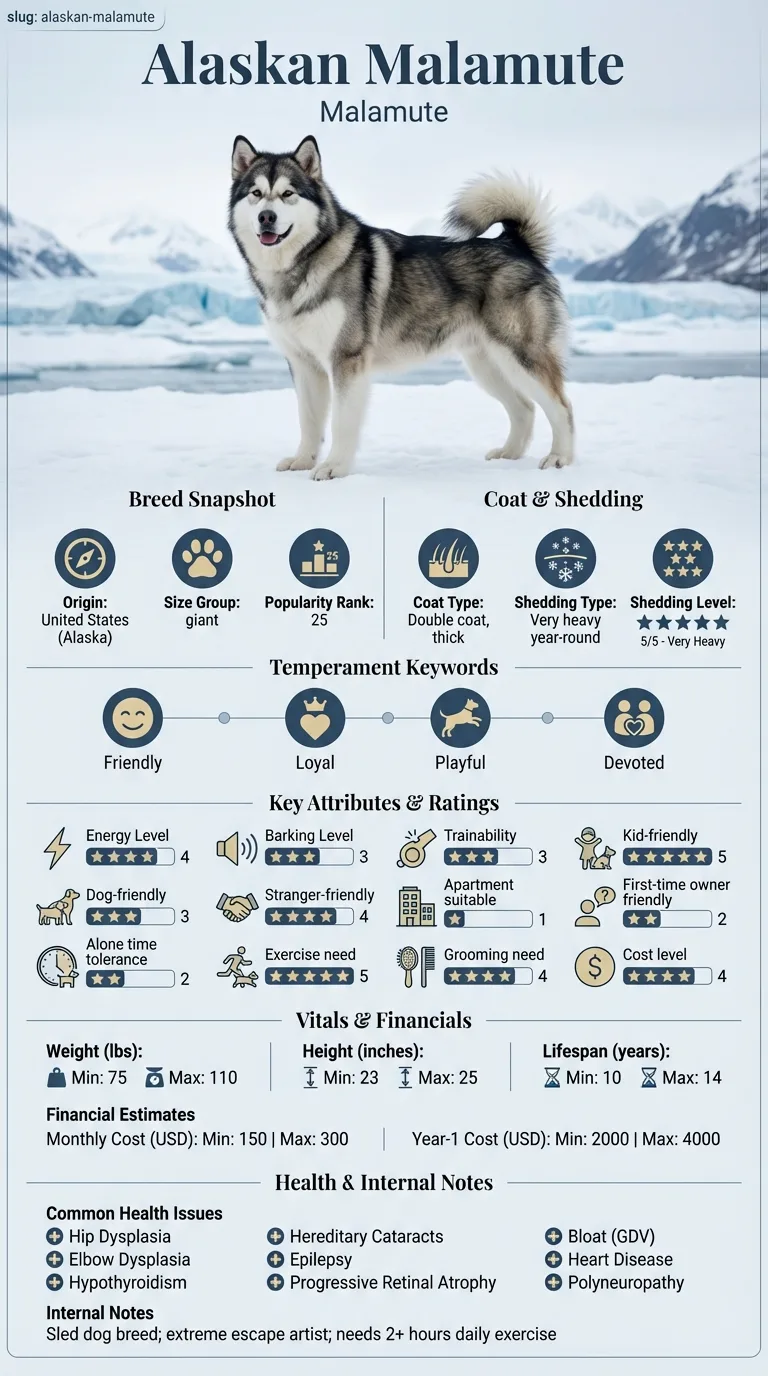
Choose the Alaskan Malamute if longevity matters or you are genuinely athletic. It lives 10 to 14 years against the Bernese's 7 to 10 and carries a much lighter cancer burden. You are accepting 5/5 exercise against 3/5, 5/5 shedding against 4/5, $150–$300 a month against $120–$250, and a determined escape artist.
Choose bernese mountain dog if...
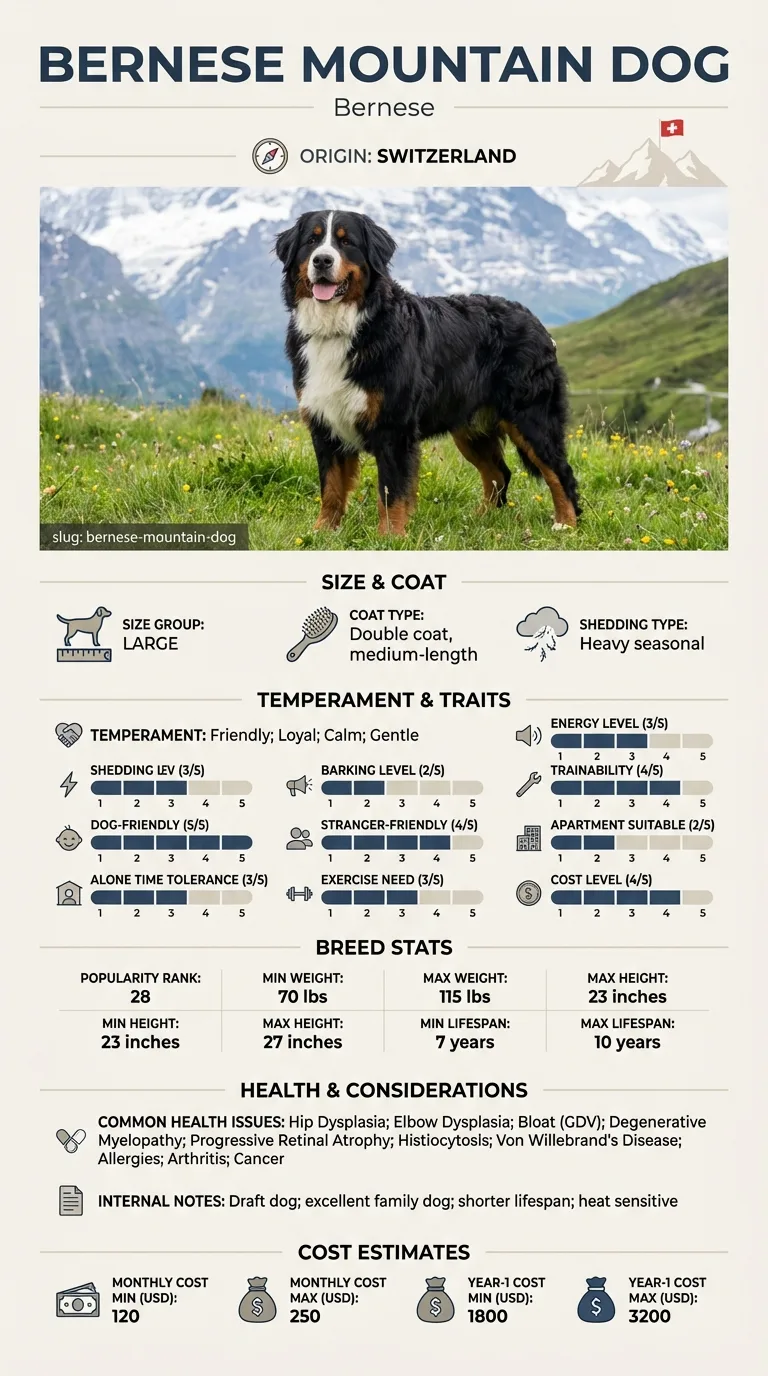
Choose the Bernese Mountain Dog if you want a calm, gentle family dog and can accept a short life. It rates 5/5 with children and other dogs, 4/5 with strangers, trainability and first-time owners, needs only 3/5 exercise and tolerates being alone at 3/5. You are accepting a heavy cancer risk and real heat sensitivity.
Head-to-head comparison
Feature
alaskan malamute
bernese mountain dog
Winner
Weight
75–110 lbs
70–115 lbs
Equal
Height
23–25 in
23–27 in
Equal
Lifespan
10–14 years
7–10 years
alaskan malamute
Coat
Thick double coat
Medium double coat
Equal
Grooming need
High (4/5)
Moderate (3/5)
bernese mountain dog
Shedding
Very high (5/5)
High (4/5)
bernese mountain dog
Energy level
High (4/5)
Moderate (3/5)
Equal
Exercise need
Very high (5/5)
Moderate (3/5)
bernese mountain dog
Trainability
Moderate (3/5)
High (4/5)
bernese mountain dog
Barking
Moderate (3/5)
Low (2/5)
bernese mountain dog
Good with kids
Very high (5/5)
Very high (5/5)
Equal
Good with other dogs
Moderate (3/5)
Very high (5/5)
bernese mountain dog
Friendly to strangers
High (4/5)
High (4/5)
Equal
Apartment suitability
Very low (1/5)
Low (2/5)
bernese mountain dog
Good for first-time owners
Low (2/5)
High (4/5)
bernese mountain dog
Tolerates being alone
Low (2/5)
Moderate (3/5)
bernese mountain dog
Typical monthly cost
$150–$300
$120–$250
bernese mountain dog
Typical first-year cost
$2,000–$4,000
$1,800–$3,200
bernese mountain dog
Deep dive
Histiocytosis and the short clock
Cancer sits on the Bernese Mountain Dog's condition list, and histiocytosis sits there with it. That second entry is the reason the lifespan figure is what it is.
Histiocytic sarcoma is a cancer arising from immune system cells, and it appears in Bernese Mountain Dogs at rates far above any other breed. It is aggressive, it spreads early, and it typically presents in middle age — often as lameness, weight loss, lethargy or breathing difficulty depending on where it starts. Treatment options are limited and outcomes are usually poor.
There is no screening test. What you can do is buy from a breeder who will discuss the age and cause of death of dogs in the line openly rather than deflecting, keep the dog lean, and treat unexplained lameness, weight loss or lethargy in a middle-aged Bernese as a reason to investigate rather than watch.
It is worth being clear-eyed rather than fatalistic. Plenty of Bernese reach ten, and every year of one is a good year. But anyone choosing this breed should do it knowing the number.
The Malamute's burden is orthopaedic, endocrine and neurological rather than oncological, and it lives three to four years longer on average.
Three out of five against five out of five
The Bernese needs around forty-five to sixty minutes of steady walking a day. It is a draft breed rather than a running breed, and many enjoy carting or drafting work, which suits the temperament and the build.
What it should not do is anything high-impact while growing. A large breed puppy that reaches a hundred pounds needs restricted forced exercise until the growth plates close: no jogging, no cycling alongside, no repeated stairs, and no jumping. Keep it visibly lean and never supplement calcium.
The Malamute needs two hours and it wants to pull. Carting, scootering, canicross or long hikes are what satisfy it; a walk does not. An under-exercised Malamute digs up a garden and leaves.
Heat limits both, and the Bernese more so — it is explicitly heat sensitive, and a black-coated mountain dog in a warm climate needs summer exercise confined to the cool ends of the day, shade, and no parked cars.
Neither coat should ever be clipped, since a double coat insulates against heat as well as cold.
Two gentle giants and one that leaves
Both rate 5/5 with children and 4/5 with strangers. Both are demonstrative and neither is any use as a guard dog — a Malamute will show a burglar the garden and a Bernese will lean on him.
The Bernese is the easier household dog beyond that. 4/5 trainability against 3/5, 5/5 with other dogs against 3/5, and 2/5 barking against 3/5. It is soft-natured and slightly sensitive, and it does best with gentle consistent handling rather than firmness.
The Malamute's social complication is other dogs, where same-sex intolerance is common and usually appears at social maturity around two years old rather than in puppyhood.
Its other complication is containment. The Malamute's own breed notes call it an extreme escape artist: it digs, climbs, works at latches and travels once loose. A fence dug in at the base and secured gates are the baseline, and its recall should never be treated as a safety measure.
A Bernese is far more inclined to stay where its people are, which for many households is the practical difference that matters most.
Coat, growth and running costs
The Bernese runs $120–$250 a month against the Malamute's $150–$300, and $1,800–$3,200 against $2,000–$4,000 in the first year.
Grooming is 3/5 against 4/5. The Bernese has a medium double coat that mats behind the ears and on the trousers and needs brushing through a couple of times a week, more when it drops. The Malamute's thicker coat needs an undercoat rake and several sessions during two heavy blows a year, and it sheds more year-round at 5/5 against 4/5.
Both are deep-chested and both carry a real bloat risk. Learn the signs — unproductive retching, a distending abdomen, restlessness — and know where the nearest out-of-hours surgery is.
The Bernese's other testable items are von Willebrand's disease, a clotting disorder worth screening before any surgery, and degenerative myelopathy, which has a DNA test.
The Malamute's are inherited polyneuropathy, which also has a DNA test, and eye certification for hereditary cataracts. Hip and elbow scores apply to both, as numbers you can see.
Alaskan Malamute vs Bernese Mountain Dog: everything except the years
The Bernese wins twelve rows on this table. It needs 3/5 exercise against 5/5, grooms at 3/5 against 4/5, sheds at 4/5 against 5/5, trains at 4/5 against 3/5, is quieter at 2/5 against 3/5, better with other dogs at 5/5 against 3/5, better for a first-time owner at 4/5 against 2/5, and manages a working day at 3/5 against 2/5.
It also costs less and fits ordinary housing better.
Then there is the lifespan row: 7 to 10 years against 10 to 14. At the pessimistic end that is a difference of seven years, which is most of another dog.
Children and strangers tie at 5/5 and 4/5 — both are sociable, demonstrative breeds and neither guards anything.
Everything on this page is a version of the same question: how much do the years matter to you against the daily ease.
Malamute or Bernese: An Easier Dog With a Much Shorter Life - Alaskan Malamute vs Bernese Mountain Dog: everything except the years
Frequently asked questions
Why do Bernese Mountain Dogs live such short lives?
Cancer, and specifically histiocytic sarcoma, which appears in this breed at rates far above any other. It is aggressive, spreads early and typically presents in middle age. There is no screening test, which is why the 7 to 10 year figure is the single most important thing to understand before choosing the breed.
Which is easier to live with day to day?
The Bernese, on almost every row. It needs 3/5 exercise against the Malamute's 5/5, trains at 4/5 against 3/5, is quieter, better with other dogs at 5/5 against 3/5, better for a first-time owner at 4/5 against 2/5, and manages a working day at 3/5 against 2/5.
How much exercise does a Bernese need?
Around forty-five to sixty minutes of steady walking a day — it is a draft breed rather than a running breed, and many enjoy carting work. While growing, restrict forced exercise entirely: no jogging, no cycling alongside, no repeated stairs and no jumping until the growth plates close.
Which handles heat better?
Neither well, and the Bernese worse. It is explicitly heat sensitive, and a black-coated mountain dog in a warm climate needs summer exercise confined to the cool ends of the day with shade and water available. Neither coat should ever be clipped — a double coat insulates against heat as well as cold.
Is a Malamute a good guard dog?
No, and neither is the Bernese. Both rate 4/5 with strangers and 5/5 with children. A Malamute will greet an intruder happily and a Bernese will lean on him. If deterrence matters, neither of these breeds is the answer.
Which is harder to contain?
The Malamute, by a wide margin. Its own breed notes call it an extreme escape artist — it digs, climbs, works at latches and travels once loose. A fence dug in at the base and secured gates are the baseline, and its recall should never be relied on. A Bernese generally stays where its people are.
What should I ask a Bernese breeder?
The ages and causes of death of dogs in the line, asked directly, along with hip and elbow scores as numbers, the degenerative myelopathy DNA result and von Willebrand's status. A breeder who answers the first question openly is telling you something more useful than any certificate.
Malamute vs Bernese Mountain Dog: which should I choose?
The Bernese if you want a calm, gentle family dog and can accept 7 to 10 years. The Malamute if longevity matters or you are genuinely athletic — it lives three to four years longer and carries a far lighter cancer burden.
Costs
How much does each cost per month?
The Malamute runs $150–$300 a month and the Bernese $120–$250, with first-year totals of $2,000–$4,000 and $1,800–$3,200. Grooming is 4/5 against 3/5.
Living
Which needs less exercise?
The Bernese at 3/5 against the Malamute's 5/5 — forty-five to sixty minutes of steady walking against two hours of pulling work. That is the single largest daily difference between the two breeds.
Health
Do both breeds risk bloat?
Yes — both are deep-chested and gastric dilatation-volvulus is a genuine emergency in each. Learn the signs and know where your nearest out-of-hours surgery is before you need it.
Health information here is general and is not veterinary advice. If your dog shows pain, sudden behaviour change, or worsening symptoms, consult a licensed veterinarian.
Some links on this site are affiliate links. We may earn a commission at no extra cost to you, and we only suggest products we believe are helpful for dog owners.
We research and check what we publish, but we do not warrant that any figure, date, price, or statement is accurate, complete, or current, and we accept no liability for any loss, cost, injury, or other harm arising from the use of this site. Use it as one reference among several. You remain responsible for your own decisions and for your dog's care - confirm anything that matters with a licensed veterinarian or another qualified professional before you act on it. Full disclaimer.