Health
Which breed lives longer?
The Cocker Spaniel, typically 10–14 years versus just 7–10 for the Bernese Mountain Dog.

Quick answer
Which breed lives longer?
The Cocker Spaniel, typically 10–14 years versus just 7–10 for the Bernese Mountain Dog.
Bernese Mountain Dog or Cocker Spaniel? On paper they differ most on grooming need, and on the scales Bernese Mountain Dog is the heavier at 70–115 lbs. Here is how the two compare on everything that shapes an ordinary week.
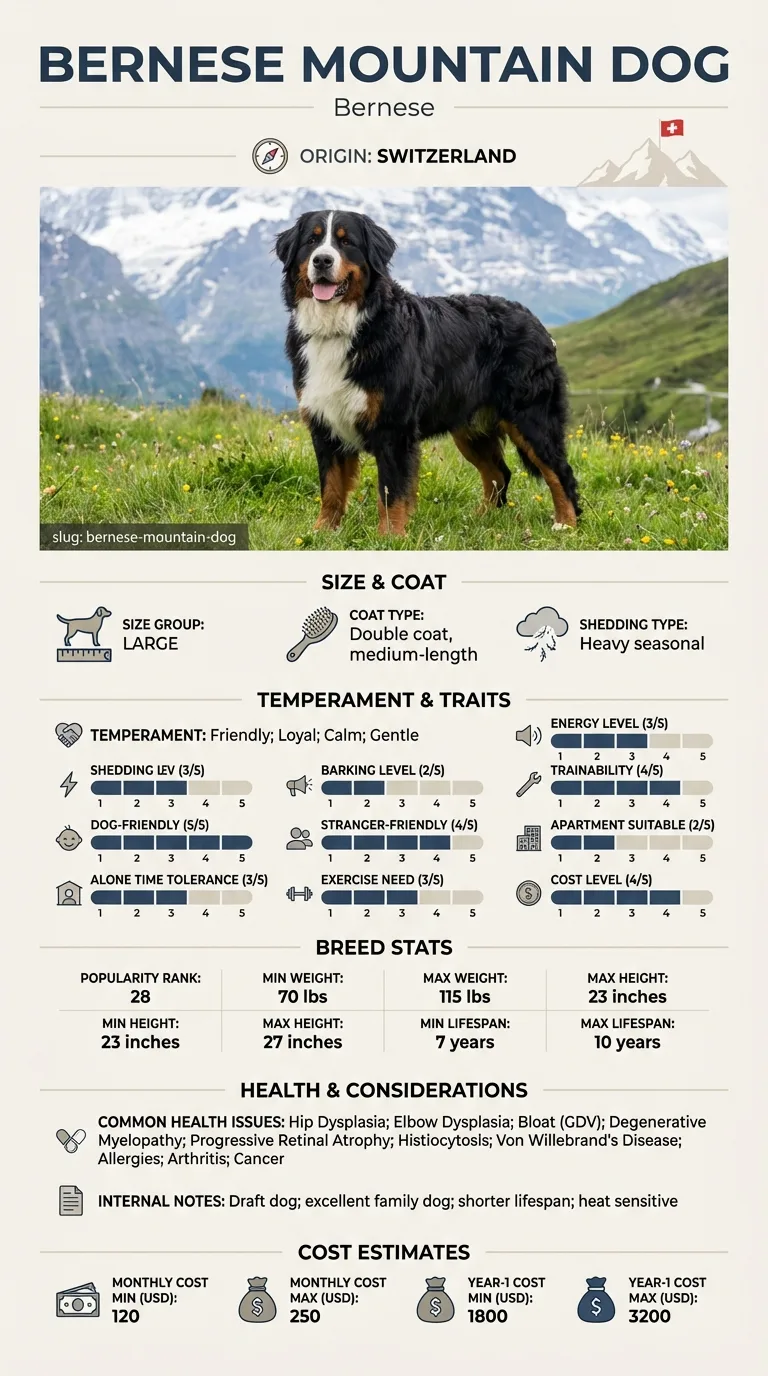
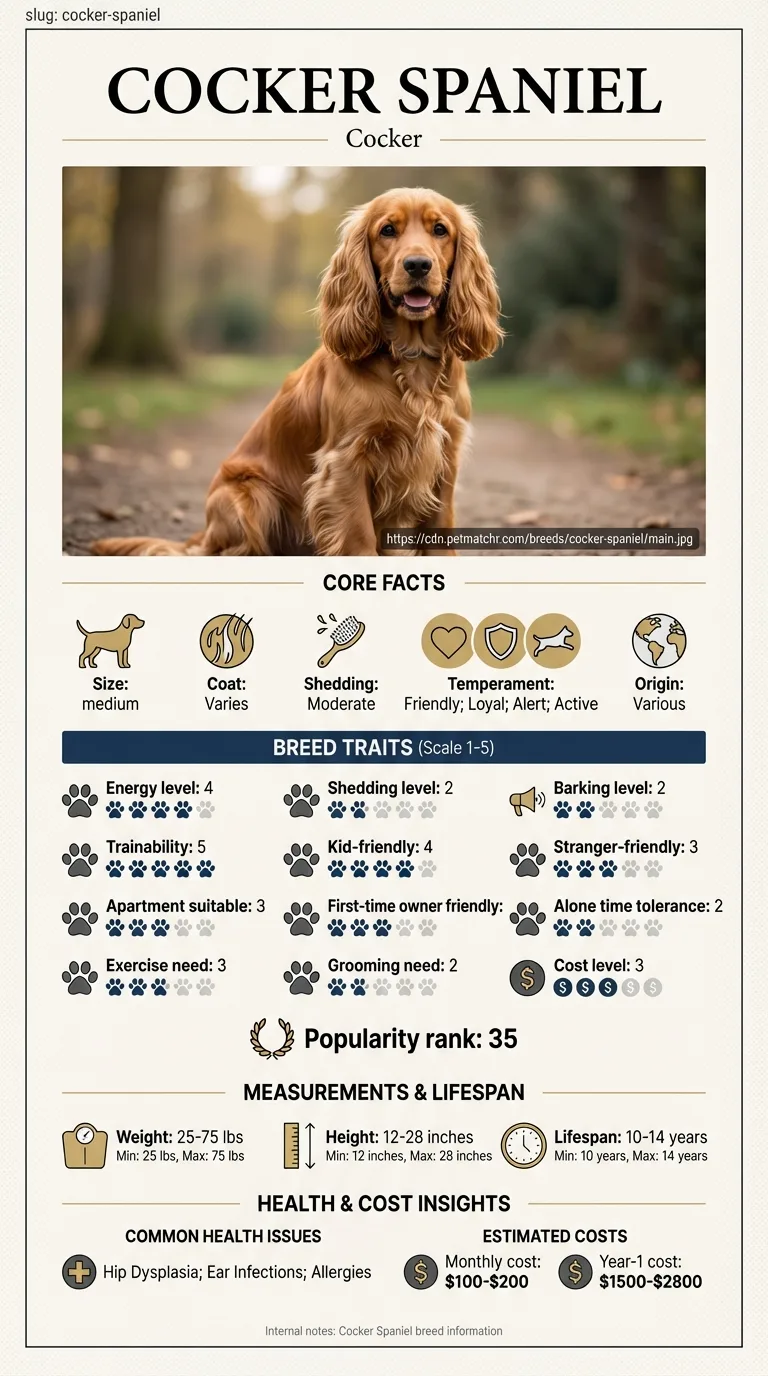
This is for someone already down to Bernese Mountain Dog and Cocker Spaniel and deciding between them. For this pair the decision usually turns on grooming need and apartment suitability, so those are covered first and in most detail. Anyone choosing from a flat has a clear answer here: Cocker Spaniel rates 4/5 against 2/5. Breed history is left out; what follows is what you will actually live with.
Between Bernese Mountain Dog and Cocker Spaniel, grooming need is what separates them, and Bernese Mountain Dog is the lower-effort dog of the two to keep.
Choose Bernese Mountain Dog if you do not want a standing grooming appointment, the dog will be alone during the working day and you already have another dog.
Choose Cocker Spaniel if you are in a flat or a smaller home, shedding is a problem in your house and a smaller dog suits your car, your home or your back.
| Feature | bernese mountain dog | cocker spaniel | Winner |
|---|---|---|---|
| Size class | large | small | Equal |
| Weight | 70–115 lbs | 20–30 lbs | Equal |
| Height | 23–27 in | 13–16 in | Equal |
| Lifespan | 7–10 years | 10–14 years | cocker spaniel |
| Exercise need | Moderate (3/5) | Moderate (3/5) | Equal |
| Grooming need | Moderate (3/5) | Very high (5/5) | bernese mountain dog |
| Shedding | High (4/5) | Moderate (3/5) | cocker spaniel |
| Energy level | Moderate (3/5) | Moderate (3/5) | Equal |
| Barking | Low (2/5) | Moderate (3/5) | bernese mountain dog |
| Apartment suitability | Low (2/5) | High (4/5) | cocker spaniel |
| Good for first-time owners | High (4/5) | High (4/5) | Equal |
| Tolerates being alone | Moderate (3/5) | Low (2/5) | bernese mountain dog |
| Trainability | High (4/5) | High (4/5) | Equal |
| Good with kids | Very high (5/5) | Very high (5/5) | Equal |
| Good with other dogs | Very high (5/5) | High (4/5) | bernese mountain dog |
| Friendly to strangers | High (4/5) | High (4/5) | Equal |
| Cost level | High (4/5) | Moderate (3/5) | cocker spaniel |
| Coat | Double coat, medium-length | Silky and feathered | Equal |
| Origin | Switzerland | Various | Equal |
| Typical monthly cost | $120–$250 | $80–$150 | Equal |
| Typical first-year cost | $1,800–$3,200 | $1,100–$2,300 | Equal |
A Bernese Mountain Dog's 70–115 lb frame and 23–27 inch height dwarf a Cocker Spaniel's 20–30 lbs and 13–16 inches — the Bernese can outweigh the Cocker by nearly 4:1 at the upper end. Bred to pull carts and drive cattle in the Swiss Alps, the Bernese carries a heavy-boned, thickly muscled build under its double coat, while the Cocker's compact, athletic body was shaped for working brush and field. That size difference matters practically: a Bernese needs a car, doorways, and furniture sized for a genuinely giant breed, while a Cocker fits comfortably into far smaller spaces and a smaller food budget.
Exercise need is an exact tie at Moderate (3/5), which surprises people who assume a giant breed needs more activity than a small one — the Bernese's Calm, Gentle temperament actually keeps its exercise requirements in check compared to sportier large breeds. A daily walk plus some open-space time suits both dogs well, and the Cocker's Merry disposition means it enjoys retrieving games on top of its walks. Neither breed demands the intense, structured exercise regime that a herding or working breed would, making this pairing unusually similar on the energy front despite the size gap.
The two swap expected roles here: the Bernese needs Moderate (3/5) grooming but sheds a High (4/5) amount from its dense double coat, while the Cocker needs Very high (5/5) grooming despite only Moderate (3/5) shedding, since its silky, feathered coat mats easily around the ears and legs without frequent brushing and trims. In practice, Bernese owners deal with more loose fur around the house, especially during seasonal coat blows, while Cocker owners spend more time and money at the groomer keeping that feathering in shape. Neither coat is low-maintenance, just differently demanding.
Apartment suitability favors the Cocker, High (4/5) against the Bernese's Low (2/5), which tracks with the size difference more than temperament — a dog this size simply needs more square footage to stretch out comfortably. Barking tips slightly toward the Bernese being quieter, Low (2/5) versus the Cocker's Moderate (3/5). Tolerating time alone favors the Bernese, Moderate (3/5) against the Cocker's Low (2/5), so despite needing more space, a Bernese may actually cope better with an owner's occasional long day out than the more people-oriented Cocker will.
Both breeds tie at High (4/5) for trainability and High (4/5) for first-time-owner suitability, making this one of the more evenly matched pairs on this site for a novice household. The Bernese's Friendly, Loyal temperament makes it eager to please despite its size, while the Cocker's Eager to please trait is right there in its own temperament list. Neither breed requires the specialized handling experience that a working or guardian breed would, so the deciding factor for most first-time owners comes down to space and lifestyle rather than trainability.
Good with kids ties at Very high (5/5) for both breeds, and friendliness to strangers ties at High (4/5) as well — this is a genuinely family-friendly matchup either way. The Bernese edges ahead with other dogs, Very high (5/5) versus the Cocker's still-strong High (4/5), consistent with its Calm, Gentle temperament around other animals. For households with multiple pets, small children, and frequent visitors, both breeds score well, and the practical difference comes down to whether a family has the space and vet budget for a giant breed with a shortened lifespan.
This is the starkest gap in the whole comparison: the Bernese Mountain Dog's typical lifespan is just 7–10 years against the Cocker Spaniel's 10–14, a difference of several years that giant-breed owners need to plan for emotionally and financially. The Bernese's ten flagged conditions include Bloat (GDV), Histiocytosis, and Cancer, the latter a leading cause of death in the breed, alongside Hip Dysplasia and Elbow Dysplasia common to large dogs. The Cocker's shorter, five-item list of Ear Infections, Cataracts, PRA, Hip Dysplasia, and Autoimmune Hemolytic Anemia reflects a smaller frame with fewer joint-related risks but its own eye and ear vulnerabilities.
Monthly costs run $120–$250 for the Bernese against $80–$150 for the Cocker, and first-year totals show the same gap, $1,800–$3,200 versus $1,100–$2,300, with cost level rated High (4/5) for the Bernese and Moderate (3/5) for the Cocker. The Bernese's premium comes from sheer food volume for a 70–115 lb dog plus larger-breed vet costs, while the Cocker's Very high grooming need adds its own recurring expense despite the lower overall total. Given the Bernese's shorter 7–10 year lifespan, some owners find the total lifetime cost closer than the annual numbers suggest.
Bernese Mountain Dog weighs 70–115 lbs and lives 7–10 years; Cocker Spaniel weighs 20–30 lbs and lives 10–14 years. The two diverge most on grooming need and apartment suitability. They are level on energy level, exercise need and good for first-time owners, so those cannot decide it. The comparison marks an easier option only where one exists. Facts like weight and country of origin are not scored. Both dogs are rated from the same dataset, which is what makes the numbers comparable with each other even though any individual dog sits somewhere inside its breed's range.

At 7–10 years, the Bernese's lifespan is shortened largely by Cancer, which affects the breed at unusually high rates, along with Bloat (GDV) and other large-breed conditions on its health list.
Not ideally — it rates Low (2/5) for apartment suitability given its 70–115 lb size, compared to the Cocker Spaniel's High (4/5).
The Bernese Mountain Dog, rated High (4/5) shedding versus the Cocker Spaniel's Moderate (3/5), due to its dense double coat.
Yes — both tie at Very high (5/5) with kids, making either a strong choice for a family household.
They tie at High (4/5), so either breed suits a first-time owner about equally well; the deciding factor is usually space and budget rather than trainability.
Roughly 50 to 70 percent more — $1,800–$3,200 in year one for the Bernese versus $1,100–$2,300 for the Cocker.
The Bernese, rated Moderate (3/5) for tolerating time alone versus the Cocker's Low (2/5), despite the Cocker being the more apartment-friendly of the two.
The Cocker Spaniel, typically 10–14 years versus just 7–10 for the Bernese Mountain Dog.
The Cocker Spaniel, rated Very high (5/5) versus the Bernese's Moderate (3/5).
The Cocker Spaniel, rated High (4/5) versus the Bernese's Low (2/5).
The Cocker Spaniel, at $1,100–$2,300 in year one versus $1,800–$3,200 for the Bernese.
Secure checkout on Stripe. We never see your card.
7-day money-back guarantee. Instant access.
Health information here is general and is not veterinary advice. If your dog shows pain, sudden behaviour change, or worsening symptoms, consult a licensed veterinarian.
Some links on this site are affiliate links. We may earn a commission at no extra cost to you, and we only suggest products we believe are helpful for dog owners.
We research and check what we publish, but we do not warrant that any figure, date, price, or statement is accurate, complete, or current, and we accept no liability for any loss, cost, injury, or other harm arising from the use of this site. Use it as one reference among several. You remain responsible for your own decisions and for your dog's care - confirm anything that matters with a licensed veterinarian or another qualified professional before you act on it. Full disclaimer.
Match your lifestyle to the right dog.
Take quizNot sure which breed is right for you? Take our 2-minute quiz to find out.
Take the quiz