Behavior
Which breed needs more daily exercise?
The English Cocker Spaniel, rated High (4/5) versus the Bernese's Moderate (3/5).

Quick answer
Which breed needs more daily exercise?
The English Cocker Spaniel, rated High (4/5) versus the Bernese's Moderate (3/5).
Bernese Mountain Dog or English Cocker Spaniel? On paper they differ most on apartment suitability, and on the scales Bernese Mountain Dog is the heavier at 70–115 lbs. Here is how the two compare on everything that shapes an ordinary week.
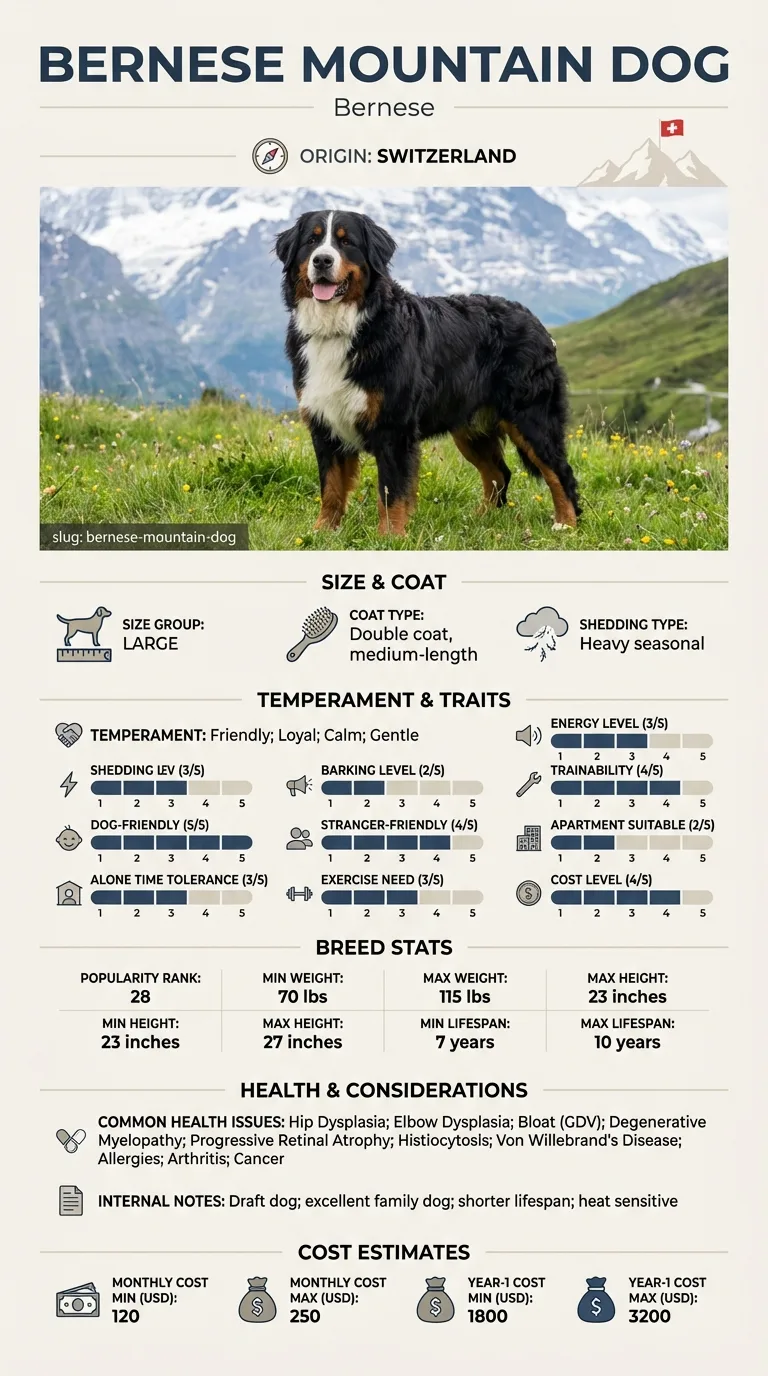
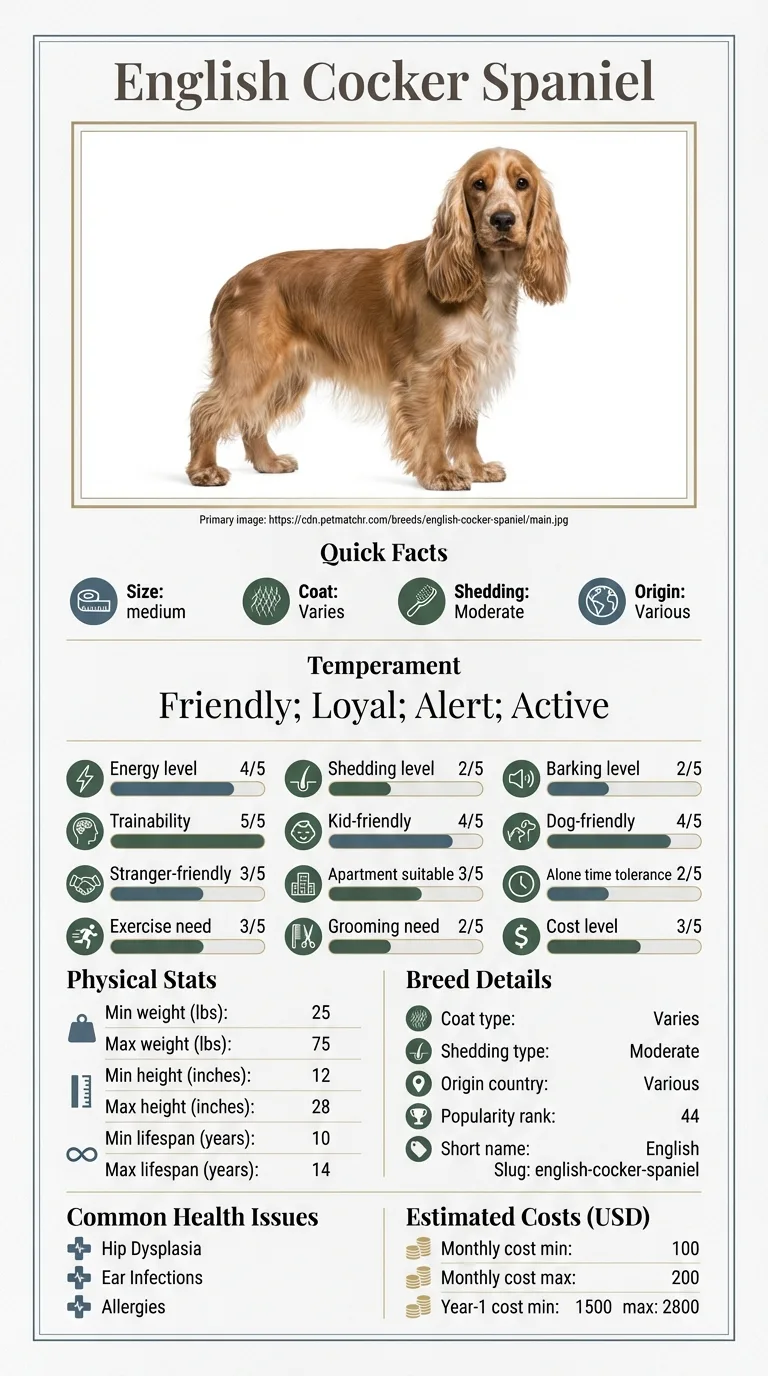
This is for someone already down to Bernese Mountain Dog and English Cocker Spaniel and deciding between them. For this pair the decision usually turns on apartment suitability, so those are covered first and in most detail. Anyone choosing from a flat has a clear answer here: English Cocker Spaniel rates 4/5 against 2/5. The focus throughout is on daily consequences rather than breed background.
Between Bernese Mountain Dog and English Cocker Spaniel, apartment suitability is what separates them, and Bernese Mountain Dog is the lower-effort dog of the two to keep.
Choose Bernese Mountain Dog if you do not want a standing grooming appointment, your walking routine is modest and the dog will be alone during the working day.
Choose English Cocker Spaniel if you are in a flat or a smaller home, shedding is a problem in your house and a smaller dog suits your car, your home or your back.
| Feature | bernese mountain dog | english cocker spaniel | Winner |
|---|---|---|---|
| Size class | large | medium | Equal |
| Weight | 70–115 lbs | 26–34 lbs | Equal |
| Height | 23–27 in | 15–17 in | Equal |
| Lifespan | 7–10 years | 12–14 years | english cocker spaniel |
| Exercise need | Moderate (3/5) | High (4/5) | bernese mountain dog |
| Grooming need | Moderate (3/5) | High (4/5) | bernese mountain dog |
| Shedding | High (4/5) | Moderate (3/5) | english cocker spaniel |
| Energy level | Moderate (3/5) | High (4/5) | Equal |
| Barking | Low (2/5) | Moderate (3/5) | bernese mountain dog |
| Apartment suitability | Low (2/5) | High (4/5) | english cocker spaniel |
| Good for first-time owners | High (4/5) | High (4/5) | Equal |
| Tolerates being alone | Moderate (3/5) | Low (2/5) | bernese mountain dog |
| Trainability | High (4/5) | High (4/5) | Equal |
| Good with kids | Very high (5/5) | Very high (5/5) | Equal |
| Good with other dogs | Very high (5/5) | High (4/5) | bernese mountain dog |
| Friendly to strangers | High (4/5) | High (4/5) | Equal |
| Cost level | High (4/5) | Moderate (3/5) | english cocker spaniel |
| Coat | Double coat, medium-length | Medium, silky and feathered | Equal |
| Origin | Switzerland | Various | Equal |
| Typical monthly cost | $120–$250 | $100–$200 | Equal |
| Typical first-year cost | $1,800–$3,200 | $1,400–$2,900 | Equal |
The English Cocker Spaniel is a step up from its American cousin, weighing 26–34 lbs and standing 15–17 inches — still dwarfed by a Bernese Mountain Dog's 70–115 lbs and 23–27 inches, but closer to a true medium-size dog than a small one. Both breeds are classified in the table as medium, the English Cocker, versus large, the Bernese, and that gap shows up in daily life: doorway width, car trunk space, and how much floor a dog claims when it lies down. The Bernese's heavy-boned, alpine-cart-pulling build stands in contrast to the English Cocker's leaner, more athletic gundog frame built for long days in the field.
Unlike the American Cocker Spaniel, the English Cocker Spaniel actually out-scores the Bernese on exercise need, High (4/5) against the Bernese's Moderate (3/5), and its energy level is rated High (4/5) as well. That Energetic streak reflects the breed's working gundog history — this is a dog bred for full days of flushing and retrieving, not just a stroll. The Bernese's Calm, Gentle temperament keeps its needs more modest despite its size, meaning a smaller English Cocker may actually need more daily exercise time than its giant-breed counterpart, a detail easy to overlook when judging a dog by size alone.
Grooming favors the Bernese at Moderate (3/5) against the English Cocker's High (4/5), while shedding flips the other way — High (4/5) for the Bernese versus Moderate (3/5) for the English Cocker. The English Cocker's medium, silky, feathered coat needs regular brushing and trimming around the ears and legs to prevent matting, similar to its American cousin but on a slightly larger frame. The Bernese sheds more overall hair volume simply due to its size and dense double coat, even though the grooming routine itself, brushing rather than trimming, is comparatively simpler.
Apartment suitability favors the English Cocker, High (4/5) versus the Bernese's Low (2/5), though its High exercise need means apartment living still requires committed daily outings rather than yard access alone. Barking is Low (2/5) for the Bernese against Moderate (3/5) for the English Cocker. Tolerating time alone favors the Bernese, Moderate (3/5) versus Low (2/5) for the English Cocker, whose Affectionate, Biddable nature makes it more people-dependent day to day despite fitting into smaller living spaces more easily.
Trainability and first-time-owner suitability both tie at High (4/5), making this another evenly matched pair for newer owners. The English Cocker's Biddable temperament, literally bred to be responsive to handler commands during hunts, makes structured training sessions productive early on. The Bernese's Friendly, Loyal disposition brings a similar eagerness to please, just wrapped in a much larger, slower-maturing body that takes longer to physically settle even once basic obedience is solid. Neither breed presents the training challenges of a guardian or terrier breed.
Both breeds tie at Very high (5/5) with kids and High (4/5) with strangers, and the Bernese edges ahead with other dogs at Very high (5/5) against the English Cocker's still-strong High (4/5). The English Cocker's Merry, Affectionate temperament makes it a warm presence at gatherings, while the Bernese's Calm nature means it's less likely to get overstimulated in a busy household despite its imposing size. Families choosing between these two are unlikely to go wrong on temperament alone — the decision comes down to space, exercise capacity, and budget.
The lifespan gap here is even larger than in the American Cocker comparison — 7–10 years for the Bernese against 12–14 for the English Cocker, a potential four-plus-year difference. The English Cocker's five-item list, Ear Infections, PRA, Hip Dysplasia, Familial Nephropathy, and Adult-Onset Neuropathy, includes two breed-specific neurological and kidney conditions worth discussing with a breeder about health testing. The Bernese's ten-item list remains dominated by Cancer, Bloat (GDV), and joint issues typical of giant breeds. Prospective owners weighing years of companionship against a bigger dog's presence should treat this lifespan gap as a central, not secondary, factor.
Monthly costs sit at $120–$250 for the Bernese against $100–$200 for the English Cocker, a narrower gap than with the American Cocker Spaniel given the English variety's larger size. First-year costs follow suit at $1,800–$3,200 versus $1,400–$2,900, with cost level rated High (4/5) for the Bernese and Moderate (3/5) for the English Cocker. The English Cocker's High grooming need and High exercise level both add ongoing costs, grooming appointments and potentially a dog walker, that partially close the gap with the larger, food-hungrier Bernese.
Bernese Mountain Dog weighs 70–115 lbs and lives 7–10 years; English Cocker Spaniel weighs 26–34 lbs and lives 12–14 years. The two diverge most on apartment suitability. They are level on good for first-time owners, good with kids and friendly to strangers, so those cannot decide it. The table below marks a winner only where one breed is genuinely easier for a typical owner; size and origin are facts rather than merits and stay level. Ratings come from one source applied to both breeds, so they are meaningful against each other rather than as absolute scores.

Yes — the English Cocker rates High (4/5) for exercise need and energy level, compared to Moderate (3/5) for the American Cocker Spaniel, reflecting its stronger working gundog heritage.
Potentially four or more years — 12–14 years for the English Cocker versus 7–10 for the Bernese Mountain Dog.
Their temperaments complement well — the Bernese's Calm, Gentle nature and the English Cocker's Merry, Energetic disposition rarely clash, and both breeds score Very high with kids.
Familial Nephropathy and Adult-Onset Neuropathy are two conditions on the English Cocker's list not shared with the Bernese, alongside more common risks like Hip Dysplasia and PRA.
The English Cocker Spaniel, rated High (4/5) versus the Bernese's Moderate (3/5), due to its feathered coat requiring regular trims.
The English Cocker is more workable at High (4/5) apartment suitability, provided its High exercise need is met daily; the Bernese's Low (2/5) rating reflects its large size needing more space.
The Bernese Mountain Dog, at $1,800–$3,200 versus $1,400–$2,900 for the English Cocker Spaniel, though the gap is narrower than with smaller Cocker varieties.
The English Cocker Spaniel, rated High (4/5) versus the Bernese's Moderate (3/5).
The English Cocker Spaniel, typically 12–14 years versus 7–10 for the Bernese.
The English Cocker Spaniel, rated High (4/5) versus the Bernese's Low (2/5).
The Bernese Mountain Dog, rated High (4/5) versus the English Cocker's Moderate (3/5).
Secure checkout on Stripe. We never see your card.
7-day money-back guarantee. Instant access.
Health information here is general and is not veterinary advice. If your dog shows pain, sudden behaviour change, or worsening symptoms, consult a licensed veterinarian.
Some links on this site are affiliate links. We may earn a commission at no extra cost to you, and we only suggest products we believe are helpful for dog owners.
We research and check what we publish, but we do not warrant that any figure, date, price, or statement is accurate, complete, or current, and we accept no liability for any loss, cost, injury, or other harm arising from the use of this site. Use it as one reference among several. You remain responsible for your own decisions and for your dog's care - confirm anything that matters with a licensed veterinarian or another qualified professional before you act on it. Full disclaimer.
Match your lifestyle to the right dog.
Take quizNot sure which breed is right for you? Take our 2-minute quiz to find out.
Take the quiz