DogBreedCompass

Malamute or Bernedoodle: Rake It Out or Comb It Through

Both breeds rate 4/5 for grooming and they could not mean less similar things. The Malamute sheds at 5/5 and the work is raking an undercoat out twice a year. The Bernedoodle sheds at 2/5 and the work is combing a coat that never lets go of its dead hair. One fills a bin bag; the other fills a groomer's diary.

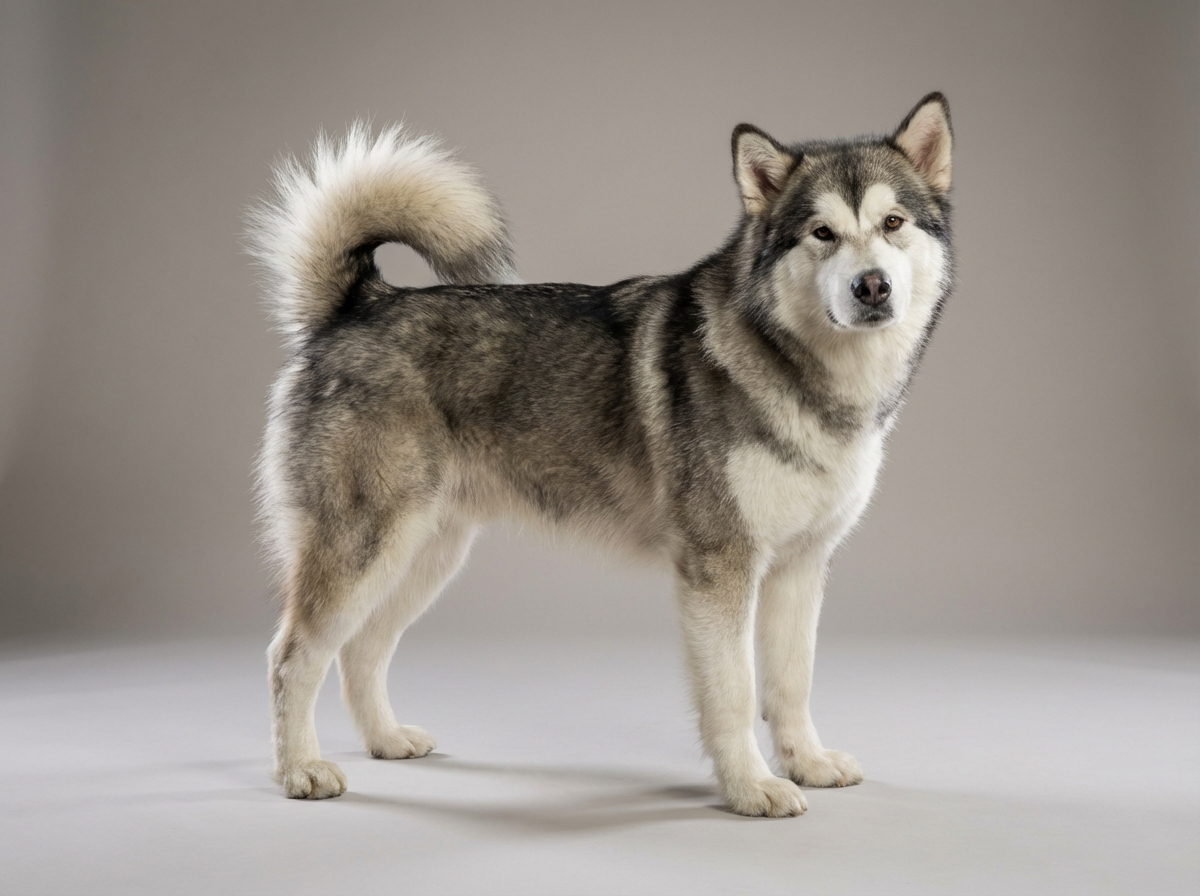
alaskan malamute infographic
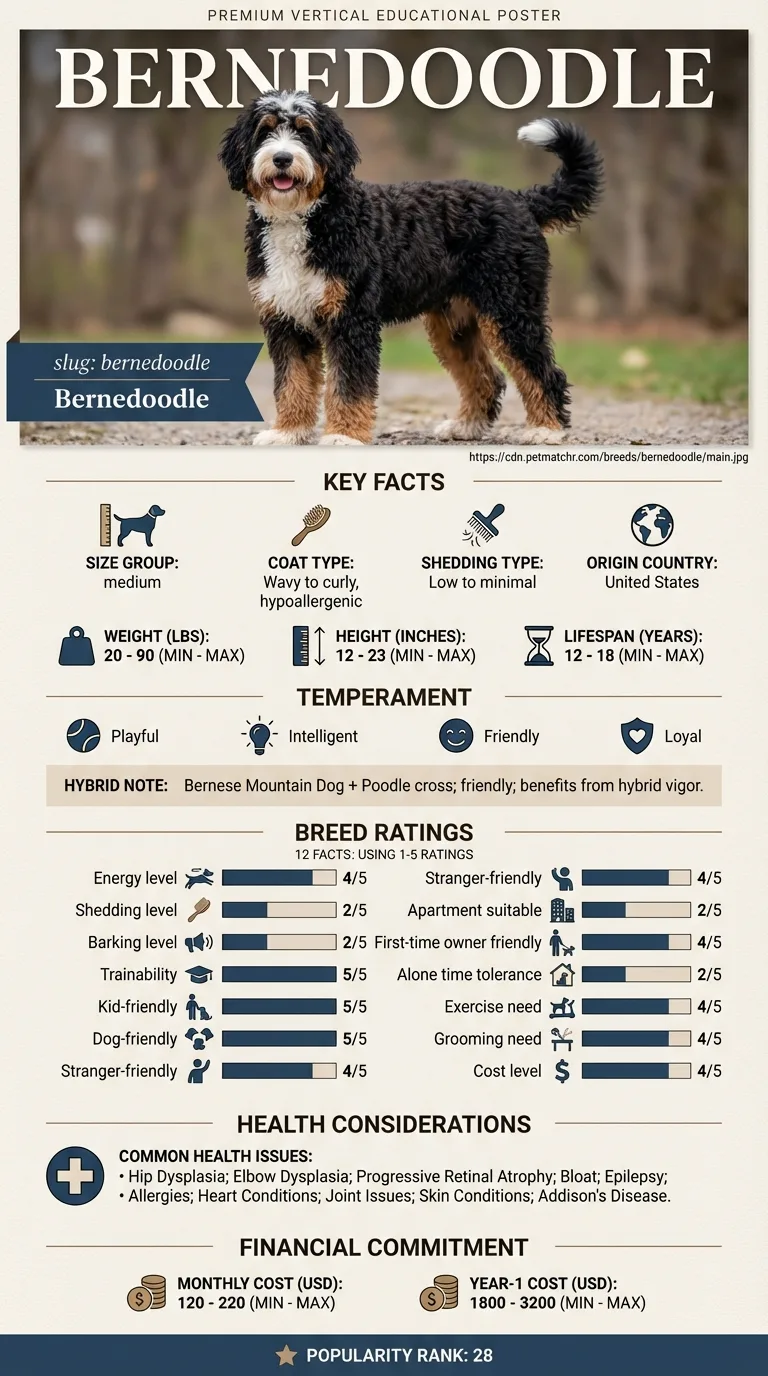
bernedoodle infographic

This page is for someone weighing a low-shedding family cross against a large northern working breed. It covers the two kinds of coat work, size and coat unpredictability, an unusually long lifespan range, temperament, and cost.

Quick verdict

The Bernedoodle is the easier temperament and the more variable animal with a much longer potential life; the Malamute is entirely predictable and asks far more of your legs.

Choose alaskan malamute if...

Choose the Alaskan Malamute if you want to know exactly what you are getting and would rather rake a coat than pay a groomer. It rates 5/5 with children like the Bernedoodle, 4/5 with strangers, and needs no professional grooming at all. You are accepting 5/5 shedding, 5/5 exercise, $150–$300 a month and a 1/5 apartment rating.

Choose bernedoodle if...

Choose the Bernedoodle if shedding is the deciding factor and you will fund grooming for life. It rates 5/5 for trainability, children and other dogs, 4/5 with strangers and for first-time owners, sheds at 2/5 and can live 12 to 18 years. You are accepting real uncertainty about adult size and coat.

Head-to-head comparison

Featurealaskan malamutebernedoodleWinner
Weight75–110 lbs20–90 lbsEqual
Height23–25 in12–23 inEqual
Lifespan10–14 years12–18 yearsbernedoodle
CoatThick double coatWavy to curlyEqual
Grooming needHigh (4/5)High (4/5)Equal
SheddingVery high (5/5)Low (2/5)bernedoodle
Energy levelHigh (4/5)High (4/5)Equal
Exercise needVery high (5/5)High (4/5)bernedoodle
TrainabilityModerate (3/5)Very high (5/5)bernedoodle
BarkingModerate (3/5)Low (2/5)bernedoodle
Good with kidsVery high (5/5)Very high (5/5)Equal
Good with other dogsModerate (3/5)Very high (5/5)bernedoodle
Friendly to strangersHigh (4/5)High (4/5)Equal
Apartment suitabilityVery low (1/5)Low (2/5)bernedoodle
Good for first-time ownersLow (2/5)High (4/5)bernedoodle
Tolerates being aloneLow (2/5)Low (2/5)Equal
Typical monthly cost$150–$300$120–$220bernedoodle
Typical first-year cost$2,000–$4,000$1,800–$3,200bernedoodle

Deep dive

Alaskan Malamute vs Bernedoodle: two 4/5 coats, two different jobs

The grooming ratings match at 4/5 and the shedding ratings sit at opposite ends, 5/5 against 2/5. That combination is worth unpacking because it is the heart of the comparison.

The Malamute's coat is a thick double coat that sheds constantly and blows its undercoat in sheets twice a year. The work is concentrated: an undercoat rake, several sessions, and a lot of hair. Between blows it needs little. It never mats and never needs a groomer, and it should never be clipped, because it insulates against heat as well as cold.

The Bernedoodle's coat does the opposite. Hair that dies stays in the curl rather than falling out, which is why it sheds so little and why it mats. The work is continuous: combing to the skin several times a week and a professional groom every six to eight weeks, for the whole of a potentially very long life.

One coat costs you a vacuum cleaner. The other costs you a standing appointment. Neither is low effort, and choosing between them is really choosing which kind of effort you would rather make.

Why the range says 20 to 90 pounds

That is not a typographical oddity. A Bernedoodle is a Bernese Mountain Dog crossed with a Poodle, and the Poodle may be Toy, Miniature or Standard. Later-generation crosses compound the variation further.

Coat is equally variable. Some Bernedoodles inherit a flatter, Bernese-type coat and shed substantially, which defeats the main reason people choose the cross.

The questions that reduce the uncertainty are specific. What generation is this litter? What size were the Poodle ancestors? Have previous puppies from these parents shed? Can you meet both parents and see their coats? A breeder who answers precisely is worth paying for; one who answers with adjectives is not.

Health testing varies just as widely, because this is not a standardised breed with an agreed protocol. Ask for hip and elbow scores on both parents, eye certification, cardiac examination and DNA panels appropriate to each parent breed. A hybrid does not automatically escape either parent's problems.

The Malamute's ratings describe every Malamute. That predictability is worth something real, and it is the one thing a cross cannot offer.

Twelve to eighteen years, and why the range is so wide

The Bernedoodle's lifespan range is the widest on this site, and both ends of it are informative.

The lower figure reflects the Bernese side. The Bernese Mountain Dog lives only 7 to 10 years, one of the shortest lifespans of any breed, largely because of an exceptional cancer burden. A large Bernedoodle from Standard Poodle lines will sit toward the lower end of the range.

The upper figure reflects the Poodle side and the smaller sizes, where 15 to 18 years is realistic.

So the size question is also the longevity question, and it is worth understanding before you choose a litter rather than afterwards.

A long life is also a long grooming commitment. Eighteen years of appointments every six to eight weeks is well over a hundred visits, and it should be in the budget from the start.

The Malamute's 10 to 14 years is narrower and more predictable, and its coat needs no professional attention across any of it.

Two sociable dogs, one much easier to teach

Children ties at 5/5 and strangers ties at 4/5. Both are demonstrative, friendly breeds and neither is any use as a guard — the Malamute in particular will greet an intruder happily.

The Bernedoodle is the easier dog to live with in almost every other respect: 5/5 for trainability against 3/5, 5/5 with other dogs against 3/5, 4/5 for first-time owners against 2/5, and 2/5 barking against 3/5.

Its drive is real but manageable at 4/5 exercise — around ninety minutes a day with some mental work, which suits the Poodle half.

The Malamute wants two hours and it wants to pull, and it is satisfied by physical output alone.

Both rate 2/5 for solitude and neither suits an empty house without cover. Absence training from week one applies to either.

The Malamute's other social complication is same-sex intolerance with other dogs, which usually surfaces at social maturity around two years old rather than in puppyhood.

Health lists and running costs

The Bernedoodle's list reflects both parents: hip and elbow dysplasia, joint issues, progressive retinal atrophy, bloat, epilepsy, allergies, skin conditions, heart conditions and Addison's disease.

Addison's is the one worth learning to recognise — the adrenal glands stop producing enough of the hormones that regulate salt, water and the stress response, producing vague relapsing illness that resolves and returns, often worse after a stressful event. It is treatable and dangerous if missed.

The Malamute's list runs to hip and elbow dysplasia, hypothyroidism, hereditary cataracts, progressive retinal atrophy, epilepsy, heart disease, bloat, inherited polyneuropathy and zinc-responsive skin disease. Polyneuropathy has a DNA test and belongs in any purchase conversation.

Both carry a real bloat risk and both households should know the signs: unproductive retching, a distending abdomen, restlessness.

On money the Bernedoodle runs $120–$220 a month against $150–$300, and $1,800–$3,200 against $2,000–$4,000 in the first year — before grooming, which only one of them needs.

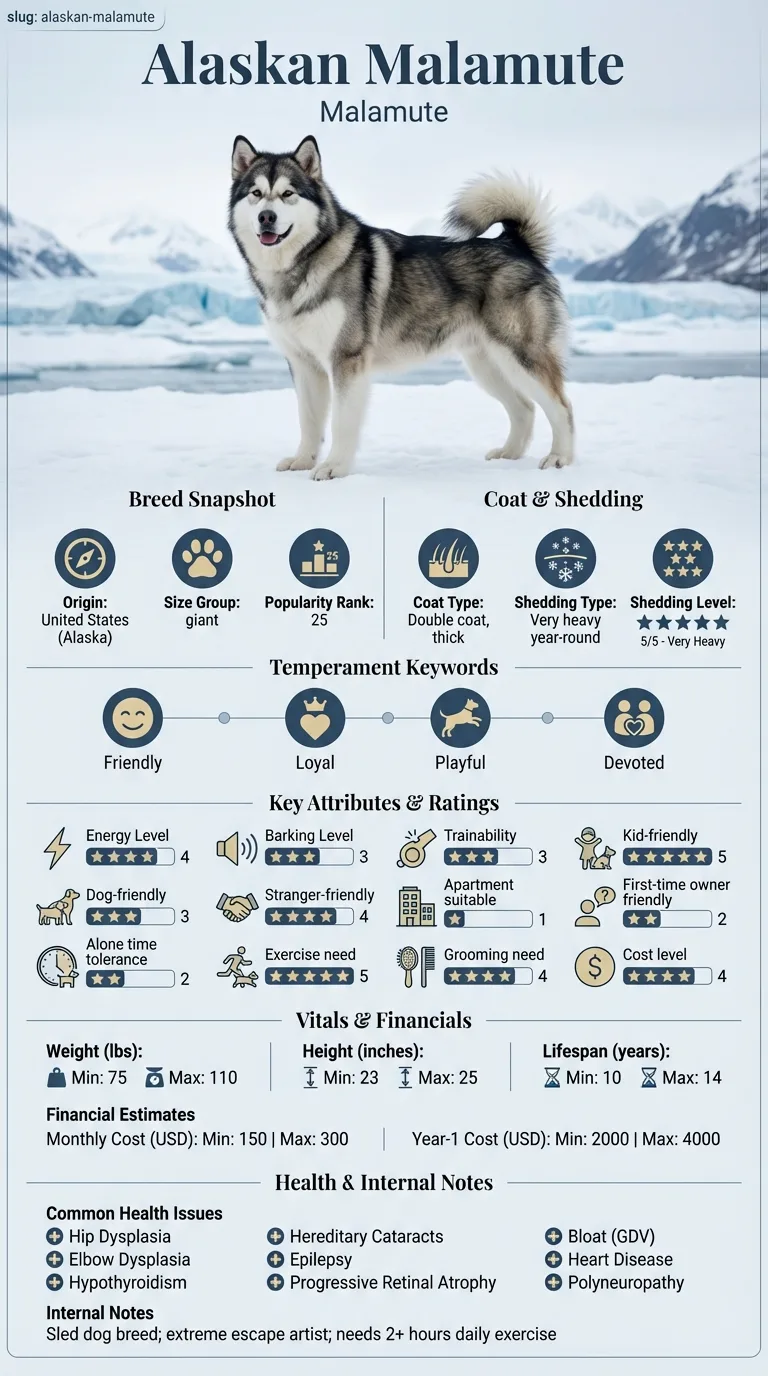
Alaskan Malamute vs Bernedoodle at a glance

Both breeds rate 4/5 for grooming, and that shared number hides two completely different jobs. The Malamute sheds at 5/5 and the work is raking a blown undercoat out twice a year with a bin bag at the end of it. The Bernedoodle sheds at only 2/5 and the work is combing a coat that never lets go of its dead hair, followed by a professional groom every six to eight weeks for the whole of a potentially long life.

The Bernedoodle is the easier temperament — 5/5 for trainability, children and other dogs — and the more uncertain animal, since its size and coat depend on which generation and which Poodle ancestor produced the litter. The Malamute is entirely predictable in size and temperament, but it needs two hours a day and a home with cold weather and secure fencing.

Choose the Malamute if you want to know exactly what you are getting. Choose the Bernedoodle if shedding is the deciding factor and you will fund grooming for life.

Frequently asked questions

Why do both breeds rate 4/5 for grooming?

Because they need different kinds of work in similar quantities. The Malamute needs an undercoat rake and several sessions during two heavy shedding periods a year. The Bernedoodle needs combing to the skin several times a week plus a professional groom every six to eight weeks, because a non-shedding coat mats.

Do Bernedoodles shed?

Usually very little at 2/5, against the Malamute's 5/5 — but it varies by generation and individual, and some inherit a flatter Bernese-type coat and shed substantially. Ask the breeder directly whether previous puppies from these parents have shed, and meet both parents to see their coats.

Why does the weight range span 20 to 90 pounds?

Because the Poodle parent may be Toy, Miniature or Standard, and later generations compound the variation. Ask what generation the litter is and what size the Poodle ancestors were. The answer also affects lifespan, since the smaller sizes sit at the top of the 12 to 18 year range.

Why is the Bernedoodle's lifespan range so wide?

Because the two parent breeds are so far apart. The Bernese Mountain Dog lives only 7 to 10 years, largely due to a heavy cancer burden, while Poodles are among the longest-lived breeds. A large Bernedoodle sits toward the lower end and a small one toward the upper.

What health testing should a Bernedoodle breeder have done?

Hip and elbow scores on both parents, eye certification, cardiac examination, and DNA panels appropriate to each parent breed. Because this is a cross rather than a standardised breed, testing varies enormously between breeders, and a hybrid does not automatically avoid either parent's problems.

Which is better with other dogs?

The Bernedoodle at 5/5 against the Malamute's 3/5. Malamute same-sex intolerance is common and usually appears at social maturity around two years old, in a dog that was fine as a puppy. Both are excellent with people and neither is any use as a guard dog.

Which is cheaper to keep?

The Bernedoodle on the headline figures — $120–$220 a month against $150–$300 — but neither number includes grooming, and only the Bernedoodle needs a groomer. Across a life that can reach eighteen years, that is well over a hundred appointments to budget for.

Quick answers

View more answers
Living

Malamute vs Bernedoodle: which should I choose?

The Bernedoodle if shedding is the deciding factor and you will fund grooming for life. The Malamute if you want a predictable dog and would rather rake a coat twice a year than keep a standing appointment.

Costs

How much does each cost per month?

The Malamute runs $150–$300 a month and the Bernedoodle $120–$220, with first-year totals of $2,000–$4,000 and $1,800–$3,200. Neither figure includes the Bernedoodle's grooming.

Living

Which needs more exercise?

The Malamute at 5/5 against the Bernedoodle's 4/5 — around two hours of pulling work against ninety minutes with some mental work. The Malamute is satisfied by physical output alone; the Bernedoodle wants problems to solve as well.

Behavior

Which copes better with a working day?

Neither — both rate 2/5. Absence training from week one and a walker or day care for a full-time household apply whichever dog you choose.

Related DogBreedCompass guides

  • Alaskan Malamute breed guideThe Malamute profile covers exercise, containment and the breed's coat.
  • Bernedoodle breed guideThe Bernedoodle profile covers coat types, generations and health testing.
  • Malamute vs Bernese Mountain DogThe Bernese Mountain Dog is one half of the cross and explains the lower lifespan figure.
  • Akita vs GoldendoodleThe Goldendoodle is the other retriever-poodle cross worth weighing against it.
  • Bernedoodle bloat and GDVThe inherited conditions worth screening for before buying a Bernedoodle puppy.
  • Malamute bloat and GDVBloat is a genuine emergency in both breeds and every owner should know the signs.

Related guides

Important reminder

Health information here is general and is not veterinary advice. If your dog shows pain, sudden behaviour change, or worsening symptoms, consult a licensed veterinarian.

Some links on this site are affiliate links. We may earn a commission at no extra cost to you, and we only suggest products we believe are helpful for dog owners.

Find Your Perfect Breed

Match your lifestyle to the right dog.

Take quiz

Find your match

Not sure which breed is right for you? Take our 2-minute quiz to find out.

Take the quiz