Living
Akita vs Papillon: which should I choose?
The Papillon if you want a small dog you can genuinely train and will engage its brain daily. The Akita if you want quiet and a self-contained dog that needs no mental work at all.

Quick answer
Akita vs Papillon: which should I choose?
The Papillon if you want a small dog you can genuinely train and will engage its brain daily. The Akita if you want quiet and a self-contained dog that needs no mental work at all.
The Papillon rates 5/5 for trainability — the same as a Border Collie or a German Shepherd — in a body that weighs five to ten pounds. It also lives 14 to 16 years, the longest in this batch. It is by some distance the most capable small dog on this page, and it is nothing like a lap dog.
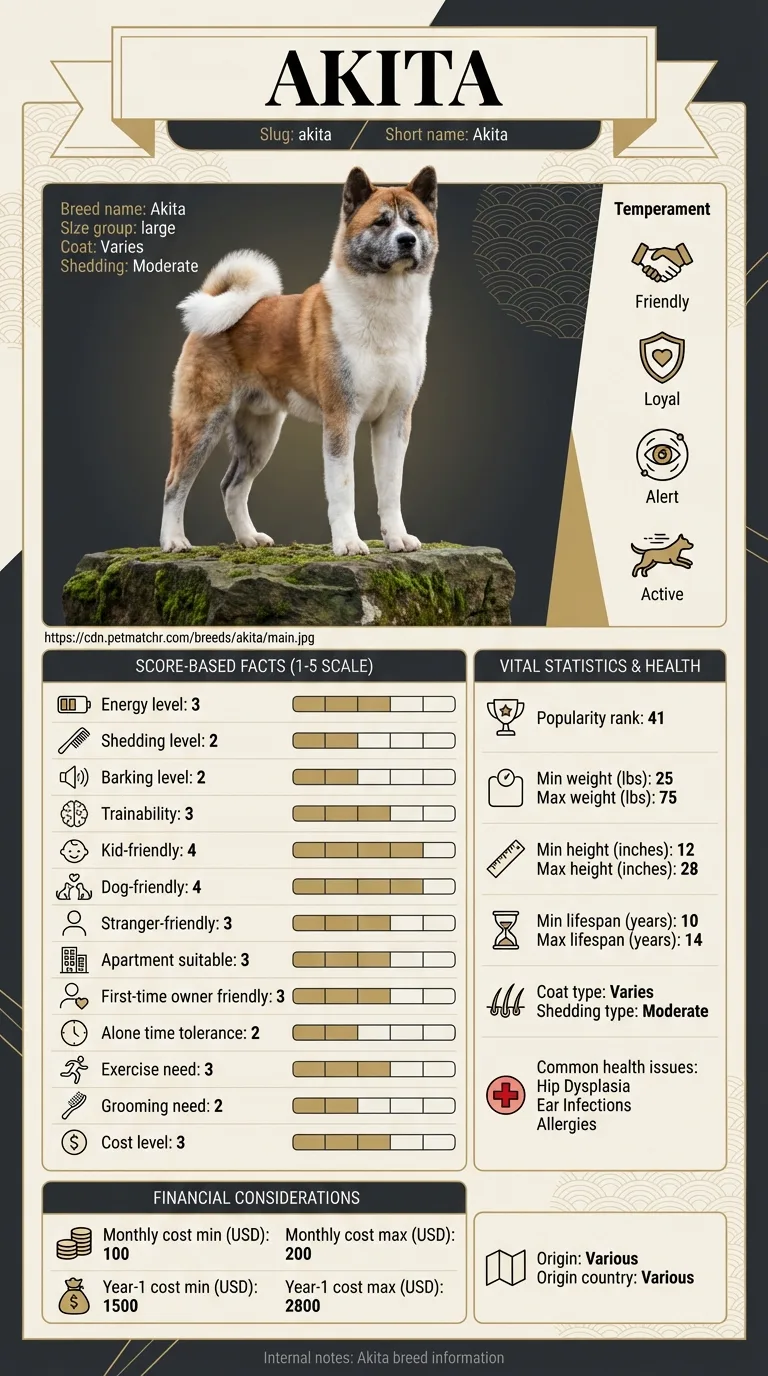
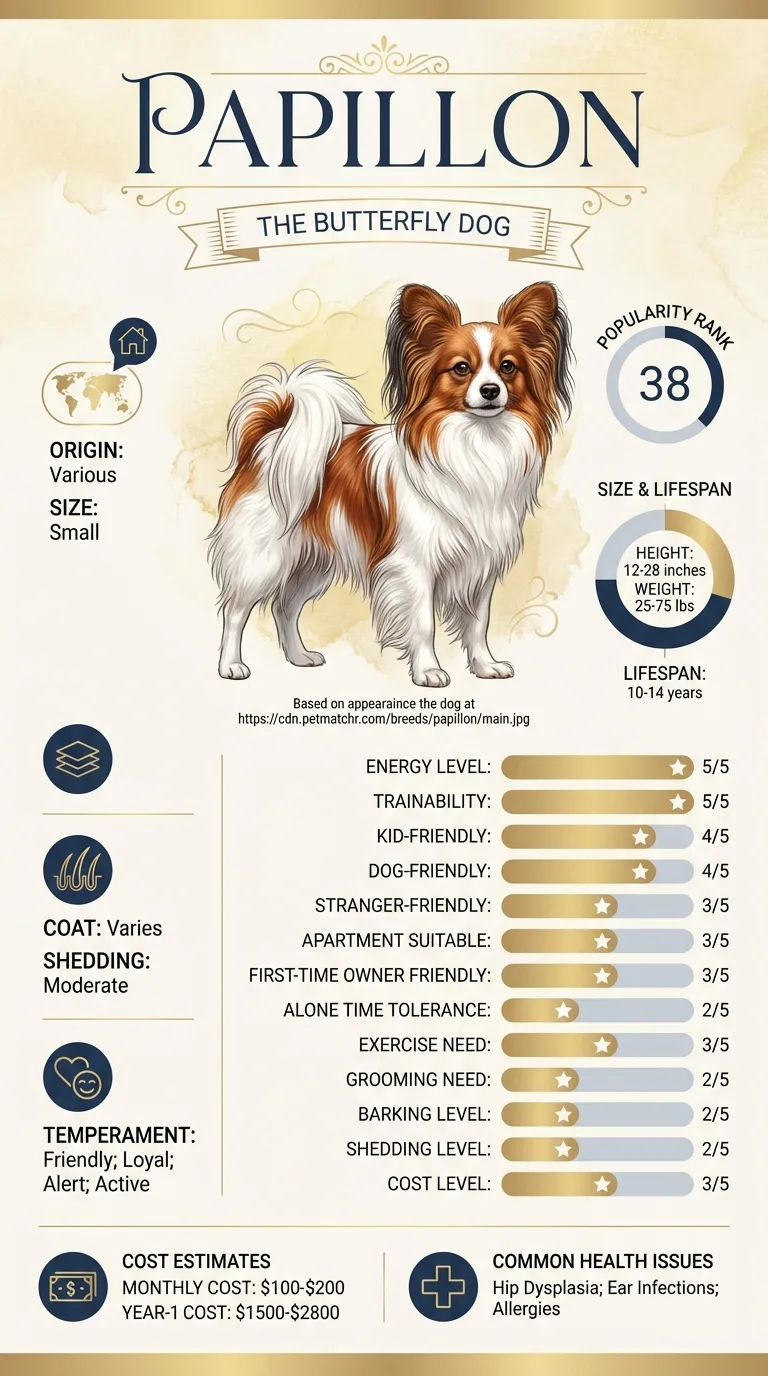
This page is for someone weighing a very small, very bright dog against a large guardian. It covers what 5/5 trainability means in a toy breed, the exercise requirement people underestimate, skull and windpipe fragility, barking, and cost.
The Papillon is the cheapest, longest-lived and most trainable dog in this comparison, and it needs far more mental work than its size suggests; the Akita needs less of everything except space and care.
Choose the Akita if you want quiet and a self-contained dog. It barks at 2/5 against the Papillon's 4/5 and tolerates being alone at 3/5 against 2/5. You are accepting 5/5 shedding, 1/5 for first-time owners, 2/5 with other dogs and strangers, $110–$240 a month and a much shorter life at 10 to 13 years.
Choose the Papillon if you want a small dog you can genuinely train and will engage its brain daily. It rates 5/5 for trainability, 5/5 for apartments, 4/5 with other dogs and strangers, grooms at only 2/5, lives 14 to 16 years and costs $80–$150 a month. You are accepting 4/5 barking and a fragile frame.
| Feature | akita | papillon | Winner |
|---|---|---|---|
| Weight | 70–130 lbs | 5–10 lbs | Equal |
| Height | 24–28 in | 8–11 in | Equal |
| Lifespan | 10–13 years | 14–16 years | papillon |
| Coat | Dense double coat | Long silky single coat | Equal |
| Grooming need | Moderate (3/5) | Low (2/5) | papillon |
| Shedding | Very high (5/5) | Low (2/5) | papillon |
| Energy level | Moderate (3/5) | High (4/5) | Equal |
| Exercise need | Moderate (3/5) | Moderate (3/5) | Equal |
| Trainability | Moderate (3/5) | Very high (5/5) | papillon |
| Barking | Low (2/5) | High (4/5) | akita |
| Good with kids | Moderate (3/5) | Moderate (3/5) | Equal |
| Good with other dogs | Low (2/5) | High (4/5) | papillon |
| Friendly to strangers | Low (2/5) | High (4/5) | papillon |
| Apartment suitability | Low (2/5) | Very high (5/5) | papillon |
| Good for first-time owners | Very low (1/5) | High (4/5) | papillon |
| Tolerates being alone | Moderate (3/5) | Low (2/5) | akita |
| Typical monthly cost | $110–$240 | $80–$150 | papillon |
| Typical first-year cost | $1,700–$3,200 | $1,100–$2,300 | papillon |
The Papillon consistently outperforms every other toy breed in agility and obedience, and it competes credibly against much larger working breeds. That rating is not a courtesy.
What it means for an owner is that this dog needs a job. Trick training, scent games, agility, obedience, puzzle feeders — a Papillon given fifteen focused minutes a day is a delight, and one given nothing becomes noisy, demanding and inventive about entertaining itself.
The 4/5 barking rating is closely connected. An under-occupied Papillon barks, and it has a sharp carrying voice for its size. A well-exercised, mentally engaged one is much quieter, so a good deal of the noise is within your control.
House-training is straightforward compared with most toy breeds, which is another consequence of the same intelligence.
The Akita at 3/5 is independent rather than slow, and needs no mental work at all. It will not invent a hobby if you fail to provide one, which for some households is precisely the point.
Two items on the Papillon's list are structural and both change how you handle the dog.
Open fontanel — a molera — is a soft spot where the skull bones have not fully fused. Many close in the first months; some never do. A dog with a persistent opening has an unprotected area of skull, so falls from furniture, rough handling and knocks to the head carry real risk. Ask the breeder, and ask your vet to check it.
Collapsing trachea is the second. The cartilage rings supporting the windpipe soften and flatten, producing a characteristic honking cough that worsens with excitement or pressure on the throat. The practical rule is absolute: a harness, never a collar, for the whole life of the dog.
Patellar luxation — a kneecap slipping out of its groove — and progressive retinal atrophy, which has a DNA test, complete the list alongside dental disease.
That last one is the routine cost. Crowded teeth in a small jaw mean daily brushing genuinely reduces the number of anaesthetics across a sixteen-year life.
The Akita's burden is autoimmune and endocrine, with hip dysplasia and bloat.
The Papillon rates 4/5 with other dogs and 4/5 with strangers, which makes it easy to take places, and it is not a fearful or snappy toy breed when properly socialised.
That qualifier matters. Small dogs that are carried away from every situation that worries them never learn to handle any of them, and the result is a reactive adult. A Papillon should walk on pavements, meet calm dogs, and be treated like a dog rather than an accessory.
At 2/5 for solitude it is a closely bonded breed. It manages better than a Cavalier or a Havanese but a full working day without cover is not fair on it, and absence training from the first week is the right approach.
Prey drive is worth mentioning: this is a spaniel-descended dog and many will chase.
The Akita's 2/5 with strangers and 2/5 with other dogs are the opposite temperament, and its adult views arrive at social maturity around two years old rather than in puppyhood — which is why socialisation has to continue past the first year.
At $80–$150 a month and $1,100–$2,300 in the first year, the Papillon is among the least expensive dogs in this batch. The Akita runs $110–$240 and $1,700–$3,200.
Grooming is unusually easy for a long-coated breed — 2/5 — because the coat is single with no undercoat, so it does not mat the way a Maltese or a Havanese coat does. Brushing a couple of times a week, plus attention to the ear fringes and the trousers, covers it. Shedding is 2/5.
The predictable costs are dental work and, for some dogs, patella surgery. Both are small-breed norms rather than surprises.
The number that changes the arithmetic is lifespan. Fourteen to sixteen years is a long commitment, and it means the cheap monthly figure is paid for considerably longer than an Akita's more expensive one. Over a lifetime the totals are closer than they look.
On housing the Papillon rates 5/5 for apartments against 2/5, with the barking rating as the one caveat.
Exercise ties at 3/5 and children tie at 3/5. The exercise tie is the surprising one — a seven-pound dog needing the same daily activity as a hundred-pound guardian.
It is accurate. The Papillon rates 4/5 for energy and is an active, busy, athletic little dog rather than a cushion ornament. It needs proper walks and, more importantly, something to think about.
The children rating is 3/5 for both and means opposite things. The Papillon is fine-boned and genuinely at risk from a toddler; the Akita's caveat is size and guardian temperament.
The big separations are trainability at 5/5 against 3/5, lifespan at 14 to 16 years against 10 to 13, and barking at 4/5 against 2/5. The Papillon is a small dog with a big voice and a bigger brain.
On cost it is the cheaper option throughout: $80–$150 a month against $110–$240.

Yes — 5/5, the same rating as a Border Collie or a German Shepherd. Papillons consistently outperform every other toy breed in agility and obedience and compete credibly against much larger dogs. The corollary is that the breed needs a job; an unoccupied Papillon becomes noisy and inventive.
3/5 — the same as an Akita, which surprises most people. It rates 4/5 for energy and is a genuinely active dog rather than a lap ornament. Proper walks matter, and fifteen focused minutes of training or scent work a day matters more than the extra distance.
4/5, against the Akita's 2/5, and the voice is sharp and carrying for the size. It is closely tied to occupation — an under-stimulated Papillon barks and a well-exercised, mentally engaged one is much quieter — so a good deal of the noise is within an owner's control.
A soft spot where the skull bones have not fully fused, also called a molera. Many close in the first months and some never do. A dog with a persistent opening has an unprotected area of skull, so falls from furniture and knocks to the head carry real risk. Ask the breeder and have your vet check.
No — use a harness for life. Collapsing trachea appears on the breed's condition list, and pressure on a windpipe with softening cartilage makes it worse. The characteristic sign is a honking cough that gets worse with excitement or pulling on the lead.
The Papillon, at 14 to 16 years against the Akita's 10 to 13 — the longest lifespan in this batch. That is worth planning for: sixteen years of daily brushing of teeth, harness walks and a dog that still wants to think, right to the end.
Less than it looks — 2/5, against the Akita's 3/5. The Papillon's coat is single with no undercoat, so it does not felt the way a double or a cotton-textured coat does. Brushing a couple of times a week plus attention to the ear fringes and trousers is enough.
The Papillon if you want a small dog you can genuinely train and will engage its brain daily. The Akita if you want quiet and a self-contained dog that needs no mental work at all.
The Papillon runs $80–$150 a month and the Akita $110–$240, with first-year totals of $1,100–$2,300 and $1,700–$3,200 — though the Papillon is paid for three to six years longer.
The Papillon at 5/5 against the Akita's 2/5 — small, low-shedding and easy to exercise indoors as well as out. The caveat is 4/5 barking, which needs managing from the first week in a building with thin walls.
Yes, at 4/5 against the Akita's 2/5, provided they are socialised properly rather than carried away from every situation. Small dogs that are always lifted out of trouble never learn to handle it.
Secure checkout on Stripe. We never see your card.
7-day money-back guarantee. Instant access.
Health information here is general and is not veterinary advice. If your dog shows pain, sudden behaviour change, or worsening symptoms, consult a licensed veterinarian.
Some links on this site are affiliate links. We may earn a commission at no extra cost to you, and we only suggest products we believe are helpful for dog owners.
We research and check what we publish, but we do not warrant that any figure, date, price, or statement is accurate, complete, or current, and we accept no liability for any loss, cost, injury, or other harm arising from the use of this site. Use it as one reference among several. You remain responsible for your own decisions and for your dog's care - confirm anything that matters with a licensed veterinarian or another qualified professional before you act on it. Full disclaimer.
Match your lifestyle to the right dog.
Take quizNot sure which breed is right for you? Take our 2-minute quiz to find out.
Take the quiz