Costs
Which is cheaper to keep?
The Papillon, at $1,100–$2,300 in year one versus the Schnauzer's $1,300–$2,500.

Quick answer
Which is cheaper to keep?
The Papillon, at $1,100–$2,300 in year one versus the Schnauzer's $1,300–$2,500.
Miniature Schnauzer or Papillon? On paper they differ most on grooming need, and on the scales Miniature Schnauzer is the heavier at 11–20 lbs. Here is how the two compare on everything that shapes an ordinary week.
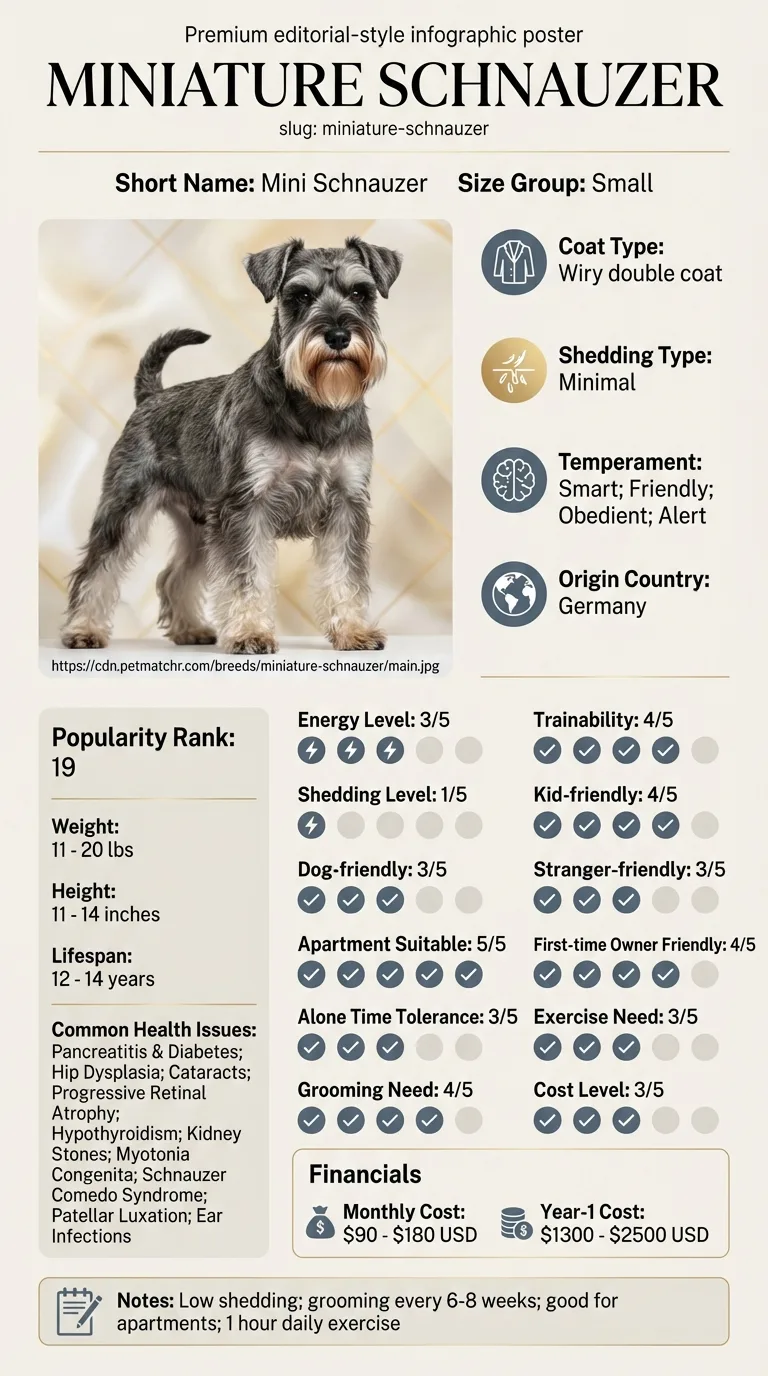
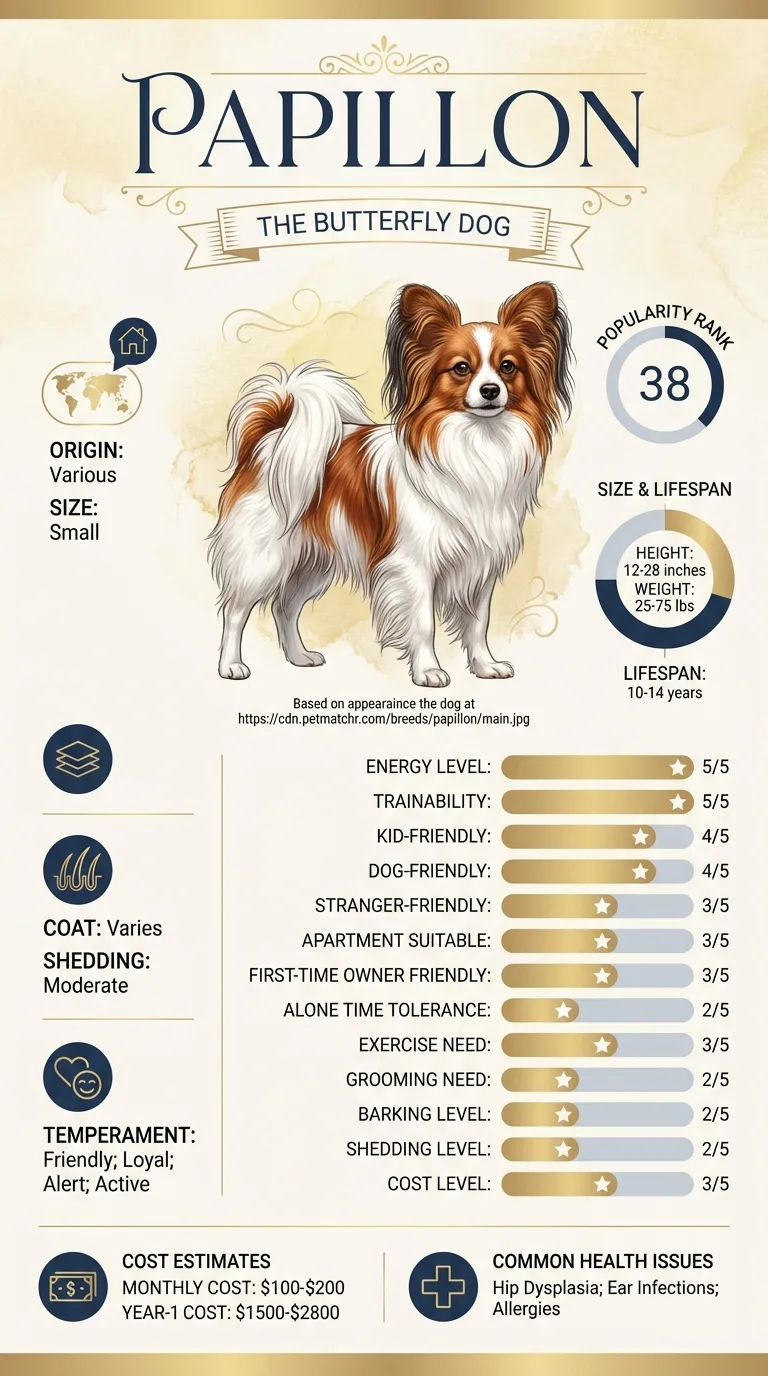
This is for someone already down to Miniature Schnauzer and Papillon and deciding between them. For this pair the decision usually turns on grooming need, so those are covered first and in most detail. Both rate 5/5 for flats, so housing does not settle this one. It is written for the decision rather than the breed history.
Between Miniature Schnauzer and Papillon, grooming need is what separates them, and Papillon is the lower-effort dog of the two to keep.
Choose Miniature Schnauzer if shedding is a problem in your house, the dog will be alone during the working day and there are young children at home.
Choose Papillon if you do not want a standing grooming appointment, you already have another dog and you want a dog that picks up training quickly.
| Feature | miniature schnauzer | papillon | Winner |
|---|---|---|---|
| Size class | small | small | Equal |
| Weight | 11–20 lbs | 5–10 lbs | Equal |
| Height | 11–14 in | 8–11 in | Equal |
| Lifespan | 12–14 years | 14–16 years | papillon |
| Exercise need | Moderate (3/5) | Moderate (3/5) | Equal |
| Grooming need | High (4/5) | Low (2/5) | papillon |
| Shedding | Very low (1/5) | Low (2/5) | miniature schnauzer |
| Energy level | Moderate (3/5) | High (4/5) | Equal |
| Barking | High (4/5) | High (4/5) | Equal |
| Apartment suitability | Very high (5/5) | Very high (5/5) | Equal |
| Good for first-time owners | High (4/5) | High (4/5) | Equal |
| Tolerates being alone | Moderate (3/5) | Low (2/5) | miniature schnauzer |
| Trainability | High (4/5) | Very high (5/5) | papillon |
| Good with kids | High (4/5) | Moderate (3/5) | miniature schnauzer |
| Good with other dogs | Moderate (3/5) | High (4/5) | papillon |
| Friendly to strangers | Moderate (3/5) | High (4/5) | papillon |
| Cost level | Moderate (3/5) | Low (2/5) | papillon |
| Coat | Wiry double coat | Long, silky single coat | Equal |
| Origin | Germany | Various | Equal |
| Typical monthly cost | $90–$180 | $80–$150 | Equal |
| Typical first-year cost | $1,300–$2,500 | $1,100–$2,300 | Equal |
Both breeds fall into the small size class, but there's still a real gap — the Miniature Schnauzer runs 11 to 20 pounds and 11 to 14 inches, while the Papillon is lighter at 5 to 10 pounds and shorter at 8 to 11 inches, roughly half the Schnauzer's weight. The Schnauzer's wiry double coat gives it a squared-off, bearded look, while the Papillon is named for its butterfly-shaped ears and carries a long, silky single coat instead of a double one. Anyone deciding between them is choosing between a sturdier terrier build and a more delicate toy-spaniel frame.
Exercise need ties at Moderate (3/5), but energy level nudges toward the Papillon at High (4/5) against the Schnauzer's Moderate (3/5) — a genuinely energetic toy breed that can outpace expectations set by its small size. The Schnauzer's Alert, Obedient nature channels energy into focused activity, while the Papillon's Quick-witted, Confident temperament shows up as near-constant motion and curiosity. Both fit into a moderate daily exercise routine, but owners should expect the Papillon to want more mental stimulation and play variety to match that higher energy rating.
Grooming need favors the Papillon at Low (2/5) against the Schnauzer's High (4/5), a genuine surprise given the Papillon's long, silky coat — its single-layer structure resists matting better than the Schnauzer's wiry double coat, which needs regular hand-stripping or clipping. Shedding runs the other way, Very low (1/5) for the Schnauzer versus Low (2/5) for the Papillon, though both numbers are low enough that neither breed leaves much hair behind. On balance the Papillon asks for less routine coat maintenance despite looking like the higher-upkeep dog in photos.
Both breeds tie at Very high (5/5) for apartment suitability and High (4/5) for barking, making them functionally similar choices for small-space living with one caveat: both are vocal. Neither the Schnauzer's Alert temperament nor the Papillon's Quick-witted, Confident nature suppresses a tendency to announce visitors and noises, so apartment dwellers should plan on some bark training regardless of which one they choose. Where they differ is tolerating time alone — Schnauzer Moderate (3/5), Papillon Low (2/5) — making the Papillon more prone to separation stress during long workdays.
Both breeds rate High (4/5) for first-time owner suitability, but the Papillon edges out the Schnauzer on raw trainability, Very high (5/5) against High (4/5) — Papillons are consistently ranked among the most trainable toy breeds, and its Quick-witted temperament backs that up. The Schnauzer's Obedient, Smart profile still trains readily, just with slightly more independence built in. For a new owner focused purely on how fast a dog picks up commands, the Papillon has a small statistical edge, though either breed rewards consistent, positive training.
With kids the Schnauzer rates higher, High (4/5) against the Papillon's Moderate (3/5), reflecting the Papillon's smaller, more delicate frame and lower tolerance for rough handling. The Papillon pulls ahead with other dogs (High 4/5 versus Moderate 3/5) and strangers (High 4/5 versus Moderate 3/5), its Friendly, Confident nature making it more outgoing in group settings than the Schnauzer's comparatively Alert, watchful style. A household with young kids may lean Schnauzer for durability; one that socializes frequently with other dogs and visitors may find the Papillon the smoother fit.
The Papillon edges ahead on lifespan, 14 to 16 years against the Schnauzer's 12 to 14, and its five-item health list — Patellar Luxation, Progressive Retinal Atrophy, Dental Disease, Open Fontanel, and Collapsing Trachea — is shorter than the Schnauzer's ten-item list, which adds Pancreatitis & Diabetes, Kidney Stones, and the breed-specific Myotonia Congenita and Schnauzer Comedo Syndrome. Both breeds share Patellar Luxation and Progressive Retinal Atrophy as common risks, so joint and eye monitoring matters for either. The Open Fontanel risk is worth flagging specifically to Papillon owners, since it's a toy-breed-specific skull development concern with no Schnauzer equivalent here.
Cost level favors the Papillon at Low (2/5) against the Schnauzer's Moderate (3/5), and the dollar ranges follow — $80–$150 monthly and $1,100–$2,300 in year one for the Papillon versus $90–$180 monthly and $1,300–$2,500 for the Schnauzer. The gap is modest rather than dramatic, mostly reflecting the Papillon's smaller food portions and lower grooming need (Low 2/5 versus the Schnauzer's High 4/5). Either breed sits toward the affordable end of the spectrum compared to larger dogs, but the Papillon comes in slightly cheaper across nearly every line item.
Miniature Schnauzer weighs 11–20 lbs and lives 12–14 years; Papillon weighs 5–10 lbs and lives 14–16 years. The two diverge most on grooming need. They are level on apartment suitability, barking and exercise need, so those cannot decide it. In the table, a "winner" means easier for an ordinary household — not better. Size, coat and origin are recorded without a verdict. Because both breeds are scored the same way, the gaps are reliable even where the absolute numbers are rough.

The Papillon, rated Very high (5/5) versus the Schnauzer's High (4/5), though both are considered easy for first-time owners.
Neither much — the Schnauzer is Very low (1/5) and the Papillon is Low (2/5), a small gap either way.
The Papillon, rated Low (2/5) against the Schnauzer's High (4/5), despite its long coat.
Yes, both rate Very high (5/5) for apartment suitability, though both also rate High (4/5) for barking, so noise is a shared consideration.
The Miniature Schnauzer, rated High (4/5) against the Papillon's Moderate (3/5), largely due to its sturdier build.
The Schnauzer, rated Moderate (3/5) versus the Papillon's Low (2/5).
The Papillon, typically 14–16 years, versus the Schnauzer's 12–14 years.
The Papillon, at $1,100–$2,300 in year one versus the Schnauzer's $1,300–$2,500.
The Papillon, rated High (4/5) versus the Schnauzer's Moderate (3/5).
The Miniature Schnauzer, at 11–20 lbs versus the Papillon's 5–10 lbs.
Neither more than the other — both rate High (4/5) for barking.
Secure checkout on Stripe. We never see your card.
7-day money-back guarantee. Instant access.
Health information here is general and is not veterinary advice. If your dog shows pain, sudden behaviour change, or worsening symptoms, consult a licensed veterinarian.
Some links on this site are affiliate links. We may earn a commission at no extra cost to you, and we only suggest products we believe are helpful for dog owners.
We research and check what we publish, but we do not warrant that any figure, date, price, or statement is accurate, complete, or current, and we accept no liability for any loss, cost, injury, or other harm arising from the use of this site. Use it as one reference among several. You remain responsible for your own decisions and for your dog's care - confirm anything that matters with a licensed veterinarian or another qualified professional before you act on it. Full disclaimer.
Match your lifestyle to the right dog.
Take quizNot sure which breed is right for you? Take our 2-minute quiz to find out.
Take the quiz