Living
Papillon or Cavalier overall?
For families with young kids, the Cavalier (5/5 with kids vs 3/5); for a quieter budget-friendly toy dog, consider the Papillon.

Quick answer
Papillon or Cavalier overall?
For families with young kids, the Cavalier (5/5 with kids vs 3/5); for a quieter budget-friendly toy dog, consider the Papillon.
Cavalier King Charles Spaniel or Papillon? On paper they differ most on barking, and on the scales Cavalier King Charles Spaniel is the heavier at 13–18 lbs. Here is how the two compare on everything that shapes an ordinary week.
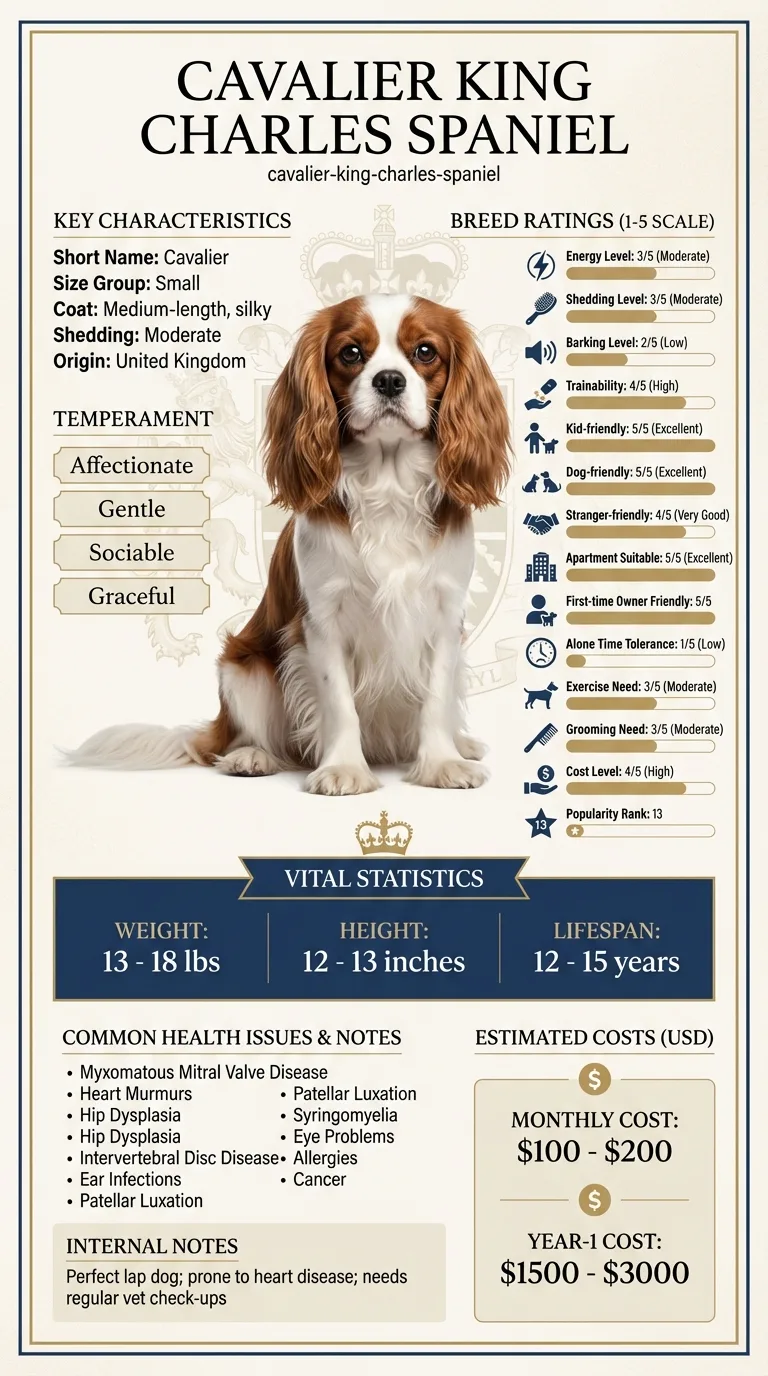
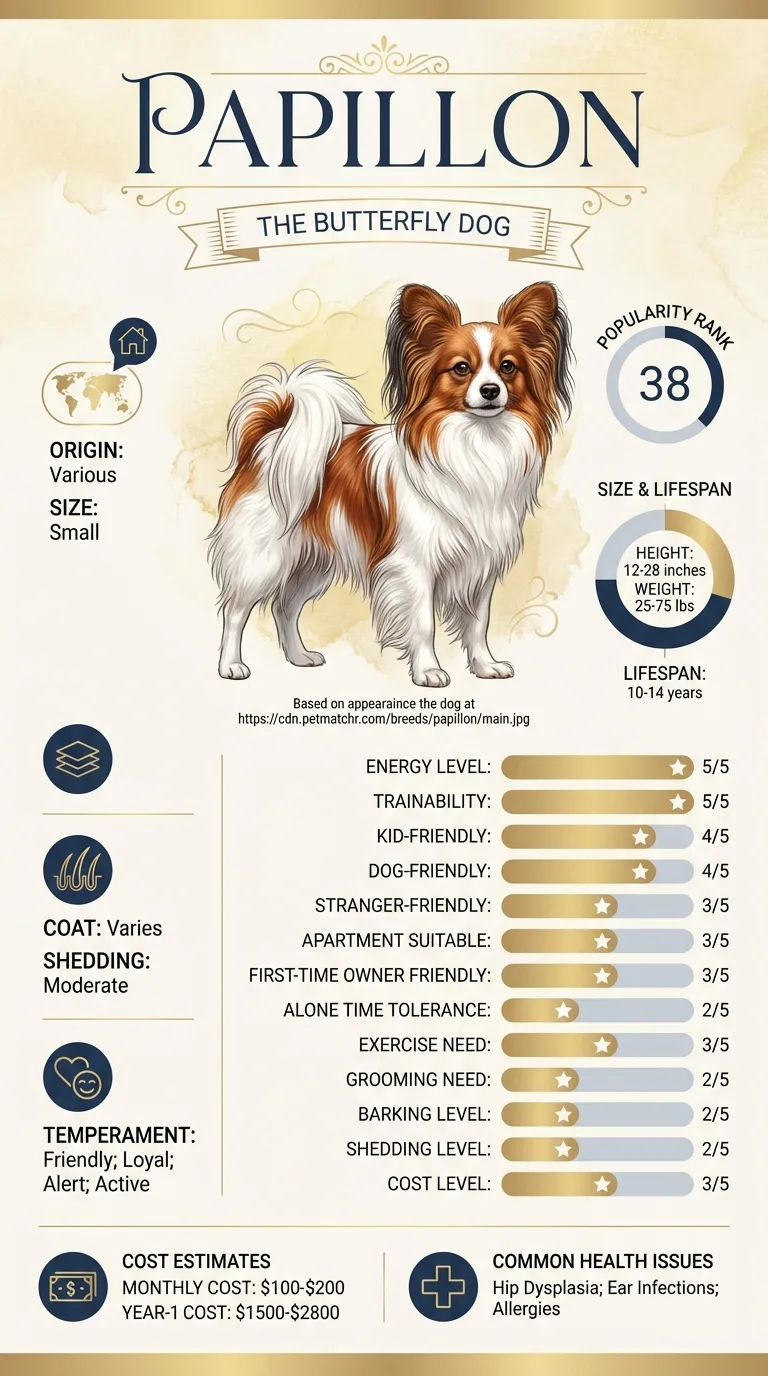
This is for someone already down to Cavalier King Charles Spaniel and Papillon and deciding between them. For this pair the decision usually turns on barking and good with kids, so those are covered first and in most detail. Both rate 5/5 for flats, so housing does not settle this one. There is no origin story here — only what changes about your week.
Between Cavalier King Charles Spaniel and Papillon, barking is what separates them, and Papillon is the lower-effort dog of the two to keep.
Choose Cavalier King Charles Spaniel if this is your first dog, there are young children at home and you already have another dog.
Choose Papillon if you do not want a standing grooming appointment, shedding is a problem in your house and you want a dog that picks up training quickly.
| Feature | cavalier king charles spaniel | papillon | Winner |
|---|---|---|---|
| Size class | small | small | Equal |
| Weight | 13–18 lbs | 5–10 lbs | Equal |
| Height | 12–13 in | 8–11 in | Equal |
| Lifespan | 12–15 years | 14–16 years | papillon |
| Exercise need | Moderate (3/5) | Moderate (3/5) | Equal |
| Grooming need | Moderate (3/5) | Low (2/5) | papillon |
| Shedding | Moderate (3/5) | Low (2/5) | papillon |
| Energy level | Moderate (3/5) | High (4/5) | Equal |
| Barking | Low (2/5) | High (4/5) | cavalier king charles spaniel |
| Apartment suitability | Very high (5/5) | Very high (5/5) | Equal |
| Good for first-time owners | Very high (5/5) | High (4/5) | cavalier king charles spaniel |
| Tolerates being alone | Very low (1/5) | Low (2/5) | papillon |
| Trainability | High (4/5) | Very high (5/5) | papillon |
| Good with kids | Very high (5/5) | Moderate (3/5) | cavalier king charles spaniel |
| Good with other dogs | Very high (5/5) | High (4/5) | cavalier king charles spaniel |
| Friendly to strangers | High (4/5) | High (4/5) | Equal |
| Cost level | High (4/5) | Low (2/5) | papillon |
| Coat | Medium-length, silky | Long, silky single coat | Equal |
| Origin | United Kingdom | Various | Equal |
| Typical monthly cost | $100–$200 | $80–$150 | Equal |
| Typical first-year cost | $1,500–$3,000 | $1,100–$2,300 | Equal |
Flip your assumptions here — the Papillon is the smaller of this pair, 5-10 lbs and 8-11 inches against the Cavalier's 13-18 lbs and 12-13 inches. That toy-breed frame plus those famous butterfly ears makes the Papillon delicate in a way the sturdier Cavalier isn't; small children and rough play are more of a concern with the smaller dog.
Exercise need ties at moderate (3/5), but energy level runs a touch higher for the Papillon, high (4/5) against the Cavalier's moderate (3/5). In practice that shows up as a livelier, more alert dog underfoot rather than a demand for long outdoor sessions — the Papillon's energy tends to burn off indoors.
The Papillon is the easier-care coat here: grooming rates low (2/5) against the Cavalier's moderate (3/5), and shedding follows the same pattern, low (2/5) versus moderate (3/5). That long silky single coat looks high-maintenance but doesn't mat or shed the way a Cavalier's does.
Both breeds tie at very high (5/5) for apartment suitability, so space isn't the deciding factor. Noise is: the Papillon barks high (4/5) against the Cavalier's low (2/5), a real consideration for thin apartment walls. Neither tolerates being left alone well — Cavalier very low (1/5), Papillon low (2/5) — so plan around a full workday either way.
Trainability favors the Papillon, very high (5/5) against the Cavalier's already-solid high (4/5) — it's one of the more trainable toy breeds around. First-time-owner suitability tilts the other way, very high (5/5) for the Cavalier against high (4/5) for the Papillon, largely a function of the Papillon's higher barking and smaller, more fragile build.
This is the pair's clearest divide: Cavaliers rate very high (5/5) with kids, Papillons only moderate (3/5) — their small size makes them more injury-prone around boisterous children. Cavaliers also edge ahead with other dogs, very high (5/5) against high (4/5), while both tie at high (4/5) with strangers.
The Papillon actually outlives the Cavalier here, 14-16 years against 12-15 — one of the longer lifespans among small breeds. Its health list runs shorter and lighter too: patellar luxation, dental disease, collapsing trachea, none of the cardiac or neurological severity that marks the Cavalier's list (mitral valve disease, syringomyelia). Patellar luxation is the one condition both share.
The Papillon is meaningfully cheaper to keep: cost level rates low (2/5) against the Cavalier's high (4/5), monthly $80-150 versus $100-200, and $1,100-2,300 versus $1,500-3,000 in year one. Smaller food portions and a generally lighter health-issue load both work in the Papillon's favor here.
Cavalier King Charles Spaniel weighs 13–18 lbs and lives 12–15 years; Papillon weighs 5–10 lbs and lives 14–16 years. The two diverge most on barking, good with kids and cost level. They are level on apartment suitability, exercise need and friendly to strangers, so those cannot decide it. Where the table declares a winner it means less work for the owner, nothing more; descriptive rows are left as ties on purpose. The value here is in the differences between the two columns; treat any single score as approximate.

The Papillon — 5-10 lbs against the Cavalier's 13-18 lbs, despite both being classed as small breeds. It's a genuine toy breed, roughly half the Cavalier's weight.
The Papillon, rated high (4/5) against the Cavalier's low (2/5). It's the more alert, vocal of the two, which matters if you're in an apartment with close neighbors.
Less so than the Cavalier — it rates moderate (3/5) against the Cavalier's very high (5/5). Its small, delicate frame makes it a better match for older, gentler children than for toddlers.
The Papillon, clearly — $80-150 a month against $100-200 for the Cavalier, and $1,100-2,300 versus $1,500-3,000 in the first year. It rates low (2/5) on overall cost level against the Cavalier's high (4/5).
The Papillon, 14-16 years against 12-15 for the Cavalier — a solid few extra years, and one of the better lifespans among toy breeds generally.
Patellar luxation is the main overlap. Otherwise the lists diverge sharply — the Cavalier carries serious cardiac and neurological risk (mitral valve disease, syringomyelia) that doesn't appear on the Papillon's shorter, milder list.
The Papillon, very high (5/5) against the Cavalier's high (4/5) — it's considered one of the most trainable toy breeds, competitive even in agility circles.
For families with young kids, the Cavalier (5/5 with kids vs 3/5); for a quieter budget-friendly toy dog, consider the Papillon.
The Papillon, $80-150 versus $100-200 for the Cavalier.
The Papillon, 14-16 years against 12-15 for the Cavalier.
The Papillon, rated high (4/5) against the Cavalier's low (2/5).
Secure checkout on Stripe. We never see your card.
7-day money-back guarantee. Instant access.
Health information here is general and is not veterinary advice. If your dog shows pain, sudden behaviour change, or worsening symptoms, consult a licensed veterinarian.
Some links on this site are affiliate links. We may earn a commission at no extra cost to you, and we only suggest products we believe are helpful for dog owners.
We research and check what we publish, but we do not warrant that any figure, date, price, or statement is accurate, complete, or current, and we accept no liability for any loss, cost, injury, or other harm arising from the use of this site. Use it as one reference among several. You remain responsible for your own decisions and for your dog's care - confirm anything that matters with a licensed veterinarian or another qualified professional before you act on it. Full disclaimer.
Match your lifestyle to the right dog.
Take quizNot sure which breed is right for you? Take our 2-minute quiz to find out.
Take the quiz