Behavior
Which one should I actually get?
If you want a dog that shares the Shepherd's trainability but fits a small home and modest budget, Papillon. If you want size, presence, and a more protective dog, Shepherd.

Quick answer
Which one should I actually get?
If you want a dog that shares the Shepherd's trainability but fits a small home and modest budget, Papillon. If you want size, presence, and a more protective dog, Shepherd.
German Shepherd or Papillon? On paper they differ most on apartment suitability, and on the scales German Shepherd is the heavier at 50–90 lbs. Here is how the two compare on everything that shapes an ordinary week.
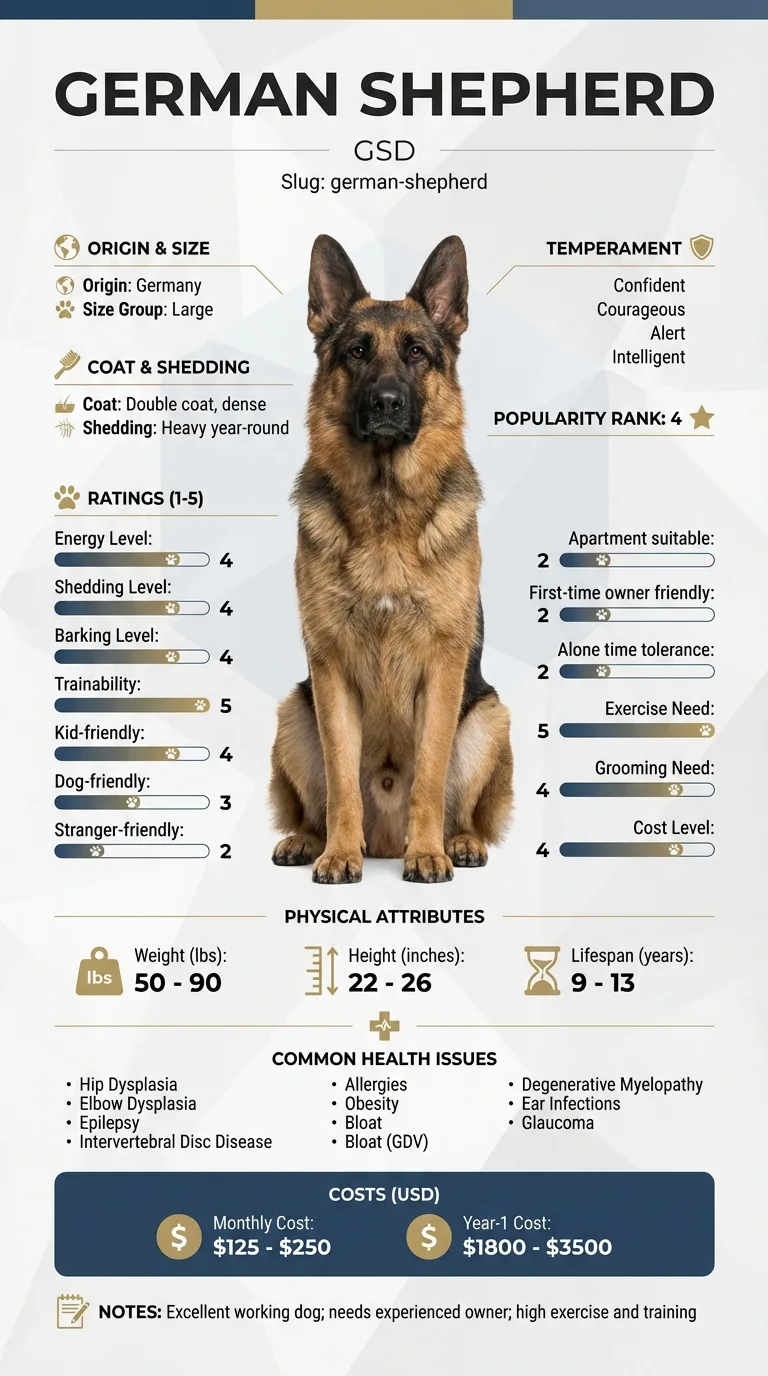
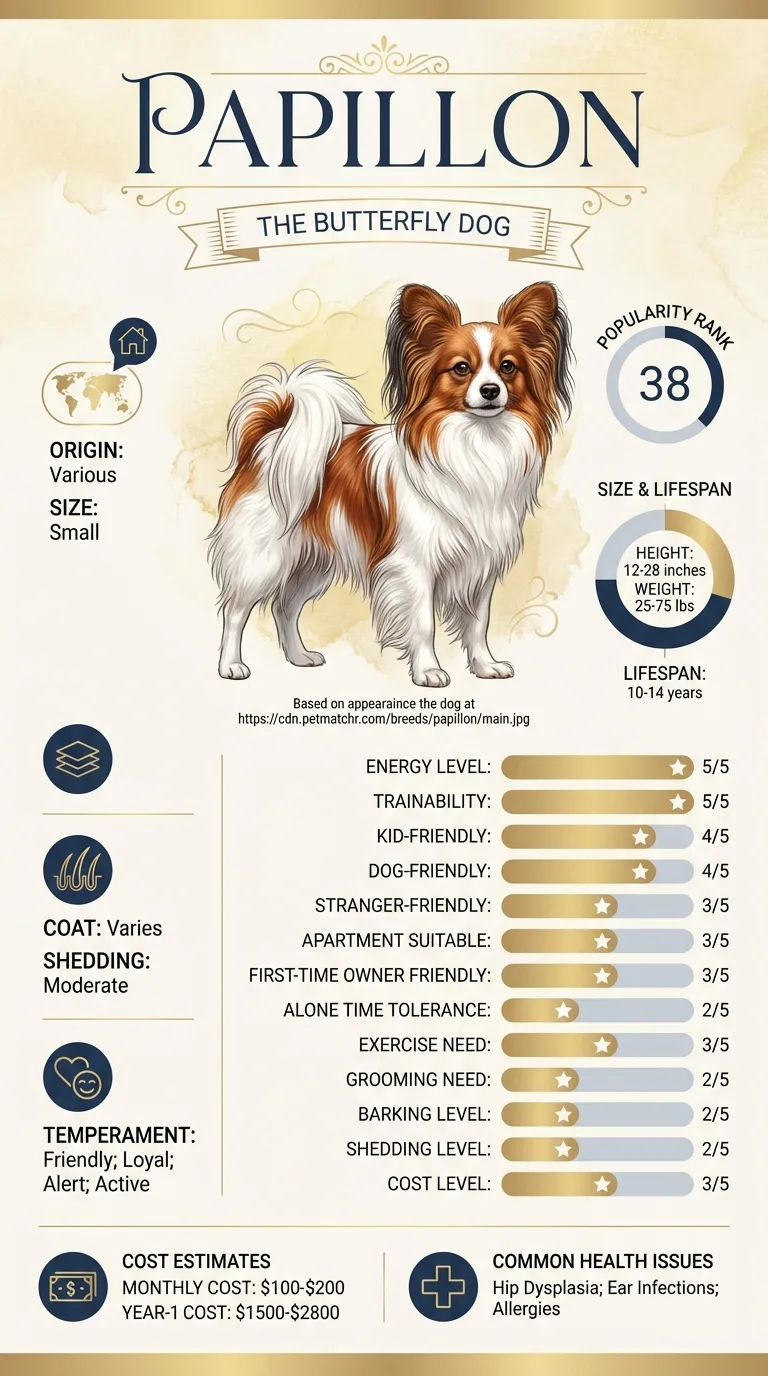
This is for someone already down to German Shepherd and Papillon and deciding between them. For this pair the decision usually turns on apartment suitability and exercise need, so those are covered first and in most detail. Anyone choosing from a flat has a clear answer here: Papillon rates 5/5 against 2/5. It is written for the decision rather than the breed history.
Between German Shepherd and Papillon, apartment suitability is what separates them, and Papillon is the lower-effort dog of the two to keep.
Choose German Shepherd if there are young children at home, you want a dog that can keep up with an active routine and you want a dog that is more watchful with visitors.
Choose Papillon if you are in a flat or a smaller home, this is your first dog and you do not want a standing grooming appointment.
| Feature | german shepherd | papillon | Winner |
|---|---|---|---|
| Size class | large | small | Equal |
| Weight | 50–90 lbs | 5–10 lbs | Equal |
| Height | 22–26 in | 8–11 in | Equal |
| Lifespan | 9–13 years | 14–16 years | papillon |
| Exercise need | Very high (5/5) | Moderate (3/5) | papillon |
| Grooming need | High (4/5) | Low (2/5) | papillon |
| Shedding | High (4/5) | Low (2/5) | papillon |
| Energy level | High (4/5) | High (4/5) | Equal |
| Barking | High (4/5) | High (4/5) | Equal |
| Apartment suitability | Low (2/5) | Very high (5/5) | papillon |
| Good for first-time owners | Low (2/5) | High (4/5) | papillon |
| Tolerates being alone | Low (2/5) | Low (2/5) | Equal |
| Trainability | Very high (5/5) | Very high (5/5) | Equal |
| Good with kids | High (4/5) | Moderate (3/5) | german shepherd |
| Good with other dogs | Moderate (3/5) | High (4/5) | papillon |
| Friendly to strangers | Low (2/5) | High (4/5) | papillon |
| Cost level | High (4/5) | Low (2/5) | papillon |
| Coat | Double coat, dense | Long, silky single coat | Equal |
| Origin | Germany | Various | Equal |
| Typical monthly cost | $125–$250 | $80–$150 | Equal |
| Typical first-year cost | $1,800–$3,500 | $1,100–$2,300 | Equal |
The gap here is extreme even by toy-breed standards: 5 to 10 lbs and 8 to 11 inches for the Papillon against 50 to 90 lbs and 22 to 26 inches for the Shepherd. You could plausibly fit four or five Papillons into one Shepherd's bodyweight.
Energy level actually ties at 4/5 for both breeds, the Papillon is not a couch potato despite its size. Exercise need is where the gap opens, 5/5 for the Shepherd against 3/5 for the Papillon, since a toy breed's shorter legs cover far less ground per walk even at the same energy output.
The Papillon is the lower-maintenance coat by a wide margin, 2/5 for both grooming and shedding, against the Shepherd's 4/5 on each. That long silky single coat lacks the dense undercoat that drives the Shepherd's year-round shedding, so brushing twice a week covers most of what the Papillon needs.
Barking ties at 4/5, so don't expect either dog to be the quiet type. Apartment suitability is where they split hard, 5/5 for the Papillon against 2/5 for the Shepherd, and the Papillon edges ahead on first-time-owner suitability too, 4/5 versus 2/5, though both share the same low 2/5 tolerance for being left alone.
Trainability ties at 5/5, the Papillon consistently ranks among the smartest toy breeds, and this comparison bears that out directly against a working breed known for the same trait. The real difference for a new owner is what that intelligence demands: a Shepherd needs a job and firm structure, a Papillon needs mental stimulation packed into a much smaller daily footprint.
The Shepherd actually wins with kids here, 4/5 against the Papillon's 3/5, a toy breed this small is easier to injure during rough play. Everywhere else the Papillon leads: 4/5 with other dogs against 3/5, and 4/5 with strangers against the Shepherd's wary 2/5.
The Papillon's 14-16 year lifespan is well ahead of the Shepherd's 9-13, and notably, none of the ten health risks listed for the Shepherd appear on the Papillon's list of five. The Papillon's risks run toward orthopedic and dental issues typical of tiny breeds, patellar luxation, dental disease, collapsing trachea, a genuinely different risk profile, not just a shorter version of the Shepherd's.
Cost level rates 4/5 for the Shepherd and just 2/5 for the Papillon, and the dollar figures track that closely, $125-$250 monthly against $80-$150, and first-year costs of $1,800-$3,500 versus $1,100-$2,300. A toy breed's food bill alone is a fraction of a large working dog's, and that adds up across a lifespan that's likely to run several years longer besides.
German Shepherd weighs 50–90 lbs and lives 9–13 years; Papillon weighs 5–10 lbs and lives 14–16 years. The two diverge most on apartment suitability, exercise need and grooming need and 4 other rated axes. They are level on tolerates being alone, barking and energy level, so those cannot decide it. In the table, a "winner" means easier for an ordinary household — not better. Size, coat and origin are recorded without a verdict. Because both breeds are scored the same way, the gaps are reliable even where the absolute numbers are rough.

Dramatically, 5-10 lbs against 50-90, and 8-11 inches against 22-26. This is one of the largest size gaps in any comparison on this site.
Yes, it ties the Shepherd at 5/5 for trainability, one of the highest scores a toy breed can get. Papillons are consistently ranked among the smartest small breeds.
No, none of the Shepherd's ten listed conditions appear on the Papillon's list of five. Their risk profiles are essentially unrelated, one skewed toward structural and neurological issues, the other toward small-breed orthopedic and dental problems.
The Papillon, rated 4/5 against the Shepherd's 2/5. Its lower exercise needs and smaller size make early handling mistakes much less consequential.
The Papillon, typically 14-16 years, several years beyond the Shepherd's 9-13.
The Papillon, by a wide margin, $80-$150 monthly against the Shepherd's $125-$250, and roughly half the first-year cost.
Moderately, it rates 3/5, actually behind the Shepherd's 4/5. Its small size makes it more vulnerable to injury from rough handling than a sturdier large breed.
If you want a dog that shares the Shepherd's trainability but fits a small home and modest budget, Papillon. If you want size, presence, and a more protective dog, Shepherd.
$125-$250 for the Shepherd versus $80-$150 for the Papillon, notably cheaper.
The Shepherd rates 5/5, the Papillon 3/5.
The Papillon, 14-16 years, versus the Shepherd's 9-13, a multi-year gap.
Secure checkout on Stripe. We never see your card.
7-day money-back guarantee. Instant access.
Health information here is general and is not veterinary advice. If your dog shows pain, sudden behaviour change, or worsening symptoms, consult a licensed veterinarian.
Some links on this site are affiliate links. We may earn a commission at no extra cost to you, and we only suggest products we believe are helpful for dog owners.
We research and check what we publish, but we do not warrant that any figure, date, price, or statement is accurate, complete, or current, and we accept no liability for any loss, cost, injury, or other harm arising from the use of this site. Use it as one reference among several. You remain responsible for your own decisions and for your dog's care - confirm anything that matters with a licensed veterinarian or another qualified professional before you act on it. Full disclaimer.
Match your lifestyle to the right dog.
Take quizNot sure which breed is right for you? Take our 2-minute quiz to find out.
Take the quiz