Health
Do Shelties carry the dwarfism gene variant?
No. They are proportionate small herding dogs with straight forelegs, and CDDY is not part of the breed's genetic profile.

Quick answer
Do Shelties carry the dwarfism gene variant?
No. They are proportionate small herding dogs with straight forelegs, and CDDY is not part of the breed's genetic profile.
Short legs and early disc disease travel together in dogs, and the reason is a single piece of duplicated genetic material. Knowing whether your breed carries it tells you a lot about what to expect from its spine.
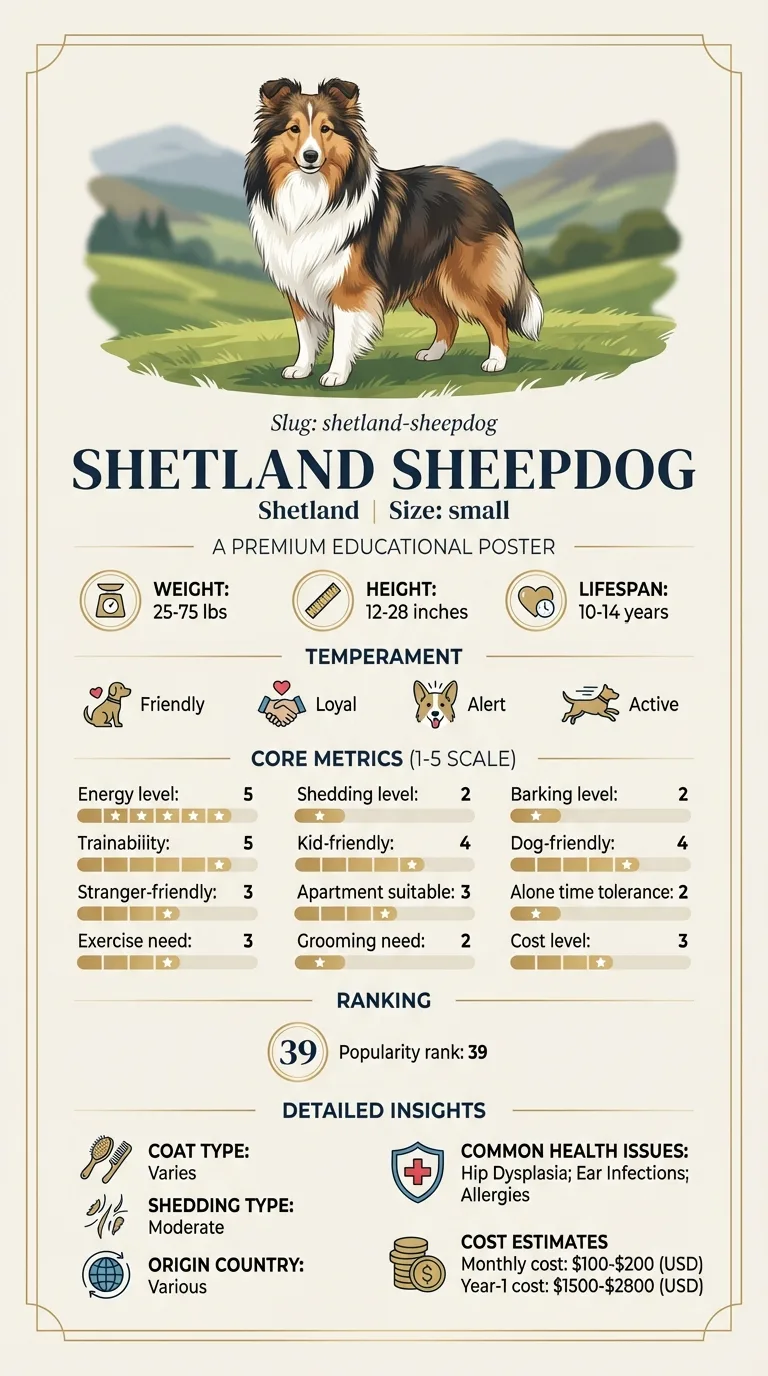
Owners who have seen a DNA panel offering a CDDY test and want to know whether to tick the box. People whose Sheltie has short-looking legs under a heavy coat and are wondering what that means. Anyone researching the genetics behind disc disease before choosing a breed.
This guide is not medical advice. If your dog shows pain, sudden behavior change, or worsening symptoms, consult a licensed veterinarian.
Some links may be affiliate links. We may earn a commission at no extra cost to you. We only suggest products we believe are helpful for dog owners.
We research and check what we publish, but we do not warrant that any figure, date, price, or statement is accurate, complete, or current, and we accept no liability for any loss, cost, injury, or other harm arising from the use of this site. Use it as one reference among several. You remain responsible for your own decisions and for your dog's care - confirm anything that matters with a licensed veterinarian or another qualified professional before you act on it. Full disclaimer.
Chondrodystrophy is a developmental pattern in which the long bones of the limbs stop growing early while the body develops normally, producing the short-legged silhouette of breeds such as the Dachshund, Corgi and Basset Hound. The variant known as CDDY carries a second consequence: the gel-like centre of the spinal discs mineralises during the first year of life, setting up sudden disc ruptures in young adults. The Shetland Sheepdog is not part of this group.
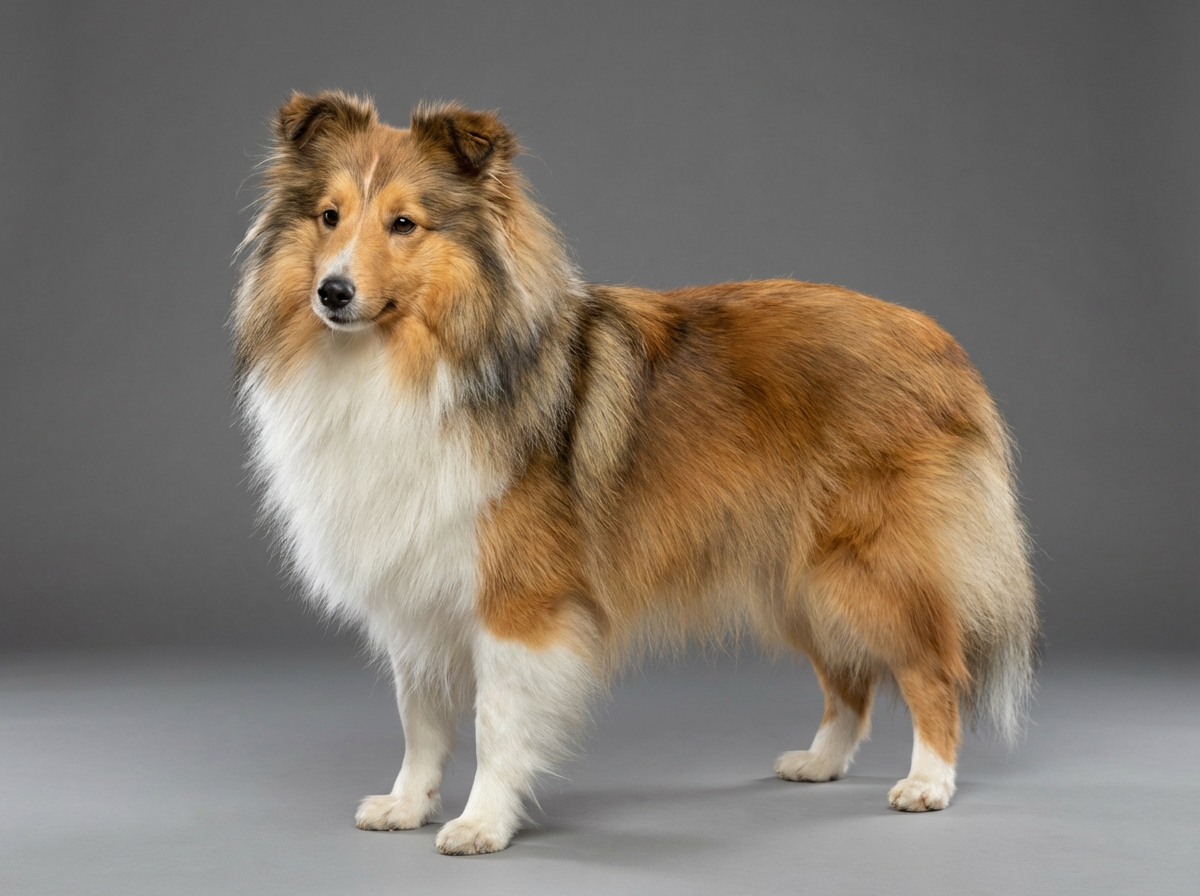
Not applicable in this breed in any practical sense. Chondrodystrophy does not appear among the five conditions documented for the Shetland Sheepdog, and the breed standard describes a proportionate dog of 13 to 16 inches with straight forelegs. The question arises for Sheltie owners almost entirely because coat volume creates a misleading silhouette, or because a DNA panel offers the test alongside dozens of others.
Nothing in the Shetland Sheepdog's development selected for shortened limbs. It was bred as a small working herding dog on rough ground, where proportionate legs and agility mattered, and the standard reflects that. The breed's genuinely documented structural condition is patellar luxation, which concerns how the kneecap groove forms rather than how the long bones grow. The one honest complication is coat: a long, dense double coat with a full ruff and heavy trousers visually shortens the leg, which is why owners ask this question about a breed that has no dwarfing at all.
Genetics determines limb proportion entirely, and no environmental factor changes it. Where environment matters is in what a spine has to absorb. For any dog, regardless of proportion, repeated jumping from furniture and car boots, slippery flooring that lets the hind legs splay, and carrying excess weight all load the discs. Those factors matter more in a chondrodystrophic dog whose discs are already compromised, and they still matter, more modestly, in a proportionate Sheltie.
Bring visibly bowed forelegs, outward-turning feet or a marked discrepancy between limb length and body size to a veterinary appointment, particularly in a puppy, since developmental bone abnormalities have causes worth identifying. Seek urgent care for any sudden hind limb weakness, dragging feet, inability to stand or loss of bladder control, which are spinal cord emergencies in any breed and are time critical. Ask your vet which DNA tests are actually relevant to your individual dog before buying a panel, and if your dog's parentage is uncertain and her conformation is atypical, ask specifically whether CDDY testing would change anything about her management.
See all Shetland Sheepdog health problems, which breeds are prone to chondrodystrophy cddy, or the full Shetland Sheepdog breed guide for temperament, exercise needs and ownership costs.
There is no condition here to treat and therefore no recovery timeline. A DNA test takes two to three weeks from swab to result. Building the habit of ramp use rather than jumping takes two to four weeks of consistent practice and then holds indefinitely.
Success is an accurate understanding of what your dog is and is not at risk of, a targeted set of tests rather than a broad and mostly irrelevant panel, and a household set up to reduce spinal impact for reasons that apply to any dog rather than to a genotype this breed does not carry.
A Shetland Sheepdog in full coat looks lower and longer than she is, because the ruff, the skirt and the trousers all fill in the outline. These are the actual measurements and checks.
Commercial canine DNA panels test for dozens of variants, and the honest reality is that many of them are irrelevant to any given breed. Testing a Shetland Sheepdog for CDDY produces a result that is almost always negative and that changes nothing about how you manage the dog. It is not harmful, and if it comes bundled in a panel there is no reason to object, but it is not a reason to buy a test.
The tests that genuinely earn their place in this breed map onto the conditions actually documented for it. MDR1 drug sensitivity is the standout, because the result changes veterinary decisions for the dog's whole life and it is a single permanent answer from a cheek swab. The variant associated with Collie Eye Anomaly is the second, particularly for anyone breeding, and it is complemented by specialist eye examination of the litter rather than replaced by it. Thyroid status is not a DNA test but is worth checking on bloodwork as the dog ages, since hypothyroidism is documented in the breed.
What this adds up to is a small, targeted list rather than a broad panel bought on the assumption that more information is better. If your budget allows one test, it is MDR1, and it is not close.
One caveat about mixed heritage. Dogs sold as Shelties are occasionally crosses, and a cross with a chondrodystrophic breed can carry CDDY. If your dog's parentage is uncertain and her forelegs are visibly bowed, a test becomes meaningful, because a positive result changes what you should watch for in her spine and how carefully you manage jumping.

Bracken's owner Lucy bought a comprehensive DNA panel when he was a year old, partly out of curiosity. It returned results for around forty variants, almost all of them clear and almost all of them irrelevant to a Shetland Sheepdog, including a negative CDDY result she had half expected to explain his short-looking legs. One result was not irrelevant. Bracken carried one faulty copy of MDR1. Lucy printed it, gave a copy to her practice and photographed it for her phone. Three years later he needed an emergency dental after breaking a tooth on a stone, and the out-of-hours clinic had the genotype in front of them before they premedicated him. Lucy's view is that thirty nine of the tests were entertainment and one of them was the reason to have bought it.
Key takeaway: Buy the test that changes a decision. For a Sheltie that is MDR1, and the dwarfism panel is a curiosity by comparison.
No. The breed has normal limb proportions and straight forelegs and is not classified as chondrodystrophic. That is why the early explosive disc disease seen in Dachshunds and Basset Hounds is not a Sheltie expectation.
Both are insertions of extra growth factor gene copies that shorten the legs. CDPA shortens legs only. CDDY shortens legs and also causes early calcification of the disc centres, which is what drives the disc ruptures. It is the second one that carries the spinal risk.
Not on its own. The expected result is negative and it would not change your management. Spend the money on the MDR1 test instead, which is documented in this breed and directly affects veterinary drug choices.
Look at her after a bath with the coat flat, and measure her height at the withers against the 13 to 16 inch range. Full coat makes almost every Sheltie look lower than she is. Genuinely bowed forelegs are a different matter and worth a veterinary opinion.
No. Proportionate breeds can still develop the slower, wear-related form of disc disease in middle and later life. It behaves differently, with gradual gait changes rather than sudden paralysis, but it is not impossible.
Then parentage matters. A cross with a chondrodystrophic breed can inherit CDDY, and if the forelegs are bowed a test becomes genuinely informative. Discuss it with your vet rather than assuming the Sheltie half is protective.
No. They are proportionate small herding dogs with straight forelegs, and CDDY is not part of the breed's genetic profile.
MDR1 drug sensitivity. It is documented in the breed, permanent, cheap and it changes veterinary decisions for life.
Thirteen to sixteen inches at the withers, weighing 15 to 25 pounds. Measure to the shoulder, not the top of the head.
Considerably. The ruff, skirt and trousers fill the outline, so assess proportions on a wet dog with the coat flat.
Mostly not for a purebred Sheltie. A targeted MDR1 and eye screening approach gives more useful information for less.
A one-page prep sheet for this condition: the signs, the questions to ask, what to get priced. Unlocks here.
You get: Vet visit prep sheet
No spam. One-click unsubscribe. See our privacy policy.
Preview page 1 before you decide.