Health
What is the emergency sign in a spinal problem?
Loss of the ability to stand or walk on the hind legs, or a bladder that is not emptying. Both mean an emergency hospital immediately.

Quick answer
What is the emergency sign in a spinal problem?
Loss of the ability to stand or walk on the hind legs, or a bladder that is not emptying. Both mean an emergency hospital immediately.
There is one question that decides everything about a spinal problem: is this pain, or is this pain plus a nervous system that has stopped working properly? The second one is a race against the clock.
Owners standing in a hallway watching their dog fail to get up. People whose Sheltie has developed a wobbly, scuffing hind gait over several months. Anyone weighing an expensive surgical decision against conservative management under time pressure.
This guide is not medical advice. If your dog shows pain, sudden behavior change, or worsening symptoms, consult a licensed veterinarian.
Some links may be affiliate links. We may earn a commission at no extra cost to you. We only suggest products we believe are helpful for dog owners.
We research and check what we publish, but we do not warrant that any figure, date, price, or statement is accurate, complete, or current, and we accept no liability for any loss, cost, injury, or other harm arising from the use of this site. Use it as one reference among several. You remain responsible for your own decisions and for your dog's care - confirm anything that matters with a licensed veterinarian or another qualified professional before you act on it. Full disclaimer.
Spinal problems in dogs range from a strained ligament to a spinal cord compressed by displaced disc material. The distinguishing feature is neurological function: whether the dog can still feel and control her hind legs, tail and bladder. Where that function is intact, the situation is painful but usually recoverable with rest. Where it is failing, every hour matters, because nerve tissue deprived of blood supply does not wait for a convenient appointment.
Uncommon in this breed as a formal diagnosis. Shetland Sheepdogs do not appear on the standard high-risk lists for intervertebral disc disease, and the five documented conditions for the breed are eye, drug, skin-muscle, thyroid and kneecap related rather than spinal. Given a typical lifespan of 12 to 14 years, gradual age-related spinal change is the version most owners will meet, if they meet any at all.
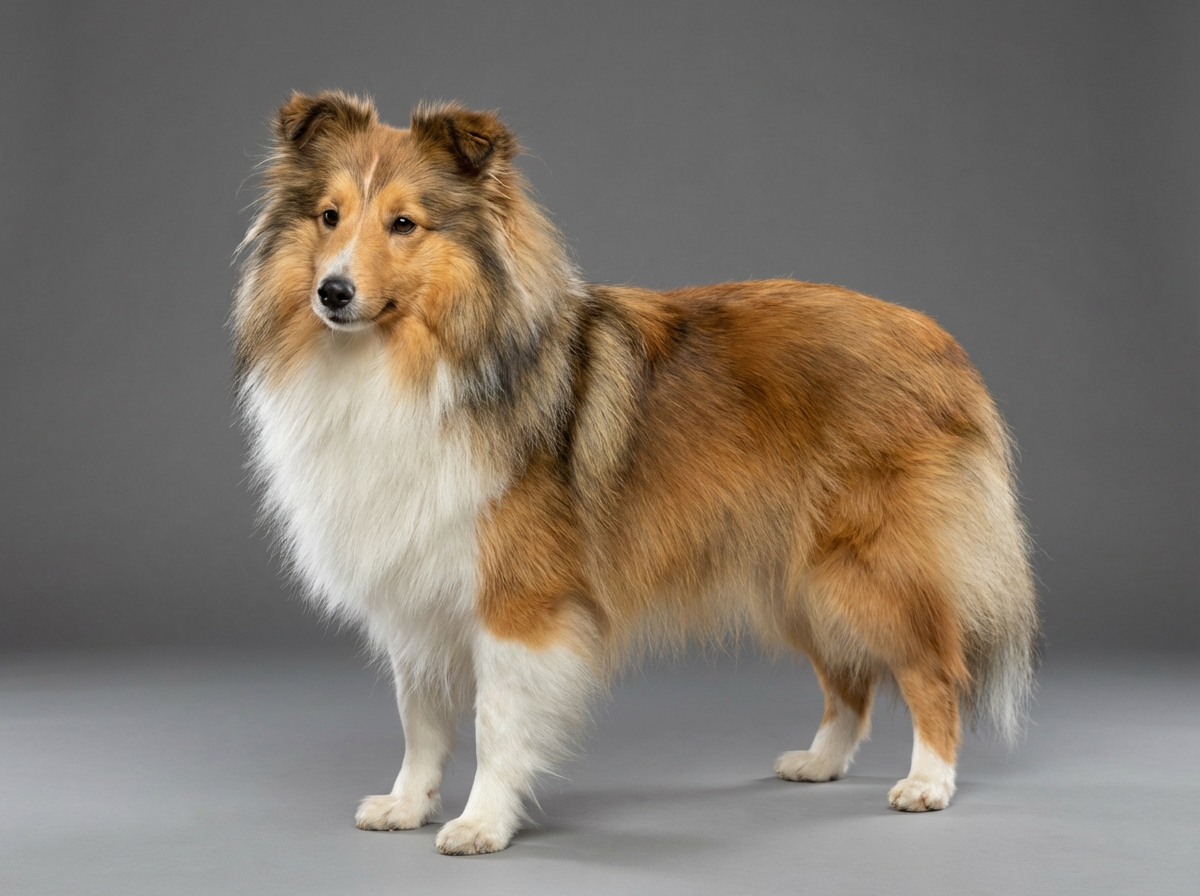
The Shetland Sheepdog does not carry the conformational risk that defines the classic disc breeds. Its limbs are proportionate, its back is not disproportionately long, and it weighs only 15 to 25 pounds, so the continuous compressive load on each disc is modest. What the breed brings instead is longevity and activity. Living to 14 gives ordinary wear time to accumulate, and an energy level rated four out of five with strong herding instinct means a lot of rotational movement over those years. Patellar luxation, documented in the breed, alters gait and shifts load through the spine in ways that add up.
Impact and traction dominate. Repeated jumping down from height loads the spine hard on landing, and smooth floors let the hind legs slide apart in exactly the way a spine is not designed to tolerate. Weight above the breed range is a continuous, silent stressor on every disc. Cold weather stiffens the surrounding musculature so the discs absorb more of any sudden movement. Households where the dog is inactive all week then exercised hard at weekends see the most injuries.
Drive to an emergency veterinary hospital immediately, at any hour, if your dog cannot stand or walk on her hind legs, is dragging her feet, has not urinated in twelve hours or is leaking urine, is crying continuously, or has become suddenly weak behind. Spinal cord compression is time critical and the outcome depends heavily on how quickly it is decompressed. Seek a same-day appointment for a hind gait that has become wobbly, crossing or scuffing even if the dog is still walking. Book within the week for a dog who is simply tense, hunched and reluctant to jump, and rest her strictly while you wait.
See all Shetland Sheepdog health problems, which breeds are prone to backspine issues, or the full Shetland Sheepdog breed guide for temperament, exercise needs and ownership costs.
Conservative management means four to six weeks of strict confinement followed by a gradual four week return to activity. Surgical cases are usually walking again within two to six weeks, with physiotherapy continuing for months. Gradual age-related change is managed indefinitely rather than resolved.
A dog who walks with even, deliberate hind foot placement, empties her bladder normally, and manages the daily route comfortably. Some dogs keep a slight sway or a scuff that never fully disappears, and that is a good outcome, not an incomplete one.
Veterinary neurologists grade spinal cord injury by function. You can make a rough assessment at home, and it directly determines how fast you need to move.
Disc disease comes in two broad forms. The explosive kind happens in chondrodystrophic breeds, where an inherited difference causes the soft disc centre to calcify early. A hardened disc can rupture suddenly and fire material into the spinal canal, often in a dog only three or four years old. That is the classic Dachshund emergency.
The second form is the slow one. The outer ring of the disc thickens and bulges gradually upward against the cord over months or years. Signs creep in rather than arriving overnight: a slightly unsteady hind end, scuffed nails on the outer toes, hesitancy on stairs, and a dog who has quietly stopped jumping. This form is what a middle-aged or older Sheltie is more likely to develop, and the gradual onset is precisely why it gets attributed to age.
That difference changes what you should watch for. A Sheltie owner is less likely to face a dog who was fine at breakfast and paralysed by lunch, and more likely to face a dog whose gait has been subtly deteriorating for a season. Filming your dog walking directly away from you every couple of months, on the same stretch of path, gives you a comparison that memory cannot provide.
Wherever the process ends up, sedation for imaging is part of getting an answer, and advanced imaging generally requires full anesthesia. The Shetland Sheepdog carries a documented MDR1 drug sensitivity, so having the genotype on file before a neurological crisis is one of the more useful things an owner can do in advance.

If you think your Shetland has back/spine issues, the plan is three steps: write down what you have seen and when it started, book a veterinary appointment rather than waiting for the next flare, and take video of the behaviour or symptom before you go — the thing you are worried about rarely happens in the consulting room. Screening in the parents covers collie eye anomaly, mdr1 drug sensitivity, dermatomyositis.
What the vet visit should produce is a diagnosis and a written plan, not just reassurance: what is being ruled out, what the monitoring interval is, and which signs mean you come back sooner. Ask what the treatment costs across a year rather than per visit, because that is the number that decides whether you are managing this condition or reacting to it.
Between appointments, keep a short log — dates, what you saw, what changed. It is the single most useful thing an owner brings to a follow-up, and for back/spine issues it is often what separates a clear pattern from a guess.
Corrie was ten and her owner Alasdair had noticed she seemed a bit unsteady behind, though he could never say when it had started. What eventually convinced him was a nail: the outer claw on her left hind was worn flat and split, and he found the same on the right. He filmed her walking away from him down the same lane and compared it with a clip from a family video eight months earlier. The difference was obvious. Investigation found chronic disc bulging in the lower back with mild cord compression. Corrie was managed conservatively with weight loss, a strict no-jumping rule, ramps everywhere and monthly physiotherapy. At twelve she still scuffs slightly and still walks two miles a day.
Key takeaway: Worn outer nails on the hind feet are evidence. Look at your dog's claws before you decide she is just getting old.
No. Disc disease is not on the breed's documented condition list, and Shelties lack the dwarfing conformation that drives early disc calcification. It happens, but as an individual event rather than a breed expectation.
The dog places a hind paw with the toes folded under, walking on the top of the foot for a moment before correcting. Look for worn or split nails on the outer two toes, which is the physical evidence left behind.
No. Dogs with pain only, or mild unsteadiness, are often managed conservatively with strict rest and medication. Surgery becomes the serious option when the dog cannot walk, and the case for it strengthens the faster function is being lost.
Genuinely strict, for the full duration your vet gives you, usually four to six weeks. Lead toilet breaks only, no stairs, no furniture, no running. Partial rest is the commonest reason a conservatively managed dog relapses.
Many do, particularly those who retain deep pain sensation. Recovery is measured in weeks to months and often needs physiotherapy. Dogs who have lost deep pain have a considerably poorer outlook, which is why that specific test is checked first.
Keep the dog still and supported in a flat carrier or box rather than letting her walk or be carried loosely. Do not give any painkiller from a cupboard. Phone ahead so the hospital knows a possible spinal case is coming.
Loss of the ability to stand or walk on the hind legs, or a bladder that is not emptying. Both mean an emergency hospital immediately.
Usually gradually, as a wobbly or scuffing hind gait over months, rather than the sudden collapse seen in long-backed dwarf breeds.
A short video of your dog walking away from you on the same path every couple of months. Gait change is nearly impossible to judge from memory.
Advanced imaging plus surgery and aftercare runs into thousands, orders of magnitude above the breed's usual monthly cost. Insurance before symptoms is the only practical answer.
Not directly, but teaching a dog to use a ramp instead of jumping down, and to walk rather than sprint on tile, removes real load.
A one-page prep sheet for this condition: the signs, the questions to ask, what to get priced. Unlocks here.
You get: Vet visit prep sheet
No spam. One-click unsubscribe. See our privacy policy.
Preview page 1 before you decide.