Living
Which breed should you choose overall?
Choose the Cocker if you want a friendlier dog around strangers and quieter neighbors; choose the Sheltie if trainability and a smaller footprint matter more than noise.

Quick answer
Which breed should you choose overall?
Choose the Cocker if you want a friendlier dog around strangers and quieter neighbors; choose the Sheltie if trainability and a smaller footprint matter more than noise.
English Cocker Spaniel or Shetland Sheepdog? On paper they differ most on barking, and on the scales English Cocker Spaniel is the heavier at 26–34 lbs. Here is how the two compare on everything that shapes an ordinary week.
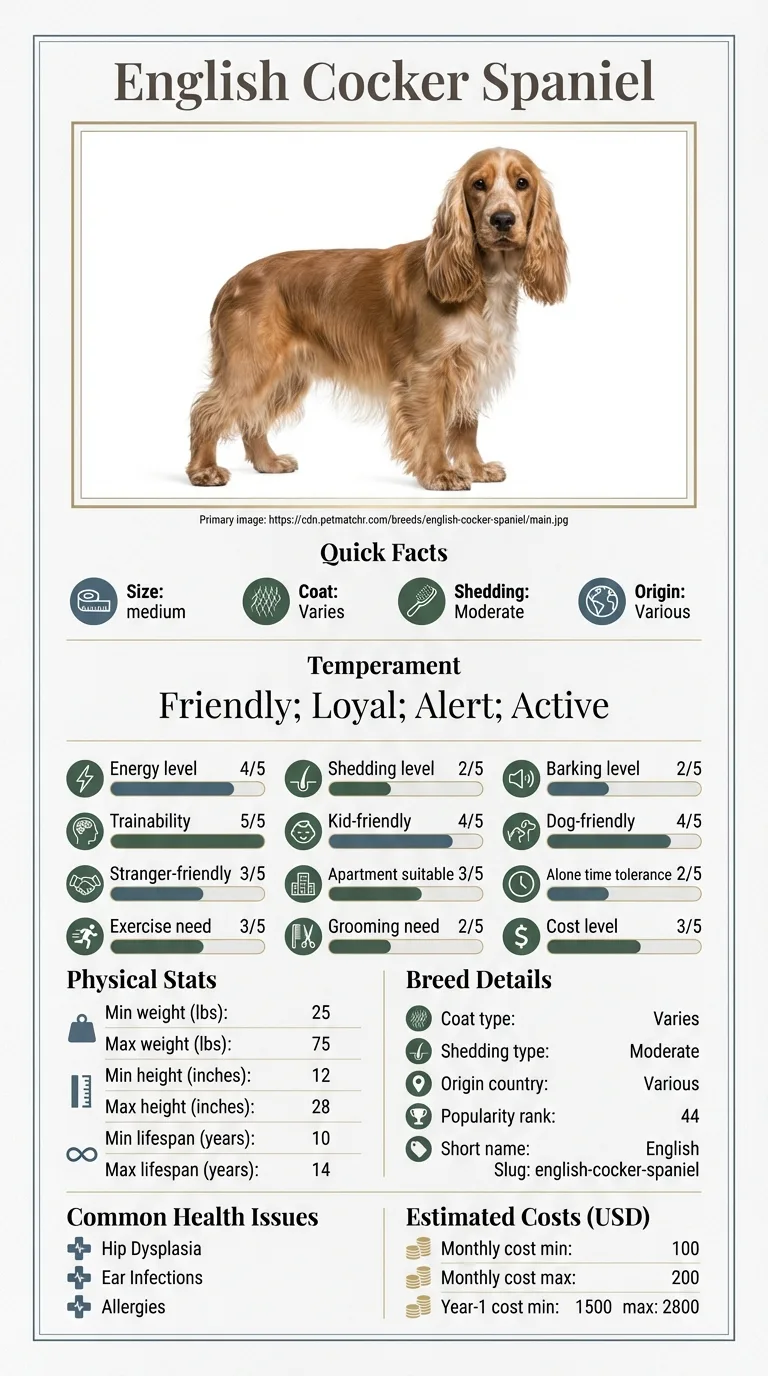
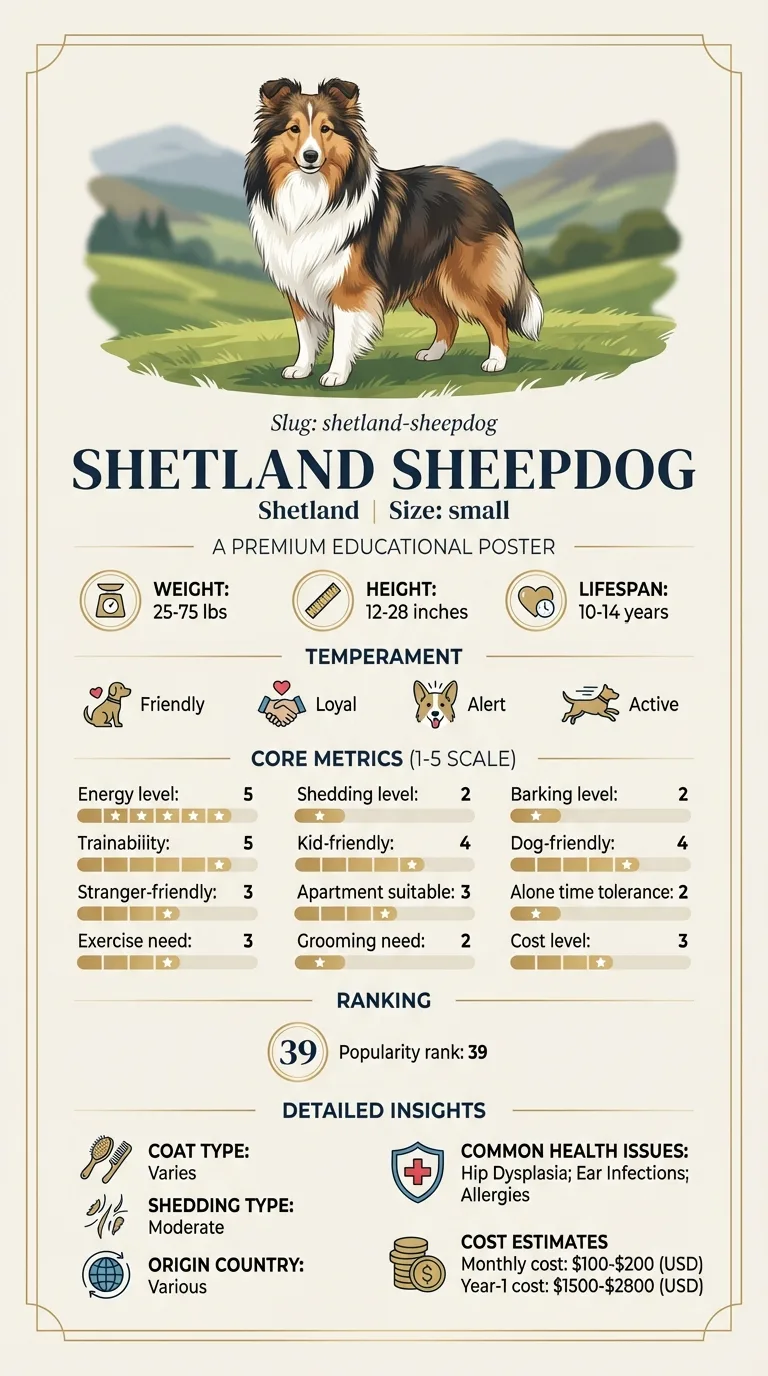
This is for someone already down to English Cocker Spaniel and Shetland Sheepdog and deciding between them. For this pair the decision usually turns on barking and friendly to strangers, so those are covered first and in most detail. Anyone choosing from a flat has a clear answer here: English Cocker Spaniel rates 4/5 against 3/5. The focus throughout is on daily consequences rather than breed background.
Between English Cocker Spaniel and Shetland Sheepdog, barking is what separates them, and English Cocker Spaniel is the lower-effort dog of the two to keep.
Choose English Cocker Spaniel if you are in a flat or a smaller home, shedding is a problem in your house and there are young children at home.
Choose Shetland Sheepdog if you want a dog that picks up training quickly, a smaller dog suits your car, your home or your back and you want a dog that is more watchful with visitors.
| Feature | english cocker spaniel | shetland sheepdog | Winner |
|---|---|---|---|
| Size class | medium | small | Equal |
| Weight | 26–34 lbs | 15–25 lbs | Equal |
| Height | 15–17 in | 13–16 in | Equal |
| Lifespan | 12–14 years | 12–14 years | Equal |
| Exercise need | High (4/5) | High (4/5) | Equal |
| Grooming need | High (4/5) | High (4/5) | Equal |
| Shedding | Moderate (3/5) | High (4/5) | english cocker spaniel |
| Energy level | High (4/5) | High (4/5) | Equal |
| Barking | Moderate (3/5) | Very high (5/5) | english cocker spaniel |
| Apartment suitability | High (4/5) | Moderate (3/5) | english cocker spaniel |
| Good for first-time owners | High (4/5) | High (4/5) | Equal |
| Tolerates being alone | Low (2/5) | Low (2/5) | Equal |
| Trainability | High (4/5) | Very high (5/5) | shetland sheepdog |
| Good with kids | Very high (5/5) | High (4/5) | english cocker spaniel |
| Good with other dogs | High (4/5) | High (4/5) | Equal |
| Friendly to strangers | High (4/5) | Low (2/5) | english cocker spaniel |
| Cost level | Moderate (3/5) | Moderate (3/5) | Equal |
| Coat | Medium, silky and feathered | Long, dense double coat | Equal |
| Origin | Various | Various | Equal |
| Typical monthly cost | $100–$200 | $80–$150 | Equal |
| Typical first-year cost | $1,400–$2,900 | $1,100–$2,300 | Equal |
The Sheltie is the smaller dog here despite its big, fluffy coat suggesting otherwise — 15 to 25 lbs and 13 to 16 inches, against the Cocker's 26 to 34 lbs and 15 to 17 inches. Size class reflects that: small for the Sheltie, medium for the Cocker. Under all that fur, a Sheltie is a genuinely compact dog.
No daylight between these two on activity level — both score 4/5 for exercise need and 4/5 for energy. Both were bred to work, the Cocker flushing birds and the Sheltie herding sheep, and both still carry that drive. Neither is a low-key breed; plan on a real daily outlet for whichever one you pick.
Grooming workload is tied at 4/5 for both breeds, but the Sheltie sheds more — 4/5 against the Cocker's 3/5 — thanks to a longer, denser double coat built for Scottish winters. Expect more brushing sessions and more fur in the house with the Sheltie specifically, even though the grooming time itself is similar.
The standout number here is barking: the Sheltie rates 5/5, the top of the scale, against the Cocker's moderate 3/5. Shelties were bred to herd with their voice, and that instinct doesn't switch off indoors. Apartment suitability follows the same pattern — Cocker at 4/5, Sheltie a step down at 3/5 — mostly because of the noise, not the size.
Both breeds are rated highly suitable for first-time owners (4/5 each). The Sheltie actually trains a notch easier — 5/5 versus the Cocker's 4/5 — a reflection of its herding-dog focus and sensitivity to correction. That same sensitivity means a Sheltie responds badly to harsh handling, so gentle, consistent training matters more with this breed.
Both dogs do well with other dogs (4/5 each), but the gap with people is wide. The Cocker is rated very high with kids (5/5) and high with strangers (4/5). The Sheltie scores a full point lower with kids (4/5) and drops sharply with strangers to just 2/5, consistent with its reputation as reserved and watchful around people it doesn't know.
Lifespan is identical on paper, 12 to 14 years for both breeds, so longevity isn't a differentiator. The health risks don't overlap at all in the data: the Cocker's list centers on ears, eyes, hips, and kidneys, while the Sheltie's includes MDR1 drug sensitivity and dermatomyositis, conditions tied specifically to herding-breed genetics.
Both breeds carry a moderate (3/5) cost rating, but the Sheltie runs cheaper in real numbers — $80 to $150 a month against the Cocker's $100 to $200, and $1,100 to $2,300 in the first year versus $1,400 to $2,900. The smaller body size accounts for most of that gap.
English Cocker Spaniel weighs 26–34 lbs and lives 12–14 years; Shetland Sheepdog weighs 15–25 lbs and lives 12–14 years. The two diverge most on barking and friendly to strangers. They are level on tolerates being alone, cost level and good with other dogs, so those cannot decide it. The table below marks a winner only where one breed is genuinely easier for a typical owner; size and origin are facts rather than merits and stay level. Ratings come from one source applied to both breeds, so they are meaningful against each other rather than as absolute scores.

The Sheltie is the smaller breed — 15 to 25 lbs and classed small — against the Cocker's medium 26 to 34 lbs.
Not the Sheltie — it rates 5/5 for barking, the highest score possible. The Cocker is more moderate at 3/5.
The Cocker, clearly — rated 4/5 against the Sheltie's 2/5. The Sheltie's reserved-around-strangers trait shows up directly in the data.
Yes, both rate 4/5 for first-time-owner suitability.
The Sheltie, at $80–150 a month against the Cocker's $100–200.
No overlap in the data — the Cocker's risks center on ears, eyes, hips, and kidneys, while the Sheltie's are tied to herding-breed genetics, including MDR1 drug sensitivity.
The Sheltie, rated 4/5 against the Cocker's 3/5.
Choose the Cocker if you want a friendlier dog around strangers and quieter neighbors; choose the Sheltie if trainability and a smaller footprint matter more than noise.
$80–150 for the Sheltie versus $100–200 for the Cocker — the smaller Sheltie runs a bit cheaper.
Tied at high (4/5) for both — expect a real daily outlet either way.
Tied at 12–14 years for both breeds.
Secure checkout on Stripe. We never see your card.
7-day money-back guarantee. Instant access.
Health information here is general and is not veterinary advice. If your dog shows pain, sudden behaviour change, or worsening symptoms, consult a licensed veterinarian.
Some links on this site are affiliate links. We may earn a commission at no extra cost to you, and we only suggest products we believe are helpful for dog owners.
We research and check what we publish, but we do not warrant that any figure, date, price, or statement is accurate, complete, or current, and we accept no liability for any loss, cost, injury, or other harm arising from the use of this site. Use it as one reference among several. You remain responsible for your own decisions and for your dog's care - confirm anything that matters with a licensed veterinarian or another qualified professional before you act on it. Full disclaimer.
Match your lifestyle to the right dog.
Take quizNot sure which breed is right for you? Take our 2-minute quiz to find out.
Take the quiz