Living
Which should you pick overall?
The Frenchie if noise and alone-time are concerns; the Sheltie if you want a highly trainable, budget-friendly dog and can manage the barking.

Quick answer
Which should you pick overall?
The Frenchie if noise and alone-time are concerns; the Sheltie if you want a highly trainable, budget-friendly dog and can manage the barking.
French Bulldog or Shetland Sheepdog? On paper they differ most on tolerates being alone, and on the scales French Bulldog is the heavier at 20–30 lbs. Here is how the two compare on everything that shapes an ordinary week.
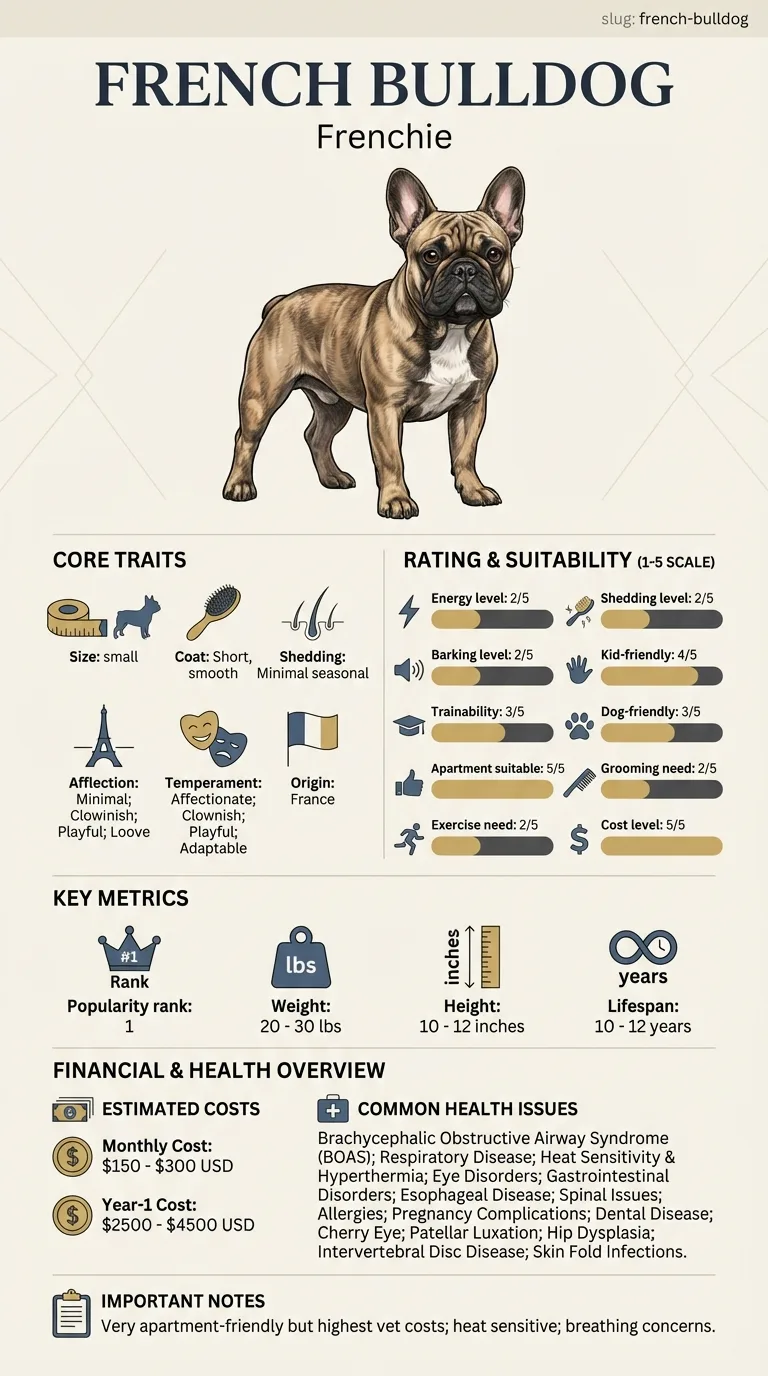
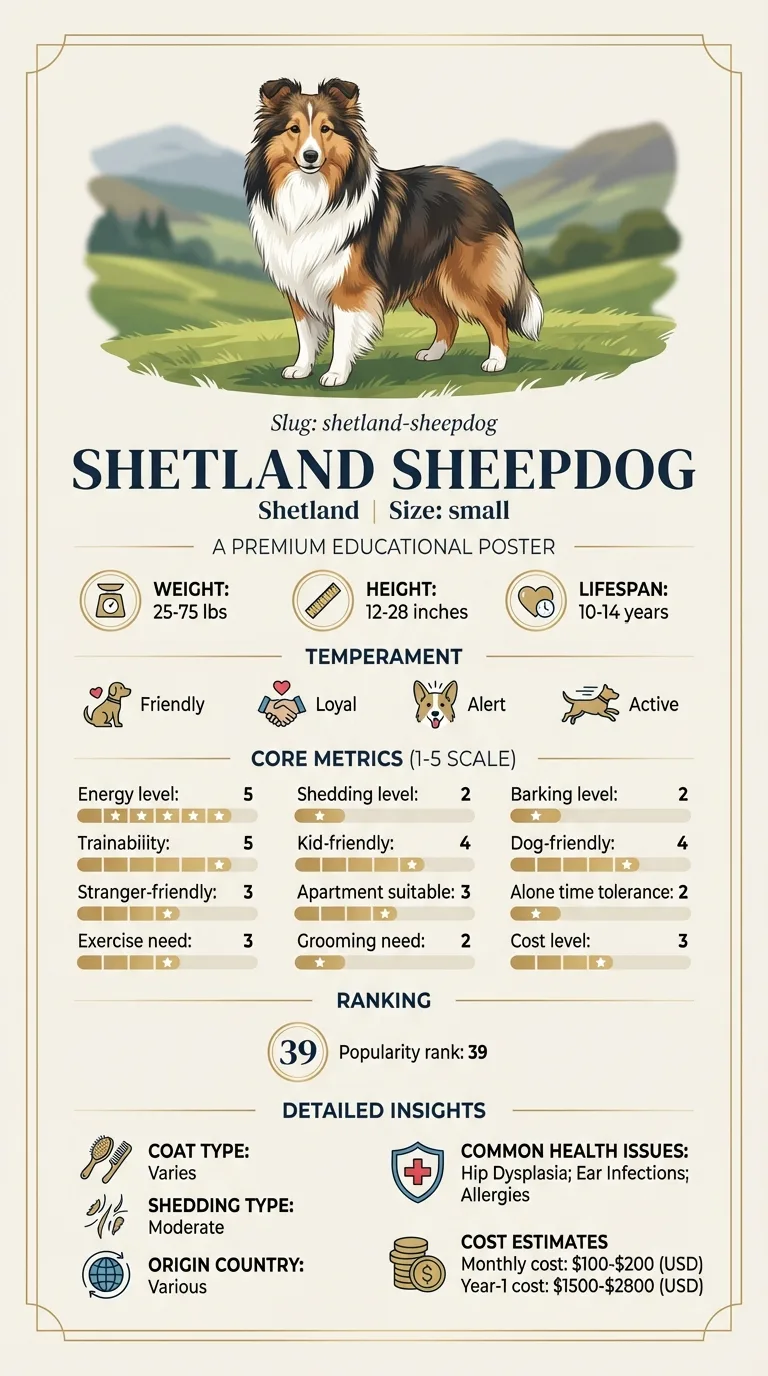
This is for someone already down to French Bulldog and Shetland Sheepdog and deciding between them. For this pair the decision usually turns on tolerates being alone and barking, so those are covered first and in most detail. Anyone choosing from a flat has a clear answer here: French Bulldog rates 5/5 against 3/5. It is written for the decision rather than the breed history.
Between French Bulldog and Shetland Sheepdog, tolerates being alone is what separates them, and French Bulldog is the lower-effort dog of the two to keep.
Choose French Bulldog if you are in a flat or a smaller home, this is your first dog and you do not want a standing grooming appointment.
Choose Shetland Sheepdog if you already have another dog, you want a dog that picks up training quickly and a smaller dog suits your car, your home or your back.
| Feature | french bulldog | shetland sheepdog | Winner |
|---|---|---|---|
| Size class | small | small | Equal |
| Weight | 20–30 lbs | 15–25 lbs | Equal |
| Height | 10–12 in | 13–16 in | Equal |
| Lifespan | 10–12 years | 12–14 years | shetland sheepdog |
| Exercise need | Low (2/5) | High (4/5) | french bulldog |
| Grooming need | Low (2/5) | High (4/5) | french bulldog |
| Shedding | Low (2/5) | High (4/5) | french bulldog |
| Energy level | Low (2/5) | High (4/5) | Equal |
| Barking | Low (2/5) | Very high (5/5) | french bulldog |
| Apartment suitability | Very high (5/5) | Moderate (3/5) | french bulldog |
| Good for first-time owners | Very high (5/5) | High (4/5) | french bulldog |
| Tolerates being alone | Very high (5/5) | Low (2/5) | french bulldog |
| Trainability | Moderate (3/5) | Very high (5/5) | shetland sheepdog |
| Good with kids | High (4/5) | High (4/5) | Equal |
| Good with other dogs | Moderate (3/5) | High (4/5) | shetland sheepdog |
| Friendly to strangers | Moderate (3/5) | Low (2/5) | french bulldog |
| Cost level | Very high (5/5) | Moderate (3/5) | shetland sheepdog |
| Coat | Short, smooth | Long, dense double coat | Equal |
| Origin | France | Various | Equal |
| Typical monthly cost | $150–$300 | $80–$150 | Equal |
| Typical first-year cost | $2,500–$4,500 | $1,100–$2,300 | Equal |
Both breeds land in the small size class on paper, though the overlap mostly stops at the label. The Sheltie is actually lighter than the Frenchie — 15-25 lbs against 20-30 lbs — but stands taller (13-16 in vs. 10-12 in) and carries that weight over a leaner, herding-dog frame rather than the Frenchie's dense, compact one. Picture a miniature Rough Collie next to a squat, muscular little bulldog and the visual difference becomes obvious, even with both technically filed under the same size bracket.
The Frenchie's exercise need is low (2/5); the Sheltie's is high (4/5), with an energy level to match. As a working herding breed, it wants a job — fetch, agility, or a genuine daily walk with purpose, not just a stroll. A Sheltie left under-exercised tends to find its own outlet, usually a vocal one. Herding-breed instincts don't disappear just because there's no flock around — expect a Sheltie to try herding kids, other pets, or even joggers if it isn't given a more structured outlet.
Grooming need is low (2/5) for the Frenchie and high (4/5) for the Sheltie, whose long double coat needs regular brushing to avoid matting. Shedding tells the more surprising story: the Sheltie rates high (4/5) against the Frenchie's low (2/5) — proof that a smaller dog doesn't automatically mean a lighter shedding load. Plan on brushing a Sheltie at least a couple of times a week, more during seasonal coat blows, if you want to keep the shedding manageable indoors.
Barking is the sharpest gap in this whole comparison: very high (5/5) for the Sheltie against low (2/5) for the Frenchie. Shelties are famously vocal, historically bred to alert on approaching flocks. Apartment suitability (5/5 vs. moderate 3/5) and alone tolerance (5/5 vs. low 2/5) both favor the Frenchie clearly — the Sheltie's herding instincts don't switch off just because the flock is gone.
The Frenchie rates 5/5 for first-time owners against the Sheltie's still-solid 4/5 — both are reasonably approachable for a beginner. Trainability favors the Sheltie clearly, very high (5/5) against the Frenchie's moderate (3/5); it's one of the more consistently obedient breeds around, provided the barking tendency gets addressed early. Enroll a Sheltie puppy in obedience classes early and its high trainability tends to pay off quickly, including on the barking front where consistency really counts.
Kids tie at high (4/5) for both. The Sheltie edges ahead with other dogs, high (4/5) against the Frenchie's moderate (3/5), but falls behind with strangers — low (2/5) against the Frenchie's moderate (3/5). That combination fits its herding-dog roots: sociable with other animals, more reserved with unfamiliar people. If you host frequent guests, expect a Sheltie to need a few minutes of warm-up time with new faces rather than greeting them immediately the way a Frenchie typically will.
The Sheltie's 12-14 year lifespan beats the Frenchie's 10-12. Its five-item health list is short and eye- and skin-focused: Collie Eye Anomaly, MDR1 drug sensitivity (a genetic trait affecting how the breed processes certain medications), dermatomyositis, hypothyroidism, and patellar luxation. The Frenchie's fifteen-item list is respiratory- and spine-driven instead — the two lists don't overlap at all. The MDR1 sensitivity is worth flagging to any vet treating a Sheltie, since it changes which medications are safe to prescribe.
The Sheltie is the most budget-friendly breed in this whole ten-pair batch: $80-150 monthly and $1,100-2,300 in year one, against the Frenchie's $150-300 and $2,500-4,500. Cost level reflects it directly — moderate (3/5) for the Sheltie against very high (5/5) for the Frenchie. That gap holds up across the dog's lifetime too, not just the first year, since the Sheltie avoids the ongoing brachycephalic-related vet costs that keep pushing the Frenchie's numbers higher.
French Bulldog weighs 20–30 lbs and lives 10–12 years; Shetland Sheepdog weighs 15–25 lbs and lives 12–14 years. The two diverge most on tolerates being alone, barking and exercise need and 6 other rated axes. Almost every rated axis separates them at least slightly. In the table, a "winner" means easier for an ordinary household — not better. Size, coat and origin are recorded without a verdict. Because both breeds are scored the same way, the gaps are reliable even where the absolute numbers are rough.

The Frenchie, at 20-30 lbs against the Sheltie's 15-25 lbs — despite the Sheltie standing a few inches taller. Both count as small breeds, but they distribute that classification differently.
Yes, rated high (4/5) despite being a small dog — noticeably more than the Frenchie's low (2/5). Their long double coat sheds heavily, especially seasonally.
Very — a 5/5 barking rating, the highest possible, against the Frenchie's low 2/5. It's the sharpest single gap in this whole comparison.
The Frenchie, 5/5 against the Sheltie's moderate 3/5, largely because of that barking tendency and the Sheltie's higher exercise needs.
The Sheltie by a wide margin — $1,100-2,300 in year one against the Frenchie's $2,500-4,500, the lowest cost figures of any breed compared against the Frenchie in this batch.
No overlap. The Sheltie's issues are eye- and skin-related (Collie Eye Anomaly, dermatomyositis) plus a drug sensitivity gene; the Frenchie's are respiratory and spinal.
The Sheltie, at 12-14 years against the Frenchie's 10-12.
The Frenchie if noise and alone-time are concerns; the Sheltie if you want a highly trainable, budget-friendly dog and can manage the barking.
The Sheltie is notably cheaper at $80-150 versus the Frenchie's $150-300 — the lowest figures in this comparison batch.
The Sheltie, rated high (4/5) need against the Frenchie's low (2/5).
The Sheltie, typically 12-14 years against the Frenchie's 10-12.
Secure checkout on Stripe. We never see your card.
7-day money-back guarantee. Instant access.

Health information here is general and is not veterinary advice. If your dog shows pain, sudden behaviour change, or worsening symptoms, consult a licensed veterinarian.
Some links on this site are affiliate links. We may earn a commission at no extra cost to you, and we only suggest products we believe are helpful for dog owners.
We research and check what we publish, but we do not warrant that any figure, date, price, or statement is accurate, complete, or current, and we accept no liability for any loss, cost, injury, or other harm arising from the use of this site. Use it as one reference among several. You remain responsible for your own decisions and for your dog's care - confirm anything that matters with a licensed veterinarian or another qualified professional before you act on it. Full disclaimer.
Match your lifestyle to the right dog.
Take quizNot sure which breed is right for you? Take our 2-minute quiz to find out.
Take the quiz