Health
What does CDDY predict?
Early degeneration and mineralisation of the spinal discs, and with it a raised lifetime risk of intervertebral disc herniation.

Quick answer
What does CDDY predict?
Early degeneration and mineralisation of the spinal discs, and with it a raised lifetime risk of intervertebral disc herniation.
There is a version of this conversation that only makes sense for a working breed. For a pet dog, a CDDY result is a household-management question — ramps, weight, keeping an eye out for back pain. For a Malinois pointed at protection sport, detection work, agility or police service, it is a career question, and it is one best answered at eighteen months rather than at five years with an injury already on the table.
Handlers and sport owners making training-load decisions for a dog whose whole value proposition is explosive athleticism, and who need to know whether the spine underneath it can take a decade of that.
This guide is not medical advice. If your dog shows pain, sudden behavior change, or worsening symptoms, consult a licensed veterinarian.
Some links may be affiliate links. We may earn a commission at no extra cost to you. We only suggest products we believe are helpful for dog owners.
We research and check what we publish, but we do not warrant that any figure, date, price, or statement is accurate, complete, or current, and we accept no liability for any loss, cost, injury, or other harm arising from the use of this site. Use it as one reference among several. You remain responsible for your own decisions and for your dog's care - confirm anything that matters with a licensed veterinarian or another qualified professional before you act on it. Full disclaimer.
A heritable variant that accelerates degeneration and mineralisation of the spinal discs, raising the lifetime risk of disc herniation and neurological injury. In a working or sport dog its practical significance is a training-load and discipline-selection question, since the loading patterns of some disciplines are far harder on degenerated discs than others.
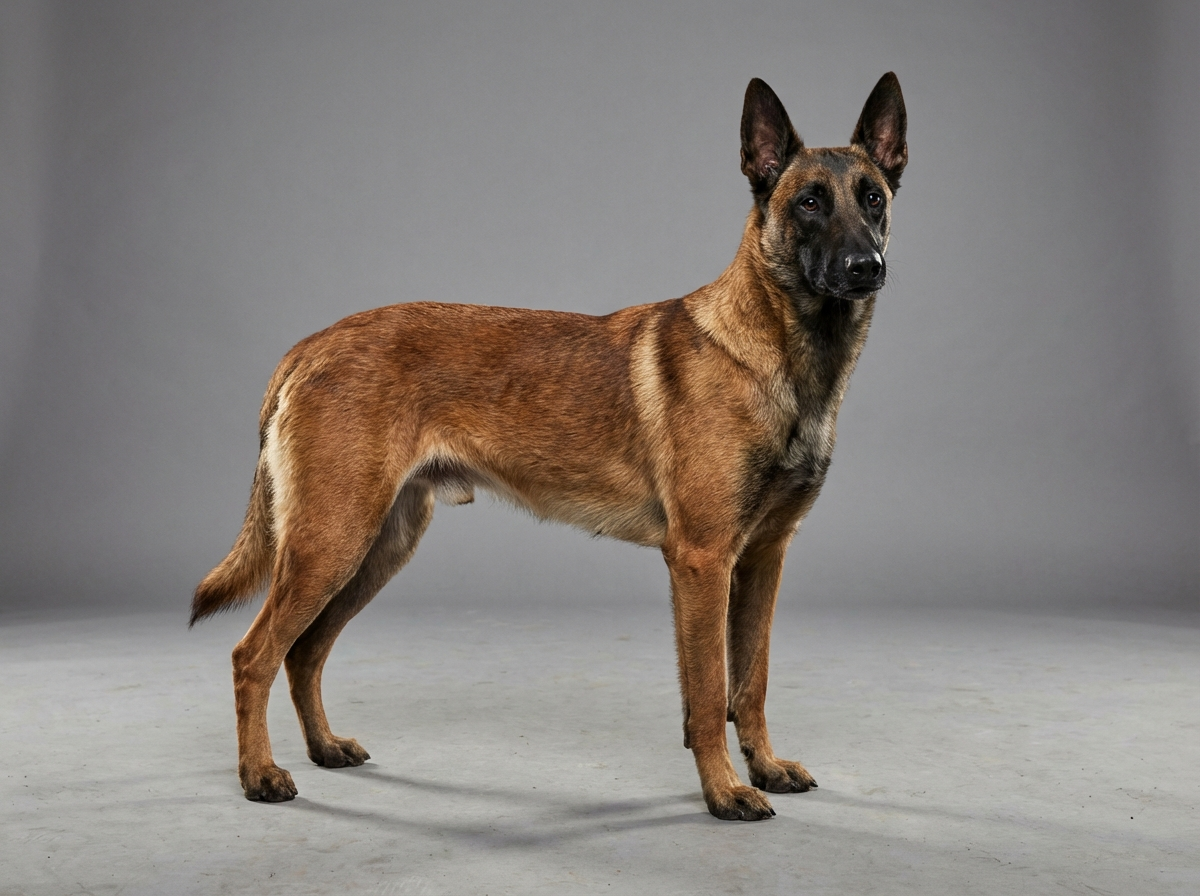
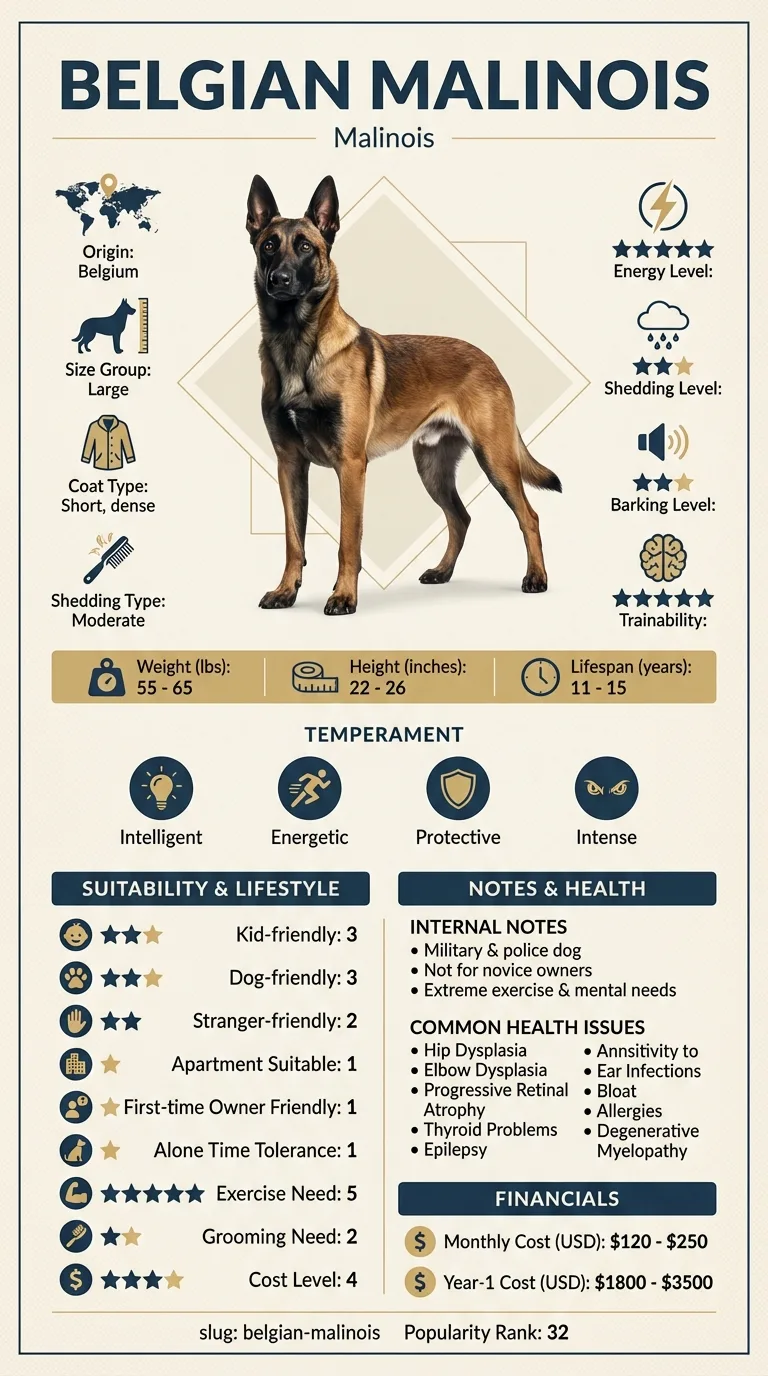
The variant is documented across a wide range of breeds and mixed-breed dogs rather than being confined to short-legged types, with frequency varying considerably between populations. It appears among the conditions listed for the Belgian Malinois, meaning individual dogs may carry it; the frequency within any given working line is not something an owner can assume either way without testing.
The variant is an individual inheritance rather than something the breed as a whole carries, but the Malinois amplifies its consequences more than almost any other breed could. This is a dog with documented very high energy and exceptional drive, bred for explosive power and asked routinely to perform exactly the movements that stress a degenerated disc. Its willingness compounds the problem: a Malinois will keep working through discomfort because stopping is not in its nature, so the behavioural warning signs a handler would rely on in another dog arrive late or not at all. The breed's documented sensitivity means a subtle change in drive or focus can be an earlier signal than any obvious lameness.
For a working dog the training program is the environment, and volume matters as much as intensity. A jump repeated forty times in a session is a different exposure from the same jump taken twice. Training surface is a second factor — hard packed ground and indoor concrete transmit impact that grass and rubber matting absorb. Vehicle deployment is an underrated one: a dog that exits a high-sided vehicle multiple times a shift accumulates a large number of drops that nobody counts as training. Kennel flooring and the absence of a proper warm-up and cool-down round out the picture.
Bring the test result to a routine appointment and ask specifically how it should shape the training plan, ideally with a veterinarian who has sports-medicine experience. Book an appointment for any new reluctance to jump or load into a vehicle, a hunched or roached topline, a drop in drive or focus that you cannot explain, an altered gait, or scuffed nails suggesting a paw is dragging. Treat as an emergency requiring immediate care any hind-limb weakness or incoordination, dragging of the back legs, inability to rise, or loss of bladder or bowel control — acute disc herniation is time-critical, and the delay between onset and surgical decompression is one of the strongest influences on whether the dog walks again. Do not administer human pain medication en route.
Start here: Belgian Malinois Most Common Genetic Disorders: Screening
See all Belgian Malinois health problems, which breeds are prone to chondrodystrophy cddy, or the full Belgian Malinois breed guide for temperament, exercise needs and ownership costs.
A positive result is a probability, not a verdict, and plenty of carriers work full careers without incident. The planning it prompts happens once: a discipline decision, a revised training program, a conditioning routine that then runs for life. Expect the risk to sit quietly through the dog's early years and to become most relevant in middle age, which is precisely when a working dog's accumulated training volume is highest. Rebuilding a training program around lower-impact work takes a season, not a week.
Success is a Malinois that retires from work sound rather than injured — that finishes a career in detection or tracking at ten with a spine still doing its job, and transitions into an active retirement instead of a crate. It looks like a handler who knows the number of jumps in the session, who noticed the flat day and rested the dog, and who chose a discipline deliberately rather than by default.
The useful window for this information is narrow and it opens before serious training does. A DNA panel run at the same time as the puppy's other health screening costs little and gives you the result while everything is still negotiable: which disciplines to pursue, how much repetitive jumping to program, whether to build a career around bitework and jump-heavy obedience or steer toward detection and tracking.
Run it late and the result changes almost nothing. A six-year-old Malinois that has already logged four years of hard jumping has either accumulated the damage or has not, and a positive test at that stage tells you to manage what you have rather than to plan differently.
There is a second reason to test early that has nothing to do with your own dog. Breeding decisions in this breed are frequently made on working ability and conformation, and a known genetic result belongs in that conversation. Discuss the specific implications with a veterinarian and an experienced breed mentor who can read the full panel rather than a single line of it.
Not all demanding work is demanding in the same direction, and this distinction is what makes a positive result actionable rather than merely worrying.
The hardest disciplines for a compromised disc combine impact with rotation: repeated hurdle and A-frame work, the wall jump in protection sport, hard catches taken airborne and landed twisted, dock diving, and any exercise involving a controlled fall from height. Sustained pulling in a harness against heavy resistance adds compressive load of a different kind.
The gentler ones are still genuinely hard work — this is not a recommendation to make the dog's life dull. Tracking and detection are cognitively exhausting and physically low-impact. Long-distance conditioning on varied natural ground builds fitness without repetitive vertical loading. Controlled swimming does the same. Obedience and heelwork can be trained to a very high standard with the jumps reduced in height or frequency.
A CDDY-positive dog with a demonstrable talent for bitework is a genuinely hard call, and it belongs with a veterinarian and a sports-medicine practitioner who can examine the dog rather than with an article. What an article can tell you is that the choice exists and is worth making deliberately.

A handler bought a Malinois puppy intending to compete in protection sport and ran a full genetic panel at four months, mostly as a formality. CDDY came back positive. Her veterinarian was careful not to overstate it — plenty of carriers never herniate a disc — but agreed the wall and hurdle volume the discipline demanded was the part worth reconsidering. She pivoted to detection work instead. The dog turned out to have an exceptional nose, certified at two, and worked for seven years with an intense, physically demanding job that happened to keep him mostly on the ground. He retired sound at nine. Her honest view is that she will never know whether the change was necessary. She is also clear that she would make the same call again with the same information.
Key takeaway: The point of testing a working prospect early is that a positive result still leaves several excellent careers open. Testing late leaves only management.
It can be. CDDY affects disc composition; the variant most responsible for dramatically shortened limbs is a different one. Normal conformation does not exclude it.
Alongside the puppy's other health screening. The result is most valuable while discipline and training-load decisions are still open.
Not automatically. It should shape which discipline and how much repetitive jumping. Discuss the specific dog with a vet experienced in canine sports medicine.
Anything combining impact with rotation — hurdle and wall work, airborne catches landed twisted, dock diving, controlled falls from height.
Tracking, detection, scent work, conditioning on varied ground, swimming, and obedience with jump height and frequency reduced. None of that is a soft option.
In this breed, watch drive rather than lameness. An unexplained drop in focus, reluctance to load into the vehicle, or a refused familiar exercise is the early signal.
Emergency-urgent. Wobbling, dragging, inability to stand or loss of bladder control needs veterinary care immediately, because time to treatment affects the outcome.
That decision belongs with a veterinarian and an experienced breed mentor reading the full panel alongside the proposed mate's results, not with a single test line in isolation.
Early degeneration and mineralisation of the spinal discs, and with it a raised lifetime risk of intervertebral disc herniation.
With the rest of the puppy health screening, so the result informs discipline choice and training load before either is committed to.
Repetitive jumping, airborne catches landed with rotation, controlled falls from height, and drops from high-sided vehicles.
A change in drive rather than obvious pain — a Malinois works through discomfort, so reluctance and lost focus come before limping.
Hind-limb weakness, incoordination, dragging paws, inability to rise, or loss of bladder or bowel control require immediate veterinary attention.
A one-page prep sheet for this condition: the signs, the questions to ask, what to get priced. Unlocks here.
You get: Vet visit prep sheet
No spam. One-click unsubscribe. See our privacy policy.
Preview page 1 before you decide.