Health
Do purebred dogs have higher cancer risk?
Some data shows purebred dogs at higher risk than non-purebred dogs, though it varies by breed and cancer type.

Quick answer
Do purebred dogs have higher cancer risk?
Some data shows purebred dogs at higher risk than non-purebred dogs, though it varies by breed and cancer type.
The honest answer is more nuanced than 'purebred bad, mixed good': genetic diversity matters, but a mixed-breed dog carrying the same breed-specific risk genes from a purebred parent doesn't automatically escape that risk just by also having other ancestry.
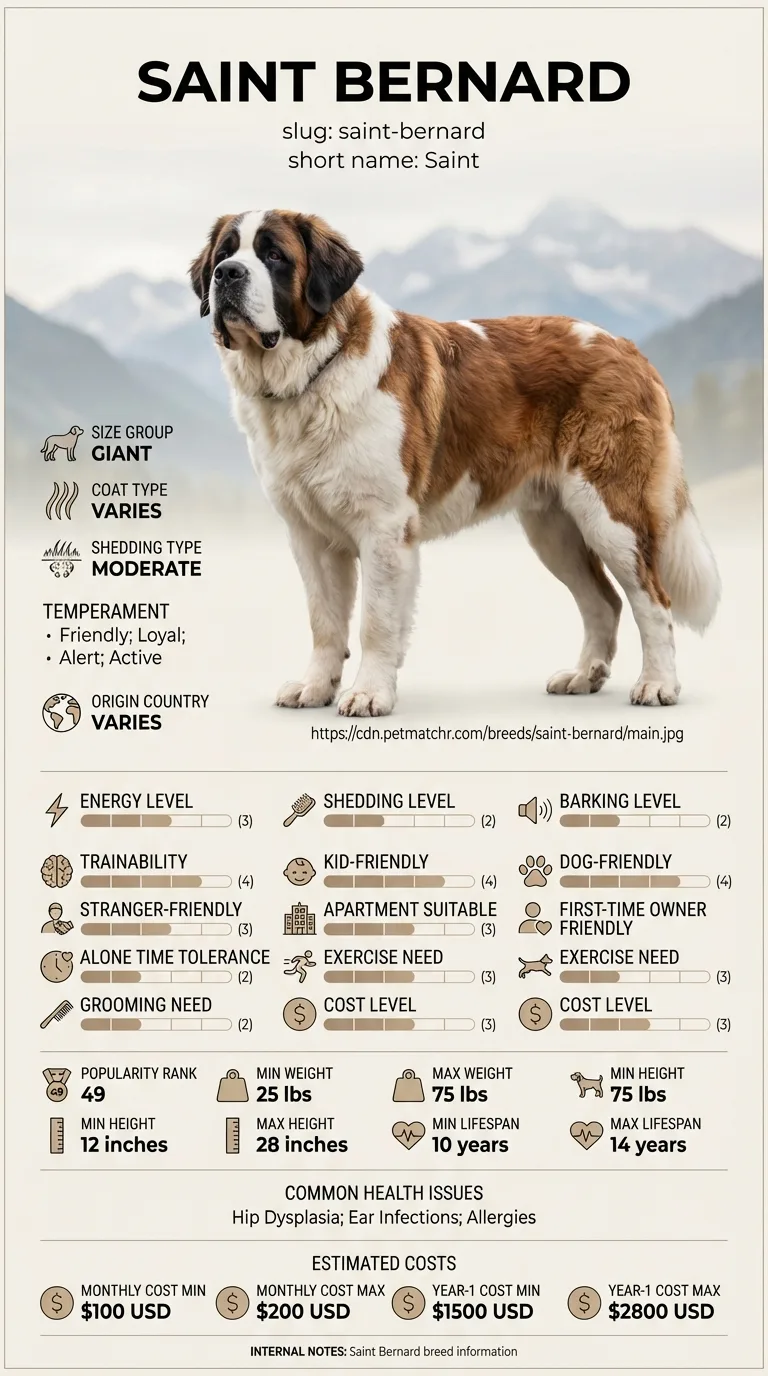
This mostly comes up for prospective owners weighing a purebred Saint Bernard puppy against a mixed-breed dog, or current owners of mixed-breed dogs trying to understand how much of their dog's health risk still traces back to Saint Bernard ancestry specifically.
This guide is not medical advice. If your dog shows pain, sudden behavior change, or worsening symptoms, consult a licensed veterinarian.
Some links may be affiliate links. We may earn a commission at no extra cost to you. We only suggest products we believe are helpful for dog owners.
We research and check what we publish, but we do not warrant that any figure, date, price, or statement is accurate, complete, or current, and we accept no liability for any loss, cost, injury, or other harm arising from the use of this site. Use it as one reference among several. You remain responsible for your own decisions and for your dog's care - confirm anything that matters with a licensed veterinarian or another qualified professional before you act on it. Full disclaimer.
Check this first
This is a background genetics and decision-making topic rather than a medical emergency topic itself. That said, the practical consequence of getting this wrong shows up later as real, sometimes urgent health problems, whether that's a hip dysplasia crisis, a cardiac emergency, or a cancer diagnosis, all of which are covered in detail in their own dedicated guides and do have real emergency thresholds worth knowing regardless of a dog's purebred or mixed status.
For a dog of any ancestry showing acute symptoms, sudden inability to bear weight, labored breathing, collapse, or severe pain, the emergency guidance is the same regardless of whether the dog is purebred, mixed, or of unknown ancestry: seek veterinary care immediately rather than trying to reason about genetic risk in the moment.
Where this topic actually matters practically is in the decision-making phase, before acquiring a dog, when understanding genetic risk factors can inform screening priorities and what conditions to watch for proactively, regardless of which side of the purebred-versus-mixed decision someone ultimately makes.
If any of these apply, call your vet or an emergency clinic now. The rest of this page is for the cases that are not an emergency.
Some data has shown purebred dogs facing a notably higher cancer risk than non-purebred dogs, which raises real questions for anyone comparing a purebred Saint Bernard against a mixed-breed dog. The honest picture is more nuanced than a simple health advantage for one option: genetic diversity can reduce some inherited risks, but a dog carrying substantial Saint Bernard ancestry, purebred or mixed, still faces much of the breed's documented risk for size-related conditions like hip dysplasia and cardiac disease.
Comparative cancer risk data between purebred and non-purebred dogs is well documented across broad population studies, though how meaningfully it applies to any one individual dog depends heavily on that specific dog's actual ancestry, screening, and health history.
Purebred populations, including Saint Bernards, are managed within a defined gene pool, which can increase the odds of certain recessive conditions appearing compared to a more genetically diverse population, while size-related and conformation-related risks, like hip dysplasia and cardiac disease, are driven substantially by physical traits that persist in mixed-breed dogs carrying significant Saint Bernard ancestry as well.
Breeding practices, specifically how much genetic diversity is maintained within a breeding program and whether health screening is used to guide pairing decisions, are the main environmental factors that meaningfully affect real-world health outcomes, regardless of whether a given dog is purebred or mixed.
Talk to your vet about your dog's specific ancestry and relevant health screening priorities, regardless of purebred or mixed status. For any dog showing acute symptoms like sudden inability to bear weight, labored breathing, or collapse, seek veterinary care immediately.
This comparison gets oversimplified in ways that lead to poor decisions on both sides of the purebred-versus-mixed question.
See all Saint Bernard health problems, which breeds are prone to purebred vs mixed breeds, or the full Saint Bernard breed guide for temperament, exercise needs and ownership costs.
This is a decision made before acquiring a dog, and its practical impact plays out over that dog's entire lifetime through the specific health conditions that do or don't develop, rather than through any immediate, observable difference.
Success means making an informed decision based on actual health testing and ancestry information rather than assumptions about purebred or mixed status alone, and then following through with appropriate preventive screening throughout the dog's life regardless of which choice was made.
Jorge was deciding between a purebred Saint Bernard puppy and a mixed-breed puppy that was roughly half Saint Bernard. Rather than assuming one option was automatically healthier, he asked for health testing documentation from both the purebred breeder and the mixed-breed puppy's known parent. The purebred breeder provided documented hip, elbow, and cardiac screening for both parents. The mixed-breed puppy's Saint Bernard parent had no documented testing available. Jorge chose the purebred puppy, Leo, specifically because of the available health documentation rather than the purebred label itself.
Key takeaway: The deciding factor for Jorge wasn't purebred versus mixed status, it was which option actually had verifiable health screening behind it, which is the detail that mattered more than either label alone.
Some studies have found purebred dogs at meaningfully higher cancer risk than non-purebred dogs, though the picture varies by specific breed and specific cancer type, and genetic diversity within a breeding population is one factor thought to contribute to the difference.
It depends heavily on what else makes up the mix. A dog that's mostly Saint Bernard ancestry can still carry much of the breed's documented risk for conditions like hip dysplasia or cardiac disease, while a more evenly mixed dog may have somewhat more genetic diversity buffering some inherited risks.
Greater genetic diversity can reduce the odds of two copies of the same harmful recessive gene combining in one dog, which is relevant to some inherited conditions, though it doesn't eliminate risk for conditions driven by body size or conformation regardless of genetic diversity.
This is a personal decision best made alongside a vet, factoring in health testing availability, breeder reputation, and your own priorities, rather than assuming either choice guarantees a healthier outcome.
For an individual dog, yes. A purebred puppy from health-tested, screened parents often carries meaningfully lower risk for specific conditions than an untested mixed-breed dog whose ancestry and health history are unknown.
Somewhat, depending on the mix, but a dog with substantial giant-breed ancestry, purebred or mixed, still faces meaningful risk for size-related conditions like hip dysplasia and bloat, since these are driven significantly by body size and structure rather than purebred status alone.
Ask for health testing documentation regardless of whether you're considering a purebred or mixed-breed dog, and discuss the specific ancestry and known health history with your vet before making a final decision.
Some data shows purebred dogs at higher risk than non-purebred dogs, though it varies by breed and cancer type.
No, a mixed-breed dog with substantial Saint Bernard ancestry still carries much of that breed's documented risk.
Individual health screening and documented testing of a dog's actual parents matter more than purebred status alone.
It can help with some inherited recessive conditions, but not with size-related risks like hip dysplasia or bloat.
Yes, requesting documented parent health testing is valuable whether considering a purebred or mixed-breed dog.
A one-page prep sheet for this condition: the signs, the questions to ask, what to get priced. Unlocks here.
You get: Vet visit prep sheet
No spam. One-click unsubscribe. See our privacy policy.
Preview page 1 before you decide.