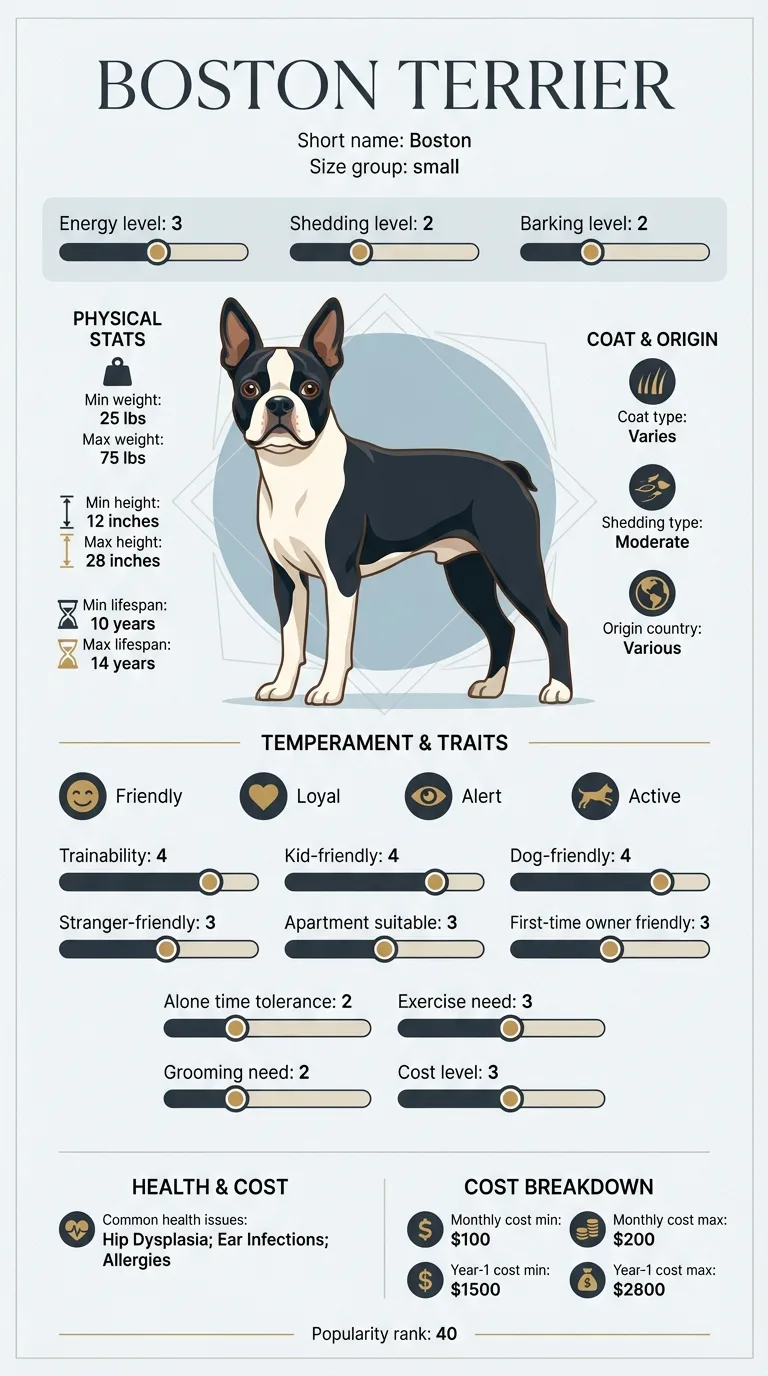
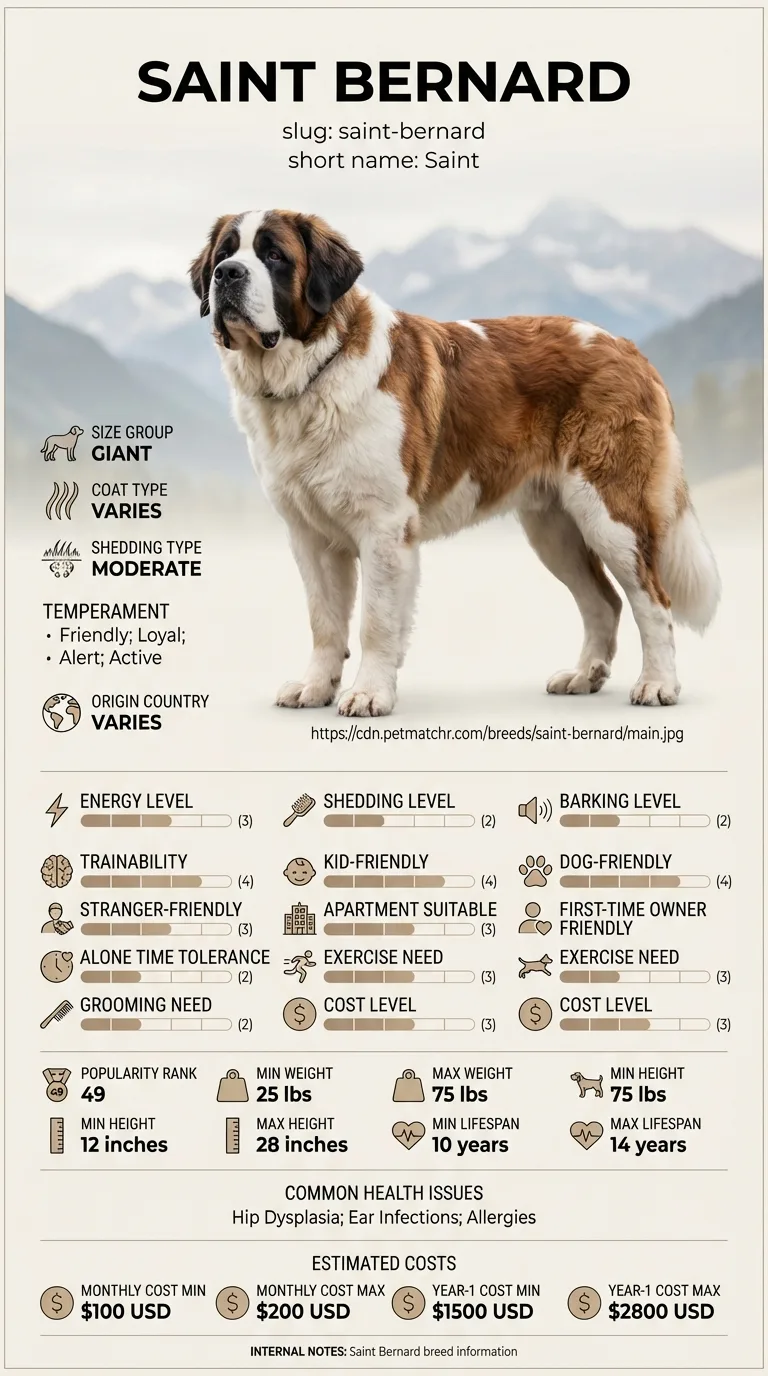
Boston Terrier vs Saint Bernard: Which Suits Your Home?
Quick answer
Which is the better choice overall?
If you have the space and budget, the Saint Bernard's gentle temperament with kids matches the Boston point for point - the deciding factors are really apartment fit and cost, both of which favor the Boston heavily.
Boston Terrier or Saint Bernard? On paper they differ most on apartment suitability, and on the scales Saint Bernard is the heavier at 120–180 lbs. Here is how the two compare on everything that shapes an ordinary week.
This is for someone already down to Boston Terrier and Saint Bernard and deciding between them. For this pair the decision usually turns on apartment suitability and grooming need, so those are covered first and in most detail. Anyone choosing from a flat has a clear answer here: Boston Terrier rates 5/5 against 1/5. It is written for the decision rather than the breed history.
Quick verdict
Between Boston Terrier and Saint Bernard, apartment suitability is what separates them, and Boston Terrier is the lower-effort dog of the two to keep.
Choose boston terrier if...
Choose Boston Terrier if you are in a flat or a smaller home, this is your first dog and you do not want a standing grooming appointment.
Choose saint bernard if...
Choose Saint Bernard if its temperament and look are what you want; on the measurable axes it gives up nothing to the other.
Head-to-head comparison
Feature
boston terrier
saint bernard
Winner
Size class
small
giant
Equal
Weight
12–25 lbs
120–180 lbs
Equal
Height
15–17 in
26–30 in
Equal
Lifespan
11–13 years
8–10 years
boston terrier
Exercise need
Low (2/5)
Low (2/5)
Equal
Grooming need
Very low (1/5)
Moderate (3/5)
boston terrier
Shedding
Low (2/5)
High (4/5)
boston terrier
Energy level
Moderate (3/5)
Low (2/5)
Equal
Barking
Low (2/5)
Low (2/5)
Equal
Apartment suitability
Very high (5/5)
Very low (1/5)
boston terrier
Good for first-time owners
Very high (5/5)
Moderate (3/5)
boston terrier
Tolerates being alone
Moderate (3/5)
Moderate (3/5)
Equal
Trainability
High (4/5)
Moderate (3/5)
boston terrier
Good with kids
Very high (5/5)
Very high (5/5)
Equal
Good with other dogs
High (4/5)
High (4/5)
Equal
Friendly to strangers
High (4/5)
High (4/5)
Equal
Cost level
Moderate (3/5)
Very high (5/5)
boston terrier
Coat
Short and smooth
Short or long double coat
Equal
Origin
Various
Various
Equal
Typical monthly cost
$80–$150
$150–$310
Equal
Typical first-year cost
$1,100–$2,300
$2,200–$4,200
Equal
Deep dive
Size and build
This is the most extreme size gap on the site. The Boston weighs 12-25 lbs; the Saint Bernard runs 120-180 lbs, up to seven times heavier, and stands 26-30 inches against the Boston's 15-17. Size class says it plainly: small versus giant, and that scale gap is worth sitting with before you fall for the Saint Bernard's reputation alone.
Energy and exercise
Despite the size difference, exercise need actually ties at low (2/5) for both breeds - Saint Bernards are famously laid-back for their size, more couch companion than athlete. Energy level runs slightly higher for the Boston day to day (3/5 vs 2/5), which can be a surprise given how much bigger the Saint Bernard is. Do not assume a giant breed needs giant amounts of exercise; this pair is the clearest counterexample on the site.
Grooming and shedding
Grooming favors the Boston (1/5 vs 3/5, moderate), and shedding does too, more sharply - the Saint Bernard rates 4/5, high, against the Boston's 2/5. A giant breed's coat simply produces more hair by volume, even at a moderate shedding rate per square inch, so expect a heavier daily cleanup with the Saint Bernard. Both short and long-coated Saint Bernards fall under this same shedding rating.
Apartment living, noise and time alone
The gap here is stark - the Boston rates 5/5 for apartment suitability, the Saint Bernard just 1/5, very low. Barking ties low for both (2/5), so it is purely a space issue: a 150+ lb dog needs room to turn around that most apartments do not offer, regardless of how quiet or calm the dog itself is.
Training and owner experience
The Boston trains a bit more easily (4/5 vs 3/5) and rates notably higher for first-time owners (5/5 vs 3/5). A giant breed like the Saint Bernard needs early obedience work simply because its adult size makes bad habits, like pulling or jumping, far harder to manage than they would be on a small dog. A well-trained giant breed is a joy to live with; an untrained one is genuinely difficult to handle.
Kids, other dogs and visitors
Both breeds tie at 5/5 with kids, 4/5 with other dogs, and 4/5 with strangers - genuinely comparable temperaments once you look past size. The Saint Bernard's reputation for gentleness with children holds up in the numbers here, matching a small breed's score point for point despite the enormous size gap. Supervision still matters with any dog this large around small children, temperament aside.
Health and lifespan
The Boston lives notably longer, 11-13 years against the Saint Bernard's 8-10, a common pattern for giant breeds. The Saint Bernard's health list includes hip and elbow dysplasia, dilated cardiomyopathy, entropion and bloat, the last one a particular risk for large, deep-chested dogs and worth knowing about before you commit. Ask a breeder or rescue about cardiac and joint screening history before bringing one home.
Cost to keep
Keeping a Saint Bernard costs meaningfully more: $150-310 monthly against the Boston's $80-150, and $2,200-4,200 in the first year versus $1,100-2,300, nearly double at the top end. Food volume for a 180 lb dog is the obvious driver, but larger vet bills and bigger everything, crates, beds, medication doses, add up too. Factor those recurring costs in alongside the shorter expected lifespan when you budget long term.
Boston Terrier vs Saint Bernard at a glance
Boston Terrier weighs 12–25 lbs and lives 11–13 years; Saint Bernard weighs 120–180 lbs and lives 8–10 years. The two diverge most on apartment suitability, grooming need and shedding and 2 other rated axes. They are level on tolerates being alone, barking and good with other dogs, so those cannot decide it. In the table, a "winner" means easier for an ordinary household — not better. Size, coat and origin are recorded without a verdict. Because both breeds are scored the same way, the gaps are reliable even where the absolute numbers are rough.
Boston Terrier vs Saint Bernard: Which Suits Your Home? - Boston Terrier vs Saint Bernard at a glance
Frequently asked questions
How much bigger is a Saint Bernard than a Boston Terrier?
Enormously - up to 180 lbs versus the Boston's 25 lb ceiling, roughly seven times the weight. This is a small breed against a giant one.
Do Saint Bernards need a lot of exercise?
No, surprisingly - it ties the Boston at low exercise need (2/5). Saint Bernards are a calm, low-energy giant breed despite their size.
Is a Saint Bernard apartment-friendly?
Not really - it rates just 1/5 for apartment suitability against the Boston's 5/5. Size is the limiting factor here, not activity level or noise.
Which is better with kids?
Both tie at 5/5 - Saint Bernards have a strong reputation for gentleness with children that holds up in this data.
What will a Saint Bernard cost me?
$150-310 a month and $2,200-4,200 in the first year, against the Boston's $80-150 monthly and $1,100-2,300 first-year range.
Which lives longer?
The Boston, by a good margin - 11-13 years versus the Saint Bernard's 8-10, typical for a giant breed.
What health issues should I watch for with a Saint Bernard?
Hip and elbow dysplasia, dilated cardiomyopathy, entropion and bloat - the last is a genuine emergency risk in large, deep-chested dogs and worth discussing with a vet in advance.
If you have the space and budget, the Saint Bernard's gentle temperament with kids matches the Boston point for point - the deciding factors are really apartment fit and cost, both of which favor the Boston heavily.
Costs
What's the monthly cost gap?
The Saint Bernard runs $150-310 against the Boston's $80-150 - close to double.
Behavior
Do Saint Bernards need lots of exercise?
No - both breeds tie at low exercise need (2/5), which surprises a lot of people given the size difference.
Health
Which lives longer?
The Boston Terrier, at 11-13 years versus the Saint Bernard's 8-10.
Related DogBreedCompass guides
Boston Terrier breed guide – Readers comparing the two usually want the full profile of Boston Terrier before deciding.
Saint Bernard breed guide – The same for Saint Bernard, so the comparison can be checked against the detail.
Boston Terrier vs Pug – Pug is the closest breed to Boston Terrier on the measured axes, so it is the natural next comparison.
Saint Bernard vs Newfoundland – Newfoundland sits closest to Saint Bernard, which makes it the alternative worth ruling out.
Boston Terrier vs Newfoundland – Newfoundland is the other breed Saint Bernard is most often weighed against.
Saint Bernard health problems – The health pages set out what each breed is actually screened for.
Health information here is general and is not veterinary advice. If your dog shows pain, sudden behaviour change, or worsening symptoms, consult a licensed veterinarian.
Some links on this site are affiliate links. We may earn a commission at no extra cost to you, and we only suggest products we believe are helpful for dog owners.
We research and check what we publish, but we do not warrant that any figure, date, price, or statement is accurate, complete, or current, and we accept no liability for any loss, cost, injury, or other harm arising from the use of this site. Use it as one reference among several. You remain responsible for your own decisions and for your dog's care - confirm anything that matters with a licensed veterinarian or another qualified professional before you act on it. Full disclaimer.