Health
What is IVDD Type I?
A sudden rupture of hardened disc material into the spinal canal, causing acute pain or neurological symptoms.

Quick answer
What is IVDD Type I?
A sudden rupture of hardened disc material into the spinal canal, causing acute pain or neurological symptoms.
This form is far more classically documented in short-legged, long-backed breeds, which makes its occasional appearance in a giant breed like the Saint Bernard worth understanding on its own terms rather than assuming it works the same way.
This is most relevant to owners facing a sudden, frightening change, a dog that was fine one hour and in visible pain or unable to walk normally the next, since Type I disease is defined by exactly that kind of abrupt onset.
This guide is not medical advice. If your dog shows pain, sudden behavior change, or worsening symptoms, consult a licensed veterinarian.
Some links may be affiliate links. We may earn a commission at no extra cost to you. We only suggest products we believe are helpful for dog owners.
We research and check what we publish, but we do not warrant that any figure, date, price, or statement is accurate, complete, or current, and we accept no liability for any loss, cost, injury, or other harm arising from the use of this site. Use it as one reference among several. You remain responsible for your own decisions and for your dog's care - confirm anything that matters with a licensed veterinarian or another qualified professional before you act on it. Full disclaimer.
Check this first
IVDD Type I is essentially always an emergency by the time it's symptomatic, because it represents sudden, physical rupture of disc material into the spinal canal rather than a slow-building process. Sudden crying out in pain, reluctance to move the neck or back, hind-leg weakness or dragging, loss of bladder or bowel control, or inability to stand should all be treated as urgent and seen by a vet the same day, ideally within hours.
The severity spectrum matters for treatment decisions: a dog with pain but normal leg strength and reflexes has more treatment options than a dog that has lost the ability to feel deep pain in the affected limb, which is a much more serious sign requiring urgent surgical evaluation. This is why a same-day neurological exam, not just pain medication, is the right first step.
Because outcomes are strongly tied to how quickly spinal cord compression is relieved, the practical rule for Type I disease is that any sudden onset of pain or weakness in the back or neck is treated as a time-sensitive emergency until a vet says otherwise, rather than something to monitor overnight first.
If any of these apply, call your vet or an emergency clinic now. The rest of this page is for the cases that are not an emergency.
IVDD Type I is a sudden, acute form of disc disease where hardened disc material ruptures through the disc's outer wall and compresses the spinal cord, causing pain or neurological symptoms with little to no warning. It is far more classically associated with short-legged breeds prone to early disc calcification, but it can occur in a giant breed like the Saint Bernard, often connected to a specific traumatic movement given the physical forces involved in a large dog jumping or landing awkwardly.
Type I disc extrusion is considerably less common in giant breeds than in classic chondrodystrophic breeds, but it is documented as an occasional, serious event in large dogs, usually tied to a specific triggering incident rather than pure genetic predisposition.
While the Saint Bernard doesn't carry the strong genetic tendency toward early disc calcification seen in classic chondrodystrophic breeds, the sheer body mass and force generated during a jump, fall, or awkward landing can be enough to rupture a disc that has already undergone some age-related hardening, producing the same sudden extrusion pattern.
A single triggering event, an awkward jump off furniture, a slip, or a sudden twisting motion during play, is usually the immediate environmental cause, acting on a disc that may have already been quietly weakening before the rupture occurred.
Contact your vet immediately for any sudden onset of pain, reluctance to move the neck or back, hind-leg weakness or dragging, or inability to stand. This is not a wait-and-see situation; same-day evaluation gives the best chance of a good outcome.
Because Type I disease comes on so suddenly, the mistakes owners make are mostly about timing and response speed.
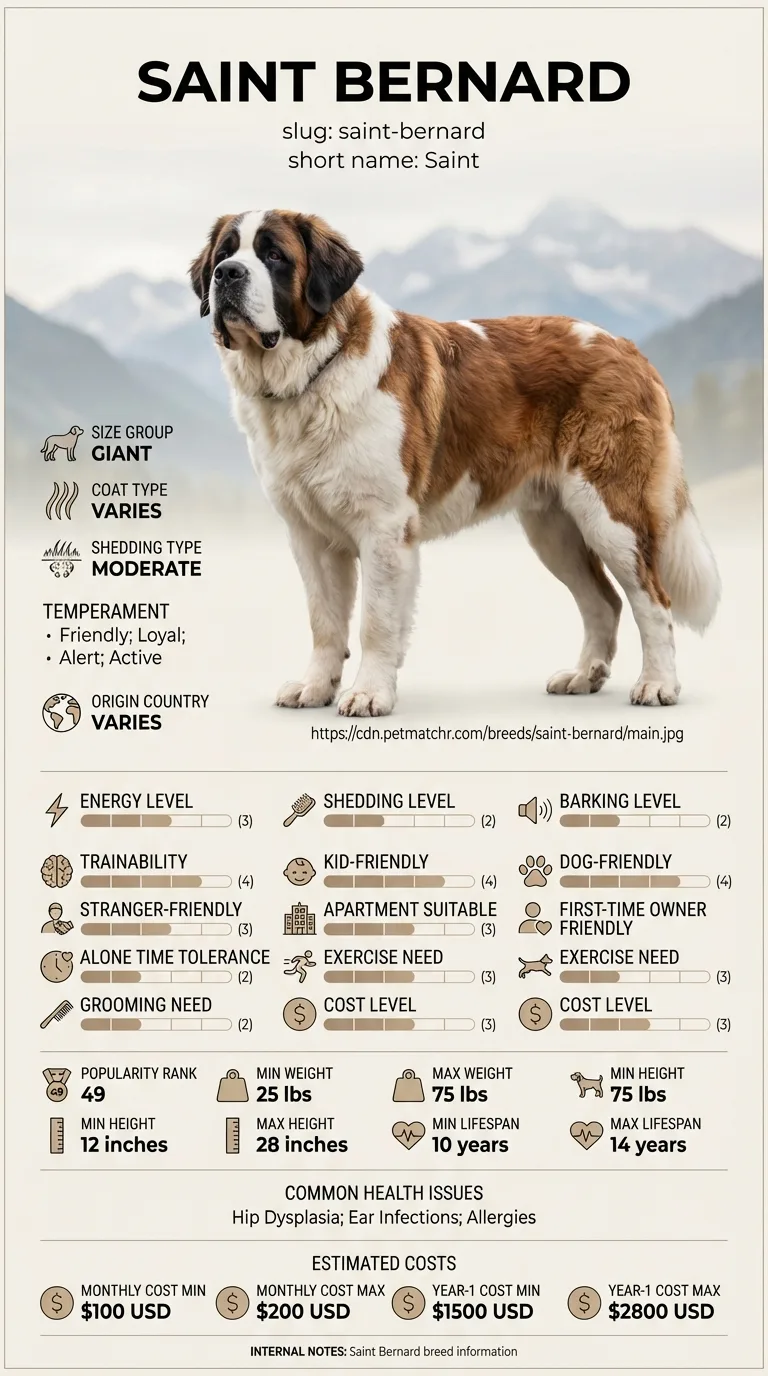
See all Saint Bernard health problems, which breeds are prone to intervertebral disc disease ivdd type i, or the full Saint Bernard breed guide for temperament, exercise needs and ownership costs.
Symptoms appear suddenly, often within seconds of the triggering movement, and treatment decisions typically need to happen within hours to days for the best outcome. Recovery, with prompt treatment, generally spans several weeks to a few months of restricted activity and rehabilitation.
Success means a meaningful recovery of mobility and pain-free movement through prompt diagnosis and treatment, recognizing that the degree of recovery is closely tied to how quickly spinal cord compression was addressed rather than something that can be reliably reversed after a long delay.
Derek's five-year-old Saint Bernard, Bear, yelped suddenly while jumping off the porch steps and then stood hunched, refusing to move. Derek got him to an emergency vet within the hour rather than waiting to see if it passed, and a neurological exam found reduced reflexes in one hind leg. An MRI confirmed an acute disc extrusion in Bear's lower back, and given the neurological findings, the specialist recommended surgery the same day. Bear went through several weeks of restricted activity and rehabilitation afterward, and regained close to full use of the affected leg by three months post-surgery.
Key takeaway: Acting within the hour, rather than waiting overnight to see if Bear improved, is very likely what preserved his chance at a good recovery, since deep pain sensation was still intact when he reached the vet.
Type I involves the disc's inner material hardening and then rupturing suddenly through the disc's outer wall, causing acute spinal cord compression, unlike the slower, gradual bulging seen in Type II disc disease.
It's more classically documented in short-legged, long-backed breeds with a genetic tendency toward early disc calcification, but it can occur in giant breeds too, sometimes triggered by a specific traumatic movement given how much force a Saint Bernard's body generates during a jump or fall.
Sudden pain, reluctance to move the neck or back, hunching, hind-leg weakness or dragging, and in severe cases, complete inability to walk or loss of bladder and bowel control.
A neurological exam assessing reflexes, pain response, and limb strength, combined with advanced imaging like an MRI or CT scan, confirms the location and severity of the rupture.
Not always, mild cases with pain but no significant weakness may be managed with strict rest and medication, but moderate to severe cases with weakness or paralysis generally have the best outcomes with prompt surgical decompression.
Many dogs recover well, especially with prompt treatment before deep pain sensation is lost. Dogs that have already lost deep pain sensation before surgery have a more guarded, though not hopeless, prognosis.
Advanced imaging and emergency spinal surgery represent one of the more significant single medical expenses a dog owner can face, often requiring specialist referral and inpatient care.
A sudden rupture of hardened disc material into the spinal canal, causing acute pain or neurological symptoms.
Yes, sudden onset disc extrusion is treated as a time-sensitive emergency requiring same-day veterinary care.
It's less common than in small, long-backed breeds, but it can happen, sometimes after a specific traumatic movement.
Not always, but moderate to severe cases with weakness generally have better outcomes with prompt surgical decompression.
Yes, it's one of the more significant single veterinary expenses an owner can face.
A one-page prep sheet for this condition: the signs, the questions to ask, what to get priced. Unlocks here.
You get: Vet visit prep sheet
No spam. One-click unsubscribe. See our privacy policy.
Preview page 1 before you decide.