Health
What causes hip dysplasia in Saint Bernards?
A combination of genetic predisposition and rapid growth places uneven stress on the developing hip joint.

Quick answer
What causes hip dysplasia in Saint Bernards?
A combination of genetic predisposition and rapid growth places uneven stress on the developing hip joint.
A Saint Bernard puppy can gain more weight in its first year than most dogs weigh their entire lives, and that speed of growth is exactly what makes hip joints in this breed so vulnerable to developing improperly.
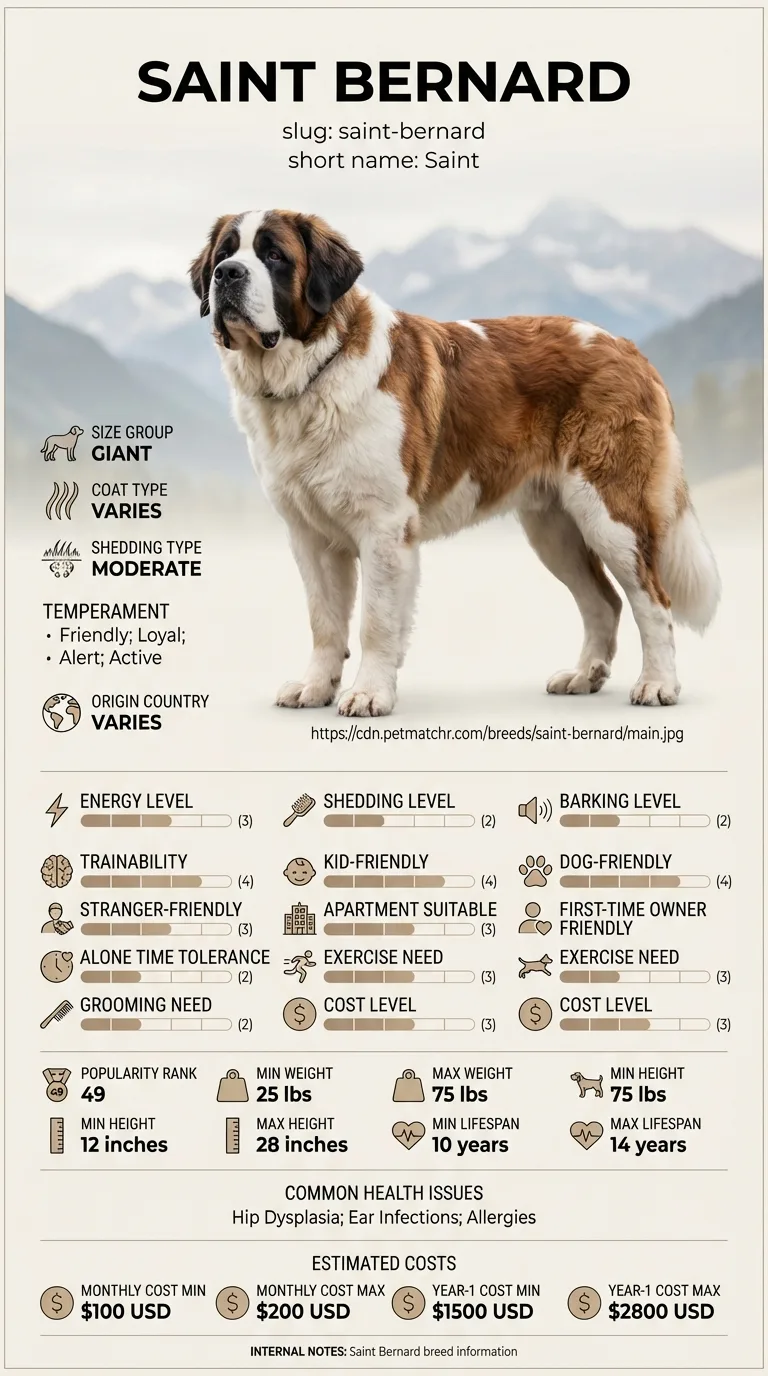
This affects owners across the dog's whole life, from puppy owners managing growth-plate-safe exercise to owners of older dogs navigating arthritis pain that follows years of joint laxity.
This guide is not medical advice. If your dog shows pain, sudden behavior change, or worsening symptoms, consult a licensed veterinarian.
Some links may be affiliate links. We may earn a commission at no extra cost to you. We only suggest products we believe are helpful for dog owners.
We research and check what we publish, but we do not warrant that any figure, date, price, or statement is accurate, complete, or current, and we accept no liability for any loss, cost, injury, or other harm arising from the use of this site. Use it as one reference among several. You remain responsible for your own decisions and for your dog's care - confirm anything that matters with a licensed veterinarian or another qualified professional before you act on it. Full disclaimer.
Check this first
Hip dysplasia itself is a chronic, progressive condition rather than a sudden emergency, but it can produce acute crises. A dog that suddenly cannot bear weight on a hind leg at all, is crying out in pain, or collapses when trying to stand needs a same-day vet visit, since this can indicate a serious flare, a secondary injury, or a fracture in a joint already weakened by dysplasia.
More typical day-to-day signs are gradual: difficulty rising after rest, a bunny-hopping gait when running, reluctance to jump into a car or climb stairs, and visible muscle loss in the hindquarters over time. These are appointment-worthy rather than emergency-worthy, and tend to be managed with a combination of weight control, joint supplements, physical therapy, and pain management rather than crisis intervention.
The key distinction is whether the change is sudden or gradual. A slow decline in mobility over months is the expected pattern of dysplasia-driven arthritis progressing; a sudden inability to use a leg at all is different and should be treated as urgent, since it may represent something beyond the underlying dysplasia itself.
If any of these apply, call your vet or an emergency clinic now. The rest of this page is for the cases that are not an emergency.
Hip dysplasia develops when the hip joint's ball and socket don't form a snug fit, leading to abnormal movement, wear, and eventually arthritis. In a giant breed like the Saint Bernard, the sheer speed and scale of puppy growth adds mechanical stress to a joint that may already carry a genetic tendency toward laxity, making this one of the breed's most consistently documented orthopedic concerns.
Hip dysplasia is one of the most frequently documented health issues in Saint Bernards specifically, alongside elbow dysplasia and cardiac conditions, making it a central consideration for anyone bringing this breed into their home.
Saint Bernards carry a genetic predisposition toward hip dysplasia that is compounded by their growth pattern: this breed can go from a few pounds at birth to well over a hundred pounds within about eighteen months, and that speed of growth puts real mechanical demand on a joint that needs time and controlled loading to develop properly.
Excess calorie intake accelerating growth beyond what the skeleton can comfortably support, high-impact exercise like repeated jumping or long-distance running during puppyhood, and ongoing excess body weight in adulthood are the main environmental factors that turn a genetic predisposition into a clinically significant problem.
Talk to your vet about a bunny-hopping gait, reluctance to climb stairs or jump, or visible difficulty rising after rest. A sudden inability to bear weight on a hind leg, crying out in pain, or collapse while standing are more urgent and should be seen the same day.
Certain choices, especially in puppyhood, measurably raise the odds of hip dysplasia becoming a serious problem later.
See all Saint Bernard health problems, which breeds are prone to hip dysplasia, or the full Saint Bernard breed guide for temperament, exercise needs and ownership costs.
Some puppies show signs as early as four to twelve months, while others don't show visible symptoms until arthritis sets in during middle age. Management, once started, is typically lifelong rather than a fixed-length treatment.
Success generally means a dog that stays mobile and comfortable with a managed weight, appropriate exercise, and pain control, rather than a joint that returns to a fully normal, dysplasia-free state, since the underlying structural issue doesn't reverse.
Laura's Saint Bernard, Samson, started showing a bunny-hopping gait around nine months old. X-rays confirmed moderate hip dysplasia in both hips. Rather than jumping straight to surgery, her vet recommended a structured weight-management plan, joint supplements, and a switch from long runs to controlled leash walks and swimming. By his second birthday, Samson had noticeably better muscle tone in his hindquarters and had stopped showing the hopping gait during normal movement, though his vet noted the underlying joint looseness was still there on follow-up X-rays.
Key takeaway: Conservative management made a real functional difference for Samson even though it didn't change what the X-rays showed, which is a realistic outcome for many dogs with moderate hip dysplasia.
It's a malformation of the hip joint where the ball and socket don't fit together snugly, causing looseness that leads to abnormal wear, inflammation, and eventually arthritis over time.
Signs can appear as early as four to twelve months during rapid growth, though some dogs don't show visible symptoms until arthritis develops in middle age, even if the underlying joint laxity was present from puppyhood.
A vet uses a physical exam checking for joint laxity and pain, combined with X-rays to assess how well the ball and socket fit and whether arthritic changes are present.
It can't be fully prevented since there's a genetic component, but controlled puppy growth, appropriate exercise, and maintaining a lean body weight throughout life all reduce how severely it develops and progresses.
Not always. Many dogs are managed successfully with weight control, joint supplements, physical therapy, and pain management. Surgical options exist for more severe cases, ranging from less invasive procedures in young dogs to full hip replacement in adults.
Conservative management with supplements and occasional vet visits is more modest, while surgical options like hip replacement can run into the thousands of dollars per hip, making this one of the more significant lifetime costs for the breed.
Most dogs don't progress to that point with proper management, though severe, poorly managed cases can eventually affect mobility enough that mobility aids become part of daily life.
A combination of genetic predisposition and rapid growth places uneven stress on the developing hip joint.
A bunny-hopping gait when running, or reluctance to climb stairs, are common early signs worth mentioning to a vet.
Yes, surgical options like hip replacement can be a significant cost, often thousands of dollars per hip.
Many dogs manage well long-term with weight control, joint supplements, and appropriate exercise.
Yes, keeping a lean body weight significantly reduces the joint stress that drives arthritis progression.
A one-page prep sheet for this condition: the signs, the questions to ask, what to get priced. Unlocks here.
You get: Vet visit prep sheet
No spam. One-click unsubscribe. See our privacy policy.
Preview page 1 before you decide.