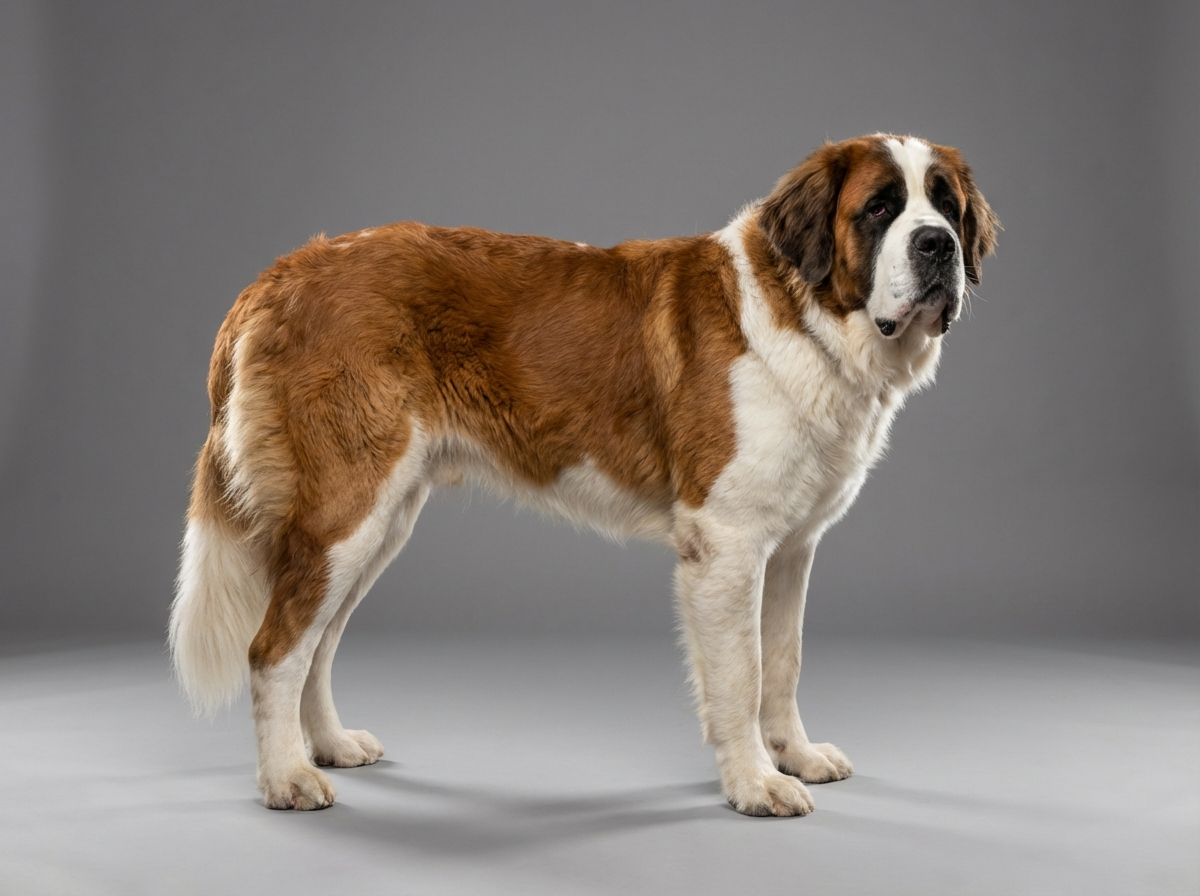
Costs
Saint Bernard cost in Albuquerque
About $141–$291/month and $2,068–$3,948 for year one — below average for the country, with the local wrinkle being spring dust season pressing on this breed's documented entropion risk.

See Saint Bernard price across all cities →
Quick answer
Saint Bernard cost in Albuquerque
About $141–$291/month and $2,068–$3,948 for year one — below average for the country, with the local wrinkle being spring dust season pressing on this breed's documented entropion risk.
A Saint Bernard in Albuquerque runs about $141 to $291 a month, with the first year landing near $2,068 to $3,948 — modestly below the national average, because New Mexico's general cost of living sits under the US line. The genuinely Albuquerque-specific variable for this breed is not the price of food. It is airborne grit. This is a documented Entropion breed, and Albuquerque's spring wind season pushes fine dust off the Rio Grande valley floor for weeks at a stretch.
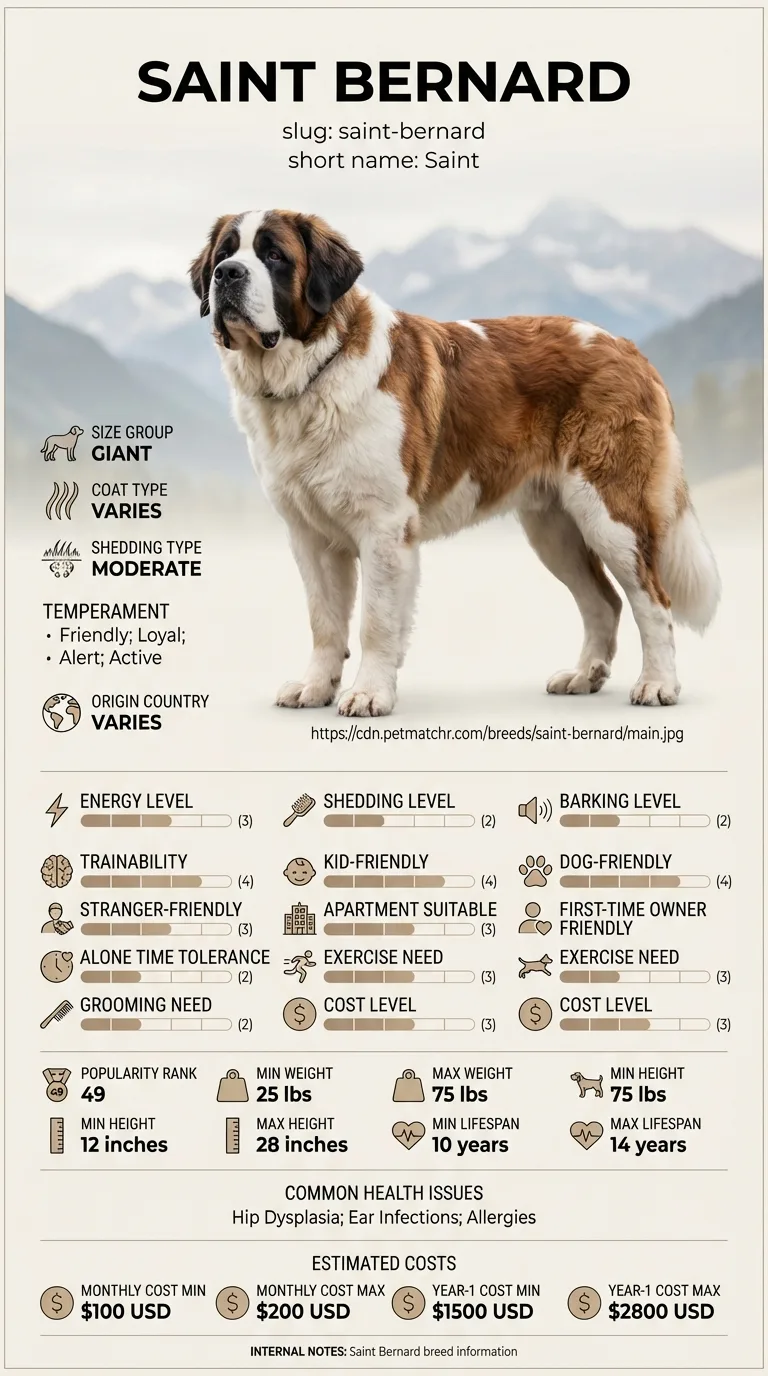
Entropion is frequently corrected surgically, and that is a real, plannable one-time expense rather than a monthly one. The larger spike risk in this breed is Bloat (GDV), which is a same-day surgical emergency, alongside documented Hip Dysplasia, Elbow Dysplasia and Dilated Cardiomyopathy. Every one of those bills is scaled by a 120-to-180-pound body, because anesthesia and medication are dosed by weight.
These figures reflect Albuquerque's below-average general costs, offset by the fact that every weight-dosed item for a 120-to-180-pound dog sits in the top price tier no matter how cheap the market is.
Estimate · source: estimation · confidence: medium · updated 2026-10-06 · not a quote
| Item | Cost range |
|---|---|
One-time setup (giant crate, orthopedic bed, first exam, spay/neuter) Crate and bedding sizing for a giant breed is the single largest gear bill of any size class, and Albuquerque's below-average service pricing helps most on the spay/neuter side. | $489 - $846 |
| Item | Cost range |
|---|---|
Food (giant-breed volume) A 120-to-180-pound dog eats several times what a mid-sized dog does; New Mexico's softer retail pricing takes a modest edge off a bill that is large by definition. | $68 - $120 |
Parasite prevention (top weight tier, nine-month window) Heartworm and flea-tick products are dosed by body weight, so this breed sits in the most expensive bracket, though Albuquerque's dry nine-month season trims the annual count. | $30 - $55 |
Each range starts from a national baseline for this breed's size class and is then adjusted for local cost of living and veterinary pricing. The baselines, and the source each one came from, are listed on our sources page (dataset 2026.09). Two inputs, the purchase price and the emergency reserve, have no published national figure we could verify, so we leave them to you rather than invent them.
These are planning estimates, not quotes. Your own numbers will move with the individual dog, your vet and your insurer. Build a budget with your own figures.
For a Saint Bernard in Albuquerque, insurance earns its keep less through the eye — an entropion correction is usually a plannable, one-time surgery — and more through the conditions that arrive without warning.
If you are enrolling before any eye or joint finding is on record, this is a strong candidate breed: Bloat is a same-day surgical emergency, and joint and cardiac work in a giant breed is expensive everywhere, Albuquerque included.
An owner who has already funded a five-figure-capable reserve and is comfortable writing a surgical check on short notice can reasonably self-insure instead.
Albuquerque gives you a genuinely cheaper baseline than most of the country. The savings are best spent on things that reduce the odds of an emergency rather than on trimming the recurring bill.
Most Albuquerque cost advantages for a dog are straightforward. New Mexico's general cost of living runs under the national line, so food, boarding and routine veterinary visits price a little softer here than in a coastal metro. The nine-month parasite window is shorter than the Gulf South's, which trims a few doses off the year.
What is not straightforward is the eye. Entropion appears on this breed's documented condition list, and the practical consequence is that the lower lid can roll in far enough for hair to sweep the cornea with every blink. Owners usually notice it as squinting, a wet track down the face, or a dog that keeps turning away from the window.
Albuquerque's contribution is timing. The city sits at roughly a mile of elevation in a valley that channels wind, and the late-winter-into-spring stretch is when that wind reliably picks up loose sediment. A healthy eye flushes grit out. An eye already being scraped from the inside does not get that chance, and what would have been a mild irritation in a different city can become a corneal ulcer here — a same-week vet visit rather than a wait-and-see.
Treat the eye as a scheduled line, not a surprise. A surgical entropion correction is typically done once, often before the dog is fully grown if the lid conformation is clear early, and Albuquerque's below-average surgical pricing is a genuine advantage on that specific bill.
Everything else follows the size of the animal. A dog in this weight class eats several times what a mid-sized dog eats, and weight-tier parasite prevention lands in the top price bracket. Neither of those is negotiable, and neither of them gets cheaper because the market is affordable. What the affordable market does is make the discretionary items — a second orthopedic bed, a lift ramp for the car, an extra grooming appointment during the shed — genuinely reachable on a normal budget.

An Albuquerque household noticed their young Saint Bernard blinking hard on breezy afternoons and put it down to dust, which it partly was. By the second spring the squint had become a permanent tilt of the head away from the light, and the exam found a lower lid that had been rolling inward the whole time. The correction went fine and was, in this market, affordable. What it cost was two years of a cornea being sanded from both sides at once.
Key takeaway: In Albuquerque, dust is the thing you notice and the eyelid is the thing that matters. Get the lid looked at before you decide the wind is to blame.
About $141–$291, a little under the national average, tracking New Mexico's below-average general cost of living.
Roughly $2,068–$3,948, which folds the first exam, spay/neuter, and giant-size gear on top of the recurring monthly figure.
For a breed with documented entropion risk, yes. An inward-rolling lid is already abrading the cornea, and the fine sediment the spring wind lifts off the valley removes the eye's margin for error.
Persistent squinting, a wet stain running down the face, redness that doesn't clear in a day, or a dog that turns away from bright light — all worth a same-week appointment rather than a wait.
Worth quoting early. Entropion, Bloat, Hip Dysplasia, Elbow Dysplasia and Dilated Cardiomyopathy are all documented in this breed, and every surgical bill is priced against a 120-to-180-pound body.
Around $1,150. That reflects Albuquerque's softer local pricing set against the reality that giant-breed emergency care costs far more per incident than small-breed care.
About $141–$291/month and $2,068–$3,948 for year one — below average for the country, with the local wrinkle being spring dust season pressing on this breed's documented entropion risk.
This guide is not medical advice. If your dog shows pain, sudden behavior change, or worsening symptoms, consult a licensed veterinarian.
Some links may be affiliate links. We may earn a commission at no extra cost to you. We only suggest products we believe are helpful for dog owners.
We research and check what we publish, but we do not warrant that any figure, date, price, or statement is accurate, complete, or current, and we accept no liability for any loss, cost, injury, or other harm arising from the use of this site. Use it as one reference among several. You remain responsible for your own decisions and for your dog's care - confirm anything that matters with a licensed veterinarian or another qualified professional before you act on it. Full disclaimer.
One sheet with every line item, the emergency fund and when insurance pays off - unlocks on this page.
You get: 12-month budget sheet
No spam. One-click unsubscribe. See our privacy policy.
See a sample page before you decide.