Health
What breed size is wobbler syndrome usually associated with?
Large and giant breeds are far more classically documented, though it can occur rarely in small breeds like Pugs too.

Quick answer
What breed size is wobbler syndrome usually associated with?
Large and giant breeds are far more classically documented, though it can occur rarely in small breeds like Pugs too.
An uncoordinated, swaying walk that looks like the hind end and front end aren't quite in sync with each other points toward the neck, not the lower back — and that specific distinction is what separates wobbler syndrome from more common Pug back problems.
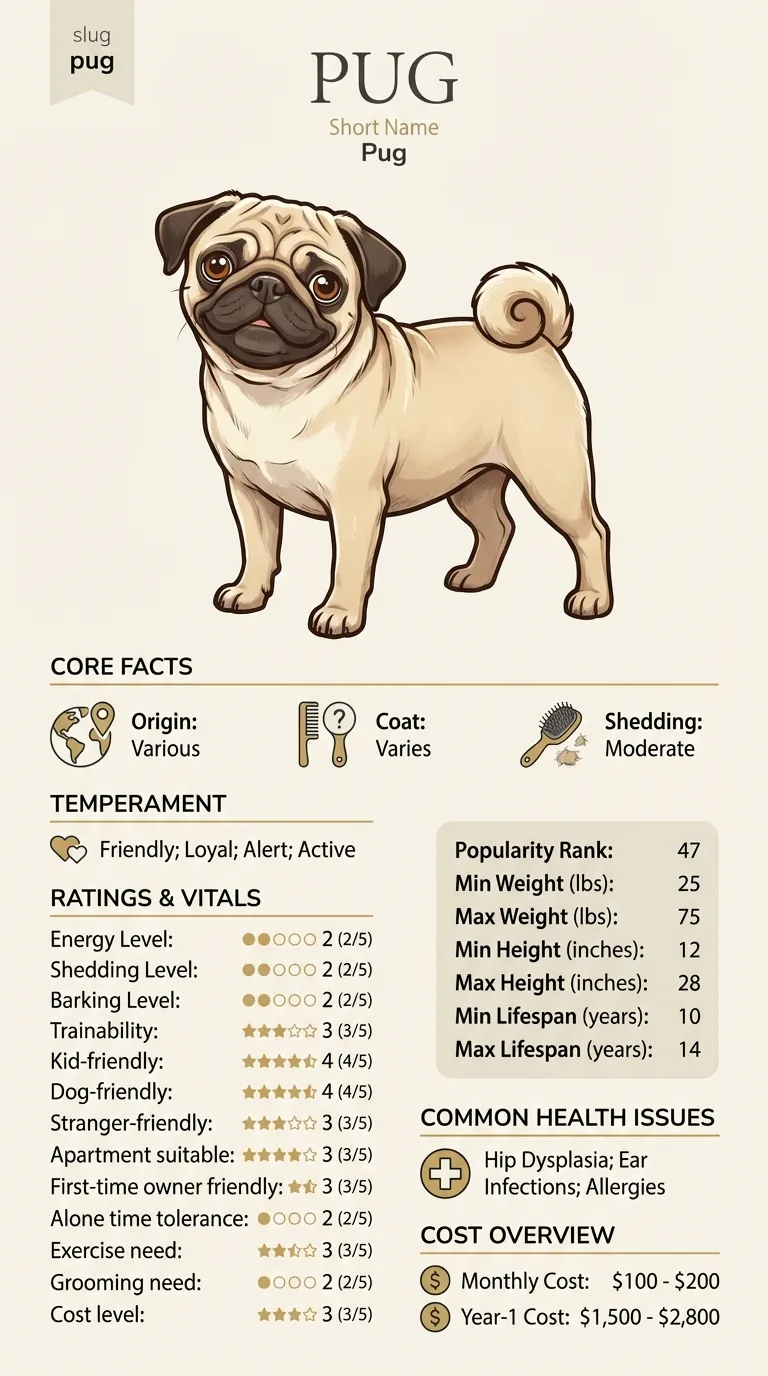
Owners noticing an unusual, uncoordinated gait in their Pug and trying to understand why a condition typically discussed in giant breeds is being considered for a small dog.
This guide is not medical advice. If your dog shows pain, sudden behavior change, or worsening symptoms, consult a licensed veterinarian.
Some links may be affiliate links. We may earn a commission at no extra cost to you. We only suggest products we believe are helpful for dog owners.
We research and check what we publish, but we do not warrant that any figure, date, price, or statement is accurate, complete, or current, and we accept no liability for any loss, cost, injury, or other harm arising from the use of this site. Use it as one reference among several. You remain responsible for your own decisions and for your dog's care - confirm anything that matters with a licensed veterinarian or another qualified professional before you act on it. Full disclaimer.
Wobbler syndrome involves instability or compression at the neck vertebrae that puts pressure on the spinal cord, producing a characteristic uncoordinated gait affecting all four legs. It's a rare diagnosis in Pugs, classically associated with large breeds, but remains a possible consideration given the breed's separately documented tendency toward vertebral abnormalities.
Wobbler syndrome is uncommon in small breeds generally and rare in Pugs specifically, remaining far more classically documented in large and giant breeds, though it isn't impossible in this breed given related vertebral development tendencies.
Wobbler syndrome is most classically tied to rapid growth and long-necked conformation in large and giant breeds, a mechanism that doesn't directly apply to Pugs. However, the breed's separately documented tendency toward vertebral malformations, like hemivertebrae, reflects an underlying spinal development vulnerability that can, in rare cases, extend to instability at the neck level as well.
There's no specific environmental trigger established for this condition in small breeds specifically, though general spinal stress from normal activity can reveal or worsen symptoms once an underlying vertebral vulnerability is already present.
Bring your dog in for evaluation if you notice an uncoordinated, wobbly gait affecting all four legs, reluctance to lower the head, or resistance to neck handling. Seek prompt care for any progressive worsening of these signs, since spinal cord compression can advance over time without treatment.
Start here: Pug Most Common Genetic Disorders: What to Screen For
See all PUG health problems, which breeds are prone to wobbler syndrome, or the full PUG breed guide for temperament, exercise needs and ownership costs.
Diagnosis typically takes one to a few weeks given the specialist imaging usually involved. Conservative management may show improvement over several weeks of restricted activity, while surgical recovery generally takes longer, with outcomes depending heavily on severity at diagnosis.
Success is a dog with stable or improved coordination and no progression of symptoms, achieved through appropriate management — not necessarily a spine that returns to a completely typical structure, since the underlying vertebral vulnerability in this breed is a structural trait rather than something reversible.
Wobbler syndrome involves either a narrowing of the spinal canal within the neck vertebrae or instability between vertebrae that allows abnormal movement, both of which compress the spinal cord at the neck level rather than further down the back. Because the spinal cord at this level carries signals to both the front and hind limbs, compression here produces a characteristic gait abnormality affecting all four legs — often more pronounced in the hind end — rather than the more localized hind-leg-only presentation typical of a lower back disc problem.
This condition is most extensively documented in large and giant breeds, where rapid growth and long necks create particular vertebral stress, but Pugs carry a separately documented tendency toward vertebral malformations like hemivertebrae, tied to the same compact, sometimes irregular spinal development seen in screw-tailed breeds. This existing vertebral vulnerability is part of why wobbler syndrome, while rare in this breed, isn't something to rule out purely based on Pugs not being a classic "wobbler breed" — the underlying vertebral abnormality risk factor is already present for other, related reasons.
The four-limb, uncoordinated nature of this gait pattern is the key clue that points a workup toward the neck rather than the lower back.

If you think your Pug has wobbler syndrome, the plan is three steps: write down what you have seen and when it started, book a veterinary appointment rather than waiting for the next flare, and take video of the behaviour or symptom before you go — the thing you are worried about rarely happens in the consulting room. Screening in the parents covers brachycephalic airway syndrome (boas), pug dog encephalitis, corneal ulcers.
What the vet visit should produce is a diagnosis and a written plan, not just reassurance: what is being ruled out, what the monitoring interval is, and which signs mean you come back sooner. Ask what the treatment costs across a year rather than per visit, because that is the number that decides whether you are managing this condition or reacting to it.
Between appointments, keep a short log — dates, what you saw, what changed. It is the single most useful thing an owner brings to a follow-up, and for wobbler syndrome it is often what separates a clear pattern from a guess.
Oscar's Pug, Bean, developed an odd, swaying walk over a few weeks that looked different from anything Oscar had read about typical Pug back problems — both the front and back legs seemed slightly uncoordinated, not just the hind end. His vet noted the unusual four-limb pattern and, despite wobbler syndrome being rare in small breeds, recommended a neurologist referral given how atypical the presentation was for a more common lower-back issue. An MRI confirmed cervical spinal cord compression consistent with wobbler syndrome. Given the moderate severity, Bean's neurologist recommended conservative management first — activity restriction and anti-inflammatory medication — which brought meaningful improvement over six weeks. Bean's gait isn't perfectly normal, but the wobbliness has stayed stable and manageable in the year since.
Key takeaway: An uncoordinated gait affecting all four legs, not just the hind end, is a specific enough clue to warrant considering a rare diagnosis even in a breed where it's not the classic expectation.
No, it's rare in this breed and far more classically documented in large and giant breeds. It remains a possible, if uncommon, diagnosis worth considering given the Pug's separately documented tendency toward vertebral abnormalities like hemivertebrae.
Wobbler syndrome affects the neck vertebrae, producing an uncoordinated gait in all four legs, while more typical Pug back issues like disc disease usually occur lower in the spine and primarily affect the hind legs.
A swaying, uncoordinated walk affecting both front and hind legs, sometimes more pronounced in the hind end, distinct from the hind-leg-only weakness typical of a lower back problem.
MRI imaging of the neck is the standard tool for confirming spinal cord compression at that level and identifying the specific cause, often following a referral to a veterinary neurologist given how uncommon this diagnosis is outside large breeds.
Not always — milder cases may be managed conservatively with activity restriction and anti-inflammatory treatment, while more severe or progressive cases are more likely to need surgical decompression.
Pugs have a separately documented tendency toward vertebral malformations, like hemivertebrae, tied to the same compact spinal development pattern seen in some other short-bodied breeds, which creates an underlying vulnerability even though the classic large-breed growth-related mechanism doesn't directly apply.
Outcomes vary by severity and how promptly treatment starts, similar to other spinal cord compression conditions — milder cases managed conservatively often do well, while more severe cases depend heavily on how much spinal cord function remains at diagnosis.
Large and giant breeds are far more classically documented, though it can occur rarely in small breeds like Pugs too.
An uncoordinated gait affecting all four legs, rather than a hind-leg-only presentation typical of lower back issues.
Spinal MRI imaging commonly runs $1,500 to $3,000 or more depending on the facility and any sedation required.
Milder cases sometimes are, through activity restriction and anti-inflammatory treatment, though more severe cases often need surgical decompression.
Yes, given how uncommon this specific condition is in small breeds, a specialist referral is often appropriate for accurate diagnosis and treatment planning.
A one-page prep sheet for this condition: the signs, the questions to ask, what to get priced. Unlocks here.
You get: Vet visit prep sheet
No spam. One-click unsubscribe. See our privacy policy.
Preview page 1 before you decide.