Behavior
Which is quieter?
The Pug, rated Low (2/5) for barking versus the Poodle's Moderate (3/5).

Quick answer
Which is quieter?
The Pug, rated Low (2/5) for barking versus the Poodle's Moderate (3/5).
Poodle (Miniature) or Pug? On paper they differ most on grooming need, and on the scales Pug is the heavier at 14–18 lbs. Here is how the two compare on everything that shapes an ordinary week.
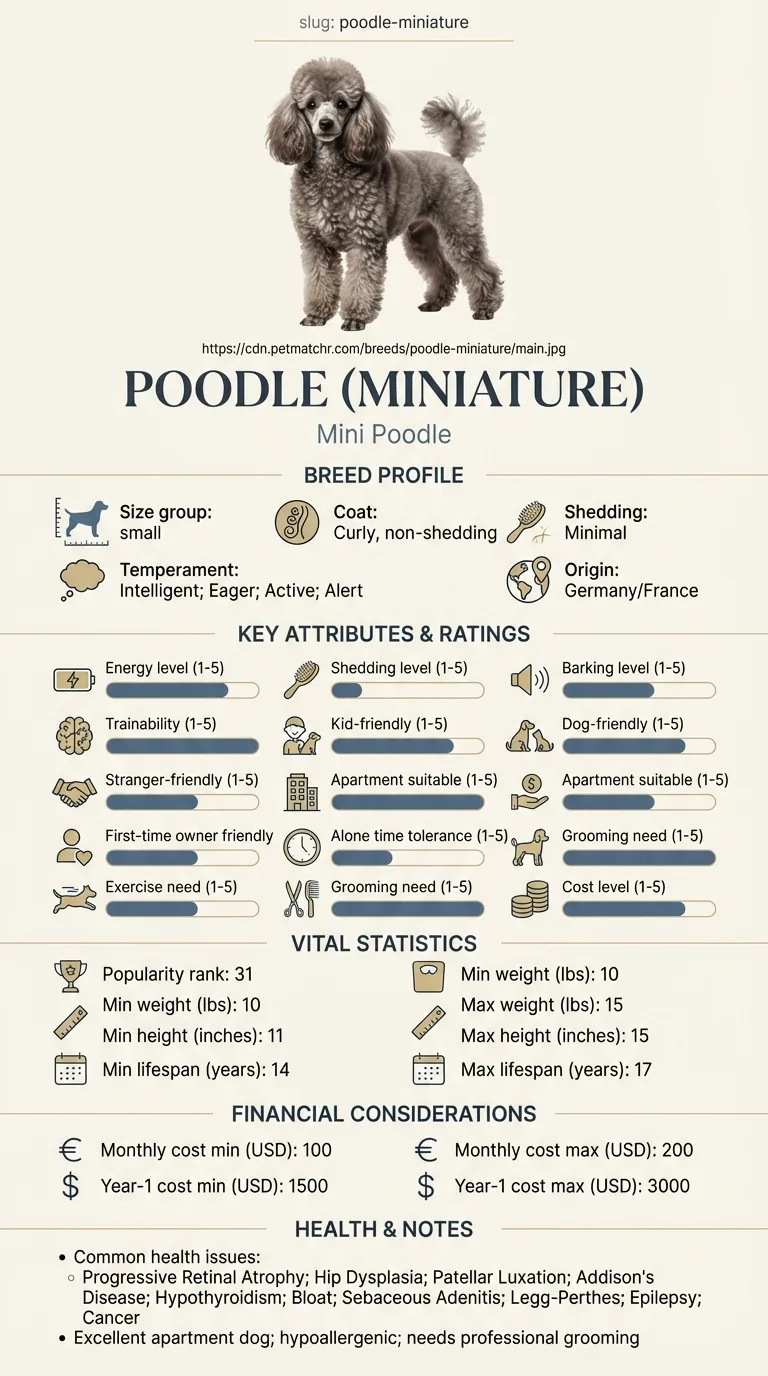
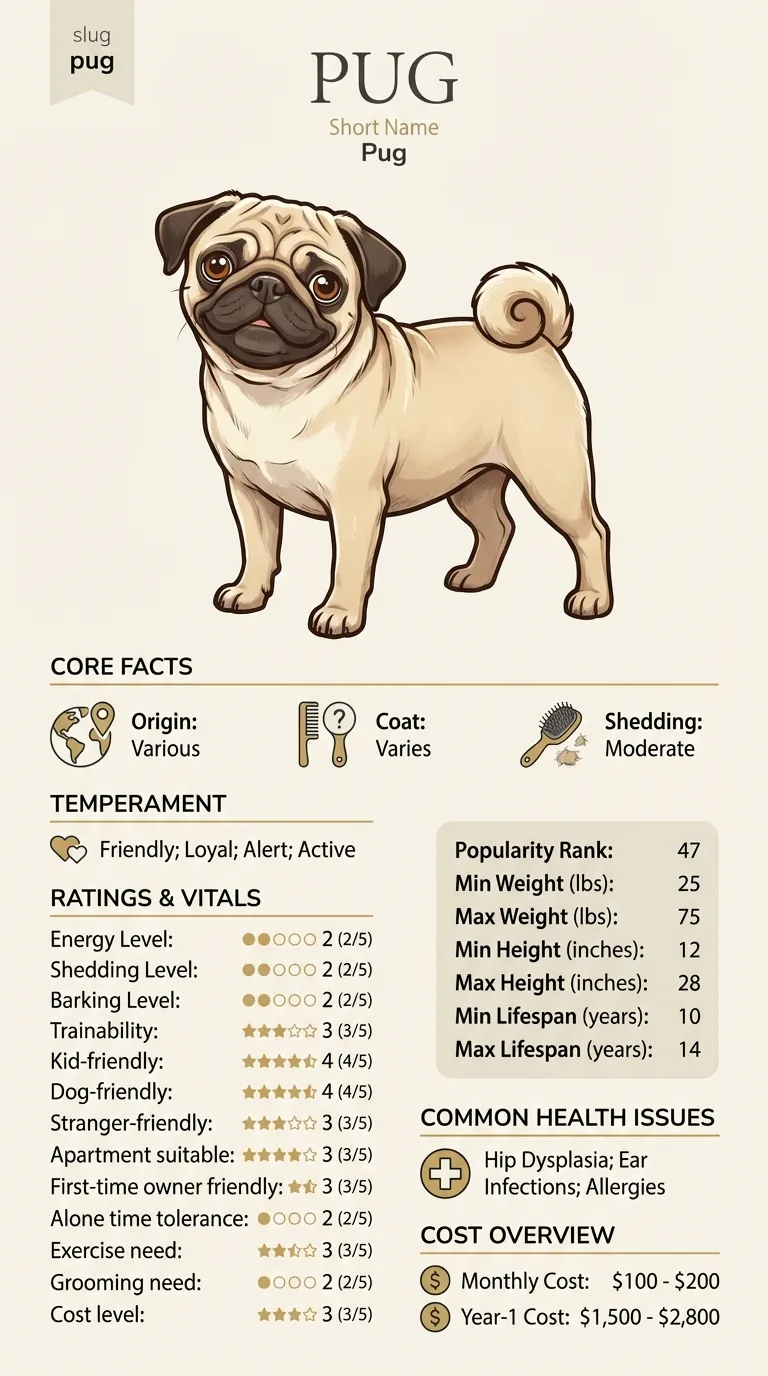
This is for someone already down to Poodle (Miniature) and Pug and deciding between them. For this pair the decision usually turns on grooming need and shedding, so those are covered first and in most detail. Both rate 5/5 for flats, so housing does not settle this one. The focus throughout is on daily consequences rather than breed background.
Between Poodle (Miniature) and Pug, grooming need is what separates them, and Pug is the lower-effort dog of the two to keep.
Choose Poodle (Miniature) if shedding is a problem in your house, you want a dog that picks up training quickly and a smaller dog suits your car, your home or your back.
Choose Pug if this is your first dog, you do not want a standing grooming appointment and your walking routine is modest.
| Feature | poodle miniature | pug | Winner |
|---|---|---|---|
| Size class | small | small | Equal |
| Weight | 10–15 lbs | 14–18 lbs | Equal |
| Height | 11–15 in | 10–13 in | Equal |
| Lifespan | 14–17 years | 13–15 years | poodle miniature |
| Exercise need | Moderate (3/5) | Low (2/5) | pug |
| Grooming need | Very high (5/5) | Low (2/5) | pug |
| Shedding | Very low (1/5) | High (4/5) | poodle miniature |
| Energy level | High (4/5) | Low (2/5) | Equal |
| Barking | Moderate (3/5) | Low (2/5) | pug |
| Apartment suitability | Very high (5/5) | Very high (5/5) | Equal |
| Good for first-time owners | Moderate (3/5) | Very high (5/5) | pug |
| Tolerates being alone | Low (2/5) | Low (2/5) | Equal |
| Trainability | Very high (5/5) | Moderate (3/5) | poodle miniature |
| Good with kids | High (4/5) | Very high (5/5) | pug |
| Good with other dogs | High (4/5) | High (4/5) | Equal |
| Friendly to strangers | Moderate (3/5) | Very high (5/5) | pug |
| Cost level | High (4/5) | Moderate (3/5) | pug |
| Coat | Curly, non-shedding | Short, smooth double coat | Equal |
| Origin | Germany/France | Various | Equal |
| Typical monthly cost | $100–$200 | $80–$150 | Equal |
| Typical first-year cost | $1,500–$3,000 | $1,100–$2,300 | Equal |
Both breeds sit in the small size class with genuinely comparable numbers — the Miniature Poodle at 10 to 15 pounds and 11 to 15 inches against the Pug at 14 to 18 pounds and 10 to 13 inches, close enough that either could plausibly be the larger dog in a given pair. The resemblance stops at the coat and skull, though: the Poodle's curly, non-shedding coat and elegant, upright frame contrast sharply with the Pug's short, smooth double coat and compact, brachycephalic build. Anyone picturing these two side by side is comparing a slender, athletic silhouette against a stocky, flat-faced one.
The Poodle rates Moderate (3/5) for exercise need against the Pug's Low (2/5), and energy level shows a wider gap still — High (4/5) for the Poodle versus Low (2/5) for the Pug. Part of that difference is structural: the Pug's brachycephalic airway, flagged directly in its health profile as Brachycephalic Airway Syndrome (BOAS), limits how much sustained exertion it can safely handle, especially in heat. The Poodle's Active, Eager nature calls for real daily engagement, while the Pug's Even-tempered, low-key disposition is content with short, gentle walks and plenty of couch time in between.
Grooming need runs opposite to what many expect: the Poodle rates Very high (5/5) against the Pug's Low (2/5), yet shedding favors the Poodle at Very low (1/5) against the Pug's High (4/5). That means the Pug is the lower-effort coat to maintain day to day but leaves noticeably more hair on furniture and clothing, while the Poodle demands regular professional clipping but keeps the house comparatively hair-free. A household prioritizing minimal cleanup over minimal grooming cost should lean Poodle; one that wants simple, no-fuss coat care should accept the Pug's shedding trade-off.
Both breeds tie at Very high (5/5) for apartment suitability, making either a strong fit for small-space living, and barking favors the Pug at Low (2/5) against the Poodle's Moderate (3/5) — a quieter housemate despite its smaller size. Both also tie at Low (2/5) for tolerating time alone, so neither is well suited to long solo stretches regardless of the apartment fit. For noise-sensitive buildings specifically, the Pug's lower barking rating combined with its identical apartment score gives it a slight practical edge over the Poodle.
First-time-owner suitability strongly favors the Pug, Very high (5/5) against the Poodle's Moderate (3/5), even though the Poodle rates far higher on raw trainability, Very high (5/5) against the Pug's Moderate (3/5) — the Pug's easygoing, Charming and Even-tempered nature simply asks less of a new owner day to day, even if it learns commands more slowly. The Poodle's Intelligent, Alert profile makes it one of the most responsive breeds to structured training, but that same intelligence needs consistent mental engagement to avoid boredom-driven mischief, something the Mischievous Pug is more forgiving about if training lapses.
The Pug edges ahead with kids, Very high (5/5) against the Poodle's High (4/5), and pulls further ahead with strangers, Very high (5/5) against the Poodle's Moderate (3/5) — its Charming, Affectionate temperament makes it an easy, low-drama presence around new people and children. Both tie at High (4/5) with other dogs. The Poodle's Alert, Proud demeanor is still solidly social but reads as a notch more reserved in each category. For a household that entertains often or has young kids with frequent friends over, the Pug's consistently top social scores stand out.
The Poodle holds a real lifespan advantage, 14 to 17 years against the Pug's 13 to 15, and the health profiles diverge sharply in character rather than just count. The Pug's five listed conditions — Brachycephalic Airway Syndrome (BOAS), Pug Dog Encephalitis, Corneal Ulcers, Hemivertebrae, and Obesity — are concentrated around its flat-faced structure and are generally considered more serious individually than a typical small-breed list. The Poodle's ten conditions, including Progressive Retinal Atrophy, Addison's Disease, Bloat, and the breed-specific Sebaceous Adenitis, are broader but less structurally severe on average. Prospective Pug owners in particular should research BOAS management before committing.
Cost level favors the Pug, Moderate (3/5) against the Poodle's High (4/5), and the ranges follow — $80–$150 monthly and $1,100–$2,300 in year one for the Pug versus $100–$200 monthly and $1,500–$3,000 for the Poodle. The Poodle's Very high (5/5) grooming need drives most of that gap through recurring professional clipping costs, while the Pug's Low (2/5) grooming need keeps its baseline lower — though prospective owners should budget separately for the Pug's higher likelihood of BOAS-related veterinary care, which isn't captured in the routine cost tier.
Poodle (Miniature) weighs 10–15 lbs and lives 14–17 years; Pug weighs 14–18 lbs and lives 13–15 years. The two diverge most on grooming need, shedding and energy level and 3 other rated axes. They are level on tolerates being alone, apartment suitability and good with other dogs, so those cannot decide it. The table below marks a winner only where one breed is genuinely easier for a typical owner; size and origin are facts rather than merits and stay level. Ratings come from one source applied to both breeds, so they are meaningful against each other rather than as absolute scores.

The Pug, rated Very high (5/5) for first-time-owner suitability against the Poodle's Moderate (3/5).
The Poodle, rated Very high (5/5) versus the Pug's Moderate (3/5), despite the Pug being the easier breed overall for beginners.
Its brachycephalic (flat-faced) structure carries a real risk of Brachycephalic Airway Syndrome (BOAS), listed directly in its health profile, along with a Low (2/5) exercise need reflecting that limitation.
The Pug, rated High (4/5) versus the Poodle's Very low (1/5).
The Pug, rated Low (2/5) versus the Poodle's Very high (5/5).
The Pug, rated Very high (5/5) versus the Poodle's Moderate (3/5).
The Pug, at $1,100–$2,300 in year one versus the Poodle's $1,500–$3,000, though BOAS-related vet care can offset the savings.
The Pug, rated Low (2/5) for barking versus the Poodle's Moderate (3/5).
The Poodle, rated Moderate (3/5) versus the Pug's Low (2/5).
The Poodle, typically 14–17 years, versus the Pug's 13–15 years.
The Pug, rated Very high (5/5) versus the Poodle's High (4/5).
See every pug comparison.
Secure checkout on Stripe. We never see your card.
7-day money-back guarantee. Instant access.
Health information here is general and is not veterinary advice. If your dog shows pain, sudden behaviour change, or worsening symptoms, consult a licensed veterinarian.
Some links on this site are affiliate links. We may earn a commission at no extra cost to you, and we only suggest products we believe are helpful for dog owners.
We research and check what we publish, but we do not warrant that any figure, date, price, or statement is accurate, complete, or current, and we accept no liability for any loss, cost, injury, or other harm arising from the use of this site. Use it as one reference among several. You remain responsible for your own decisions and for your dog's care - confirm anything that matters with a licensed veterinarian or another qualified professional before you act on it. Full disclaimer.
Match your lifestyle to the right dog.
Take quizNot sure which breed is right for you? Take our 2-minute quiz to find out.
Take the quiz