Health
Is DM likely in a Pug with hind-leg weakness?
Less likely than in breeds where it's well documented; disc disease is a much more common cause in this breed.

Quick answer
Is DM likely in a Pug with hind-leg weakness?
Less likely than in breeds where it's well documented; disc disease is a much more common cause in this breed.
A slow, painless hind-leg weakness in an older Pug is far more likely to be something else, but it's worth knowing what that something else could be.
This is most useful for owners of senior Pugs showing a slow, gradual decline in hind-leg coordination who want to understand why a vet might mention DM as a possibility, and why it's usually not the first or most likely explanation in this specific breed.
This guide is not medical advice. If your dog shows pain, sudden behavior change, or worsening symptoms, consult a licensed veterinarian.
Some links may be affiliate links. We may earn a commission at no extra cost to you. We only suggest products we believe are helpful for dog owners.
We research and check what we publish, but we do not warrant that any figure, date, price, or statement is accurate, complete, or current, and we accept no liability for any loss, cost, injury, or other harm arising from the use of this site. Use it as one reference among several. You remain responsible for your own decisions and for your dog's care - confirm anything that matters with a licensed veterinarian or another qualified professional before you act on it. Full disclaimer.
Degenerative myelopathy is a slow, painless spinal cord disease causing progressive hind-leg weakness, well documented in a handful of breeds but not established as common in Pugs. Given how frequently early disc disease occurs in this breed, DM is a diagnosis that warrants careful exclusion of more likely causes rather than automatic acceptance based on symptoms alone.
True confirmed DM is rare in Pugs. It's included here mainly because hind-leg weakness in an aging Pug sometimes prompts the question, and understanding why it's usually not the most likely answer helps set realistic expectations.
There is no well-established breed-specific genetic pattern connecting Pugs to DM the way there is for German Shepherds and Boxers. This breed's more relevant, well-documented spinal vulnerability is early intervertebral disc degeneration, a distinct condition.
Environment plays essentially no role in DM's underlying disease process, which is genetically driven; it's mentioned here mainly to contrast with disc disease, where weight and activity level do meaningfully affect risk.
Bring any new or progressive hind-leg weakness or coordination change to your vet's attention for a full neurological workup, since the more likely explanations in this breed need to be properly ruled out rather than assumed one way or the other.
Start here: Pug Most Common Genetic Disorders: What to Screen For
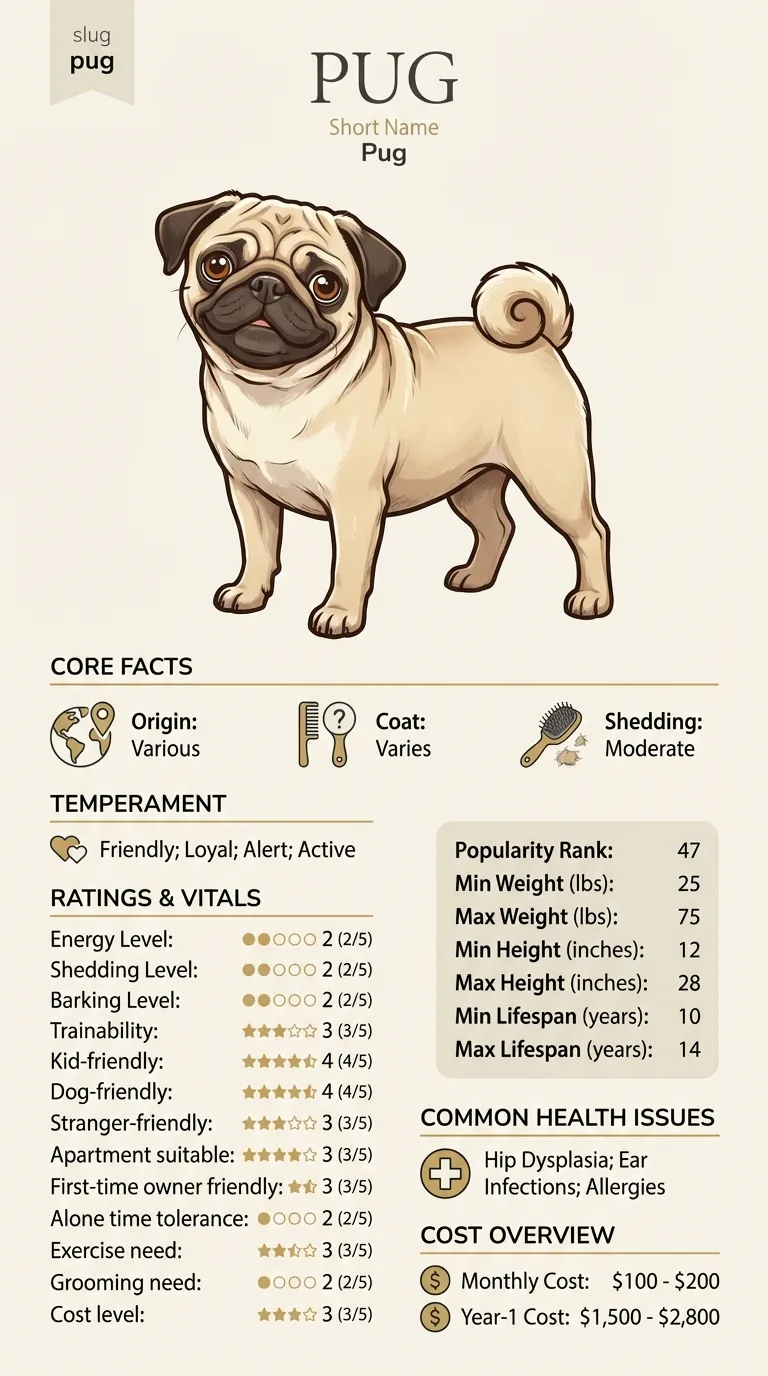
See all PUG health problems, which breeds are prone to degenerative myelopathy dm, or the full PUG breed guide for temperament, exercise needs and ownership costs.
A full diagnostic workup to distinguish DM from more likely causes typically takes a few weeks including imaging and specialist referral. If DM is ultimately confirmed, it follows a slow, progressive course typically over six months to a couple of years.
Success means reaching an accurate diagnosis rather than assuming the rarer condition, since the more likely explanations in this breed often have real treatment options that a DM assumption would overlook.
In a Pug, chronic hind-leg weakness is statistically far more likely to trace back to slow, low-grade intervertebral disc disease than to true DM, given how well documented early disc degeneration is in chondrodystrophic breeds. The key clinical difference vets look for is pain: DM is classically painless throughout its progression, while IVDD-related weakness typically involves at least some degree of back pain or sensitivity, even if subtle. A thorough neurological exam and imaging are what actually separate the two, rather than assuming DM based on age and symptoms alone.
A genetic test exists for the SOD1 gene mutation associated with DM in several well-studied breeds. It's worth understanding its limits clearly: carrying the mutation increases risk but does not guarantee a dog will develop the disease, and the test's predictive reliability is much better established in the breeds where it was originally studied than in Pugs specifically. A positive test result in a Pug showing hind-leg weakness is one data point to discuss with a veterinary neurologist, not a stand-alone diagnosis, particularly given how much more likely a disc-related cause is in this breed.

When ten-year-old Bella started dragging her back paws slightly during walks, her owner had read about DM online and feared the worst. A thorough vet exam noted subtle back sensitivity that didn't quite fit a painless DM presentation, prompting imaging that revealed low-grade, chronic disc-related nerve compression instead. With a treatment plan targeting the actual cause, including weight management and activity modification, Bella's gait notably improved over the following months. Her owner said she was relieved the vet hadn't simply accepted the DM assumption without a proper workup.
Key takeaway: In this breed, a hind-leg weakness diagnosis is worth a full workup rather than assuming the rarer, less treatable condition, since a more common and more manageable cause is often the real explanation.
No, it's not documented as a common or well-established diagnosis in this breed the way it is in German Shepherds or Boxers. Given how common early disc disease is in Pugs, that's usually the more likely explanation for similar symptoms and should be ruled out first.
DM is classically painless throughout, with gradually worsening weakness and coordination loss. IVDD-related weakness typically involves at least some pain or back sensitivity, even if mild, which is one of the clearest clinical clues used to tell them apart.
Yes, a genetic test for the SOD1 mutation exists, though it's far better validated in breeds where DM is well-documented. In a Pug, a positive result should be discussed with a veterinary neurologist alongside other diagnostic findings rather than treated as conclusive on its own.
DM is generally a diagnosis of exclusion, confirmed by ruling out other causes like disc disease, tumors, or other spinal conditions through imaging and neurological exam, sometimes alongside genetic testing, rather than through a single definitive test.
There's no cure or treatment that stops DM's progression; management focuses on maintaining mobility and quality of life through physical therapy and supportive care for as long as possible.
It's a personal decision; testing can provide useful information, particularly if hind-leg weakness develops, but given how uncommon a true DM diagnosis is in this breed, it shouldn't replace a full workup for more likely causes like disc disease.
Less likely than in breeds where it's well documented; disc disease is a much more common cause in this breed.
DM is typically painless; disc-related weakness usually involves some degree of pain or back sensitivity.
It shows risk, not a diagnosis; a positive result is one data point among several needed for confirmation.
No cure exists; physical therapy and supportive care help maintain mobility and quality of life.
Imaging and neurology referral costs add up; ask for an estimate before proceeding with advanced diagnostics.
A one-page prep sheet for this condition: the signs, the questions to ask, what to get priced. Unlocks here.
You get: Vet visit prep sheet
No spam. One-click unsubscribe. See our privacy policy.
Preview page 1 before you decide.