Living
Needs a yard, not an apartment?
The Weimaraner, rated Very low (1/5) for apartment suitability.

Quick answer
Needs a yard, not an apartment?
The Weimaraner, rated Very low (1/5) for apartment suitability.
Pug or Weimaraner? On paper they differ most on apartment suitability, and on the scales Weimaraner is the heavier at 55–90 lbs. Here is how the two compare on everything that shapes an ordinary week.
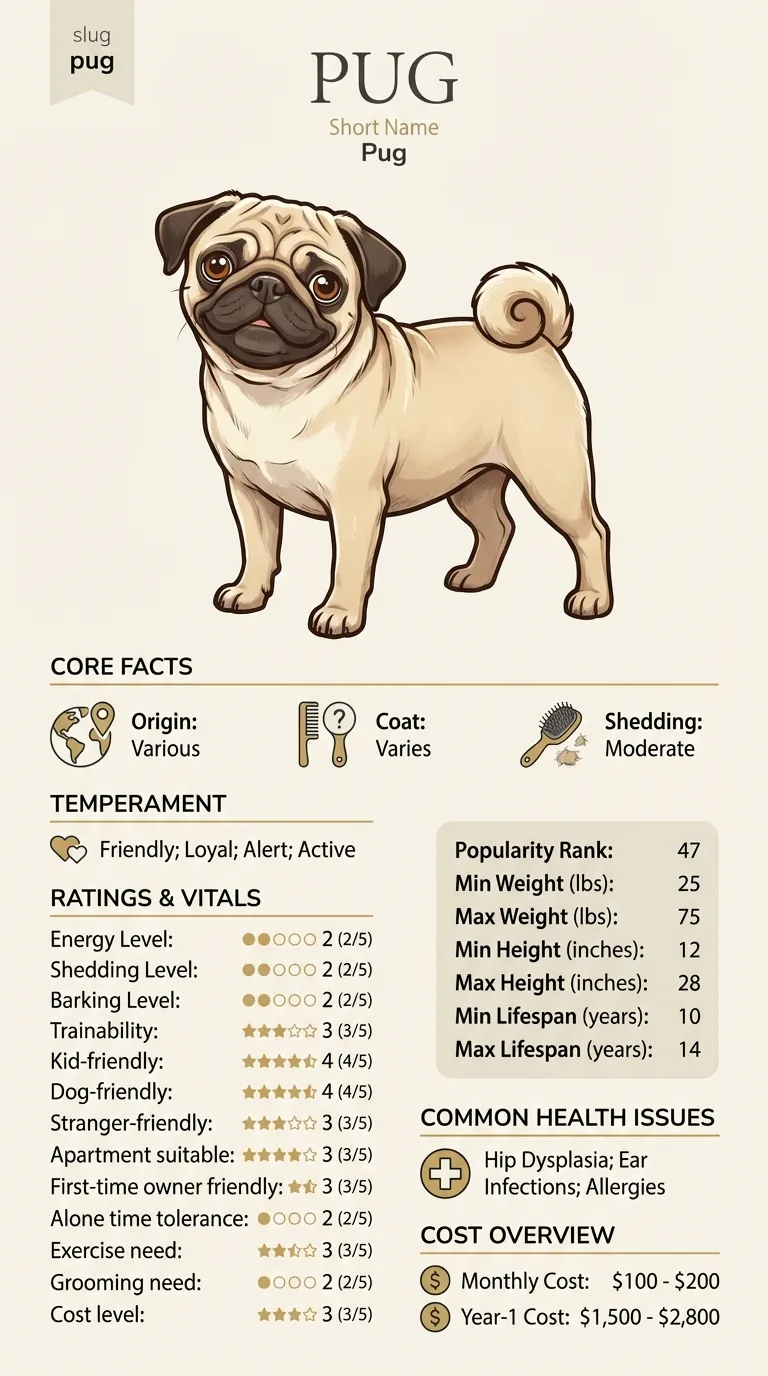
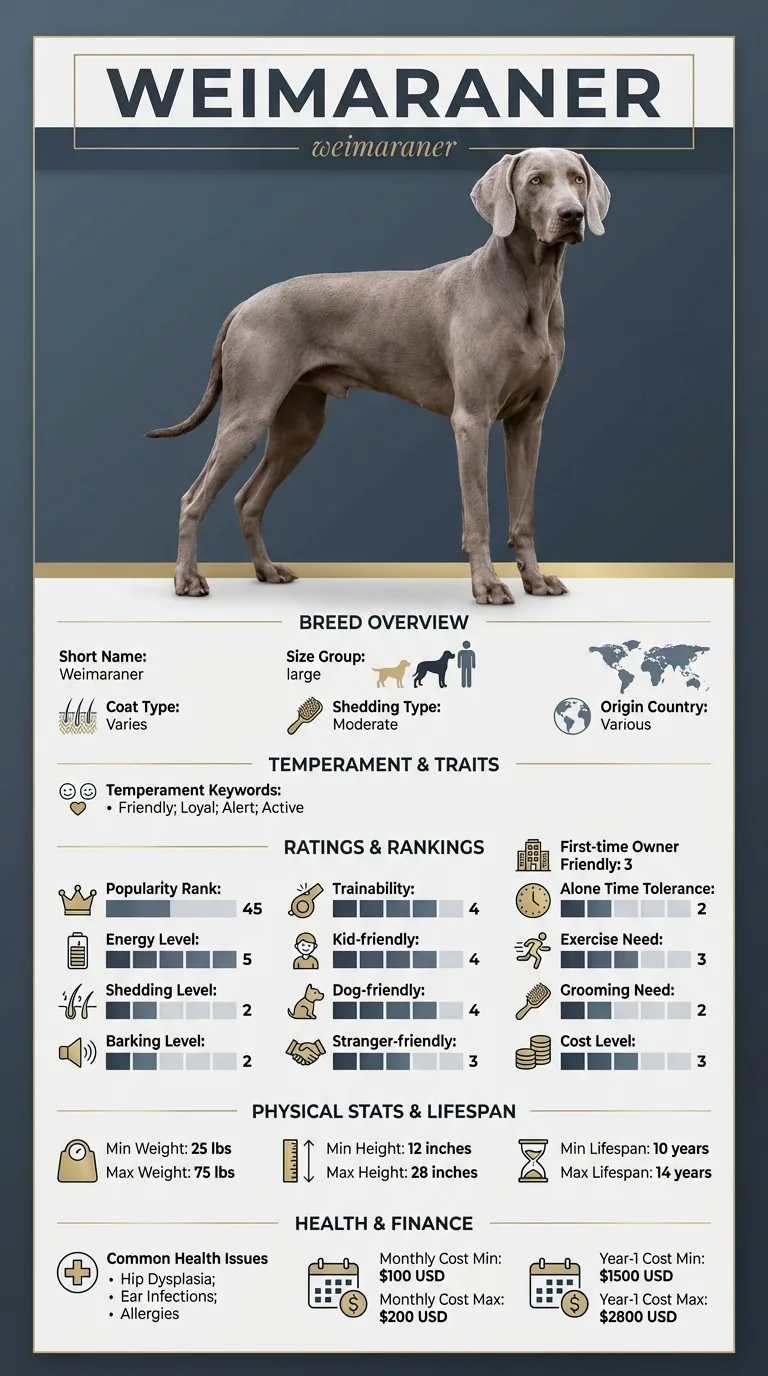
This is for someone already down to Pug and Weimaraner and deciding between them. For this pair the decision usually turns on apartment suitability and exercise need, so those are covered first and in most detail. Anyone choosing from a flat has a clear answer here: Pug rates 5/5 against 1/5. Breed history is left out; what follows is what you will actually live with.
Between Pug and Weimaraner, apartment suitability is what separates them, and Pug is the lower-effort dog of the two to keep.
Choose Pug if you are in a flat or a smaller home, this is your first dog and your walking routine is modest.
Choose Weimaraner if you do not want a standing grooming appointment, shedding is a problem in your house and you want a dog that picks up training quickly.
| Feature | pug | weimaraner | Winner |
|---|---|---|---|
| Size class | small | large | Equal |
| Weight | 14–18 lbs | 55–90 lbs | Equal |
| Height | 10–13 in | 23–27 in | Equal |
| Lifespan | 13–15 years | 10–13 years | pug |
| Exercise need | Low (2/5) | Very high (5/5) | pug |
| Grooming need | Low (2/5) | Very low (1/5) | weimaraner |
| Shedding | High (4/5) | Low (2/5) | weimaraner |
| Energy level | Low (2/5) | Very high (5/5) | Equal |
| Barking | Low (2/5) | Moderate (3/5) | pug |
| Apartment suitability | Very high (5/5) | Very low (1/5) | pug |
| Good for first-time owners | Very high (5/5) | Low (2/5) | pug |
| Tolerates being alone | Low (2/5) | Very low (1/5) | pug |
| Trainability | Moderate (3/5) | High (4/5) | weimaraner |
| Good with kids | Very high (5/5) | High (4/5) | pug |
| Good with other dogs | High (4/5) | Moderate (3/5) | pug |
| Friendly to strangers | Very high (5/5) | Moderate (3/5) | pug |
| Cost level | Moderate (3/5) | Moderate (3/5) | Equal |
| Coat | Short, smooth double coat | Short and sleek | Equal |
| Origin | Various | Various | Equal |
| Typical monthly cost | $80–$150 | $110–$240 | Equal |
| Typical first-year cost | $1,100–$2,300 | $1,700–$3,200 | Equal |
A Weimaraner can weigh up to five times more than a Pug — 55–90 pounds and 23–27 inches against the Pug's 14–18 pounds and 10–13 inches — making this one of the larger size gaps covered on this site. Known as the 'Gray Ghost' for its sleek silver coat, the Weimaraner was bred in Germany as an all-purpose hunting dog with the long legs, deep chest, and lean muscle to match, while the Pug's compact, flat-faced body was never built for fieldwork of any kind. Housing needs diverge sharply as a result: a Weimaraner needs real space to move, while a Pug fits comfortably almost anywhere.
Exercise need sits at Low (2/5) for the Pug against Very high (5/5) for the Weimaraner, a breed built to hunt alongside horses for hours and still carrying that stamina today. Left under-exercised, Weimaraners are known for developing anxious, destructive habits, which lines up with 'Separation Anxiety' appearing directly on its health list rather than just its temperament notes. Its own temperament list — Energetic, Devoted, Headstrong — captures a dog that needs a serious daily job, whether that's running, hiking, or structured training, while the Pug's Low (2/5) rating means short walks are genuinely enough to keep it content.
Coat care favors the Weimaraner outright: Very low (1/5) grooming need against the Pug's Low (2/5), and Low (2/5) shedding against the Pug's High (4/5). Its short, sleek coat is famously easy to maintain, needing little more than an occasional wipe-down to stay glossy. That's a genuine advantage for anyone weighing hair and upkeep specifically, though it's worth remembering this is the only category where the Weimaraner is the lower-maintenance choice — nearly everything else about this breed, from exercise to alone-time tolerance, demands considerably more from an owner than the Pug does.
Living situation strongly favors the Pug across the board: apartment suitability is Very high (5/5) against the Weimaraner's Very low (1/5), first-time-owner suitability is Very high (5/5) against Low (2/5), and tolerating time alone is Low (2/5) against the Weimaraner's Very low (1/5) — reinforced by Separation Anxiety appearing on its own health list as a named condition, not just a tendency. A Weimaraner left alone in a small apartment for a standard workday is a setup that plays directly against nearly every trait this breed was built with, making a house with a yard and a present owner close to a requirement.
Trainability leans toward the Weimaraner, High (4/5) against the Pug's Moderate (3/5), consistent with its background as a versatile hunting dog trained for pointing, retrieving, and close handler communication. But its temperament list also includes 'Headstrong,' a reminder that trainability and ease of ownership aren't the same thing — a smart, strong-willed large dog that decides not to cooperate is a bigger handling challenge than a mischievous Pug ever presents. That combination is exactly why first-time-owner suitability still favors the Pug at Very high (5/5) against the Weimaraner's Low (2/5), despite the Weimaraner's higher raw trainability score.
The Pug edges ahead in every household category: Very high (5/5) with kids against the Weimaraner's High (4/5), High (4/5) with other dogs against Moderate (3/5), and Very high (5/5) with strangers against Moderate (3/5). None of these gaps are extreme — a well-socialized, well-exercised Weimaraner is a devoted, loyal family dog, as its temperament list suggests — but its size alone means more supervision is warranted around small children and smaller dogs than a compact, gentle Pug typically requires, simply because an 80-pound dog's play can knock over what a 16-pound one cannot.
Lifespan favors the Pug, 13–15 years against the Weimaraner's 10–13, typical of the size-versus-longevity tradeoff seen across large breeds. The Weimaraner's five-item health list is a distinct set of large-breed concerns: Bloat (GDV), Hip Dysplasia, Hypertrophic Osteodystrophy, Von Willebrand Disease, and — notably — Separation Anxiety listed as a health condition in its own right. The Pug's list instead centers on its flat face and short spine: Brachycephalic Airway Syndrome, Pug Dog Encephalitis, Corneal Ulcers, Hemivertebrae, and Obesity. Bloat in particular is a genuine emergency risk for deep-chested breeds like the Weimaraner, worth discussing feeding practices for with a vet early on.
Cost level is rated Moderate (3/5) for both breeds, but the dollar figures diverge meaningfully: $80–$150 monthly and $1,100–$2,300 in year one for the Pug against $110–$240 and $1,700–$3,200 for the Weimaraner. Food for an 55–90 pound dog is the obvious driver, but a Weimaraner's Very high (5/5) exercise need and its documented risk of separation anxiety often push owners toward dog walkers, daycare, or training support to manage both — real recurring costs a low-energy, easily-satisfied Pug essentially never generates.
Pug weighs 14–18 lbs and lives 13–15 years; Weimaraner weighs 55–90 lbs and lives 10–13 years. The two diverge most on apartment suitability, exercise need and energy level and 3 other rated axes. Almost every rated axis separates them at least slightly. The comparison marks an easier option only where one exists. Facts like weight and country of origin are not scored. Both dogs are rated from the same dataset, which is what makes the numbers comparable with each other even though any individual dog sits somewhere inside its breed's range.

No — it rates Very low (1/5) for apartment suitability against the Pug's Very high (5/5), and its size and exercise needs make small spaces genuinely difficult.
Yes, notably so — it's listed directly on the breed's health profile alongside physical conditions like Bloat and Hip Dysplasia, reflecting how strongly the breed bonds to its people.
The Weimaraner scores higher on raw trainability, High (4/5) versus the Pug's Moderate (3/5), but its Headstrong streak makes it a tougher fit for first-time owners.
The Weimaraner, rated Low (2/5) versus the Pug's High (4/5), thanks to its short, sleek single-maintenance coat.
The Pug, at 13-15 years versus the Weimaraner's 10-13.
Meaningfully more — $1,700-3,200 in the first year versus the Pug's $1,100-2,300, driven mainly by food volume and exercise-related support costs.
Yes, rated High (4/5), just a notch below the Pug's Very high (5/5), though its size calls for more supervision around small children.
The Weimaraner, rated Very low (1/5) for apartment suitability.
The Weimaraner, rated Very low (1/5) grooming versus the Pug's Low (2/5).
The Pug, rated Very high (5/5) versus the Weimaraner's Low (2/5).
The Weimaraner, which lists it directly as a health concern.
See every pug comparison.
Secure checkout on Stripe. We never see your card.
7-day money-back guarantee. Instant access.


Health information here is general and is not veterinary advice. If your dog shows pain, sudden behaviour change, or worsening symptoms, consult a licensed veterinarian.
Some links on this site are affiliate links. We may earn a commission at no extra cost to you, and we only suggest products we believe are helpful for dog owners.
We research and check what we publish, but we do not warrant that any figure, date, price, or statement is accurate, complete, or current, and we accept no liability for any loss, cost, injury, or other harm arising from the use of this site. Use it as one reference among several. You remain responsible for your own decisions and for your dog's care - confirm anything that matters with a licensed veterinarian or another qualified professional before you act on it. Full disclaimer.
Match your lifestyle to the right dog.
Take quizNot sure which breed is right for you? Take our 2-minute quiz to find out.
Take the quiz