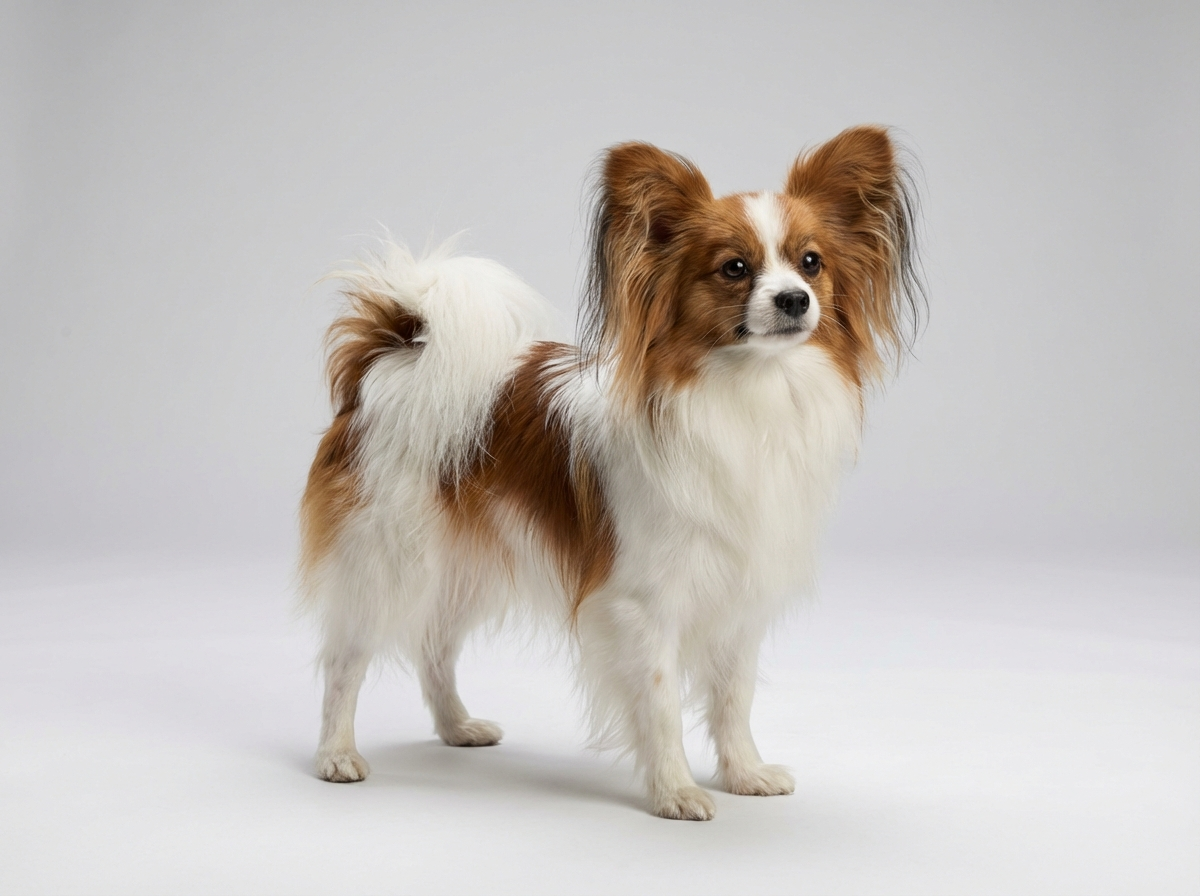
Health
Do Papillons have soft spots on their heads?
Open fontanel is a documented issue in the breed. A small gap in a healthy, normally developing puppy is often incidental, but it should be assessed by a vet.

Quick answer
Do Papillons have soft spots on their heads?
Open fontanel is a documented issue in the breed. A small gap in a healthy, normally developing puppy is often incidental, but it should be assessed by a vet.
Two things matter neurologically in this breed: what a persistent soft spot does and does not mean, and how to describe an episode well enough that someone can diagnose it.
Owners who have felt a gap on their Papillon puppy's head, and owners who have watched their dog do something alarming for thirty seconds and been unable to say afterwards what it actually was.
This guide is not medical advice. If your dog shows pain, sudden behavior change, or worsening symptoms, consult a licensed veterinarian.
Some links may be affiliate links. We may earn a commission at no extra cost to you. We only suggest products we believe are helpful for dog owners.
We research and check what we publish, but we do not warrant that any figure, date, price, or statement is accurate, complete, or current, and we accept no liability for any loss, cost, injury, or other harm arising from the use of this site. Use it as one reference among several. You remain responsible for your own decisions and for your dog's care - confirm anything that matters with a licensed veterinarian or another qualified professional before you act on it. Full disclaimer.
Neurological disease is a category rather than a diagnosis, covering the brain, the spinal cord, the nerves and the muscles they control. For Papillon owners two threads matter most. The first is the breed's documented open fontanel, a gap in the skull that is often incidental but occasionally accompanies fluid accumulation in the brain. The second is episodic events, where the real challenge is not treatment but working out what kind of episode actually happened.
Serious neurological disease is uncommon in Papillons, and the breed's documented issues are dominated by kneecaps, eyes and teeth rather than the nervous system. Open fontanel is the exception, appearing on the breed's list because it is genuinely frequent in toy breeds, and in most affected dogs it is a finding rather than a problem.
Selecting for a very small dog compresses the skull without proportionally shrinking the brain, which is why toy breeds retain fontanels more often than larger dogs do and why they appear more frequently in discussions of hydrocephalus. The Papillon's fine bone structure and eight to eleven inch stature place it firmly in that group. Separately, its very long lifespan of fourteen to sixteen years means more dogs reach the ages at which age related brain change becomes a consideration.
For a dog with an unfused skull, physical risk is the main environmental factor: being dropped, jumping from a bed, or colliding with a much larger dog at a park. For episodic events, environment matters mostly for what it reveals. Noting whether an episode happened at rest, during excitement, after a meal or in heat narrows the differential considerably, and those details are free to collect.
Go to an emergency clinic immediately for a seizure lasting more than a few minutes, for repeated seizures without full recovery in between, for collapse that does not resolve, for sudden blindness, for persistent head pressing against a wall, or for any head injury in a dog with a known fontanel. Book a prompt appointment for a first short seizure that has stopped, for circling, for a new head tilt, for unexplained wobbliness, or for a puppy that seems slow to learn in a breed noted for exceptional trainability.
See all Papillon health problems, which breeds are prone to neurologic disease, or the full Papillon breed guide for temperament, exercise needs and ownership costs.
A fontanel is monitored across the first year, often shrinking substantially. Investigating an episodic disorder usually takes one appointment plus bloodwork, then referral and imaging if indicated, over a few weeks. Where a seizure disorder requires medication, expect dose adjustment over the first months and monitoring for life.
Success is knowing exactly what your dog's episodes are rather than living with a vague worry, and, for a fontanel, a documented measurement trend plus sensible physical precautions rather than a restricted life.
A puppy's skull is assembled from separate plates that meet at sutures and gradually fuse. Most puppies complete that fusion in the early months. Toy breeds, which have been selected for very small skulls carrying comparatively large brains, more often retain a palpable gap on the top of the head, and in the Papillon this is common enough to appear on the breed's health list.
A small persistent fontanel in an otherwise normal, well grown, neurologically sound puppy is frequently an incidental finding and not a disease. Many such dogs live entirely ordinary lives, and it is important to say that clearly, because owners who feel a gap often assume the worst.
What it does warrant is attention rather than alarm, for two reasons. The first is mechanical: a gap in the skull is a gap in the armour, so a blow to the head that a fully ossified skull would absorb carries more risk. The second is that a large fontanel, particularly a very large one accompanied by a domed skull, wide set eyes, poor growth or neurological signs, can accompany hydrocephalus, in which fluid accumulates within the brain and raises pressure.
Signs that would push a vet toward investigation include a puppy that is difficult to house train, seems slow to learn in a breed that normally learns fast, circles, presses its head against surfaces, has vision problems, or has seizures. Imaging settles it.

Film it if you possibly can. Failing that, these five answers do most of the diagnostic work, so try to note them while the memory is fresh.
If you think your Papillon has neurologic disease, the plan is three steps: write down what you have seen and when it started, book a veterinary appointment rather than waiting for the next flare, and take video of the behaviour or symptom before you go — the thing you are worried about rarely happens in the consulting room. Screening in the parents covers patellar luxation, progressive retinal atrophy, dental disease.
What the vet visit should produce is a diagnosis and a written plan, not just reassurance: what is being ruled out, what the monitoring interval is, and which signs mean you come back sooner. Ask what the treatment costs across a year rather than per visit, because that is the number that decides whether you are managing this condition or reacting to it.
Between appointments, keep a short log — dates, what you saw, what changed. It is the single most useful thing an owner brings to a follow-up, and for neurologic disease it is often what separates a clear pattern from a guess.
Bea's four year old Papillon Nestor dropped to the floor at the front door as a delivery arrived, went limp for perhaps fifteen seconds, then got up and carried on barking. She described it to her vet as a seizure. The second time it happened her partner filmed it. The clip showed no paddling, no rigidity, no drooling, no urination, and Nestor upright and completely normal within twenty seconds. There had been no warning and no confusion afterwards. It had happened during peak excitement both times. That pattern sent Nestor to cardiology rather than neurology. A rhythm disturbance was documented on a monitor over the following days. Bea's vet was explicit that without the video Nestor would have started anti seizure medication for a heart problem.
Key takeaway: The label you give an episode determines which specialist sees your dog, and the wrong label wastes months. Film it, note the recovery, and let the pattern rather than the panic choose the direction.
A small one in a healthy, normally growing, neurologically normal puppy is often an incidental finding and many dogs live entirely normal lives with it. It does mean the skull has an unprotected area, so head knocks matter more than they would otherwise. A large fontanel with a domed head, poor growth or neurological signs is a different situation and needs veterinary assessment.
Often it shrinks considerably during the first months and sometimes closes entirely. In some toy breed dogs a small gap persists for life without causing problems. Your vet will measure it at puppy visits and note whether it is getting smaller, which is more informative than its size at any single appointment.
It is an accumulation of fluid within the brain's chambers, raising pressure and compressing brain tissue. It is suspected from the combination of a domed skull, a large fontanel and neurological signs, and confirmed by imaging, usually ultrasound through an open fontanel in a young puppy or advanced imaging in an older one. Treatment can be medical or surgical depending on severity.
Look at the recovery. A dog that has had a seizure is usually disoriented, wobbly or ravenous for some minutes to hours afterwards. A dog that has fainted is typically completely normal within a minute. Filming the event is worth more than any description, because these two need entirely different investigations, one neurological and one cardiac.
You should avoid situations where the head can take an impact: being dropped, jumping from heights, and unsupervised play with much larger dogs. That is sensible for any five to ten pound dog and doubly so here. It does not mean the dog needs a restricted life, and normal walking, training and play with sensible companions are fine.
Seizures occur across all breeds, and idiopathic epilepsy, meaning seizures with no identifiable underlying cause, is recognised widely. It is not a headline Papillon condition. A first seizure in any dog warrants a veterinary workup to look for a cause, and in a young Papillon that workup would reasonably consider both the skull and the liver among other things.
Open fontanel is a documented issue in the breed. A small gap in a healthy, normally developing puppy is often incidental, but it should be assessed by a vet.
By the recovery. Seizures leave a dog disoriented for minutes to hours. A faint usually resolves completely within about a minute.
A single short seizure that stops on its own needs a prompt appointment. Seizures lasting more than a few minutes, or repeating without full recovery between, are emergencies.
Yes. Video is the single most valuable thing you can bring, because these events almost never repeat in the consulting room.
A one-page prep sheet for this condition: the signs, the questions to ask, what to get priced. Unlocks here.
You get: Vet visit prep sheet
No spam. One-click unsubscribe. See our privacy policy.
Preview page 1 before you decide.