Health
How do I measure my dog's stamina objectively?
Track three things monthly: sleeping breathing rate, how long panting takes to settle after a walk, and the point on a fixed route where your dog first asks to stop.

Quick answer
How do I measure my dog's stamina objectively?
Track three things monthly: sleeping breathing rate, how long panting takes to settle after a walk, and the point on a fixed route where your dog first asks to stop.
Ask yourself one question. What is the longest walk your dog did last summer, and would it manage that route today?
Owners noticing their Papillon lagging behind on a familiar walk, or asking to be picked up on a hill it used to lead them up, and anyone whose dog has started making a harsh honking noise when it pulls.
This guide is not medical advice. If your dog shows pain, sudden behavior change, or worsening symptoms, consult a licensed veterinarian.
Some links may be affiliate links. We may earn a commission at no extra cost to you. We only suggest products we believe are helpful for dog owners.
We research and check what we publish, but we do not warrant that any figure, date, price, or statement is accurate, complete, or current, and we accept no liability for any loss, cost, injury, or other harm arising from the use of this site. Use it as one reference among several. You remain responsible for your own decisions and for your dog's care - confirm anything that matters with a licensed veterinarian or another qualified professional before you act on it. Full disclaimer.
Exercise intolerance is a reduction in how much activity a dog can sustain comfortably. It is a symptom rather than a diagnosis, and its value lies in being one of the earliest signs of several different diseases. In a Papillon the most breed-specific explanation is a collapsing windpipe, but heart, joints, weight and fitness all belong on the list and are distinguished by what accompanies the tiring.
Reduced stamina is one of the most frequent reasons owners of middle-aged and older small dogs seek advice. Collapsing trachea in particular is common enough in toy breeds to sit on the Papillon's documented health list, and it usually appears in middle age rather than youth. Simple deconditioning and excess weight together account for a large share of cases.
Two documented breed features shape this. Collapsing trachea means the airway itself can become the limiting factor, producing a cough-driven ceiling on activity that a dog learns to stay below. Patellar luxation means many Papillons carry an unstable knee that eventually becomes an arthritic one, capping distance for a different reason. Beyond those, the breed's small size means less thermal buffer in warm weather, and a long silky single coat offers little insulation but also little protection from direct sun on a hot day.
Temperature and surface matter more than owners expect for a dog eight to eleven inches tall. Hot pavement radiates upward directly into a dog that lives inches above it, and the air it breathes on a summer afternoon is warmer than the air a person feels. Collars concentrate lead pressure onto the windpipe. Weekday inactivity followed by a long weekend outing produces a chronically unfit dog that then appears to have a stamina problem.
Seek emergency attention for laboured breathing at rest, open-mouthed breathing in a dog that will not settle, blue, grey or brick-red gums, or collapse. Book a same-day appointment for a honking cough that will not stop, for a sudden loss of exercise tolerance over days, for a resting sleeping breathing rate that has climbed above thirty and stayed there, or for any fainting episode. Book a routine appointment for a gradual decline in stamina over weeks or months, for a new cough, or simply to establish a baseline in a Papillon over eight. Do not assume that a slower dog is only getting older.
See all Papillon health problems, which breeds are prone to exercise intolerance, or the full Papillon breed guide for temperament, exercise needs and ownership costs.
A workup usually reaches an answer within one to three weeks. Changes such as a harness, weight loss and cooler walking times show measurable improvement in four to eight weeks. Conditioning gains take two to three months of consistent short outings. Where the cause is a collapsing trachea or heart disease, expect long-term management with reviews every six to twelve months rather than resolution.
A dog that completes its usual route without asking to be carried, recovers within minutes of stopping, and has a stable sleeping breathing rate you can point to in a notebook. For a dog with a structural airway or cardiac diagnosis, success is a stable ceiling rather than a rising one, with walks that stay comfortably below it.
Three home measurements between them describe stamina well enough for a vet to act on.
The first is your dog's sleeping breathing rate. Count the rise and fall of the ribcage for a minute while it is genuinely asleep, once a week, and write it down. Under thirty is normal and most dogs sit in the teens or low twenties. A rate that has climbed and stayed up is a signal that appears before any visible change in behaviour.
The second is recovery time. After your usual walk, note how long it takes for panting to settle back to normal breathing once the dog has stopped and is resting in a cool place. A fit dog recovers within a few minutes. A recovery time that has doubled over a few months means something.
The third is a fixed route. Pick a walk you do regularly and record the point at which your dog first asks to stop or slow. That single landmark, tracked monthly, turns a vague sense that things are different into a date you can point at.

Collapsing trachea appears on the Papillon's documented health list, and it is the breed-specific reason a middle-aged dog stops managing what it used to. The cartilage rings holding the windpipe open weaken, and the tube flattens when air moves through it fast. The result is a dry, honking cough triggered by exertion, excitement, drinking, heat or collar pressure, and a dog that shortens its own walks to avoid it.
It is progressive and managed rather than cured, but the management is unusually effective: a harness instead of a collar, weight at the lean end of five to ten pounds, cool walking times, and reduced arousal at the door.
Beyond the windpipe, the list is the general one. Heart valve disease reduces output and raises the resting breathing rate. Arthritis, often downstream of a slipping kneecap, makes distance uncomfortable rather than breathless. Anaemia, endocrine disease and simple excess weight all reduce stamina. And a proportion of dogs are genuinely just unfit, which is diagnosed by improvement with gradual conditioning.
Grete walked her Papillon, Odin, along the same canal path every morning. Over a winter she noticed they had stopped going as far as the second bridge and were turning back at a bench about halfway. She had not decided to do that. Odin had simply started sitting down there. At his check-up she said exactly that, and added that he coughed a harsh dry cough when he pulled on his lead. Neck and chest radiographs showed narrowing of the windpipe consistent with early tracheal collapse. His heart was normal. He moved onto a harness, lost seven ounces over three months, and his walks were split into two shorter ones taken earlier in the day. By spring they were reaching the second bridge again, though Grete now turns back there deliberately rather than because Odin has sat down.
Key takeaway: The most useful history an owner can give is a place. Not that the dog seems slower, but that the route now ends at the bench instead of the bridge.
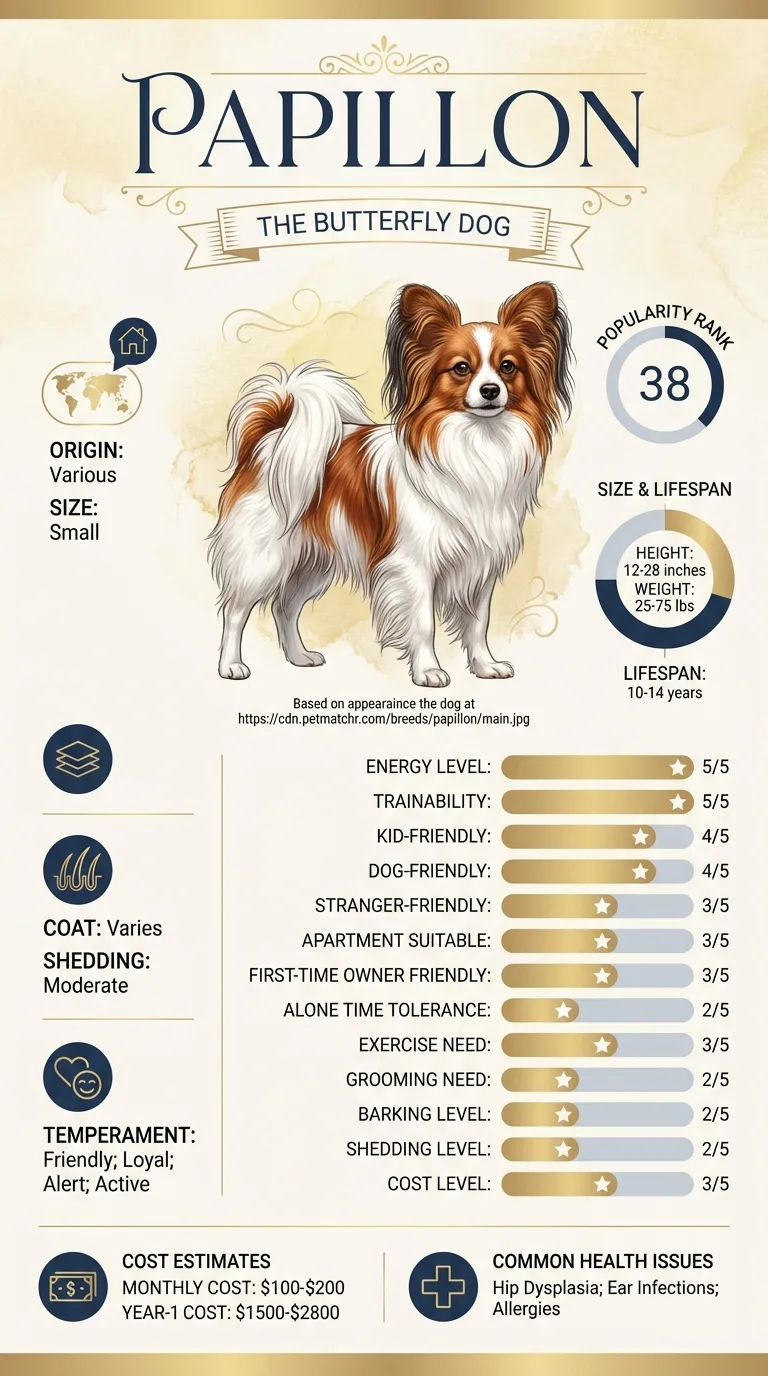
Around forty to sixty minutes a day is a reasonable target, split into two or three outings rather than one long one, plus mental work. The breed rates three out of five for exercise requirement but five out of five for trainability, so the head needs occupying as much as the legs.
Listen to what accompanies the tiring. A dry honking cough triggered by excitement, drinking or collar pressure points at the windpipe. A soft cough that is worse at night, with a rising sleeping breathing rate, points at the heart. Both need assessment.
Easily. On a nine pound dog, an extra pound is over ten percent of body mass carried on every step and pressed against the chest with every breath. Weight loss is often the single most effective intervention for a Papillon that has slowed down.
Almost never. Stopping produces deconditioning, weight gain and a worse outcome. The right response is shorter, more frequent, cooler outings within the dog's current tolerance, while the cause is investigated.
Age reduces peak performance, but a marked drop in stamina is a symptom rather than a birthday. In a breed that lives fourteen to sixteen years, treating a change at ten as inevitable can mean four or five years spent unnecessarily uncomfortable.
For any dog with a soft or collapsing windpipe, considerably. A collar concentrates every pull directly onto the trachea. A well-fitted harness distributes it across the chest and removes one of the most reliable triggers of a honking episode.
Track three things monthly: sleeping breathing rate, how long panting takes to settle after a walk, and the point on a fixed route where your dog first asks to stop.
Collapsing trachea, which is on the Papillon's documented health list. It produces a dry honking cough on exertion or excitement and shortens walks long before it causes real breathing difficulty.
A consultation with chest and neck radiographs and bloodwork typically runs three to five hundred dollars. Adding an echocardiogram brings it to around eight hundred.
Two or three short outings instead of one long one, on a harness, in the cool parts of the day, on soft ground, with water carried and a route that never strands you far from home.
Conditioning can, if added gradually: a few extra minutes a week rather than a step change. Trained arousal control also helps, since a Papillon that greets the door calmly wastes less of its reserve on excitement.
A one-page prep sheet for this condition: the signs, the questions to ask, what to get priced. Unlocks here.
You get: Vet visit prep sheet
No spam. One-click unsubscribe. See our privacy policy.
Preview page 1 before you decide.