Health
What is the earliest sign of kidney disease in a dog?
Drinking and urinating more than usual, often before blood tests change. New indoor accidents in a senior dog deserve a urine test.

Quick answer
What is the earliest sign of kidney disease in a dog?
Drinking and urinating more than usual, often before blood tests change. New indoor accidents in a senior dog deserve a urine test.
By the time an owner notices the water bowl emptying faster, a substantial portion of kidney function has usually already gone. That is not a failure of observation, it is how the organ works.
Owners of senior Bichons who have had a routine blood test flagged, and owners weighing whether the recommended diet change and repeat testing are worth it in a dog that seems perfectly happy.
This guide is not medical advice. If your dog shows pain, sudden behavior change, or worsening symptoms, consult a licensed veterinarian.
Some links may be affiliate links. We may earn a commission at no extra cost to you. We only suggest products we believe are helpful for dog owners.
We research and check what we publish, but we do not warrant that any figure, date, price, or statement is accurate, complete, or current, and we accept no liability for any loss, cost, injury, or other harm arising from the use of this site. Use it as one reference among several. You remain responsible for your own decisions and for your dog's care - confirm anything that matters with a licensed veterinarian or another qualified professional before you act on it. Full disclaimer.
Chronic kidney disease is a progressive, irreversible loss of filtering capacity that is normally diagnosed in older dogs and normally diagnosed late. For a Bichon Frise the relevance is longevity: a breed that commonly reaches its mid-teens spends several years in the age band where this becomes a realistic possibility. Early detection through routine senior screening is the only reliable way to catch it while intervention still buys meaningful time.
Kidney disease is one of the leading chronic diagnoses in dogs over about ten years old, across all breeds. It is not a Bichon-specific condition, but this breed's unusual longevity means a higher proportion of Bichons live into the window where it appears than dogs of shorter-lived breeds would.
The relevant Bichon factor is lifespan rather than kidney biology. A documented range of 14 to 15 years places this breed among the longer-lived companion dogs, and kidney tissue accumulates irreversible loss with age in every dog. The breed's documented tendency toward bladder stones is a secondary connection, since urinary tract obstruction and infection can damage kidney tissue upstream if they are not resolved promptly.
Hydration and household routine shape how well a compromised kidney copes. A dog with limited access to water, long stretches without a toilet break, or a diet with very low moisture content is working its kidneys harder than necessary. Untreated dental disease contributes a chronic inflammatory and bacterial load, which is worth naming because dental disease is on this breed's documented list and is frequently deferred in older dogs on anaesthetic grounds.
Seek same-day care for vomiting that will not stop, complete refusal of food and water, marked weakness or unsteadiness, seizures, or a strong ammonia smell on the breath in a dog already known to have kidney disease, since these suggest a crisis rather than a slow decline. Also urgent is a dog straining to urinate and producing nothing. Book within a week for increased thirst, increased urination, new indoor accidents, gradual weight loss, or a reduced appetite that has lasted more than a couple of days.
See all Bichon Frise health problems, which breeds are prone to kidney disease, or the full Bichon Frise breed guide for temperament, exercise needs and ownership costs.
Progression is measured in months to years, with most stable patients reviewed every three to six months. Diet changes take a few weeks to establish and their benefit is not something you will see; it shows up in bloodwork trends. Expect the plan to be adjusted incrementally rather than transformed at any single visit.
A dog eating willingly, maintaining weight and muscle, drinking freely, and with bloodwork that moves slowly rather than sharply. Success in kidney disease is a flat line on a graph and an ordinary life alongside it, not a return to normal values.
Each kidney contains a very large number of filtering units. As they are lost, the survivors work harder and total output stays adequate. The dog's blood values remain normal, the dog behaves normally, and nothing looks wrong.
The first function to fail is not filtration but concentration. Kidneys losing capacity can no longer produce concentrated urine, so the dog passes more volume and drinks more to keep up. That is the origin of the classic sign, increased thirst and urination, and it appears before waste products build up in the blood.
This creates a practical opportunity. A urine sample can show that concentrating ability has slipped while a blood panel still reads normal, which is why senior wellness screening usually includes urine as well as blood. Owners often decline the urine test as an optional extra, and it is frequently the more informative of the two.
In a Bichon there is a second detection problem. A dog that drinks more also urinates more, and a small dog producing more urine indoors gets described as having accidents. Those accidents are commonly interpreted as behavioural or as senility rather than as a symptom.

Vets stage kidney disease so that treatment matches severity. Each stage adds interventions rather than replacing them.
If you think your Bichon has kidney disease, the plan is three steps: write down what you have seen and when it started, book a veterinary appointment rather than waiting for the next flare, and take video of the behaviour or symptom before you go — the thing you are worried about rarely happens in the consulting room. Screening in the parents covers skin allergies, patellar luxation, bladder stones.
What the vet visit should produce is a diagnosis and a written plan, not just reassurance: what is being ruled out, what the monitoring interval is, and which signs mean you come back sooner. Ask what the treatment costs across a year rather than per visit, because that is the number that decides whether you are managing this condition or reacting to it.
Between appointments, keep a short log — dates, what you saw, what changed. It is the single most useful thing an owner brings to a follow-up, and for kidney disease it is often what separates a clear pattern from a guess.
Meredith's Bichon, Tilly, was eleven and completely well when the practice offered a senior health screen. Meredith agreed to the bloodwork and hesitated over the additional urine test, which added to the bill for a dog with no symptoms. The blood results came back within normal limits. The urine sample did not: Tilly's concentrating ability had dropped noticeably. A follow-up three months later confirmed early kidney disease. Tilly moved onto a renal diet at a stage where she was still eating enthusiastically, which made the transition straightforward. She was still walking her usual circuit at fourteen.
Key takeaway: The urine sample often detects kidney change before the blood panel does. In a long-lived breed, that optional extra on a senior screen is frequently the test that finds something.
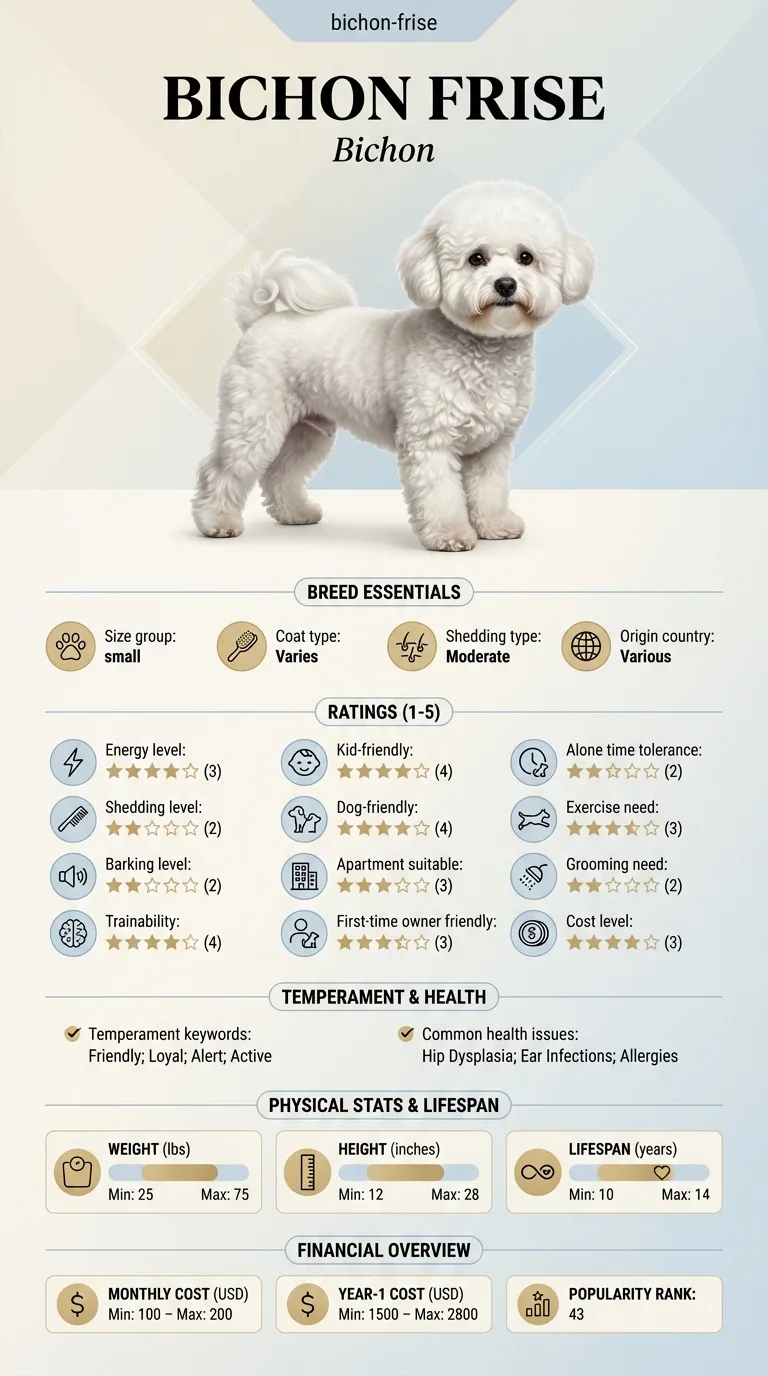
Chronic kidney disease is not listed among the breed's documented concerns, which are skin allergies, patellar luxation, bladder stones, cataracts and dental disease. It matters for Bichons mainly because they live 14 to 15 years, and age is the dominant risk factor for kidney decline in any dog.
They are separate problems that can interact. Stones are mineral formations in the urinary tract, and this breed is documented for bladder stones. Kidney disease is progressive loss of filtering tissue. A stone lodged in a ureter can damage a kidney, which is one way the two connect.
It varies enormously by stage at diagnosis. Dogs caught in the earliest stages, managed with diet and monitoring, often live for years and die of something else. Dogs diagnosed late, when appetite has already failed, have a much shorter and less predictable course.
It is the intervention with the best evidence for slowing progression and it is worth taking seriously. The practical difficulty is palatability in a dog that may already feel nauseous. Work with your vet on transitions and appetite rather than abandoning the diet quietly.
Do not adjust protein on your own. The role of protein varies by stage and by whether the dog is losing protein in urine, and a home-restricted diet risks muscle loss in an older dog. This is precisely what a therapeutic diet is formulated to balance.
Chronic kidney disease is not reversible; lost filtering tissue does not regenerate. What treatment achieves is slowing the decline and controlling the symptoms, which can add a great deal of comfortable time. Acute kidney injury from a toxin or infection is different and can sometimes be recovered from.
Drinking and urinating more than usual, often before blood tests change. New indoor accidents in a senior dog deserve a urine test.
Annual screening from around eight, including a urine sample, catches kidney decline at a stage where intervention still helps.
A prescription diet plus twice-yearly bloodwork and urine testing, with medication added at later stages. It is an ongoing rather than one-off expense.
Never. A dog with kidney disease depends on drinking to compensate. Restricting water risks dehydration and a rapid deterioration.
Add toilet breaks and use washable bedding rather than correcting the dog. The accidents are a symptom, not a training failure.
A one-page prep sheet for this condition: the signs, the questions to ask, what to get priced. Unlocks here.
You get: Vet visit prep sheet
No spam. One-click unsubscribe. See our privacy policy.
Preview page 1 before you decide.