Behavior
Why does my Lab act hungry right after a full meal?
A documented gene variant common in this breed affects appetite regulation, genuinely reducing how readily satiety is felt after eating.

Quick answer
Why does my Lab act hungry right after a full meal?
A documented gene variant common in this breed affects appetite regulation, genuinely reducing how readily satiety is felt after eating.
Research has identified a gene variant common in Labradors that affects how the brain registers fullness, meaning a Lab carrying it isn't being dramatic about wanting more food — its brain is getting a genuinely weaker 'I'm full' signal than a dog without the variant.
Owners who feel like they're constantly fighting their Lab's begging behavior, and owners who've been told their dog is 'a little heavy' at every single vet visit for years without a clear plan for what to actually change.
This guide is not medical advice. If your dog shows pain, sudden behavior change, or worsening symptoms, consult a licensed veterinarian.
Some links may be affiliate links. We may earn a commission at no extra cost to you. We only suggest products we believe are helpful for dog owners.
We research and check what we publish, but we do not warrant that any figure, date, price, or statement is accurate, complete, or current, and we accept no liability for any loss, cost, injury, or other harm arising from the use of this site. Use it as one reference among several. You remain responsible for your own decisions and for your dog's care - confirm anything that matters with a licensed veterinarian or another qualified professional before you act on it. Full disclaimer.
Obesity is one of the most common and consequential health challenges in Labrador Retrievers, driven by a documented genetic variant that reduces satiety sensation combined with the breed's naturally high food motivation and trainability. Excess weight compounds nearly every other health risk in this breed, from joint conditions to cardiac strain, making weight management one of the single highest-leverage things an owner can control.
Obesity is extremely common in Labrador Retrievers, frequently cited by veterinarians as one of the most consistent weight-management challenges across the breed, driven partly by the well-documented genetic tendency toward reduced satiety.
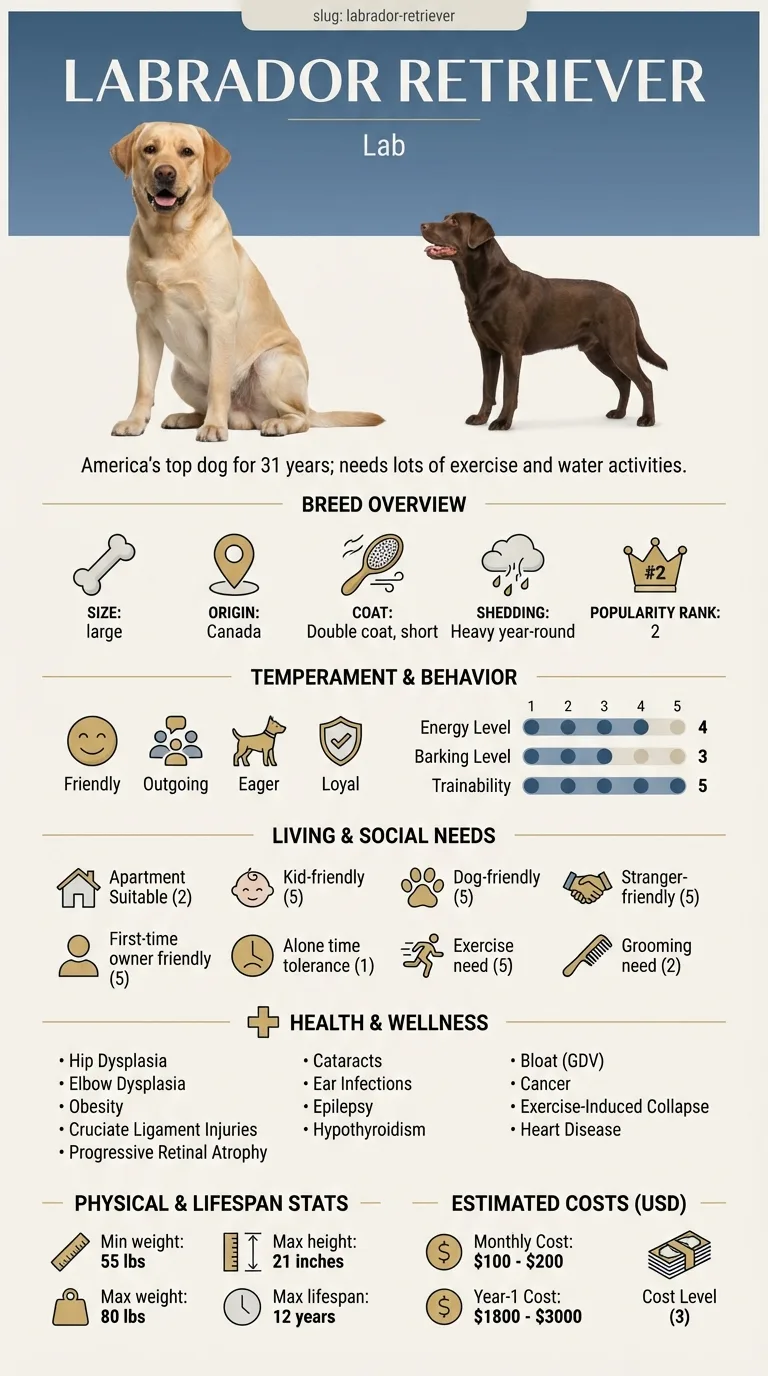
Labradors carry a well-documented gene variant affecting appetite regulation that reduces how readily satiety is felt after eating, and the breed's naturally high food motivation and trainability, while wonderful for training, work directly against easy portion control. At 55 to 80 pounds with a moderate grooming need and only moderate apartment suitability, this is also a breed whose owners may not always provide the high exercise volume needed to offset its strong appetite.
Inconsistent feeding routines, free access to food, uncounted treats, and reduced exercise as a dog ages or develops early joint discomfort all compound the underlying genetic tendency, often creating a cycle where reduced activity leads to more weight gain, which further reduces comfortable activity.
Discuss body condition score and a specific weight target at every routine visit, and reach out sooner if you notice reduced exercise tolerance, joint stiffness, or breathing changes that could be related to excess weight compounding another condition.
See all Labrador Retriever health problems, which breeds are prone to obesity, or the full Labrador Retriever breed guide for temperament, exercise needs and ownership costs.
A safe, sustainable weight loss rate for dogs is typically 1 to 2% of body weight per week, meaning a meaningful weight loss journey for an overweight Lab often takes several months to reach a healthy target, not weeks.
Success means a stable, healthy body condition score maintained long-term through consistent structure, not a one-time diet that gets abandoned once the number on the scale looks better — given the genetic drive at play, ongoing portion management is a permanent habit, not a temporary fix.
A well-documented genetic variant affecting the POMC gene, which plays a role in appetite regulation, is notably common in Labrador Retrievers compared to many other breeds. Dogs carrying this variant tend to show stronger food-seeking behavior and reach satiety less readily, meaning the same meal that would leave another dog satisfied can leave a Lab still genuinely motivated to find more food, not simply being greedy out of habit.
This matters practically because it reframes the weight management conversation. A Lab begging intensely after a full, appropriately portioned meal isn't necessarily manipulative behavior to ignore through willpower alone — it may be a genuinely stronger physiological drive that needs to be managed through structure (measured portions, consistent timing, lower-calorie satiety-supporting foods) rather than through inconsistent rule-bending under pressure from a very convincing beggar.
Combine this genetic tendency with a breed rated at the top of trainability and food-motivation scales — traits that make Labs wonderful to train specifically because food rewards work so well on them — and you get a breed where both genetics and the very traits that make it a great family dog work against easy portion control.

Given the genetic drive at play, generic 'just feed less' advice tends to fail — here's a plan built around the actual mechanism.
If you think your Lab has obesity, the plan is three steps: write down what you have seen and when it started, book a veterinary appointment rather than waiting for the next flare, and take video of the behaviour or symptom before you go — the thing you are worried about rarely happens in the consulting room. Screening in the parents covers hip dysplasia, elbow dysplasia, obesity.
What the vet visit should produce is a diagnosis and a written plan, not just reassurance: what is being ruled out, what the monitoring interval is, and which signs mean you come back sooner. Ask what the treatment costs across a year rather than per visit, because that is the number that decides whether you are managing this condition or reacting to it.
Between appointments, keep a short log — dates, what you saw, what changed. It is the single most useful thing an owner brings to a follow-up, and for obesity it is often what separates a clear pattern from a guess.
Owen had tried cutting his Lab Cooper's food multiple times over the years, only to cave every time Cooper's increasingly desperate begging wore him down within a week. At his vet's suggestion, Owen switched to weighing food precisely, splitting it into three meals, and using a portion of Cooper's own kibble as training treats instead of extra biscuits on top. Cooper still begged, because the genetic drive didn't disappear, but Owen found it easier to hold the line knowing the begging wasn't a sign he was doing something wrong. Over eight months, Cooper lost the fourteen pounds his vet had targeted, and his energy and joint comfort noticeably improved.
Key takeaway: Understanding that a Lab's begging reflects a real physiological drive, not manipulation, makes it easier to hold a consistent structure instead of caving — the plan works when it's built around the biology rather than against it.
A documented gene variant common in this breed affects appetite regulation, making Labs genuinely reach satiety less readily than many other breeds. Combined with high food motivation and trainability, this creates a real physiological tendency toward overeating, not just an owner discipline problem.
The breed standard range is roughly 55 to 80 pounds, though ideal weight varies by individual frame size. Your vet can assess body condition score directly, which is more useful than a generic number since it accounts for your specific dog's build.
Excess weight worsens joint conditions like hip dysplasia, increases cardiovascular strain, reduces heat tolerance, and is linked to shortened lifespan in dogs generally, making weight management one of the single most impactful things an owner can control.
Understanding that the begging drive may be genuinely stronger due to the breed's appetite-regulation genetics can help reframe the response — structured portion control, consistent meal timing, and including treats in the daily calorie count tend to work better than trying to out-discipline the drive itself.
Yes, under veterinary guidance — a diet formulated for weight management, often higher in fiber and protein relative to calories, can help maintain satiety while reducing overall intake, and your vet can set an appropriate target rate of loss.
It's difficult to put a single number on this since it depends on which conditions develop, but obesity-related joint, cardiac, and metabolic issues can add thousands of dollars in veterinary costs over a dog's lifetime compared to maintaining a lean body weight.
Genetics increases the drive to seek food and can reduce the felt sense of fullness, but it doesn't make weight management impossible — it means portion control needs to be more structured and consistent for this breed than the generic advice given for lower-drive breeds.
A documented gene variant common in this breed affects appetite regulation, genuinely reducing how readily satiety is felt after eating.
By weight on a kitchen scale — cup measurements can vary by up to 20% depending on how the food settles, which matters a lot over time.
Yes — training treats should be included in the total daily calorie count, not treated as separate from meal portions.
It worsens joint conditions, increases cardiovascular strain, reduces heat tolerance, and is linked to a shorter lifespan overall.
Not necessarily — it may reflect a genuinely stronger physiological food-seeking drive rather than simple stubbornness, which is worth managing with structure rather than guilt.
A one-page prep sheet for this condition: the signs, the questions to ask, what to get priced. Unlocks here.
You get: Vet visit prep sheet
No spam. One-click unsubscribe. See our privacy policy.
Preview page 1 before you decide.