Health
Why do Labradors show up so often in heatstroke statistics?
Their high drive to keep working or playing means they often don't self-regulate the way lower-drive breeds do, combined with a heat-retaining double coat.

Quick answer
Why do Labradors show up so often in heatstroke statistics?
Their high drive to keep working or playing means they often don't self-regulate the way lower-drive breeds do, combined with a heat-retaining double coat.
A Lab that's mid-retrieve, gripped by drive and the reward of the game, will keep going long after a more self-protective breed would have quit — and that gap between willingness and safety is exactly where heatstroke happens.
Owners who exercise or work their Lab hard — hunting, dock diving, extended fetch sessions — without building in mandatory rest, and anyone who's underestimated how fast a healthy young dog can go from fine to critical.
This guide is not medical advice. If your dog shows pain, sudden behavior change, or worsening symptoms, consult a licensed veterinarian.
Some links may be affiliate links. We may earn a commission at no extra cost to you. We only suggest products we believe are helpful for dog owners.
Labrador Retrievers are consistently overrepresented in heatstroke and hyperthermia cases seen by emergency vets and reflected in pet insurance claims data. The driving factor is largely behavioral: a breed built for sustained retrieving and swimming drive doesn't self-regulate around heat the way many other breeds do, and that combines with a heat-retaining double coat and muscular build to create real acute risk during intense exercise.
Heatstroke remains an uncommon outcome relative to the overall breed population, but Labs appear disproportionately often in emergency and insurance claims data specifically for heat-related emergencies compared to lower-drive breeds of similar size, making prevention disproportionately important for this breed.
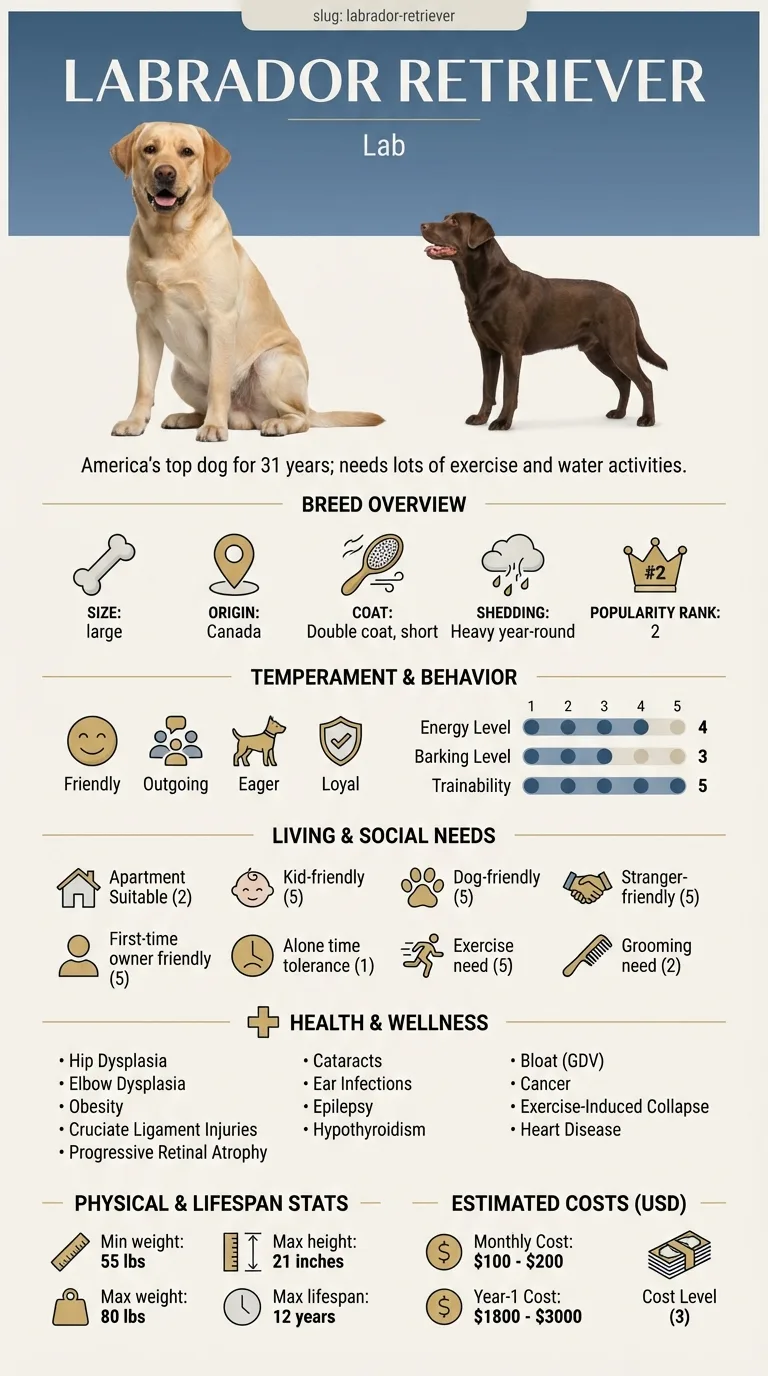
Labradors rank near the top of typical trainability and drive scales, the same traits that make them exceptional retrievers and family dogs — but those traits also mean the dog won't voluntarily stop exercising as heat builds, removing the natural safety valve lower-drive breeds rely on. Their dense double coat, rated as heavy year-round shedding, retains heat on land even as it insulates in water, and their 55 to 80 pound muscular frame generates substantial metabolic heat during sustained activity.
Hot, humid weather is the clearest trigger, since humidity specifically blunts the cooling effect of panting. Activities that involve sustained drive — repeated fetch, dock diving, hunting work — are higher risk than casual walks precisely because they align with the exact behaviors this breed won't self-limit.
Treat heavy uncontrolled panting, bright red or purple gums, thick ropey drool, stumbling, vomiting, or collapse as a true emergency requiring immediate veterinary care — begin cooling measures on the way, but don't delay the trip to assess further at home.
See all Labrador Retriever health problems, which breeds are prone to heat sensitivity hyperthermia, or the full Labrador Retriever breed guide for temperament, exercise needs and ownership costs.
Prevention is an ongoing, season-by-season commitment rather than a one-time fix — every warm season requires the same discipline around scheduled breaks and timing, for the dog's entire life. Recovery from an actual heatstroke episode, if it occurs, typically requires at least overnight veterinary monitoring even after initial cooling.
Success means an entire warm season of active play, swimming, and retrieving with zero overheating emergencies — achieved through consistent scheduled breaks and owner vigilance rather than trusting the dog to self-regulate, which this breed generally won't do.
Heatstroke, medically called hyperthermia, happens when a dog's core body temperature rises faster than its cooling mechanisms — mainly panting — can bring it back down. Any breed can get heatstroke, but the dogs most likely to end up in an emergency room for it tend to share one trait: they don't stop themselves.
Labradors are rated at or near the top of typical breed drive and trainability scales, which is exactly what makes them extraordinary working and sporting dogs — and exactly why they're overrepresented in heatstroke emergency data. A dog bred to keep retrieving, keep swimming, keep working past mild discomfort for the reward of the game or the handler's approval will not self-regulate the way a lower-drive breed instinctively does. Combine that with a dense double coat that retains heat on land, and a muscular 55 to 80 pound frame generating real metabolic heat during exertion, and the physiology stacks the same direction as the temperament.
The result is a dog that can go from 'happily still playing' to a genuine medical emergency in a shorter window than an owner watching for obvious distress might expect, because the obvious sign — the dog quitting on its own — simply isn't coming.

Heatstroke is a true emergency where the drive to a vet clinic should start immediately, not after a wait-and-see period. These steps are for the car ride, not a substitute for veterinary care.
If you think your Lab has heat sensitivity & hyperthermia, the plan is three steps: write down what you have seen and when it started, book a veterinary appointment rather than waiting for the next flare, and take video of the behaviour or symptom before you go — the thing you are worried about rarely happens in the consulting room. Screening in the parents covers hip dysplasia, elbow dysplasia, obesity.
What the vet visit should produce is a diagnosis and a written plan, not just reassurance: what is being ruled out, what the monitoring interval is, and which signs mean you come back sooner. Ask what the treatment costs across a year rather than per visit, because that is the number that decides whether you are managing this condition or reacting to it.
Between appointments, keep a short log — dates, what you saw, what changed. It is the single most useful thing an owner brings to a follow-up, and for heat sensitivity & hyperthermia it is often what separates a clear pattern from a guess.
Alex brought his two-year-old Lab, Duke, to a dock-diving practice session on a humid August morning, expecting the water to keep him cool. Duke jumped repeatedly for twenty straight minutes, tail wagging the entire time, showing no sign of wanting to stop. It was only when Alex called him over for water that he noticed Duke's gums were an alarming bright red and he was swaying slightly getting out of the water. Alex drove straight to an emergency vet, cooling Duke with wet towels in the car. He was diagnosed with moderate heatstroke and spent the night on IV fluids for monitoring, recovering fully. Alex now sets a phone timer for mandatory five-minute breaks every fifteen minutes at every practice session, regardless of how eager Duke still looks.
Key takeaway: A Lab's enthusiasm during exercise is not a safety signal — it's often the opposite, since this breed's drive to keep going is precisely what puts it at elevated risk, which is why scheduled breaks matter more than watching for the dog to ask for one.
It's largely behavioral rather than purely physical — their high drive and trainability mean they keep exercising past the point of discomfort instead of self-regulating, combined with a dense double coat that traps heat on land during exertion.
It can happen within twenty to thirty minutes of intense activity in hot or humid conditions, sometimes faster in an overweight or unfit dog. This is why prevention through scheduled breaks matters more than reacting to visible distress.
Heavy panting that doesn't ease with rest, bright red or purple gums, thick ropey drool, and a reluctance to keep moving are early signs. Progression to stumbling, vomiting, or collapse means the emergency has advanced significantly.
Yes, seriously so. Heatstroke can cause organ damage, clotting problems, and death, and outcomes are strongly tied to how quickly cooling and veterinary treatment begin. It should always be treated as an emergency, never monitored at home alone.
Yes — fitness helps but doesn't eliminate the risk, because the core issue is often that a fit, driven dog can sustain intense activity for longer before showing distress, which paradoxically increases how much heat builds up before anyone notices.
Not necessarily, but build in mandatory water and shade breaks every ten to fifteen minutes regardless of whether your dog wants to stop, and move sessions to cooler parts of the day.
Treatment typically includes controlled active cooling, IV fluids, and monitoring for complications like organ damage or abnormal blood clotting, sometimes requiring overnight hospitalization even after the dog's temperature normalizes.
Their high drive to keep working or playing means they often don't self-regulate the way lower-drive breeds do, combined with a heat-retaining double coat.
Potentially within twenty to thirty minutes of intense activity in hot or humid conditions, faster if the dog is overweight or unfit.
Stop activity immediately, move to shade or air conditioning, apply cool water to the belly and paws, and head to an emergency vet right away.
Yes — internal damage can continue even after visible symptoms improve, so a vet visit is still necessary.
Every ten to fifteen minutes, regardless of whether the dog shows any sign of wanting to stop on its own.
A one-page prep sheet for this condition: the signs, the questions to ask, what to get priced. Unlocks here.
You get: Vet visit prep sheet
No spam. One-click unsubscribe. See our privacy policy.
Preview page 1 before you decide.