Health
What's the earliest sign of bloat?
Unproductive retching and restlessness that won't settle are often the first noticeable signs.

Quick answer
What's the earliest sign of bloat?
Unproductive retching and restlessness that won't settle are often the first noticeable signs.
Of everything covered in these guides, this is the one condition where memorizing the warning signs in advance, rather than looking them up in the moment, can be the difference that matters.
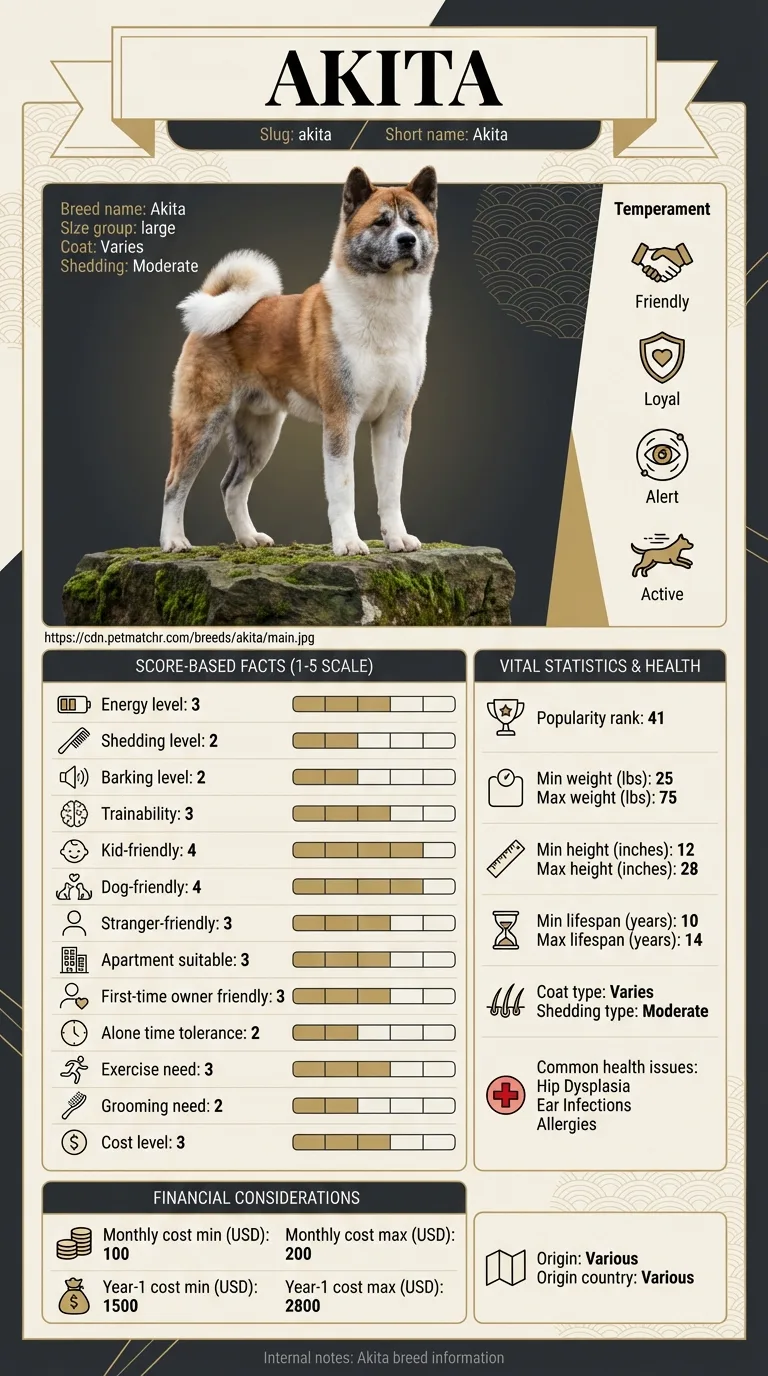
Every Akita owner is the intended audience here — this isn't a condition tied to a particular age or lifestyle the way many others are, since any adult dog of this breed carries the underlying chest-shape risk.
This guide is not medical advice. If your dog shows pain, sudden behavior change, or worsening symptoms, consult a licensed veterinarian.
Some links may be affiliate links. We may earn a commission at no extra cost to you. We only suggest products we believe are helpful for dog owners.
We research and check what we publish, but we do not warrant that any figure, date, price, or statement is accurate, complete, or current, and we accept no liability for any loss, cost, injury, or other harm arising from the use of this site. Use it as one reference among several. You remain responsible for your own decisions and for your dog's care - confirm anything that matters with a licensed veterinarian or another qualified professional before you act on it. Full disclaimer.
Check this first
A swollen, tight, or drum-like abdomen is the most recognizable sign, but it doesn't always appear early or obviously in a large, heavily coated breed like the Akita. Watch instead for the fuller symptom picture: repeated unproductive retching, excessive drooling, restlessness or pacing that won't settle, a hunched or anxious posture, and rapid, shallow breathing.
Any combination of these signs warrants an immediate trip to an emergency veterinary hospital. This is not a symptom set to monitor overnight or address at the next available regular appointment — bloat can progress from first sign to a dog in shock within just a few hours.
There is no mild version of bloat that's safe to wait out. Even if you're not certain, the cost of an unnecessary emergency visit is far lower than the cost of delaying care for actual bloat.
If any of these apply, call your vet or an emergency clinic now. The rest of this page is for the cases that are not an emergency.
Bloat is a rapid, life-threatening twisting of the stomach, and recognizing its early signs quickly is the single most important thing an Akita owner can do, since this condition offers no safe waiting period. It's listed among the breed's documented common health issues because of the Akita's deep chest conformation.
Bloat occurs often enough in deep-chested breeds like the Akita that veterinary emergency hospitals see it as a recurring presentation, which is part of why owner recognition of early signs is emphasized so heavily in breed-specific health guidance.
The anatomical basis is the Akita's deep, narrow chest cavity, which gives the stomach more room to move and rotate than in breeds with a broader chest. This structural risk exists regardless of how careful an individual owner is about feeding practices, which is why sign recognition remains critical even in well-managed dogs.
While the underlying anatomical risk can't be changed, feeding pattern, meal size, and activity timing around meals all influence how often the stomach becomes distended with gas in the first place, which is the event that can precede twisting.
Any suspected bloat sign — unproductive retching, restlessness that won't settle, drooling, abdominal distension, or labored breathing — means an immediate emergency vet visit, with no appropriate 'wait and see' period.
Bloat's early signs can look deceptively mild for the first few minutes, which is exactly when a delay in recognition costs the most.
See all Akita health problems, which breeds are prone to bloat gdv, or the full Akita breed guide for temperament, exercise needs and ownership costs.
There is no recovery timeline prior to treatment since this requires immediate surgery. Once treated, recovery from an uncomplicated case is typically 10 to 14 days of restricted activity.
Success is recognizing the signs immediately and getting to emergency care within the critical early window, which is strongly associated with better survival outcomes compared to delayed presentation.
Naomi's Akita, Onyx, seemed unusually restless one evening in Charlotte, pacing and trying to vomit without bringing anything up. Naomi didn't wait to see if it would pass — she'd read about bloat signs specifically because Onyx was a deep-chested breed, and she headed straight to the emergency vet. Onyx was diagnosed with early gastric dilatation, caught before full torsion had developed, which gave the surgical team a more straightforward case to treat. Naomi has since made feeding-schedule changes — smaller meals, no exercise right after eating — as an added layer of precaution.
Key takeaway: Knowing the sign cluster in advance, rather than researching it in the moment, is what allows an owner to act fast enough for it to matter.
Restlessness and repeated attempts to vomit without producing anything are often the earliest noticeable signs, sometimes before obvious abdominal swelling develops.
Not always immediately, and a thick or heavily coated breed can make early swelling harder to see or feel. The full pattern of restlessness, drooling, and unproductive retching matters as much as visible distension.
It can progress from first symptoms to a dog in shock within a few hours, which is why any suspicion should prompt an immediate emergency vet visit rather than a wait-and-see approach.
Yes, it's an extremely painful condition, which is part of why affected dogs often appear restless, anxious, and unable to get comfortable in any position.
Gastric dilatation without volvulus (twisting) is a related but somewhat less immediately catastrophic presentation, though it still requires urgent veterinary evaluation since it can progress to full torsion.
No — there is no safe or effective home remedy for bloat, and attempting one only delays the emergency care that's actually needed.
Call your nearest emergency veterinary hospital while you're on the way there, so they can prepare for your arrival, rather than waiting until you arrive to explain the situation.
Unproductive retching and restlessness that won't settle are often the first noticeable signs.
Immediately — call and head to an emergency vet right away, without waiting to see if symptoms ease.
No — there is no safe home remedy; emergency veterinary treatment is the only option.
No — early bloat can occur before obvious abdominal swelling is easy to feel, especially under a thick coat.
Yes — calling en route lets the hospital prepare and can save time once you arrive.
A one-page prep sheet for this condition: the signs, the questions to ask, what to get priced. Unlocks here.
You get: Vet visit prep sheet
No spam. One-click unsubscribe. See our privacy policy.
Preview page 1 before you decide.