Health
What's the earliest sign of PRA to watch for?
Reduced confidence or clumsiness in dim light or at night, often noticeable before any visible change to the eye itself.

Quick answer
What's the earliest sign of PRA to watch for?
Reduced confidence or clumsiness in dim light or at night, often noticeable before any visible change to the eye itself.
The vision loss itself can't be stopped, but the fact that it happens gradually and predictably means most dogs, and their owners, adapt far better than the diagnosis initially sounds.
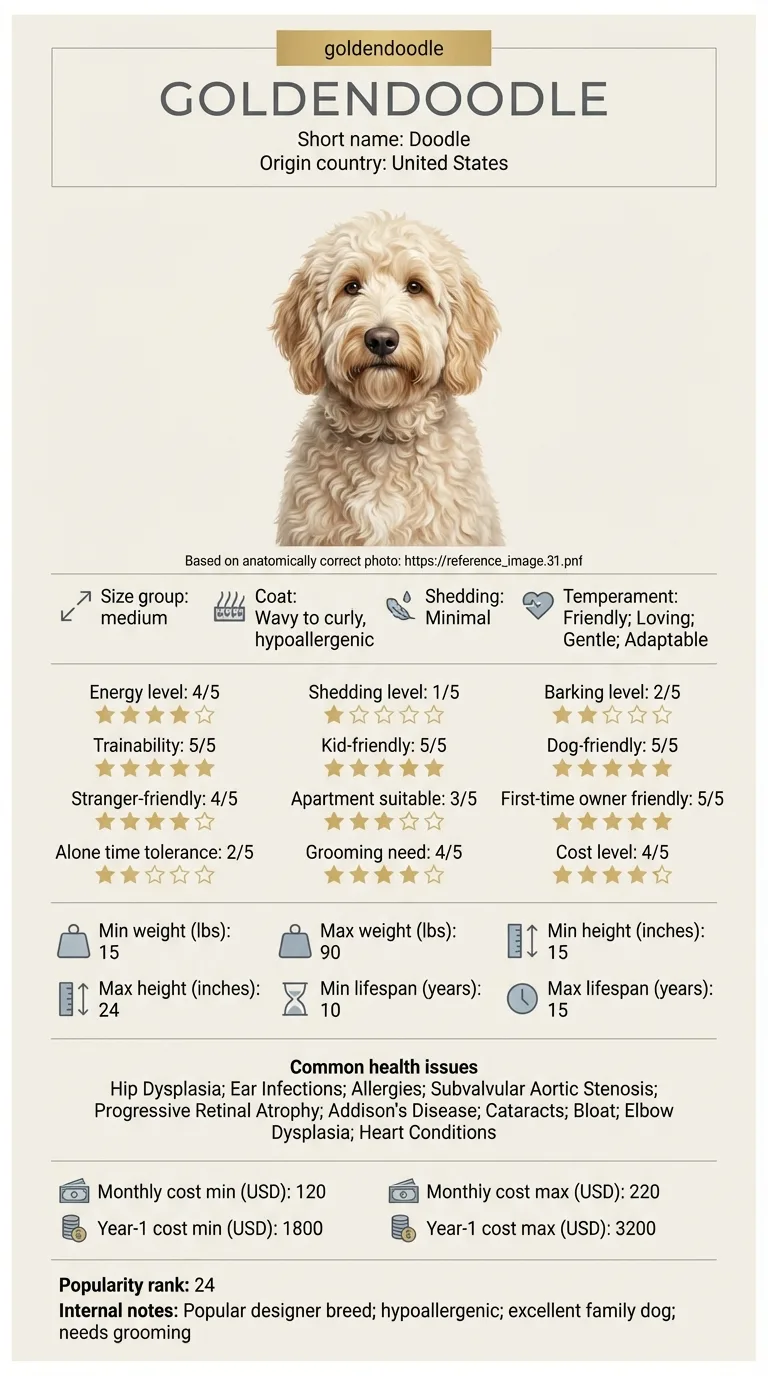
This affects owners noticing their Goldendoodle becoming hesitant or clumsy in dim light or at night, and owners of breeding dogs trying to understand what genetic testing can tell them before a litter is planned.
This guide is not medical advice. If your dog shows pain, sudden behavior change, or worsening symptoms, consult a licensed veterinarian.
Some links may be affiliate links. We may earn a commission at no extra cost to you. We only suggest products we believe are helpful for dog owners.
Progressive retinal atrophy in Goldendoodles most often refers to prcd-PRA, a well-documented mutation inherited through Poodle lineage that causes gradual degeneration of the retina's light-sensing cells. It follows a fairly predictable pattern starting with reduced night vision and progressing over months to a couple of years, and while there's no treatment, reliable genetic testing and gradual home adaptation make this a manageable, if serious, diagnosis.
Progressive Retinal Atrophy is listed among this breed's documented health issues, with the prcd mutation specifically well established as a known risk carried through Poodle lines, making genetic testing widely available and commonly used by responsible breeders.
The prcd mutation responsible for the most common form of PRA in this breed is well documented in Poodle lines and passed down through that side of the Goldendoodle cross via standard recessive inheritance, meaning two carrier parents, even without symptoms themselves, can produce an affected puppy.
There is no established environmental trigger for PRA, since it's a purely genetic condition; its onset and progression follow the underlying genetic mutation's typical timeline rather than being influenced by diet, injury, or lifestyle factors.
See a vet or veterinary ophthalmologist if you notice reduced confidence in dim light, bumping into familiar objects, or any other sign suggesting declining vision. This generally isn't an emergency, but early diagnosis helps with planning and adaptation.
See all Goldendoodle health problems, which breeds are prone to progressive retinal atrophy pra, or the full Goldendoodle breed guide for temperament, exercise needs and ownership costs.
From first noticeable night-vision changes to significant vision loss, progression commonly spans several months to a couple of years, though individual timelines vary. There's no timeline toward reversal, since the condition is currently untreatable.
Success looks like an accurate diagnosis giving you time to adapt gradually, a stable home environment supporting confident navigation despite declining vision, and, for breeders, genetic testing that prevents passing the mutation on unknowingly to future litters.
In prcd-PRA, rod cells, responsible for vision in low light, are affected first, which is why the earliest and most consistent sign is reduced confidence or clumsiness at night or in dim rooms, often noticed well before any visible change to the eye itself. As the condition progresses over months to a couple of years, cone cells, responsible for daytime and color vision, become affected too, eventually leading to significant or complete vision loss even in bright light.
Genetic testing for the prcd mutation is well established and widely available, and can identify a dog as clear, a carrier, or affected before any clinical sign appears. This is particularly valuable for breeding decisions, since two carrier parents can produce an affected puppy even if neither parent shows any symptoms themselves, given the condition's recessive inheritance pattern.
Because the progression is gradual and dogs rely heavily on smell and hearing regardless of vision status, most dogs adapt remarkably well to advancing vision loss, especially in a stable, familiar home environment. The diagnosis is undeniably significant, but it's rarely the dramatic, sudden crisis that the phrase 'progressive vision loss' might initially suggest to an owner hearing it for the first time.
Whether you're planning a litter or supporting a dog already diagnosed, these two areas — genetic testing and practical home adaptation — cover most of what's actually actionable here.

If you think your Doodle has progressive retinal atrophy (pra), the plan is three steps: write down what you have seen and when it started, book a veterinary appointment rather than waiting for the next flare, and take video of the behaviour or symptom before you go — the thing you are worried about rarely happens in the consulting room. Screening in the parents covers hip dysplasia, ear infections, allergies.
What the vet visit should produce is a diagnosis and a written plan, not just reassurance: what is being ruled out, what the monitoring interval is, and which signs mean you come back sooner. Ask what the treatment costs across a year rather than per visit, because that is the number that decides whether you are managing this condition or reacting to it.
Between appointments, keep a short log — dates, what you saw, what changed. It is the single most useful thing an owner brings to a follow-up, and for progressive retinal atrophy (pra) it is often what separates a clear pattern from a guess.
Naomi first noticed her Goldendoodle, Clover, hesitating at the bottom of the porch steps during evening walks, something she'd never done before. During the day, Clover seemed completely normal. A veterinary ophthalmologist confirmed early prcd-PRA through an ERG test, explaining the classic pattern of night vision loss appearing well before daytime vision would be affected. Over the following year, Naomi gradually adjusted their routine — keeping furniture in fixed places, adding a textured mat at the top of the stairs, and shifting evening walks to well-lit, familiar routes. Clover's vision continued to decline as expected, but she navigated her home confidently throughout, relying on the consistent layout Naomi had maintained.
Key takeaway: Catching the early, subtle night-vision signs gave Naomi a full year to adapt their home and routine gradually, which made an inevitable diagnosis far less disruptive than it could have been.
Currently no — there's no established treatment that halts the degeneration once it begins. Management focuses entirely on supporting a dog through gradual vision loss rather than reversing the underlying process.
A veterinary ophthalmologist can identify characteristic retinal changes during a specialized eye exam, sometimes using electroretinography, or ERG, to measure retinal electrical activity directly and confirm the diagnosis definitively.
The test confirms whether a dog carries the mutation and will develop the condition, but the exact timeline and rate of progression can vary somewhat between individual dogs even with the same genetic result.
Many dogs with prcd-PRA do eventually lose most or all functional vision, though the gradual timeline, often spanning a year or more, gives both dog and owner substantial time to adapt to each stage.
If there's a known family history or you're considering breeding, genetic testing is worthwhile even without symptoms, since it can identify carrier or affected status well before any clinical sign would appear.
Most cope remarkably well, relying more heavily on smell, hearing, and a memorized layout of familiar spaces, especially when the environment stays consistent and changes are introduced gradually rather than all at once.
Reduced confidence or clumsiness in dim light or at night, often noticeable before any visible change to the eye itself.
Yes — the prcd mutation test is well established and can identify clear, carrier, or affected status before any symptoms appear.
No — there's currently no treatment that halts or reverses the degeneration; management focuses on adaptation instead.
A veterinary ophthalmologist exam, sometimes including ERG testing, commonly runs a few hundred dollars depending on the specific testing needed.
Yes, many do, especially with a stable home environment and owners who adapt routines to support a dog with declining vision.
A one-page prep sheet for this condition: the signs, the questions to ask, what to get priced. Unlocks here.
You get: Vet visit prep sheet
No spam. One-click unsubscribe. See our privacy policy.
Preview page 1 before you decide.