Health
Is there a specific obesity gene in Goldendoodles?
No confirmed one — the POMC mutation tied to obesity risk is documented in Labradors and Flat-Coated Retrievers, not established in Golden Retriever or Poodle lines.

Quick answer
Is there a specific obesity gene in Goldendoodles?
No confirmed one — the POMC mutation tied to obesity risk is documented in Labradors and Flat-Coated Retrievers, not established in Golden Retriever or Poodle lines.
The well-known POMC obesity mutation is documented mainly in Labradors and Flat-Coated Retrievers — not confirmed at meaningful frequency in Golden Retriever or Poodle lines that make up a Goldendoodle.
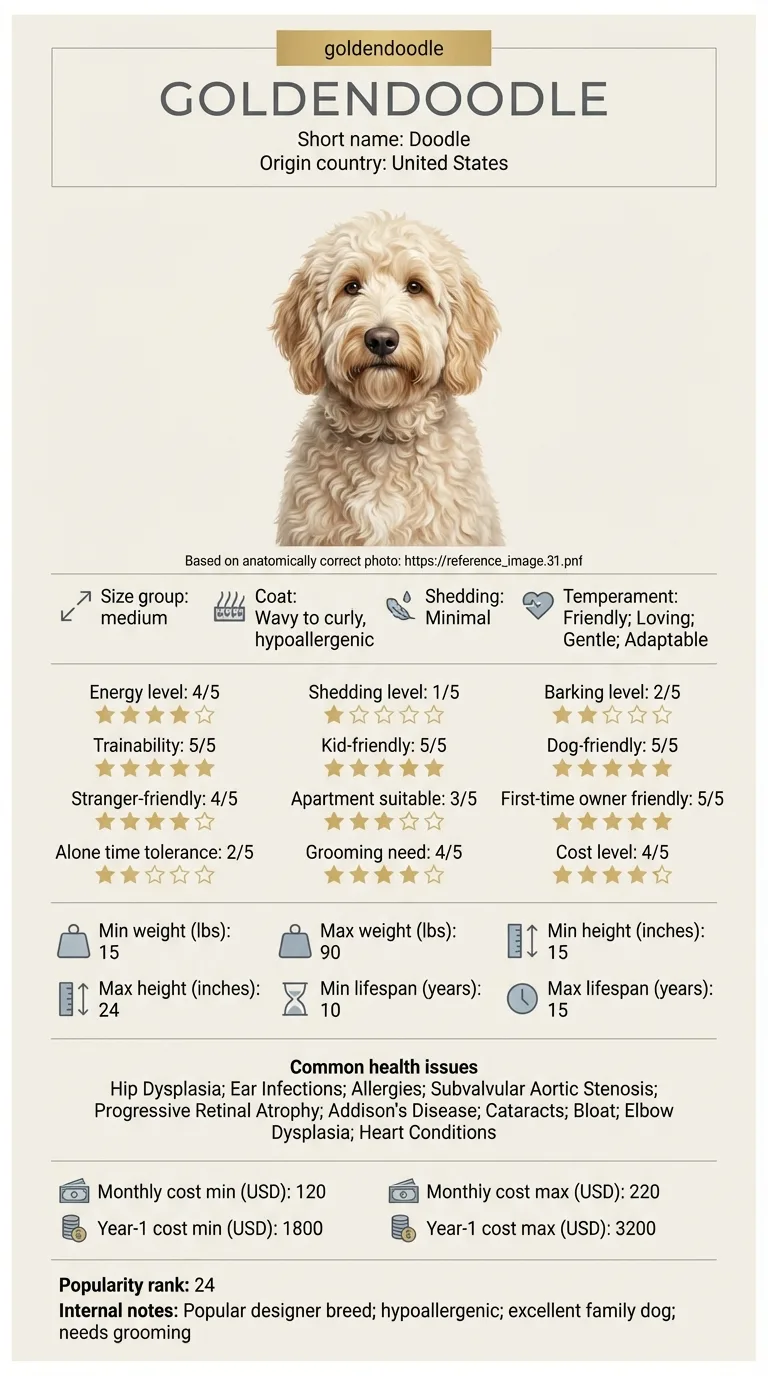
Owners of a food-motivated, moderately-to-highly active Goldendoodle who's started creeping up in weight, especially if daily exercise has become inconsistent.
This guide is not medical advice. If your dog shows pain, sudden behavior change, or worsening symptoms, consult a licensed veterinarian.
Some links may be affiliate links. We may earn a commission at no extra cost to you. We only suggest products we believe are helpful for dog owners.
Check this first
Gradual weight gain itself is rarely an emergency, but it deserves attention because of what it accelerates. This breed's record documents hip dysplasia and elbow dysplasia as known joint risks, and extra weight puts more mechanical stress on joints that may already be structurally vulnerable.
A same-day vet visit is warranted if a dog carrying excess weight suddenly shows reluctance to rise, a new limp, crying out when moving, or a marked drop in willingness to walk or climb stairs — these could indicate that joint stress has crossed into acute pain rather than just general stiffness.
Sudden, unexplained weight loss or gain, in contrast to a slow creep, is also worth a prompt vet conversation, since rapid changes can point to an unrelated medical issue rather than simple diet and exercise balance.
For most cases of gradual weight gain without other symptoms, a routine vet visit to reassess diet and exercise is the appropriate next step rather than an emergency one.
If any of these apply, call your vet or an emergency clinic now. The rest of this page is for the cases that are not an emergency.
The POMC gene mutation linked to increased appetite and obesity risk is documented mainly in Labrador Retrievers and Flat-Coated Retrievers, and is not confirmed at meaningful frequency in Golden Retriever or Poodle lines. Rather than a single obesity gene, the real, defensible risk factors for this breed are strong retriever-heritage food motivation and a moderate-to-high exercise need that's easy for a busy owner to under-meet.
There's no confirmed breed-specific obesity gene for Goldendoodles, but weight gain is common across dogs generally when calorie intake outpaces activity, and this breed's combination of high food motivation and real exercise needs makes that imbalance a genuine, frequently seen risk.
This breed's common health issues list does not include a confirmed obesity gene, and the POMC mutation associated with obesity in some retriever lines is not established in Golden Retriever or Poodle lines specifically. What is a genuine breed-linked factor is temperament: both parent breeds were developed as food-responsive companion and working dogs, producing puppies that are often highly motivated by food, which makes overfeeding easy without deliberate portion control.
A busy household that can't consistently meet this breed's exercise need, inconsistent portion sizes, frequent treats, and multiple people feeding the same dog without coordinating are the everyday environmental factors that turn food motivation into actual weight gain.
Talk to a vet if you can't easily feel the ribs, if a formerly active dog shows reluctance to rise or a new limp, or if you notice sudden, unexplained weight change in either direction rather than a slow creep — the last of these can point to an unrelated medical issue.
Obesity in this breed usually isn't one dramatic event — it's small daily habits that compound. These are the ones worth catching early.
See all Goldendoodle health problems, which breeds are prone to genetic predisposition to obesity, or the full Goldendoodle breed guide for temperament, exercise needs and ownership costs.
Safe, gradual weight loss in dogs typically takes several weeks to a few months depending on how much weight needs to come off, since rapid weight loss isn't considered safe for dogs.
Success looks like a dog at a stable, vet-confirmed healthy weight with ribs easily felt and a visible waist, maintained through a consistent routine rather than a one-time diet — since the underlying food motivation and exercise need don't go away.
If you think your Doodle has genetic predisposition to obesity, the plan is three steps: write down what you have seen and when it started, book a veterinary appointment rather than waiting for the next flare, and take video of the behaviour or symptom before you go — the thing you are worried about rarely happens in the consulting room. Screening in the parents covers hip dysplasia, ear infections, allergies.
What the vet visit should produce is a diagnosis and a written plan, not just reassurance: what is being ruled out, what the monitoring interval is, and which signs mean you come back sooner. Ask what the treatment costs across a year rather than per visit, because that is the number that decides whether you are managing this condition or reacting to it.
Between appointments, keep a short log — dates, what you saw, what changed. It is the single most useful thing an owner brings to a follow-up, and for genetic predisposition to obesity it is often what separates a clear pattern from a guess.
Paul Hendricks noticed his Goldendoodle Clementine had gone from an active daily hiker to a dog who napped through most weekends after his work schedule in Missoula, MT got busier. He hadn't changed her food portions to match the drop in exercise, and treats during her training sessions had quietly crept up too. At her annual checkup, the vet flagged that her ribs were harder to feel than the year before. Paul started measuring her meals, counted her training treats as part of her daily total, and built a shorter but consistent daily walk back into his schedule. Over the following months her weight came back down gradually.
Key takeaway: The weight gain wasn't about a special obesity gene — it was an ordinary mismatch between reduced exercise and unchanged food portions, and it was just as reversible as it was avoidable.
The POMC gene mutation linked to increased appetite and obesity risk is documented mainly in Labrador Retrievers and Flat-Coated Retrievers. It is not confirmed at meaningful frequency in Golden Retriever or Poodle lines, so it shouldn't be assumed to apply to this cross.
Not a confirmed single-gene mutation, but this breed's retriever heritage does bring a real behavioral tendency: strong food motivation. That's not the same as a documented obesity gene, but it's a genuine, defensible risk factor.
Both the Golden Retriever and Poodle sides of this cross are companion and working breeds historically bred with a strong drive to please and respond to food-based training, which tends to produce dogs that are easy to overfeed if portions aren't watched.
This breed's exercise need is rated moderate-to-high. A busy owner who consistently under-meets that need, without also reducing food intake to match, creates a straightforward calorie surplus that adds up over time.
Hip dysplasia and elbow dysplasia are both documented joint issues in this breed's health record. Extra body weight increases mechanical load on joints, which can accelerate the onset or worsen the severity of symptoms from either condition.
No — obesity risk factors are covered here, while diabetes is a distinct metabolic condition covered separately. The two can be related, but they're different topics with different management paths.
You should be able to feel, though not necessarily see, the ribs with light pressure, and there should be a visible waist when viewed from above. If ribs are hard to feel or the waist has disappeared, it's worth discussing weight with a vet.
No confirmed one — the POMC mutation tied to obesity risk is documented in Labradors and Flat-Coated Retrievers, not established in Golden Retriever or Poodle lines.
Strong retriever-heritage food motivation combined with a moderate-to-high exercise need that's easy to under-meet.
This breed's exercise need is rated 4 out of 5, meaning consistent daily activity rather than occasional walks is usually needed to match its typical calorie intake.
Yes — treating accelerated joint problems from hip or elbow dysplasia in an overweight dog typically costs more than managing weight proactively through diet and exercise.
Yes — structured training that uses small, portion-counted treats and consistent meal routines can reduce accidental overfeeding driven by strong food motivation.
A one-page prep sheet for this condition: the signs, the questions to ask, what to get priced. Unlocks here.
You get: Vet visit prep sheet
No spam. One-click unsubscribe. See our privacy policy.
Preview page 1 before you decide.