Health
Is subvalvular aortic stenosis the same in every Goldendoodle?
No — severity ranges from mild, often with no real impact, to severe, which carries meaningful risk during exertion.

Quick answer
Is subvalvular aortic stenosis the same in every Goldendoodle?
No — severity ranges from mild, often with no real impact, to severe, which carries meaningful risk during exertion.
If a young Goldendoodle's murmur turns out to be subvalvular aortic stenosis, the severity graded today is largely the severity that dog will carry for the rest of its life.
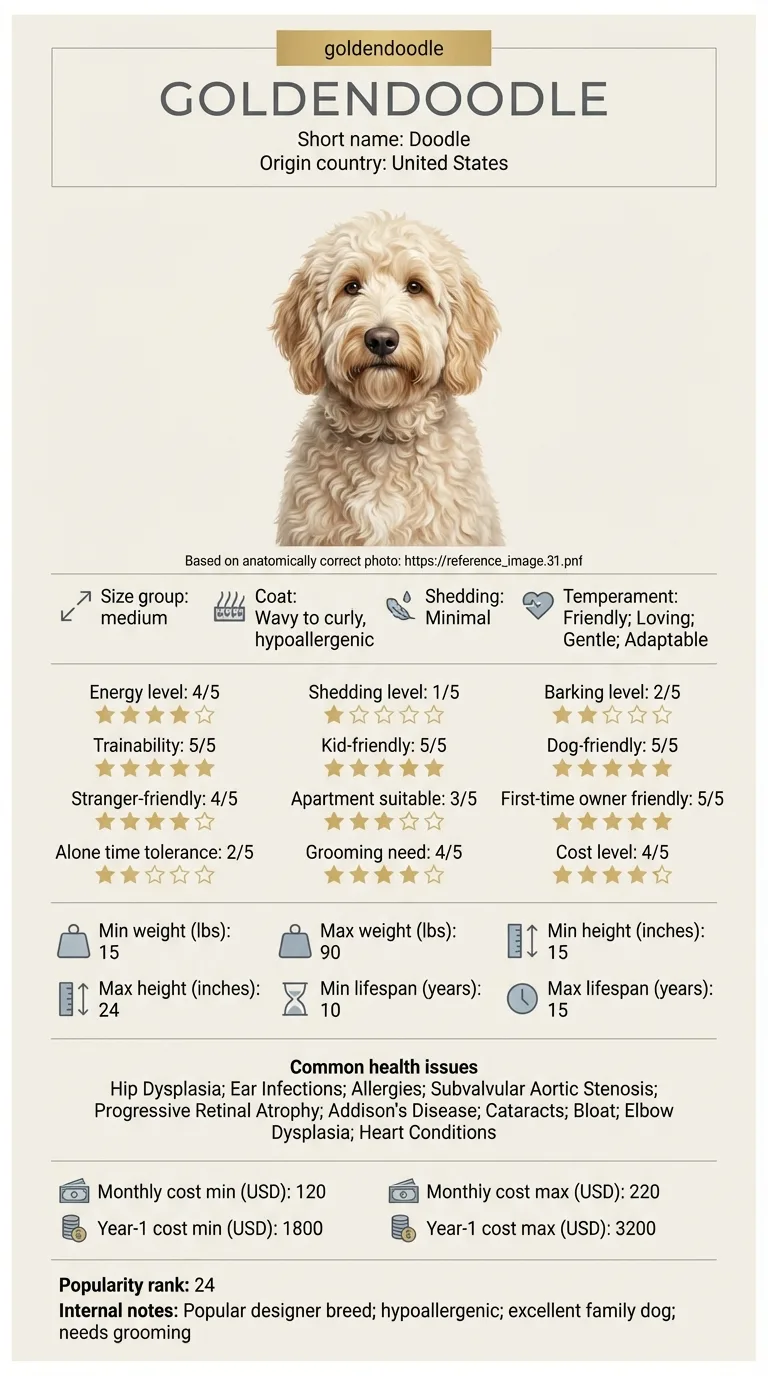
This affects owners of puppies and young adult Goldendoodles who've just received an SAS diagnosis and are trying to understand whether it's a manageable footnote or something that will shorten their dog's life.
This guide is not medical advice. If your dog shows pain, sudden behavior change, or worsening symptoms, consult a licensed veterinarian.
Some links may be affiliate links. We may earn a commission at no extra cost to you. We only suggest products we believe are helpful for dog owners.
Subvalvular aortic stenosis is a congenital narrowing below the aortic valve, inherited through Golden Retriever lineage, that forces the heart to work harder against resistance for the dog's entire life. Severity is set largely by the time growth finishes and ranges from mild, with little practical impact, to severe, with real risk during exertion.
Heart Conditions is listed among this breed's documented health issues, and SAS specifically is one of the more consistently reported congenital cardiac defects tracing to Golden Retriever lines within Goldendoodles. Mild cases are the most frequently diagnosed severity level.
SAS is a well-documented heritable defect in Golden Retriever bloodlines, and because a Goldendoodle draws roughly half its genetics from that side, the defect can be passed down directly. It is not a documented concern in Poodle lines, which is why SAS in a Goldendoodle points fairly specifically to Golden Retriever ancestry rather than the cross as a whole.
Environment doesn't cause SAS, since it's a structural defect present at birth, but intense unmonitored exertion in a dog with an undiagnosed moderate-to-severe case can unmask symptoms like fainting earlier than they might otherwise appear, which is why a baseline cardiac clearance before serious athletic activity matters.
Schedule a visit for any change in exercise tolerance, a new cough, or fatigue that seems disproportionate to activity level. Treat any fainting or collapse episode as an emergency and seek immediate veterinary care.
See all Goldendoodle health problems, which breeds are prone to heart problems, or the full Goldendoodle breed guide for temperament, exercise needs and ownership costs.
A definitive SAS diagnosis and severity grading typically takes two to four weeks from the first suspicious murmur, including scheduling a cardiology referral and echocardiogram. A confirmatory recheck around one year old is standard practice.
Success for a mild case looks like a dog living a full, largely unrestricted life with periodic cardiology rechecks. For moderate-to-severe cases, success means a clear activity plan, arrhythmia monitoring, and a family that understands the real risk profile rather than an unrealistic hope for a cure.
In SAS, a ridge or ring of fibrous tissue forms just below the aortic valve, inside the heart's main outflow tract. Every time the heart contracts, blood has to squeeze through that narrowed passage on its way out to the body, which forces the left ventricle to generate extra pressure with every single beat. Over years, that constant extra workload can thicken the heart muscle wall, and in more severe cases it raises the risk of exhaustion-triggered fainting or sudden cardiac events during exertion.
Severity is usually described as mild, moderate, or severe based on the pressure gradient measured across the narrowing during an echocardiogram — a higher gradient means more resistance the heart has to work against. Mild SAS is often compatible with a completely normal lifespan and no activity restriction. Moderate and severe SAS carry real risk of arrhythmia, fainting, and, in the most severe cases, sudden death, particularly during intense exertion.
Unlike valve disease that develops and worsens with age, SAS's severity is largely fixed by the time a puppy finishes growing. That's part of why an early, accurate echocardiogram matters so much: it's not just diagnosing the problem, it's establishing the ceiling that management decisions will be based on for the rest of the dog's life.
Because SAS is heritable and traceable to specific lines, screening before breeding is the main lever anyone has to reduce how often it shows up in future litters.

Curtis's Goldendoodle, Duke, was diagnosed with mild SAS at his one-year checkup after a soft murmur had been tracked since puppyhood. The cardiologist's message was straightforward: normal life, normal exercise, and an annual recheck. A friend's Goldendoodle from a different litter was diagnosed with severe SAS around the same age, after a louder murmur and one fainting episode during a hike. That dog's cardiologist set a much more conservative activity plan, added a medication to manage arrhythmia risk, and scheduled rechecks every four months instead of yearly. Both dogs carry the same diagnosis name on paper. Their actual day-to-day lives look almost nothing alike.
Key takeaway: The words 'subvalvular aortic stenosis' on a diagnosis sheet don't tell you much by themselves — the severity grade from an actual echocardiogram is what determines whether life changes at all.
Mild cases usually are not and can allow a normal lifespan. Moderate and especially severe cases carry a meaningfully higher risk of arrhythmia, fainting, and sudden cardiac events, particularly during intense exertion, which is why grading severity accurately matters so much.
Balloon valvuloplasty and surgical resection have been used for severe cases, but results are inconsistent and neither reliably restores normal anatomy. For most dogs, especially mild-to-moderate cases, medical management and monitoring rather than surgery is the actual path forward.
Cardiologists measure the pressure gradient across the narrowed area during an echocardiogram using Doppler ultrasound, then classify the finding as mild, moderate, or severe based on that gradient, alongside other structural findings.
Unlike valve degeneration, SAS severity is largely set by the time growth finishes, typically around one to two years old. It doesn't usually progress dramatically after that, though secondary effects like heart muscle thickening or arrhythmia can develop over time in moderate-to-severe cases.
Often yes, with a cardiologist's clearance and periodic rechecks, though very intense activities like competitive agility or long-distance running are usually discussed case-by-case rather than assumed safe.
It's a documented, heritable defect in Golden Retriever lines, and since a Goldendoodle carries roughly half its genetics from that side, the defect can be passed down directly regardless of how many generations removed from a purebred Golden Retriever the dog is.
A repeat exam around one year old is often reasonable, since severity assessed too early in a young puppy can occasionally be revised once the heart finishes maturing.
No — severity ranges from mild, often with no real impact, to severe, which carries meaningful risk during exertion.
Yes — it's typically found as a murmur at a routine puppy exam, well before any visible symptoms would appear.
A cardiology consult with Doppler echocardiogram commonly runs several hundred dollars, with rechecks adding to that over time.
Anesthesia protocols may be adjusted for a known cardiac defect, so always disclose an SAS diagnosis before any surgical procedure.
Usually yes at a moderated intensity; ask your cardiologist for specific guidance rather than assuming any activity is automatically off-limits.
A one-page prep sheet for this condition: the signs, the questions to ask, what to get priced. Unlocks here.
You get: Vet visit prep sheet
No spam. One-click unsubscribe. See our privacy policy.
Preview page 1 before you decide.