Health
What's the earliest age hip dysplasia can be detected?
Joint laxity can sometimes be seen on X-ray as early as four to six months old, well before visible symptoms appear.

Quick answer
What's the earliest age hip dysplasia can be detected?
Joint laxity can sometimes be seen on X-ray as early as four to six months old, well before visible symptoms appear.
The diagnosis on paper says 'hip dysplasia,' but what you're actually managing day to day is arthritis pain in a joint that was built a little loose from the start.
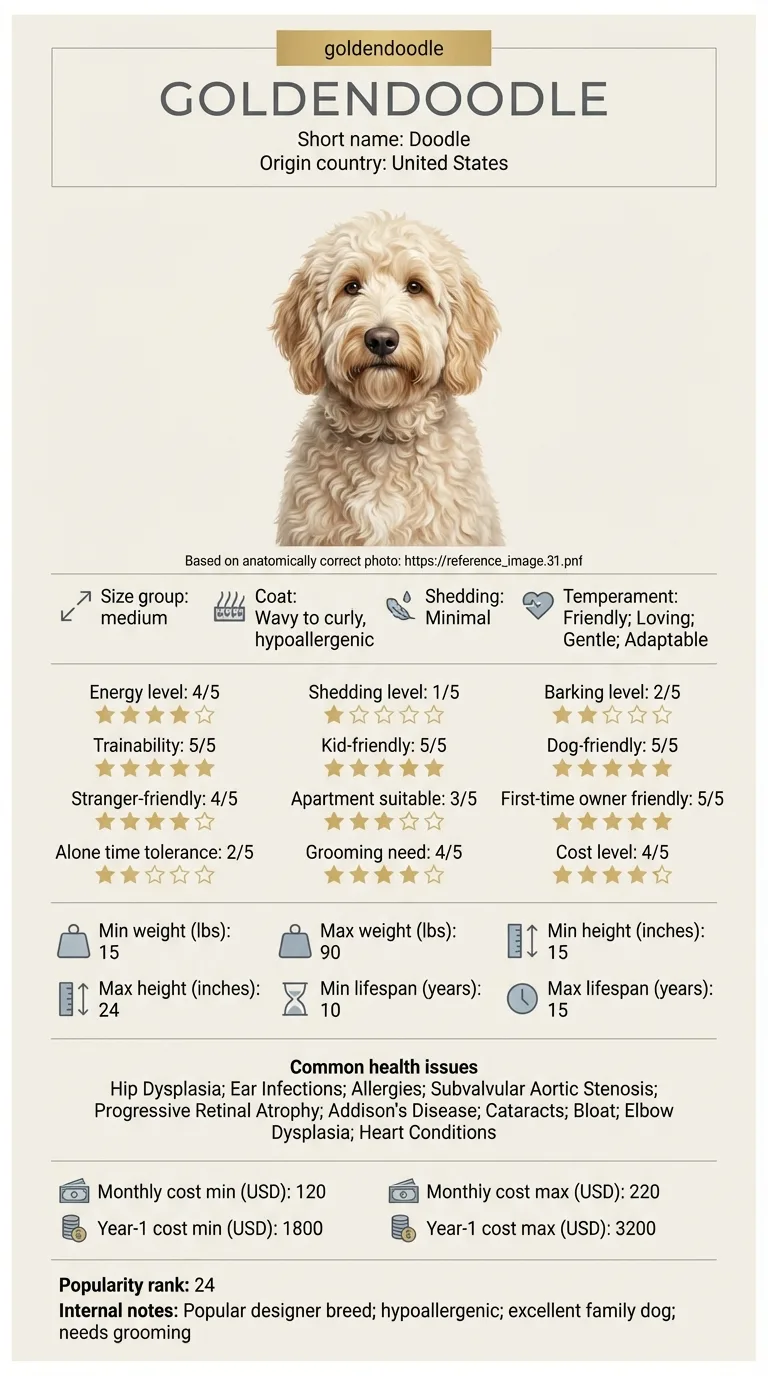
This affects owners of Goldendoodles at both ends of the age range — young dogs whose looseness is caught early on X-ray, and middle-aged to senior dogs whose long-term joint wear is finally showing as visible stiffness or lameness.
This guide is not medical advice. If your dog shows pain, sudden behavior change, or worsening symptoms, consult a licensed veterinarian.
Some links may be affiliate links. We may earn a commission at no extra cost to you. We only suggest products we believe are helpful for dog owners.
Hip dysplasia is a structural looseness in the hip joint that develops into arthritis over time as the body reacts to the resulting joint instability. It's one of the most consistently documented health issues in Goldendoodles, inherited from both Golden Retriever and Poodle lines, and ranges from mild, unnoticed laxity to severe joint disease causing visible lameness.
Hip Dysplasia is directly listed among this breed's documented health issues, and it remains one of the most frequently diagnosed orthopedic conditions in medium and large dogs generally, with both parent breeds contributing documented risk to the cross.
Both Golden Retrievers and Poodles carry documented hip dysplasia risk in their respective breed populations, and a Goldendoodle can inherit the underlying joint laxity from either or both sides. The breed's medium-to-large adult size and moderate-to-fast growth rate as a puppy also put more developmental stress on the hip joint during the growth period than a smaller, slower-growing breed would experience.
Excess body weight during growth and adulthood adds direct mechanical stress to an already loose joint. Overly intense exercise, especially repetitive jumping or hard impact activity during puppyhood while growth plates are still open, can also accelerate joint wear beyond what genetics alone would produce.
See a vet if you notice a bunny-hop gait, reluctance to jump or climb stairs, stiffness after rest that improves with movement, or visible muscle loss in the hindquarters. Sudden inability to bear weight on a leg warrants same-day evaluation.
See all Goldendoodle health problems, which breeds are prone to hip dysplasia, or the full Goldendoodle breed guide for temperament, exercise needs and ownership costs.
Diagnosis via X-ray is typically confirmed within a single vet visit once dysplasia is suspected. Meaningful improvement in comfort from weight control and exercise modification is usually noticeable within four to eight weeks of consistent management, though it's an ongoing process rather than a one-time fix.
Success looks like a dog that moves comfortably through normal daily activity, maintains muscle tone in the hindquarters, and has pain well controlled — not a joint that's been restored to a normal, tight fit, which isn't achievable through non-surgical management.
In a normal hip, the ball of the femur sits snugly inside the socket of the pelvis, moving smoothly with minimal friction. In a dysplastic hip, that fit is looser than it should be, which lets the ball shift slightly within the socket during normal movement. That micro-instability grinds down the smooth cartilage lining the joint over months and years, and eventually the body responds by laying down extra bone around the joint margins in an attempt to stabilize it — this bony remodeling is the osteoarthritis that actually causes pain.
Severity varies enormously. Some Goldendoodles with mild laxity on X-ray never show a visible symptom their whole life. Others with more pronounced looseness develop a visible bunny-hop gait, reluctance to jump or climb stairs, and muscle loss in the hindquarters as they unconsciously shift weight forward to relieve hip pain.
Because both parent breeds carry documented hip dysplasia risk, a Goldendoodle doesn't get a pass on this one the way it might on a defect unique to only one parent line — the risk is present from both directions of the cross.
Managing hip dysplasia is mostly about reducing joint stress rather than reversing the underlying looseness, which isn't something at-home care can undo.

If you think your Doodle has hip dysplasia, the plan is three steps: write down what you have seen and when it started, book a veterinary appointment rather than waiting for the next flare, and take video of the behaviour or symptom before you go — the thing you are worried about rarely happens in the consulting room. Screening in the parents covers hip dysplasia, ear infections, allergies.
What the vet visit should produce is a diagnosis and a written plan, not just reassurance: what is being ruled out, what the monitoring interval is, and which signs mean you come back sooner. Ask what the treatment costs across a year rather than per visit, because that is the number that decides whether you are managing this condition or reacting to it.
Between appointments, keep a short log — dates, what you saw, what changed. It is the single most useful thing an owner brings to a follow-up, and for hip dysplasia it is often what separates a clear pattern from a guess.
Renee had always thought her Goldendoodle, Sable, had a cute, quirky way of running — a slight bunny-hop with both back legs moving together instead of alternating normally. At Sable's one-year checkup, her vet recognized it as a classic hip dysplasia gait rather than a personality quirk and recommended X-rays. The films showed moderate laxity in both hips. Rather than surgery, Renee's vet recommended a structured plan: strict weight management, swimming twice a week instead of running on pavement, and a joint supplement. Three years later, Sable, now at a healthy lean weight, still shows the same gait, but has had no lameness episodes and moves comfortably through her daily routine.
Key takeaway: A gait quirk that looks harmless can be an early visible sign of hip dysplasia, and catching it early opens up more conservative management options than waiting until visible lameness forces the issue.
No — the underlying joint laxity is structural and permanent. Management, whether through weight control, physical therapy, medication, or in some cases surgery, focuses on reducing pain and slowing further joint wear rather than reversing the shape of the joint.
Some puppies show looseness on X-ray as early as four to six months old, though visible lameness often doesn't appear until later, sometimes not until middle age or later when arthritis has built up enough to cause pain.
No. Many dogs with mild to moderate dysplasia are managed successfully with weight control, exercise modification, and medication. Surgery, including options like a total hip replacement, is generally reserved for more severe cases where conservative management isn't controlling pain adequately.
A vet typically starts with a physical exam checking for pain, reduced range of motion, or muscle loss, then confirms with X-rays, sometimes including specialized views like PennHIP evaluation for a more precise laxity measurement.
The underlying joint laxity doesn't change, but how much pain and disability it causes can be meaningfully slowed with consistent weight control and appropriate exercise, versus a dog that stays overweight and inactive on a bad joint.
Yes — a bunny-hop gait when running, difficulty rising after rest, or reluctance to climb stairs in a young puppy can all be early signs worth an X-ray rather than assuming it's just clumsiness.
Not necessarily — many dogs have good days and bad days, with pain often worse after heavy activity, in cold or damp weather, or after a long period of rest that stiffens the joint before the dog gets moving again.
Joint laxity can sometimes be seen on X-ray as early as four to six months old, well before visible symptoms appear.
Yes, significantly — excess weight adds direct mechanical load to an already unstable joint and accelerates cartilage wear.
Conservative management with supplements and medication may run tens of dollars monthly; surgical options can run into the thousands.
Yes, generally — regular, moderate, low-impact walking is usually encouraged rather than restricted, since some movement supports joint and muscle health.
Yes — both Golden Retriever and Poodle lines carry documented hip dysplasia risk, so it can be inherited from either side of the cross.
A one-page prep sheet for this condition: the signs, the questions to ask, what to get priced. Unlocks here.
You get: Vet visit prep sheet
No spam. One-click unsubscribe. See our privacy policy.
Preview page 1 before you decide.