Health
Is DCM the same as a heart murmur?
No. DCM is heart muscle weakening and chamber enlargement; a murmur is a sound from turbulent blood flow, often from a separate structural cause.

Quick answer
Is DCM the same as a heart murmur?
No. DCM is heart muscle weakening and chamber enlargement; a murmur is a sound from turbulent blood flow, often from a separate structural cause.
Your Goldendoodle's food might be part of the reason a vet is now asking about her heart — not because of a bad ingredient, but because of what's missing.
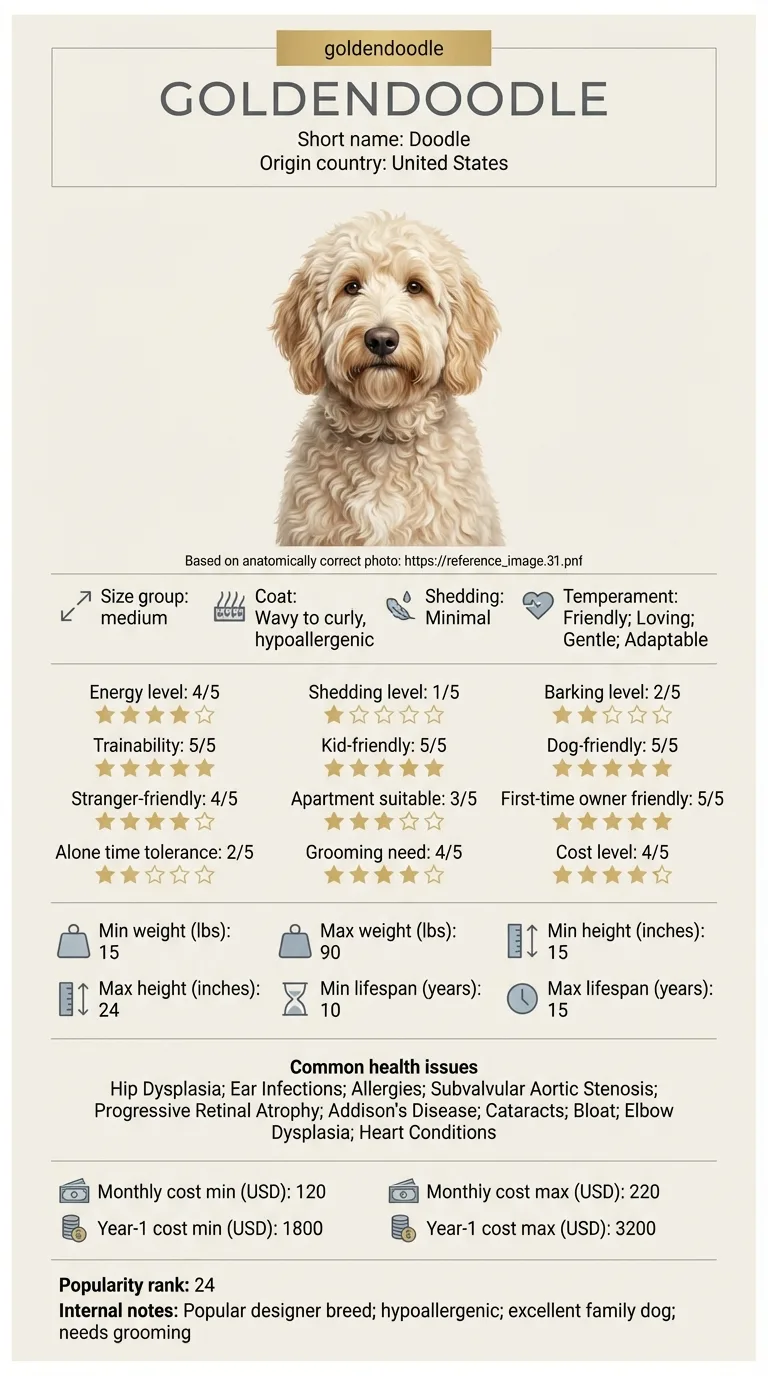
This affects owners who switched to a boutique, grain-free, or exotic-protein diet in good faith, and are now trying to work out whether that decision is connected to a new cardiac diagnosis.
This guide is not medical advice. If your dog shows pain, sudden behavior change, or worsening symptoms, consult a licensed veterinarian.
Some links may be affiliate links. We may earn a commission at no extra cost to you. We only suggest products we believe are helpful for dog owners.
Heart disease in Goldendoodles most notably includes dilated cardiomyopathy, a progressive weakening of the heart muscle that enlarges the chambers and reduces pumping strength. Unlike a structural murmur, DCM can develop silently and has drawn attention for its documented association with certain grain-free and boutique diets in dogs without a strong inherited predisposition.
Heart Disease and Heart Conditions are both listed among this breed's documented health issues, and DCM specifically drew wide attention through the FDA's diet investigation, which included Goldendoodles among the affected mixed breeds. It is not the most common cardiac finding in the breed, but it is serious enough that most cardiologists screen for it deliberately.
Goldendoodles are not among the handful of breeds with a strong inherited DCM predisposition, such as Doberman Pinschers or Great Danes. Their documented DCM risk instead tracks with the diet-associated pattern the FDA investigated, which affected a wide range of breeds, including medium and large mixed breeds without a known genetic cardiac history.
Diet composition is the dominant environmental driver identified so far — specifically long-term feeding of certain grain-free, legume-heavy, or exotic-protein formulas linked to lower taurine availability. Obesity compounds the strain on an already weakening heart muscle, and undiagnosed disease left unmonitored for months allows more damage to accumulate before signs appear.
Schedule a visit for a new cough, faster or more labored resting breathing, reduced stamina on familiar walks, or abdominal swelling. Treat fainting, collapse, or pale, blue, or gray gums as an emergency requiring immediate care.
See all Goldendoodle health problems, which breeds are prone to heart disease, or the full Goldendoodle breed guide for temperament, exercise needs and ownership costs.
A full DCM workup, including echocardiogram and taurine testing, typically resolves within two to three weeks of the first suspicious finding. If diet correction is part of the plan, measurable improvement in heart function, when it happens, usually takes three to six months to show on a repeat echocardiogram.
Success looks like a stable or improving echocardiogram on repeat testing, a dog whose energy and breathing have returned toward baseline, and a diet that's been permanently corrected rather than just paused during treatment.
Subvalvular aortic stenosis and valve disease are structural — a narrowed passage or a leaky valve. DCM is different: the heart muscle wall itself thins and weakens, so the chambers enlarge and lose their pumping strength, the way an overstretched rubber band loses its snap. That's why a dog with early DCM can have a normal-sounding heartbeat with no murmur at all, and why the disease is often caught by chest X-ray or echocardiogram rather than a stethoscope.
Goldendoodles are not one of the classically DCM-predisposed breeds the way Doberman Pinschers or Great Danes are. The diet-associated form investigated by the FDA showed up across many breeds without a strong genetic predisposition, Goldendoodles included, which is what made it different from the inherited form seen in a handful of large breeds.
The suspected mechanism in diet-associated cases centers on taurine, an amino acid the heart muscle needs, and how certain legume-heavy or exotic-protein grain-free formulas may interfere with its levels or absorption. The FDA investigation never established one single ingredient as the definitive cause, and most dogs on grain-free diets never develop DCM — but the association was consistent enough that many cardiologists now ask about diet history at the first cardiac visit.
Because DCM often starts silently, the signs that matter are the ones tracking a change from your own dog's normal.

If you think your Doodle has heart disease, the plan is three steps: write down what you have seen and when it started, book a veterinary appointment rather than waiting for the next flare, and take video of the behaviour or symptom before you go — the thing you are worried about rarely happens in the consulting room. Screening in the parents covers hip dysplasia, ear infections, allergies.
What the vet visit should produce is a diagnosis and a written plan, not just reassurance: what is being ruled out, what the monitoring interval is, and which signs mean you come back sooner. Ask what the treatment costs across a year rather than per visit, because that is the number that decides whether you are managing this condition or reacting to it.
Between appointments, keep a short log — dates, what you saw, what changed. It is the single most useful thing an owner brings to a follow-up, and for heart disease it is often what separates a clear pattern from a guess.
Priya had fed her Goldendoodle, Maple, a trendy grain-free, bison-and-lentil formula for nearly two years because it seemed like the premium choice. When Maple started coughing at night and tiring out halfway through their usual walk, Priya assumed it was just early aging. Her vet heard nothing unusual on the stethoscope but, given the diet history, ordered an echocardiogram anyway. It showed an enlarged left ventricle and reduced pumping function — early DCM. A blood taurine test came back low. Priya switched Maple to a taurine-adequate, well-established commercial diet under her cardiologist's guidance and added a prescribed taurine supplement. Six months later, a repeat echocardiogram showed real improvement in chamber size and function, though not a full return to normal.
Key takeaway: Diet-associated DCM can improve with the right correction, but the diet switch has to be guided by a cardiologist and paired with monitoring — not made alone and assumed to have worked.
Not proven to be dangerous outright, but the FDA's investigation found enough of an association between certain grain-free, legume-heavy formulas and DCM that most cardiologists now recommend a taurine-tested, name-brand diet with a long safety track record rather than a boutique grain-free formula.
In some documented cases, switching off the suspect diet and adding taurine supplementation under vet supervision led to real improvement in heart function. This isn't guaranteed and depends heavily on how much damage has already occurred, so it needs a cardiologist managing the switch, not a guess at home.
An echocardiogram is the primary tool, since it directly measures chamber size and pumping strength. Blood taurine levels, chest X-rays, and sometimes an EKG or Holter monitor for rhythm issues round out a full workup.
Not necessarily, but if you're currently feeding a boutique or exotic-protein grain-free formula, it's reasonable to ask your vet whether switching to a diet with established taurine adequacy testing is worth doing preventively.
It varies enormously by how advanced the disease is at diagnosis and whether a diet link is identified and corrected. Early diagnosis with diet correction and medical management gives the best outcomes; advanced disease with congestive heart failure carries a much more guarded prognosis.
It can be either. A small number of dogs have a primary genetic form unrelated to diet, but Goldendoodles more commonly show up in the diet-associated pattern that the FDA investigated, which is why diet history matters so much at diagnosis.
Collapse, fainting, gums that look pale, blue, or gray, and breathing that looks labored while your dog is at rest are all emergencies. Don't wait for a next-day appointment for any of these.
No. DCM is heart muscle weakening and chamber enlargement; a murmur is a sound from turbulent blood flow, often from a separate structural cause.
Only under a vet or cardiologist's direction — the transition and any taurine supplementation should be managed medically, not switched cold on your own.
A cardiology consult with echocardiogram, taurine testing, and imaging commonly runs several hundred to over a thousand dollars depending on your region.
Light, vet-approved activity is often fine early on; intensity should be set by a cardiologist and reduced as the disease progresses.
Many plans cover it if the condition wasn't pre-existing at enrollment, but check your specific policy's cardiac and chronic-condition terms before assuming.
A one-page prep sheet for this condition: the signs, the questions to ask, what to get priced. Unlocks here.
You get: Vet visit prep sheet
No spam. One-click unsubscribe. See our privacy policy.
Preview page 1 before you decide.