Health
What are this breed's two documented eye conditions?
Cataracts and progressive retinal atrophy (PRA), both directly documented as common health issues.

Quick answer
What are this breed's two documented eye conditions?
Cataracts and progressive retinal atrophy (PRA), both directly documented as common health issues.
Cataracts aren't the only documented eye risk in this breed — progressive retinal atrophy is just as directly documented and, unlike cataracts, currently has no surgical fix once it starts.
This is most relevant for owners noticing changes in their dog's vision, particularly reduced night vision or clumsiness in dim light, which is often the first sign of PRA rather than the cloudy-eye appearance people associate with cataracts.
This guide is not medical advice. If your dog shows pain, sudden behavior change, or worsening symptoms, consult a licensed veterinarian.
Some links may be affiliate links. We may earn a commission at no extra cost to you. We only suggest products we believe are helpful for dog owners.
Check this first
Sudden, complete vision loss, especially if it happens quickly rather than gradually, needs prompt veterinary evaluation, since sudden blindness can have causes beyond typical PRA progression, including a detached retina or other acute conditions that may have different management options.
A red, painful, or visibly swollen eye alongside any vision change is a more urgent situation, potentially indicating secondary glaucoma or another acute complication, and needs same-day veterinary attention rather than being assumed to be routine PRA or cataract progression.
Gradual night vision loss without pain, redness, or other symptoms is the more typical PRA pattern and warrants a scheduled evaluation, ideally including a veterinary ophthalmology referral for a full retinal exam and discussion of genetic testing options, rather than urgent same-day care.
If any of these apply, call your vet or an emergency clinic now. The rest of this page is for the cases that are not an emergency.
This breed has two directly documented eye conditions: cataracts, which cloud the lens and can often be surgically treated, and progressive retinal atrophy, a gradual degeneration of the retina's light-sensing cells with no current treatment to reverse or halt it. PRA typically announces itself through reduced night vision well before any visible change to the eye, making early awareness genuinely useful.
Both cataracts and progressive retinal atrophy are directly listed among this breed's documented common health issues, making a full eye exam a reasonable, proactive part of routine veterinary care rather than something to address only after symptoms appear.
This breed's documented health profile lists both cataracts and progressive retinal atrophy as common eye issues, likely inherited through either parent line. PRA has multiple known genetic forms across dog breeds broadly, some with validated DNA tests, giving owners a genuinely useful screening tool for this specific condition.
While PRA's progression is primarily genetically driven, cataract development can be influenced by other health factors like diabetes or chronic inflammation, making overall health management relevant to eye health broadly, even though it doesn't affect PRA's course.
Talk to your vet about any change in night vision, clumsiness in dim light, or visible eye clouding, so it can be properly evaluated and distinguished between the breed's two documented conditions. Seek prompt care for sudden vision loss or any red, painful, or swollen eye.
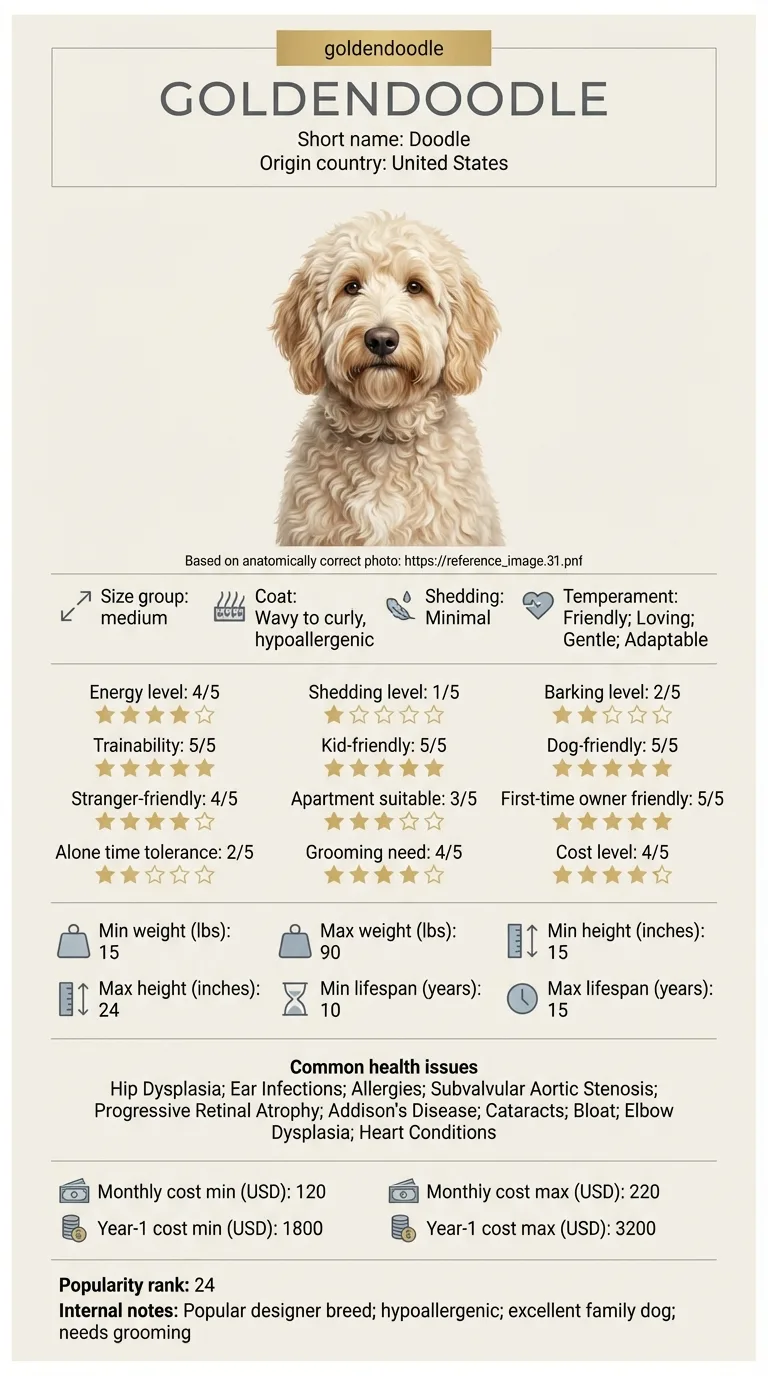
See all Goldendoodle health problems, which breeds are prone to eye disorders, or the full Goldendoodle breed guide for temperament, exercise needs and ownership costs.
PRA typically progresses gradually over months to a couple of years from the first noticeable night-vision changes to more complete vision loss, while cataract progression varies more widely by individual case and underlying cause.
Success looks like early recognition of which condition is actually present and appropriate management for each — surgical consideration for cataracts, and confident adaptation support for PRA — rather than treating every eye change the same way.
Both are real, documented risks, but they affect different eye structures with very different implications.
If you think your Doodle has eye disorders, the plan is three steps: write down what you have seen and when it started, book a veterinary appointment rather than waiting for the next flare, and take video of the behaviour or symptom before you go — the thing you are worried about rarely happens in the consulting room. Screening in the parents covers hip dysplasia, ear infections, allergies.
What the vet visit should produce is a diagnosis and a written plan, not just reassurance: what is being ruled out, what the monitoring interval is, and which signs mean you come back sooner. Ask what the treatment costs across a year rather than per visit, because that is the number that decides whether you are managing this condition or reacting to it.
Between appointments, keep a short log — dates, what you saw, what changed. It is the single most useful thing an owner brings to a follow-up, and for eye disorders it is often what separates a clear pattern from a guess.
Teresa noticed her Goldendoodle Willow had started hesitating at the top of the stairs after dark and occasionally bumping into furniture during evening walks, though her eyes looked completely normal. Assuming it was just clumsiness, Teresa didn't think much of it until a routine vet visit, where she mentioned it in passing. A referral to a veterinary ophthalmologist confirmed early progressive retinal atrophy through a specialized retinal exam. While there was no treatment to stop it, Teresa learned to keep her home layout consistent and added nightlights to help Willow navigate confidently as her vision continued to gradually decline over the following year.
Key takeaway: PRA's first sign is often behavioral rather than visible, which is exactly why it gets far less attention than cataracts despite being just as directly documented in this breed.
Cataracts and progressive retinal atrophy (PRA) are both directly documented as common health issues in this breed, affecting different parts of the eye with very different progression and treatment pictures.
Reduced night vision is usually the first sign — a dog becoming hesitant or clumsy in dim light or at dusk, often well before any visible change to the eye itself or any change in daytime vision.
PRA has multiple genetic forms, and several have validated DNA tests available through commercial genetic panels, making testing a genuinely useful screening tool for this specific condition.
Currently there's no treatment that reverses or reliably halts PRA's progression. Management focuses on supporting a dog's quality of life as vision gradually declines, including consistent home layout and confidence-building.
Through a veterinary ophthalmology exam, often including specialized retinal testing like an electroretinogram, sometimes combined with genetic testing if a known mutation applies.
Yes, many dogs adapt remarkably well to gradual vision loss, especially with a consistent home environment and owner support, since dogs rely heavily on scent and memory alongside vision.
A baseline veterinary ophthalmology exam, particularly with genetic testing for PRA, is a reasonable proactive step given both documented conditions in this breed, especially before breeding decisions if that's relevant to your situation.
Cataracts and progressive retinal atrophy (PRA), both directly documented as common health issues.
PRA is a gradual retinal degeneration with no current treatment, while cataracts cloud the lens and can often be surgically corrected.
Reduced night vision or hesitation in dim light, often before any visible eye changes appear.
A veterinary ophthalmology exam commonly runs a couple hundred dollars, with genetic testing adding a modest additional cost.
Keep furniture and household layout consistent, and build confidence with verbal cues, since dogs adapt well to vision loss using scent and memory in a familiar space.
A one-page prep sheet for this condition: the signs, the questions to ask, what to get priced. Unlocks here.
You get: Vet visit prep sheet
No spam. One-click unsubscribe. See our privacy policy.
Preview page 1 before you decide.