Health
What's the single most urgent sign of Type I herniation?
Complete loss of pain sensation in the hind paws is the most urgent sign, since it directly affects surgical timing and prognosis.

Quick answer
What's the single most urgent sign of Type I herniation?
Complete loss of pain sensation in the hind paws is the most urgent sign, since it directly affects surgical timing and prognosis.
A dog that was fine an hour ago and now can't stand isn't showing you a slow problem getting worse — this is often a single, sudden event, and the clock matters.
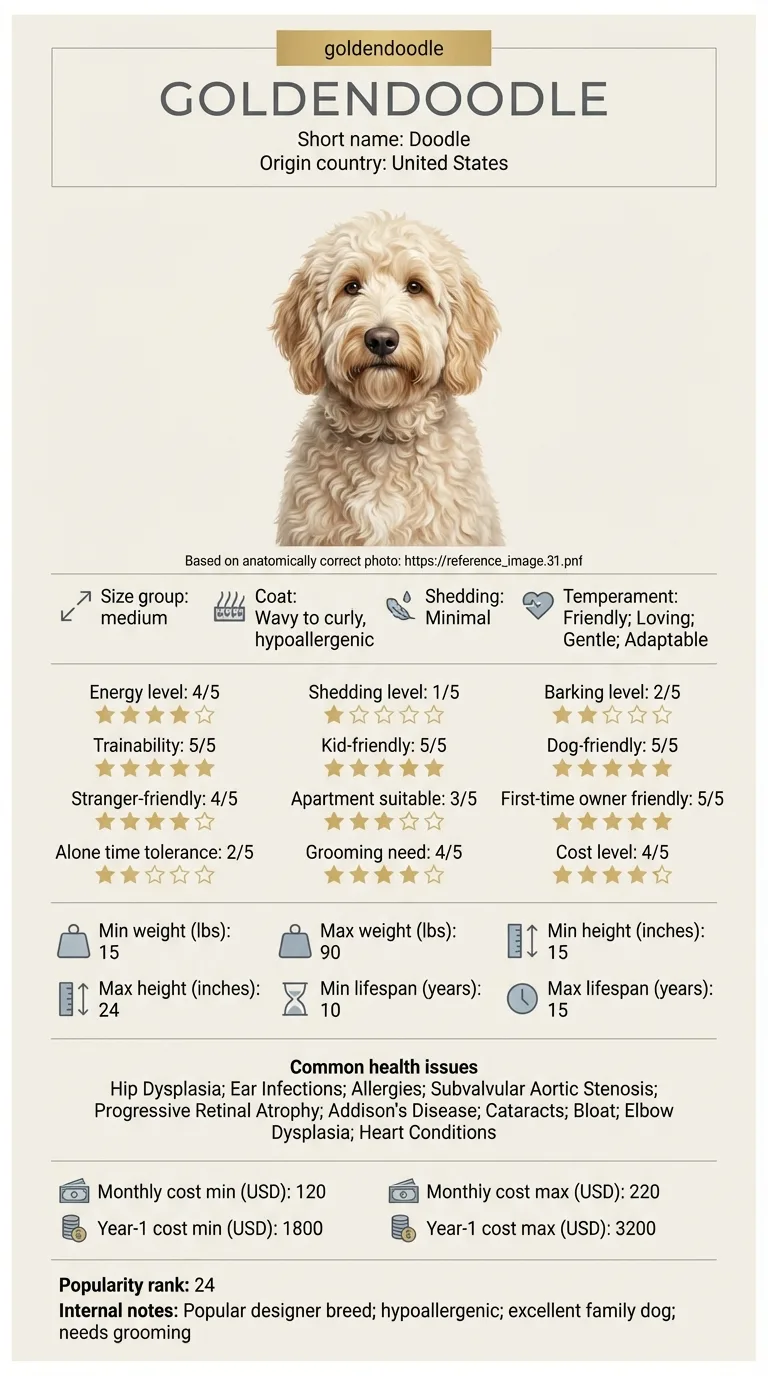
This affects owners of any Goldendoodle who suddenly cries out, refuses to move, or loses use of the hind legs, especially those unfamiliar with how differently this presents compared to ordinary age-related stiffness.
This guide is not medical advice. If your dog shows pain, sudden behavior change, or worsening symptoms, consult a licensed veterinarian.
Some links may be affiliate links. We may earn a commission at no extra cost to you. We only suggest products we believe are helpful for dog owners.
Check this first
When disc material suddenly ruptures into the spinal canal, it compresses the spinal cord directly, and that compression can cause both immediate pain and, if severe enough, disruption of nerve signals controlling the hind legs and bladder. The spinal cord tolerates compression poorly, and the longer significant compression continues, especially once a dog has lost the ability to feel pain in the affected limbs, the lower the odds of a full recovery even with surgery.
This is why veterinary neurologists generally consider surgical decompression within 24 to 48 hours of losing deep pain sensation to offer meaningfully better odds than waiting longer, and why any sudden, severe back pain paired with hind-leg weakness needs same-day evaluation rather than a wait-and-see approach at home.
While Goldendoodles aren't a chondrodystrophic breed with the dramatically elevated Type I risk seen in Dachshunds, a disc that has already undergone gradual age-related degeneration, common in older dogs of this breed, can still rupture suddenly under the right acute stress, like a hard landing from a jump, which is how this acute event most often shows up here.
If any of these apply, call your vet or an emergency clinic now. The rest of this page is for the cases that are not an emergency.
Type I intervertebral disc herniation is a sudden rupture of disc material into the spinal canal, directly compressing the spinal cord and causing acute pain, weakness, or paralysis. Unlike gradual age-related disc wear, this is a true emergency where the speed of veterinary treatment directly affects the odds of a full recovery.
Intervertebral Disc Disease Type I is a less frequent event in Goldendoodles compared to chondrodystrophic breeds like Dachshunds, since the breed lacks the inherited early-onset degeneration pattern, but it can and does occur, typically in older dogs with pre-existing disc wear.
Neither Golden Retriever nor Poodle lineage carries the chondrodystrophic cartilage abnormality that drives frequent, early-onset Type I herniation in breeds like Dachshunds. When it occurs in a Goldendoodle, it more typically happens on top of ordinary age-related disc degeneration rather than from an inherited early-onset pattern.
An acute physical event, most often a hard jump, fall, or awkward twisting motion, is usually the immediate trigger, particularly in a dog whose discs have already undergone some age-related wear. Excess body weight adds further mechanical stress that can make an existing weak spot more likely to rupture.
This condition is a same-day emergency by definition. Any sudden severe back pain, hind-leg weakness, dragging paws, loss of bladder control, or inability to feel pain in the hind paws requires immediate evaluation at a vet or emergency clinic, not a scheduled appointment.
See all Goldendoodle health problems, which breeds are prone to intervertebral disc disease ivdd type i, or the full Goldendoodle breed guide for temperament, exercise needs and ownership costs.
Diagnosis via MRI and, if needed, surgical decompression typically happens within the first 24 to 48 hours of a true emergency presentation. Post-surgical recovery and rehabilitation commonly spans several weeks to a few months depending on severity.
Success looks like treatment sought and delivered within the critical early window, and, for dogs that retained deep pain sensation at diagnosis, a good functional recovery of mobility through appropriate surgery and rehabilitation.
Any one of these signs warrants immediate evaluation at a vet or emergency clinic, ideally one with access to advanced imaging and surgical capability.

Farah's ten-year-old Goldendoodle, Marigold, yelped sharply while jumping off the couch one evening and then wouldn't put weight on her back legs at all. Farah's instinct was to wait until morning to see if it resolved on its own, but a quick search on emergency signs convinced her the total inability to bear weight warranted going in immediately. At the emergency clinic, Marigold could still feel pain in her hind paws, a critical positive sign. An MRI confirmed a Type I disc herniation, and the neurologist recommended surgery within the next day given how quickly Farah had brought her in. Marigold underwent surgical decompression and, after several weeks of structured rehabilitation, regained the ability to walk normally.
Key takeaway: Bringing Marigold in the same night, rather than waiting to see if things improved, preserved the exact window that made a good surgical outcome possible.
General disc disease describes gradual degeneration over years. Type I refers specifically to a sudden rupture of disc material into the spinal canal, an acute event that can happen on top of that gradual degeneration and requires emergency evaluation.
Very urgent — the window for the best surgical outcomes is generally considered to be within 24 to 48 hours of losing deep pain sensation in the affected limbs, which is why this is treated as a same-day emergency rather than a next-week vet visit.
Some milder cases, especially those with pain but no significant motor deficit, are managed successfully with strict crate rest and medication. More severe cases with significant weakness or loss of deep pain sensation generally have much better outcomes with prompt surgical decompression.
An MRI is the gold standard for precisely locating and characterizing the herniation, though a CT scan is sometimes used depending on availability. Plain X-rays can suggest a problem but generally can't confirm it definitively.
Prognosis depends heavily on how much deep pain sensation remained at the time of surgery and how quickly surgery happened after the onset of symptoms. Dogs that retain deep pain sensation generally have a good prognosis with prompt treatment.
No — Dachshunds carry a genetic predisposition that makes this specific acute rupture pattern far more common and to happen at a much younger age. In Goldendoodles it's a less frequent event, typically occurring on top of pre-existing age-related degeneration in older dogs.
Complete loss of pain sensation in the hind paws is the most urgent sign, since it directly affects surgical timing and prognosis.
Same-day evaluation is essential; the best surgical outcomes are generally tied to treatment within 24 to 48 hours of symptom onset.
MRI, hospitalization, and surgical decompression together commonly run into several thousand dollars depending on region and severity.
It's less common but possible, especially following a hard fall or jump, even without previously noticed stiffness or discomfort.
For milder cases without significant motor loss, yes, though it requires strict adherence and close veterinary monitoring throughout.
A one-page prep sheet for this condition: the signs, the questions to ask, what to get priced. Unlocks here.
You get: Vet visit prep sheet
No spam. One-click unsubscribe. See our privacy policy.
Preview page 1 before you decide.