Health
Are Goldendoodles as prone to IVDD as Dachshunds?
No — Dachshunds carry an inherited early-onset pattern that Goldendoodles, as a non-chondrodystrophic breed, don't share.

Quick answer
Are Goldendoodles as prone to IVDD as Dachshunds?
No — Dachshunds carry an inherited early-onset pattern that Goldendoodles, as a non-chondrodystrophic breed, don't share.
Back problems in a Goldendoodle usually come from years of ordinary wear, not the genetic disc timebomb that gives Dachshunds their reputation for it.
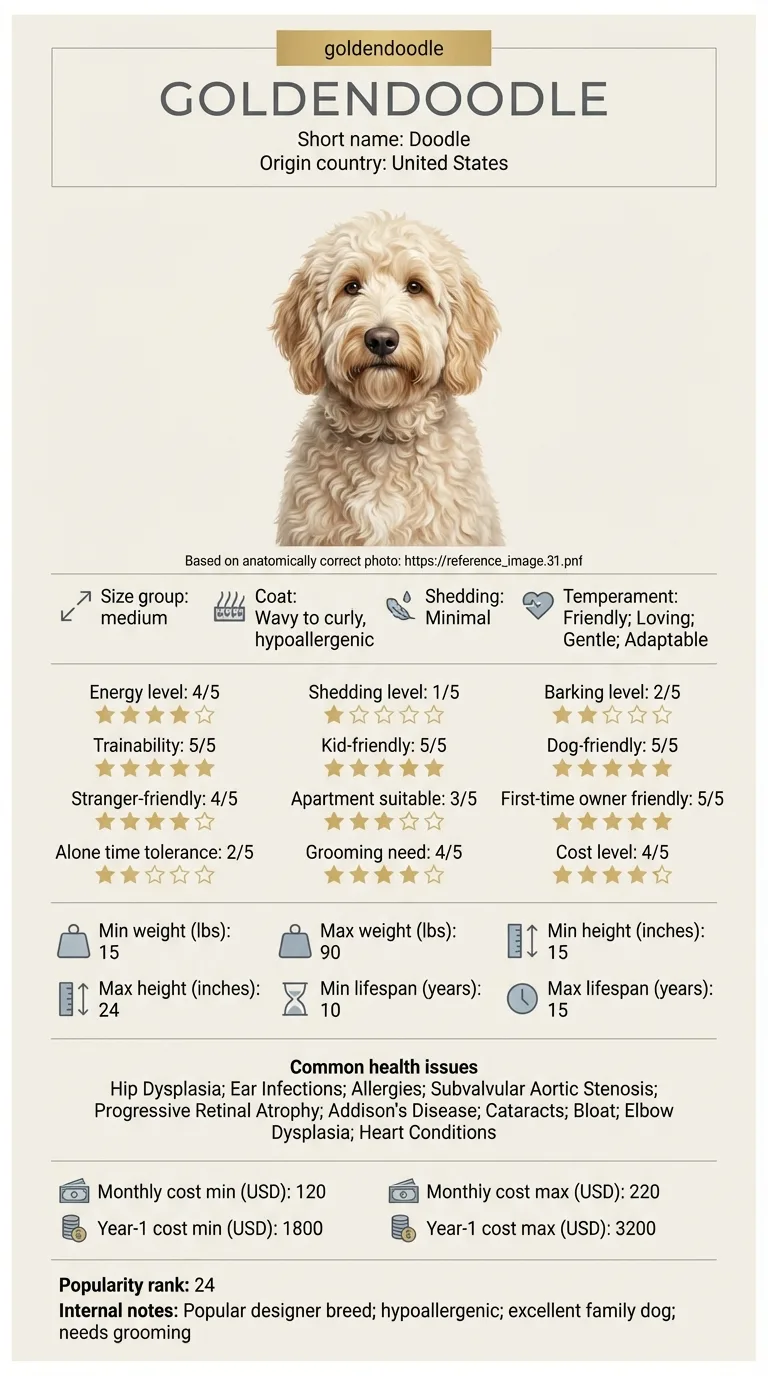
This affects owners of middle-aged to senior Goldendoodles noticing stiffness, reluctance to jump, or an odd change in gait, and owners of miniature or petite Goldendoodles whose proportionally smaller frame raises separate questions worth understanding.
This guide is not medical advice. If your dog shows pain, sudden behavior change, or worsening symptoms, consult a licensed veterinarian.
Some links may be affiliate links. We may earn a commission at no extra cost to you. We only suggest products we believe are helpful for dog owners.
We research and check what we publish, but we do not warrant that any figure, date, price, or statement is accurate, complete, or current, and we accept no liability for any loss, cost, injury, or other harm arising from the use of this site. Use it as one reference among several. You remain responsible for your own decisions and for your dog's care - confirm anything that matters with a licensed veterinarian or another qualified professional before you act on it. Full disclaimer.
Intervertebral disc disease covers a spectrum of spinal cushioning problems, from gradual age-related wear to sudden herniation. Goldendoodles, unlike chondrodystrophic breeds such as Dachshunds, don't carry an inherited early-onset disc degeneration pattern, so back problems here more typically develop later in life through ordinary wear, often accelerated by weight or an acute injury.
Intervertebral Disc Disease is documented as a back and spine concern in Goldendoodles, though it follows the more typical age-related pattern seen broadly across non-chondrodystrophic medium and large breeds, rather than the dramatically elevated, early-onset rates seen in breeds like Dachshunds.
Neither Golden Retriever nor Poodle ancestry carries the chondrodystrophic cartilage abnormality responsible for early-onset disc disease in breeds like Dachshunds, so Goldendoodles generally follow the slower, age-related disc wear pattern typical of medium and large breeds without that genetic acceleration.
Excess body weight, insufficient core and back conditioning, and repetitive high-impact activity like frequent jumping onto and off furniture or vehicles all add cumulative mechanical stress to discs over years, and an acute injury like a bad landing can trigger a sudden herniation on top of that gradual wear.
See a vet for reluctance to jump, a hunched or arched back, stiffness after rest, or sensitivity when touched along the spine. Treat sudden hind-leg weakness, dragging paws, or paralysis as an emergency requiring immediate care.
See all Goldendoodle health problems, which breeds are prone to intervertebral disc disease ivdd, or the full Goldendoodle breed guide for temperament, exercise needs and ownership costs.
Mild, age-related stiffness often responds to weight management and conditioning changes within four to eight weeks. An acute herniation requiring surgery typically involves several weeks of strict post-operative rest and a longer rehabilitation period afterward.
Success looks like a dog that moves comfortably through normal daily activity with strong core support, and any acute episode caught and treated early enough to preserve good mobility rather than progressing to significant neurological deficit.
Discs act as shock absorbers between vertebrae, and over years of normal use, the gel-like center can lose water content and elasticity, and the tougher outer ring can develop small cracks. In a chondrodystrophic breed like a Dachshund, this process is accelerated dramatically by an inherited cartilage abnormality that causes calcification and degeneration starting as early as one to two years old. Goldendoodles, drawing from two non-chondrodystrophic parent breeds, don't carry that specific genetic acceleration, which is a meaningful, factual difference worth understanding rather than assuming every 'IVDD' headline applies equally to every breed.
That doesn't mean Goldendoodles are immune to disc problems — it means when disc degeneration happens here, it more typically follows the slower, age-related pattern seen broadly across medium and large dogs, often not becoming clinically apparent until well into middle age or later, and frequently triggered or worsened by an acute event like a bad landing from a jump rather than appearing out of nowhere in a young dog.
Body weight and overall conditioning play an outsized role in this slower-developing pattern. A lean, well-muscled dog's core and back muscles help support the spine and reduce load on the discs themselves, while a heavier, less-conditioned dog puts more cumulative stress on those same discs over years.
Because the age-related pattern in this breed develops gradually, subtle early signs are often the most useful thing to catch before a more serious acute episode occurs.

Dominic noticed his nine-year-old Goldendoodle, Daisy, had started hesitating before jumping into the car, something she'd done without a second thought for years. She also seemed a bit hunched after long naps, though she loosened up once moving. His vet examined her spine directly and found mild sensitivity along the lower back, consistent with early age-related disc changes rather than anything acute. X-rays confirmed mild degeneration without a herniation. Dominic added a ramp for the car, enrolled Daisy in a structured core-conditioning program with a canine rehabilitation specialist, and kept her weight lean. A year later, her stiffness has noticeably improved and she's jumping onto the car ramp confidently on her own.
Key takeaway: Age-related back stiffness in this breed usually develops slowly and responds well to conditioning and weight management, which is a very different picture from the sudden, dramatic disc emergencies associated with chondrodystrophic breeds.
No — Dachshunds and other chondrodystrophic breeds have an inherited cartilage abnormality that accelerates disc degeneration dramatically starting at a young age. Goldendoodles don't carry that same genetic pattern, so disc problems here tend to follow a slower, more typical age-related course.
Yes, it can happen, usually triggered by an acute event like a bad jump or fall onto an already-degenerating disc, and it's treated as an emergency regardless of breed when sudden hind-limb weakness or pain appears.
When they occur, it's more commonly in middle-aged to senior dogs, reflecting gradual age-related disc wear, rather than the young-onset pattern seen in chondrodystrophic breeds.
Not always — mild cases with only pain and no significant neurological deficit are sometimes managed with strict rest and medication. More severe cases with weakness or paralysis often need surgery, and timing matters enormously for recovery odds.
Yes, meaningfully — excess weight adds cumulative mechanical stress to discs over years, while strong core and back musculature from consistent, appropriate exercise helps support the spine and may reduce risk.
Using ramps or steps for cars and furniture, and avoiding repeated hard-impact jumping, are reasonable general precautions, especially in dogs already showing any early stiffness, even without a formal diagnosis.
No — Dachshunds carry an inherited early-onset pattern that Goldendoodles, as a non-chondrodystrophic breed, don't share.
Reluctance to jump combined with a hunched posture or stiffness after rest are common early indicators worth a vet visit.
Conservative management can run modest amounts; surgical intervention for a severe case can run into the thousands.
Appropriate, consistent low-impact exercise that builds core strength can help support the spine and may reduce risk over time.
Yes — sudden weakness, dragging paws, or paralysis needs immediate veterinary evaluation regardless of the underlying cause.
A one-page prep sheet for this condition: the signs, the questions to ask, what to get priced. Unlocks here.
You get: Vet visit prep sheet
No spam. One-click unsubscribe. See our privacy policy.
See a sample page before you decide.
Early access list
The free prep sheet covers the same-day warning signs, a symptom log and the questions to ask. We are considering a fuller kit that adds a cost worksheet for the usual tests and treatments (US price ranges with their sources) and a plain-English guide to ways of covering the bill. It is not built yet; this list tells us whether it is worth building.
One email, no spam, unsubscribe anytime. Information only, not veterinary advice.