Health
What actually causes the stomach to twist in GDV?
Gas distension gives the stomach room to rotate on its supporting ligaments within the abdominal cavity, and a deeper chest provides more physical space for that rotation to occur.

Quick answer
What actually causes the stomach to twist in GDV?
Gas distension gives the stomach room to rotate on its supporting ligaments within the abdominal cavity, and a deeper chest provides more physical space for that rotation to occur.
Bloat isn't an infection or a slow-building illness — it's closer to a mechanical failure, where a gas-filled stomach in a deep chest cavity has enough room to rotate on its own supporting ligaments.
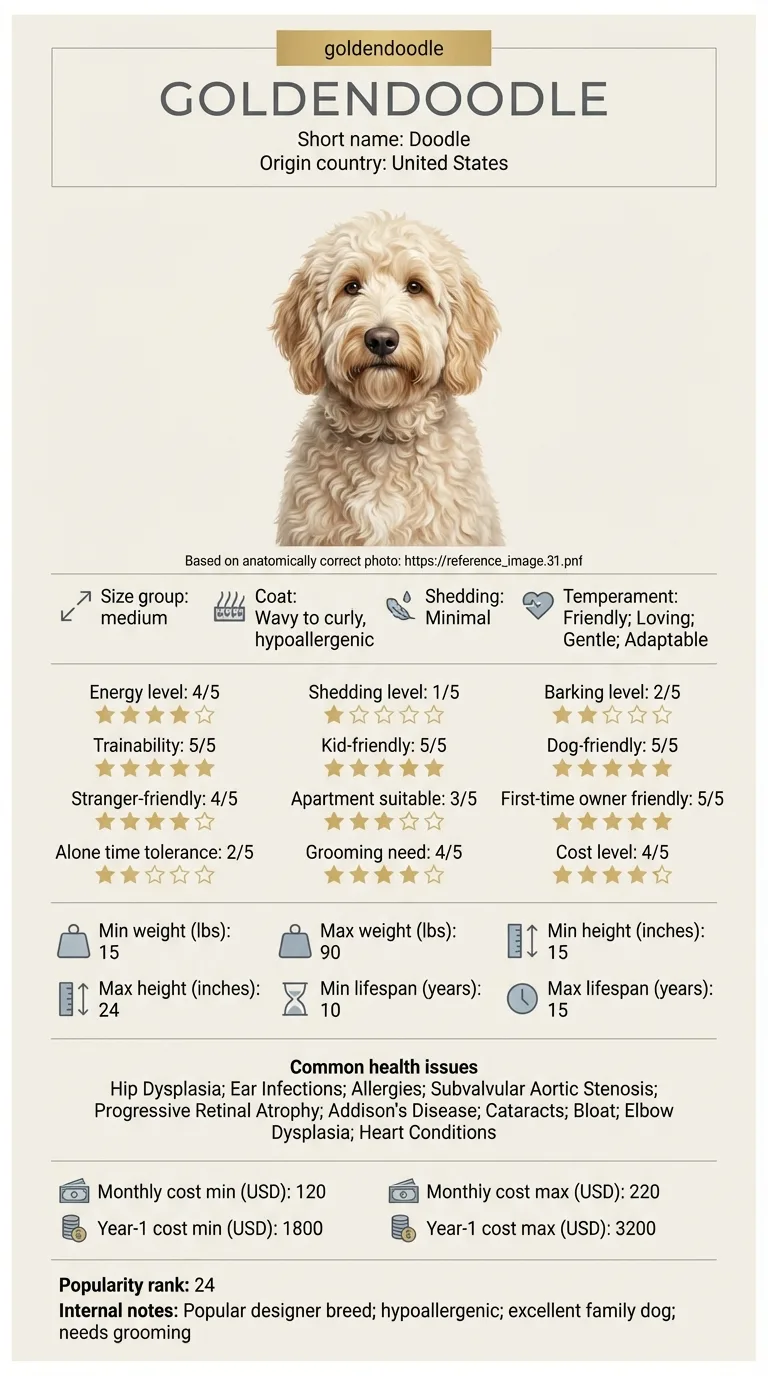
This is most relevant to owners of larger, standard-size Goldendoodles with a deeper chest cavity, and to owners trying to understand whether their dog's individual body type, eating habits, or family history actually raise real risk.
This guide is not medical advice. If your dog shows pain, sudden behavior change, or worsening symptoms, consult a licensed veterinarian.
Some links may be affiliate links. We may earn a commission at no extra cost to you. We only suggest products we believe are helpful for dog owners.
We research and check what we publish, but we do not warrant that any figure, date, price, or statement is accurate, complete, or current, and we accept no liability for any loss, cost, injury, or other harm arising from the use of this site. Use it as one reference among several. You remain responsible for your own decisions and for your dog's care - confirm anything that matters with a licensed veterinarian or another qualified professional before you act on it. Full disclaimer.
Check this first
Because the underlying mechanism involves a physical twist cutting off blood supply, there is no version of GDV where waiting is a reasonable option. A hard, visibly distended abdomen, unproductive retching, restlessness, drooling, and rapid decline are the outward signs of this internal mechanical process, and they mean an emergency vet visit immediately, regardless of time of day.
Understanding the mechanism also explains why fast treatment matters so much for outcome: the longer the twist persists, the more stomach tissue loses blood supply and begins to die, and the more strain is placed on the heart and circulation. This is why vets talk about GDV in terms of minutes and hours rather than days — the mechanical damage compounds the longer it continues.
If you understand only one thing about the mechanism, understand this: nothing you do at home can undo a physical twist in the stomach. There's no home remedy, position change, or waiting period that resolves it — surgical correction is the only fix once the stomach has actually rotated.
If any of these apply, call your vet or an emergency clinic now. The rest of this page is for the cases that are not an emergency.
Gastric dilatation-volvulus is fundamentally a mechanical event: gas distends the stomach, and in a dog with enough chest depth for the distended stomach to move, it can rotate on its own supporting ligaments, cutting off blood flow to the stomach wall and compressing nearby major vessels. Understanding this mechanism explains why the condition strikes suddenly, why it becomes life-threatening within hours, and why only surgery can correct it once it happens.
Bloat is a documented health concern for this breed, with body size and chest depth being real, physical contributors to risk rather than a vague genetic label — larger, deeper-chested individuals are generally considered at somewhat higher relative risk.
Bloat is listed among this breed's documented health issues, and the mechanical risk factor is chest depth, which varies with a Goldendoodle's size — a larger standard-size dog typically has more chest depth and abdominal space than a smaller mini variant, giving a distended stomach more room to rotate.
Feeding behavior is the environmental variable that most directly interacts with this mechanism: how fast a dog eats, how large the meal is, and how much activity happens immediately before or after eating all affect how much gas builds up and how much movement the stomach has available.
Talk to your vet in advance, before any emergency, about whether your individual dog's body type and history make preventive gastropexy worth considering. If symptoms of distension, retching, or restlessness ever appear, this is always an emergency requiring immediate care, not a scheduled conversation.
See all Goldendoodle health problems, which breeds are prone to bloat gdv, or the full Goldendoodle breed guide for temperament, exercise needs and ownership costs.
There's no timeline for 'waiting out' this mechanism — once distension begins progressing toward a twist, the situation escalates over a matter of hours, not days.
Success looks like reducing the modifiable risk factors — eating speed, meal size, activity timing — and having a plan in place for fast emergency response, since the underlying anatomical risk factor of chest depth can't itself be changed.
Understanding the mechanism helps explain why certain risk factors matter more than others.
If you think your Doodle has bloat, the plan is three steps: write down what you have seen and when it started, book a veterinary appointment rather than waiting for the next flare, and take video of the behaviour or symptom before you go — the thing you are worried about rarely happens in the consulting room. Screening in the parents covers hip dysplasia, ear infections, allergies.
What the vet visit should produce is a diagnosis and a written plan, not just reassurance: what is being ruled out, what the monitoring interval is, and which signs mean you come back sooner. Ask what the treatment costs across a year rather than per visit, because that is the number that decides whether you are managing this condition or reacting to it.
Between appointments, keep a short log — dates, what you saw, what changed. It is the single most useful thing an owner brings to a follow-up, and for bloat it is often what separates a clear pattern from a guess.
After her standard Goldendoodle Duke survived a bloat episode, Elena wanted to understand why it had happened at all, not just how the surgery went. Her vet walked her through the mechanism: Duke's deep chest gave his gas-distended stomach room to rotate, something his fast, competitive eating habit around the family's other dog likely contributed to. Elena changed Duke's feeding routine to separate, slower meals and asked about a gastropexy, which was performed as a precaution during his recovery surgery. Understanding the actual mechanism, rather than just the emergency steps, helped her make sense of a change that had felt random and terrifying at the time.
Key takeaway: Knowing the mechanical 'why' behind bloat doesn't prevent every case, but it turns a seemingly random, terrifying event into something with identifiable, partly modifiable contributing factors.
A deeper chest cavity gives a gas-distended stomach more physical room to move and rotate. It's a spatial factor, not a disease process, which is part of why body type is discussed as a risk factor for GDV.
No. Ordinary gas or an upset stomach doesn't involve the stomach rotating on its axis and cutting off its own blood supply. GDV is a mechanical, structural event, not a digestive upset.
Yes, that's part of what makes it frightening — it's a mechanical event rather than a slow-building illness, so a dog can appear completely normal right up until symptoms begin.
Rapid eating is associated with swallowing more air and filling the stomach quickly, both of which contribute to the gas distension that can precede a twist, so slower eating is a reasonable risk-reducing habit.
The twist doesn't just affect the stomach — it can compress major blood vessels running nearby, which affects circulation throughout the body, not just digestion in that one organ.
A gastropexy surgically anchors the stomach to the abdominal wall, directly preventing the rotation mechanism from happening again, which is why it's discussed as the most direct preventive measure.
The mechanism itself — gas distension plus available space to rotate — applies to any dog with sufficient chest depth, regardless of whether it's purebred or mixed. Body shape, not lineage as such, is what matters mechanically.
Gas distension gives the stomach room to rotate on its supporting ligaments within the abdominal cavity, and a deeper chest provides more physical space for that rotation to occur.
The twist cuts off blood supply to the stomach wall and can compress nearby major blood vessels, causing shock throughout the body, not just localized pain.
It can help, since rapid eating is linked to more air swallowing and faster gas buildup, both contributing factors to the mechanism.
Yes — it anchors the stomach in place, which directly prevents the rotation that causes the dangerous volvulus.
No. Once the stomach has physically rotated, only surgical correction can fix it — there is no at-home intervention that resolves the mechanism.
A one-page prep sheet for this condition: the signs, the questions to ask, what to get priced. Unlocks here.
You get: Vet visit prep sheet
No spam. One-click unsubscribe. See our privacy policy.
Preview page 1 before you decide.